
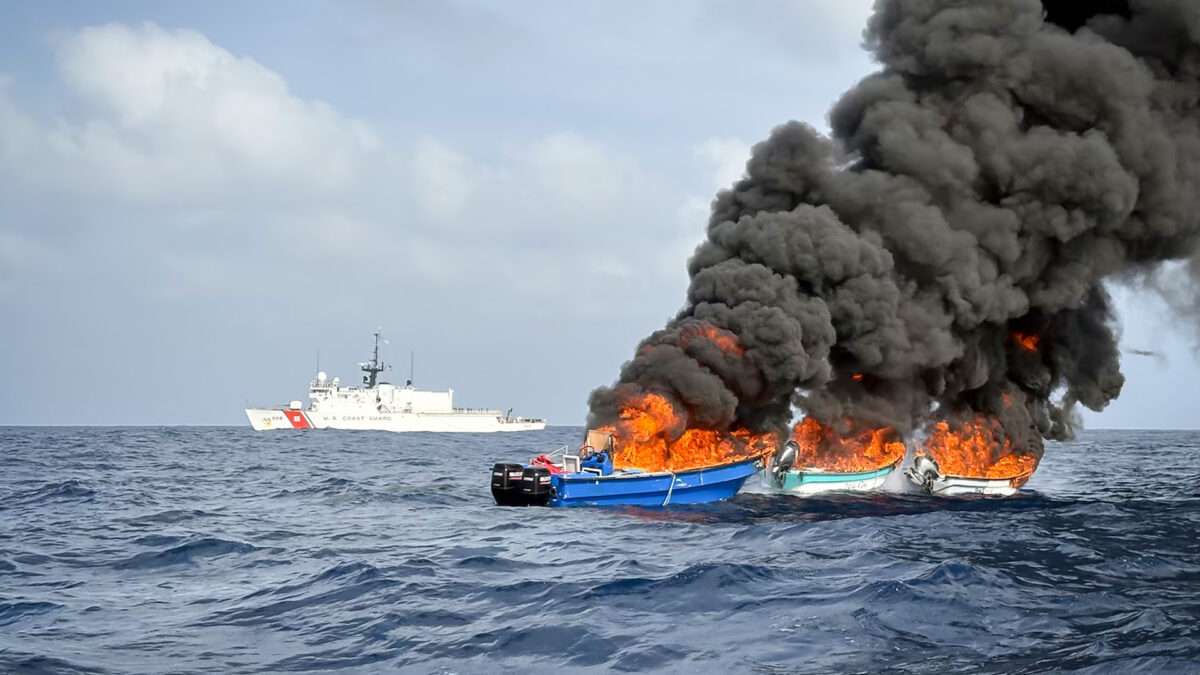
“Since September 2, the U.S. military has attacked suspected drug boats in the Caribbean and the Eastern Pacific 59 times, killing 196 people. According to President Donald Trump's mysterious math , that means this campaign of carnage has prevented around 1.5 million drug-related deaths in the United States—more than 20 times the total number recorded in the year before Trump started treating suspected cocaine smugglers as "combatants" who can be killed at will, from a distance and in cold blood. Back on planet Earth, there is no reason to think the boat strikes have prevented any deaths at all. That could only happen if blowing up smugglers—as opposed to the previous practice of intercepting them, arresting them, and seizing their cargo, which Trump says was "totally ineffective"—reduced the supply of cocaine available to American consumers. Given more than a century of failed attempts to "stop the flow" of illegal intoxicants, that never seemed likely . And nearly nine months after Trump launched his new, deadlier version of the war on drugs, there is no evidence that it is more effective than the traditional tactics he derides as insufficiently homicidal. "Blowing Up Boats Hasn't Slowed Cocaine Traffic to U.S.," The New York Times says in what surely qualifies as one of the least surprising headlines ever. That conclusion is based on several indicators, none of which is moving in the direction you would expect if Trump's strategy were working as advertised. One sign of success would be a decline in the amount of cocaine seized at the border, since that number represents a percentage of the total supply, and it is unlikely that the percentage changed much between the first eight months of Trump's second term and the eight months after he started murdering alleged cocaine smugglers. But according to data reported by U.S. Customs and Border Protection (CBP), cocaine seizures have gone up, not down. From January through August 2025, CBP seized about 43,300 pounds of cocaine. From September 2025 through April 2026, it seized about 47,800 pounds. If Trump were putting a significant dent in the cocaine supply (or, more plausibly, imposing new costs that traffickers felt compelled to recoup by charging more), you would expect retail prices to rise. But according to University of North Carolina drug researcher Nabaruun Dasgupta, the Times says, "street prices for cocaine remain between $60 [and] $100 per gram in many U.S. cities, about where they were before the boat strikes began." Pressure from the boat strikes might also be reflected in adulteration of cocaine with cheaper substances such as levamisole and lidocaine. But Dasgupta reports that "the average number of such substances in cocaine samples ranges from 1.3 to 1.5 in 2026, after the boat strikes began, compared with a range of 1.4 to 1.6 for much of 2025." A reduced supply of cocaine also should be reflected in the substances detected after drug-related deaths. But according to provisional estimates from the Centers for Disease Control and Prevention (CDC), deaths involving cocaine fell slightly in early 2025 but remained flat during the four months after the boat strikes began. Cocaine was detected in 27.9 percent of total drug fatalities last year, up slightly from 27.5 percent in 2024. Attributing all those deaths to cocaine is highly problematic, since the vast majority of the cases involve combinations of drugs. From January 2021 through June 2024, according to a 2025 CDC study , four-fifths of "cocaine-involved overdose deaths" also involved opioids, which pose a much bigger overdose risk. That may explain why Trump, in his eagerness to brag that he is saving lives by killing people, conflates cocaine with fentanyl. Although Trump's bloodthirsty strategy has not affected the amount of cocaine available in the United States, it does seem to have driven changes in smuggling patterns. According to the experts consulted by the Times , traffickers have shifted from the small speedboats targeted by Trump to overland routes through Central America and shipments concealed in cargo on larger vessels. "These operations raise serious concerns about effectiveness," Sen. Mark Kelly (D–Ariz.) noted during a Senate Armed Services Committee hearing in March. "These repeated boat strikes suggest a tactical approach that may be generating headlines, but it's far less clear that they are producing durable security outcomes. To me, this operation looks like a cycle of reactive strikes with limited long-term impact." Kelly asked Gen. Francis L. Donovan, who oversees the boat strikes as head of the U.S. Southern Command, "what evidence" he had that "this campaign is actually degrading cartel operations rather than simply destroying some low-level assets," "killing some people," and "displacing some trafficking routes." Donovan candidly admitted that "I couldn't provide you [with] measures of effectiveness for the current effort." Although "we've seen changes in the narco-traffickers' patterns," he said, "the boat strikes aren't the answer." Someone should tell the president. Or maybe the secretary of defense. The boat strikes are a "highly effective" way to "stop lethal drugs," Pete Hegseth insisted on X in November. Then again, he also claimed that summary execution of criminal suspects is "lawful under both U.S. and international law"—an equally implausible proposition. "They're not moving the needle at all," Adam Isacson, director of defense oversight at the Washington Office on Latin America, told the Times . "Is that worth killing all these people?" The post The Least Surprising Headline Ever: 'Blowing Up Boats Hasn't Slowed Cocaine Traffic to U.S.' appeared first on Reason.com .
Original story
Continue reading at Reason
reason.com
Summary generated from the RSS feed of Reason. All article rights belong to the original publisher. Click through to read the full piece on reason.com.

