
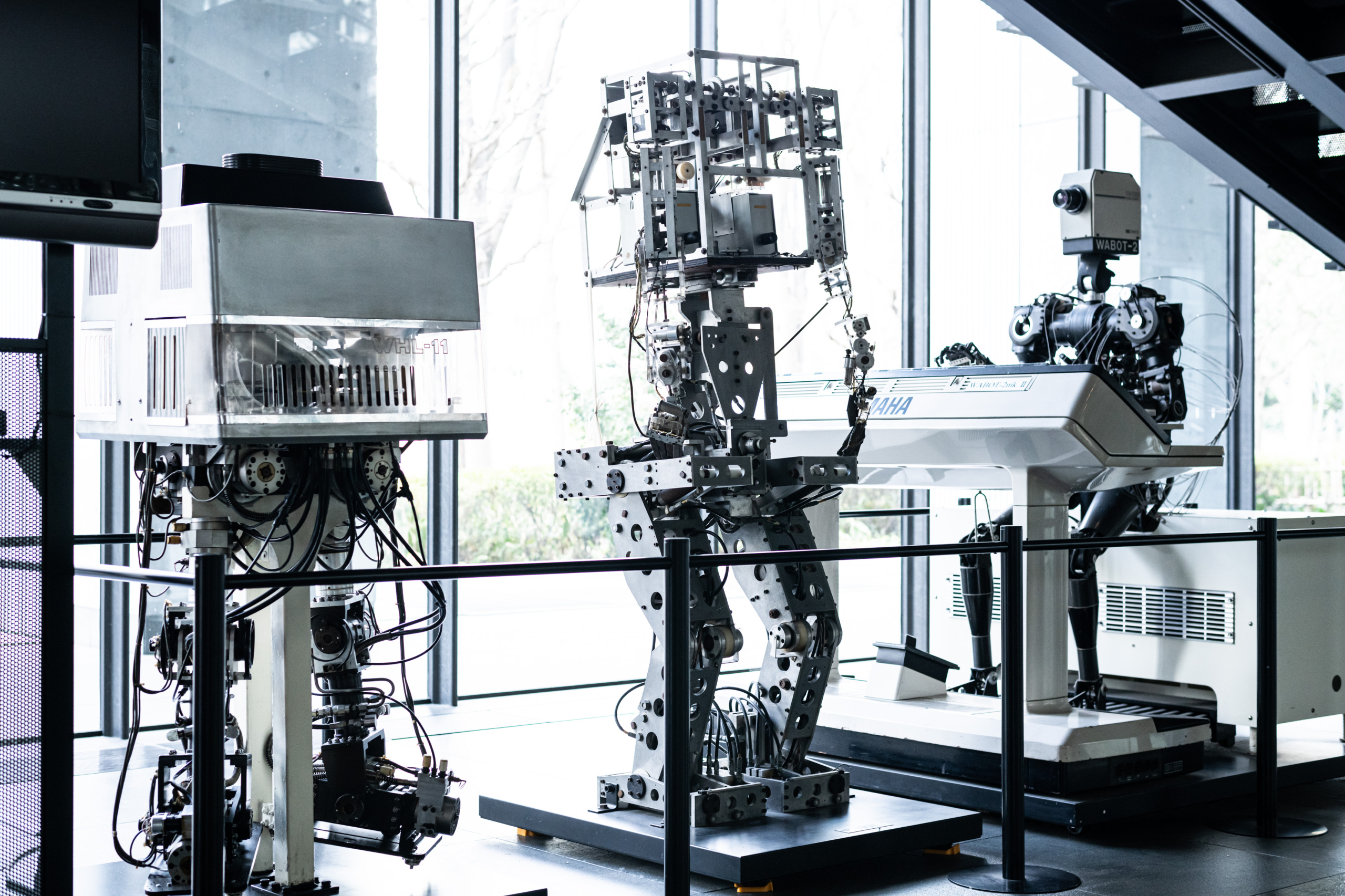
“Long before humanoid robots became a global research phenomenon, Waseda University was already building them. In 1973, WABOT-1 took its first steps, launching a legacy that continues today with AI-driven caregiving robots and more. Credit belongs to the late Professor Ichiro Kato, known as the “father of Japanese robotics research,” who first began the WABOT (WAseda roBOT) project in the early 1970’s. But that is just the start. Read on to learn about eight innovative robots developed at Waseda, including the music-reading, Electone playing WABOT-2 and the robot comedian KOBIAN. ① WABOT-1 (1973) — The World’s First Humanoid Robot Credit: Waseda University Future Robotics Organization Completed in 1973 at Waseda, WABOT-1 is widely considered the world’s first full-scale humanoid robot. It could walk on two legs, grasp objects with its hands, and even communicate in simple Japanese, which was groundbreaking at the time. Developed under the leadership of the late Professor Kato, WABOT-1 proved that robots could imitate basic human movements and senses. Researchers even compared its abilities to those of a 1 ½ year old child! This early success helped jump-start modern humanoid robotics research and influenced many later robots. You can visit WABOT-1 in Tokyo at Waseda, where it is on display in the lobby of Building 63 on the Science and Engineering Campus (Nishi-Waseda Campus). ② WABOT-2 (1984) — The Music-Reading, Electone Playing Robot Credit: Waseda University Future Robotics Organization WABOT-2 was introduced to the world in 1984 as a humanoid robot designed with musical ability. Unlike its predecessor, WABOT-1, it could read sheet music, play an electronic organ using both hands and feet, and even adjust its performance to accompany a human singer. The project, also led by Professor Kato, demonstrated early progress in combining robotics with perception and coordination. WABOT-2 became famous after being shown at Expo ’85 in Tsukuba, Japan , where it highlighted how robots could perform creative and interactive tasks. Credit for a portion of the footage: National Communication Museum, Australia WABOT-2 usually resides next to WABOT-1 in Building 63 on Waseda ’ s Science and Engineering Campus, but it is currently on loan to the National Communication Museum in Melbourne, Australia where it is the hero object of the FRIEND exhibit , which explores the relationship between humans and machines. It will be back in mid-late 2026. ③ The WABIAN (1990s-2000s) — A Series of Advanced Walking Humanoid Robots Credit: Atsuo TAKANISHI Lab., Waseda University The WABIAN series was developed in the 1990s and 2000s at Waseda to study how robots can walk more like humans. These robots focused on smooth, natural bipedal movement, including stable walking, turning, and even carrying objects while moving. Led by researchers such as Professor Atsuo Takanishi (Faculty of Science and Engineering), the WABIAN series helped improve balance control and coordination in humanoid robots. ④ The Waseda Talkers (2000-2008) — A Series of Anthropomorphic Talking Robots Credit: Atsuo TAKANISHI Lab., Waseda University Led by researchers including Professor Takanishi, the Waseda Talkers (WT series) were another key research series of robots developed at Waseda University starting around 2000. The project ’ s purpose was to study how humans produce speech. Instead of using regular speakers, these robots physically recreated parts of the human vocal system, such as artificial vocal cords, lungs, and a mouth, to generate sound . This allowed the robots to produce more natural and realistic speech by mimicking how people actually talk in order to better understand speech mechanisms and improve human–robot communication . ⑤ WF-4R (2003) — The Top Hat Wearing Flutist Robot Credit: Atsuo TAKANISHI Lab., Waseda University Prof. Takanishi led the development of the WF-4R robot, which is an anthropomorphic humanoid designed to play the flute with human-like technique and expression. Known as the “Waseda Flutist No. 4 Refined,” it is part of a long-running research effort to understand and replicate the complex motor control and sensory processes involved in musical performance. The robot can perform musical scores and interact with human musicians through features such as melody recognition and responsive control, enabling applications in music education and human–robot interaction research. And it looks great while doing it in its signature black top hat! ⑥ TWENDY-ONE (2007) — The Safe, Dependable, Caring Robot Credit: Waseda University Future Robotics Organization TWENDY-ONE was introduced in 2007 and was designed as a practical helper rather than just a research model. This humanoid robot focuses on safely assisting people in everyday situations, especially the elderly or those needing care. It is equipped with soft, sensitive hands and advanced sensors that allow it to handle delicate objects and interact gently with humans. Developed by a team led by Professor Shigeki Sugano (Faculty of Science and Engineering), a former student and colleague of Professor Kato, TWENDY-ONE highlights the move toward robots that can operate in real homes and support daily life, not just perform tasks in laboratories. ⑦ KOBIAN (2009) — The Whole-Body Emotion Expressing Comedic Robot Credit: Atsuo TAKANISHI Lab., Waseda University Instead of focusing on tasks like walking or lifting, KOBIAN, another project led by Prof. Takanishi, was created to study how robots can show feelings. It uses facial expressions and body movements to display emotions such as happiness, sadness, and surprise, which assists researchers in exploring how humans might better understand and interact with robots. ⑧ AIREC (Currently under development) — The AI-driven Robot for Embrace and Care Credit: Waseda University Future Robotics Organization The AIREC robot, currently under development at Waseda, is a next-generation humanoid system designed to live and work alongside humans in everyday environments. Its name stands for “AI-driven Robot for Embrace and Care,” reflecting its goal of supporting people through tasks such as household assistance, caregiving, and medical aid. The project is led by Professor Sugano with the support of Professor Tetsuya Ogata and others, and forms part of the Japanese government’s Moonshot Research and Development Program aiming to create robots that can autonomously learn complex tasks and integrate into society as lifelong companions. From the first steps of WABOT-1 to the human-centered vision of AIREC, Waseda’s robots reflect a continuous effort to bring machines closer to people not just in form, but in function and understanding. With this solid foundation of research and humanoid robot development, the future is bright for robotics at Waseda. To learn more , including about additional robots not introduced in this article, visit the website for Waseda’s Future Robotics Organization . There is additional information on the five robotics-centered research institutes as well: the Institute for Healthcare Robotics , the Institute for Human Robot Co-creation , the Institute for Disaster Response Robotics , the Institute for AI and Robotics , and the Institute for Space Exploration Robotics .
Original story
Continue reading at Waseda University News
www.waseda.jp/top/en-news
Summary generated from the RSS feed of Waseda University News. All article rights belong to the original publisher. Click through to read the full piece on www.waseda.jp/top/en-news.

