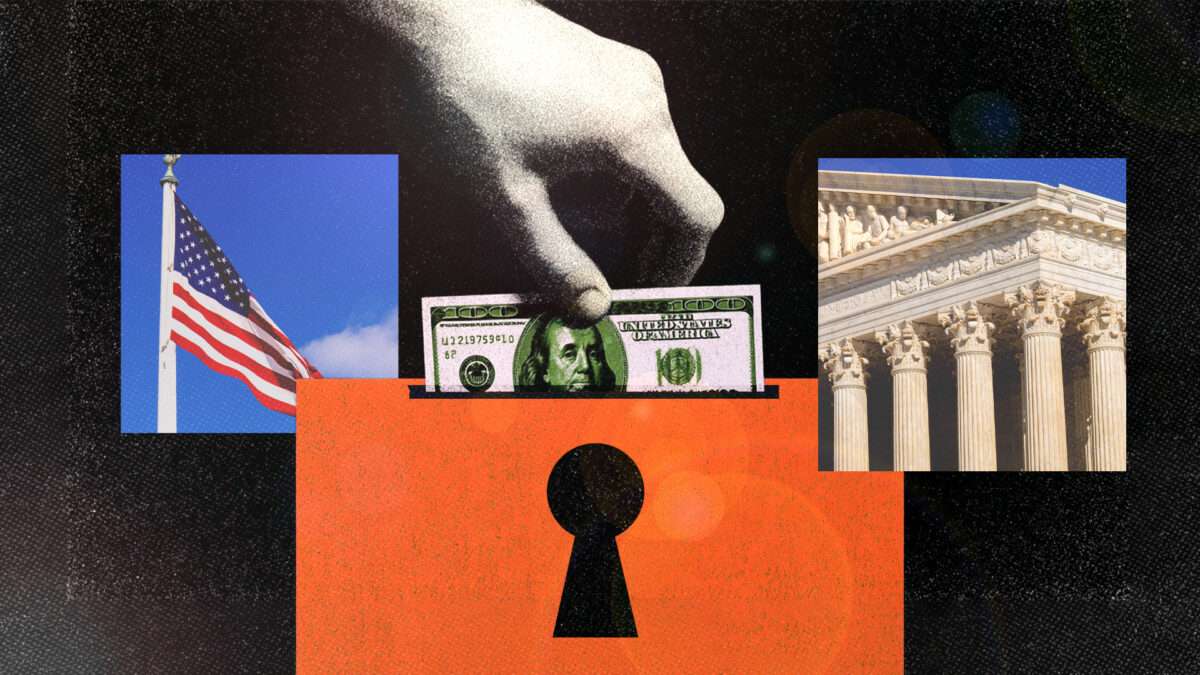
“The Supreme Court issued a resounding victory for donor privacy and free speech last month in First Choice Women's Resource Centers v. Davenport , but it is cold comfort to the hundreds of thousands of nonprofit organizations around the country that must continue handing over similar information to the IRS every year. First Choice reaffirmed that the First Amendment strongly protects the privacy of nonprofit supporters. The case arose after New Jersey's attorney general issued a sweeping subpoena to First Choice, a Christian, pro-life medical nonprofit serving pregnant women, new mothers, and fathers. The subpoena demanded the names and addresses of nearly all of First Choice's donors. The Supreme Court unanimously held that such demands inflict real and immediate harm because they deter people from associating with disfavored groups—even if the government promises to keep the information confidential. This outcome should not be surprising. Nearly 70 years ago, in NAACP v. Alabama , the Supreme Court recognized the "vital relationship" between the First Amendment and privacy. Few people might be willing to donate to a controversial or dissident group if that information might fall into the wrong hands. And NAACP v. Alabama was a perfect example: the Alabama attorney general tried to obtain a list of the NAACP's members in a blatant move to discourage people living in the Jim Crow South from supporting the civil rights organization. The Supreme Court blocked the effort because the attorney general failed to show that Alabama had an important need for such sensitive information. Drawing on this precedent, First Choice once again explained that demands for donor information inevitably chill First Amendment freedoms. And that's true, the Supreme Court held, the moment the demand is made. Organizations can therefore go straight to federal court to protect their privacy without waiting for a state court to order them to comply. First Choice will have implications far beyond one New Jersey subpoena. To its credit, the federal government recognized as much, filing an amicus brief urging the Court to rule in the nonprofit's favor. But it's a much different story for the federal government in Buckeye Institute v. Internal Revenue Service , a case that our organization, the Institute for Free Speech , is litigating in the U.S. Court of Appeals for the 6th Circuit. In Buckeye , the IRS is defending a broad disclosure regime that requires hundreds of thousands of nonprofits to disclose donor information to the federal government every year. Five years ago, in Americans for Prosperity Foundation v. Bonta , the Supreme Court held that disclosing this information—which appears on a tax form called a Schedule B—creates a "real and pervasive" chilling effect on the First Amendment. But the IRS claims that because donors to Buckeye can receive a tax deduction for their charitable contribution, Bonta doesn't apply. On the same day the Supreme Court announced its decision in First Choice , the IRS was in the 6th Circuit arguing that courts should not second guess the government's claimed need to stockpile a treasure trove of sensitive donor data. The central question in Buckeye is what standard courts must apply to evaluate the law. The Supreme Court's decision in First Choice reaffirmed that "any demand" for donor information requires the government to satisfy "exacting scrutiny." That means the government cannot compel organizations to reveal their donors without first proving that collecting this information is necessary to further an important government interest. But in Buckeye , the federal government has urged the court to adopt a far more deferential approach on the theory that nonprofit organizations can avoid the disclosure requirement simply by forgoing tax-exempt status. This interpretation would allow the government to condition valuable tax benefits on a willingness to surrender one's fundamental rights. Buckeye is far more than a technical dispute about tax forms. At stake is whether the federal government can systematically collect the identities of tens of thousands of nonprofit donors—year after year, across the entire country—despite no suspicion of wrongdoing, and without even a second glance from the courts. First Choice recognizes how critical associational privacy is to the freedoms we all cherish. But those freedoms mean nothing if the courts do not apply the scrutiny to government overreach that the Constitution demands. The post The Supreme Court Protected Donor Privacy. The IRS Didn't Get the Memo. appeared first on Reason.com .
Original story
Continue reading at Reason
reason.com
Summary generated from the RSS feed of Reason. All article rights belong to the original publisher. Click through to read the full piece on reason.com.
