
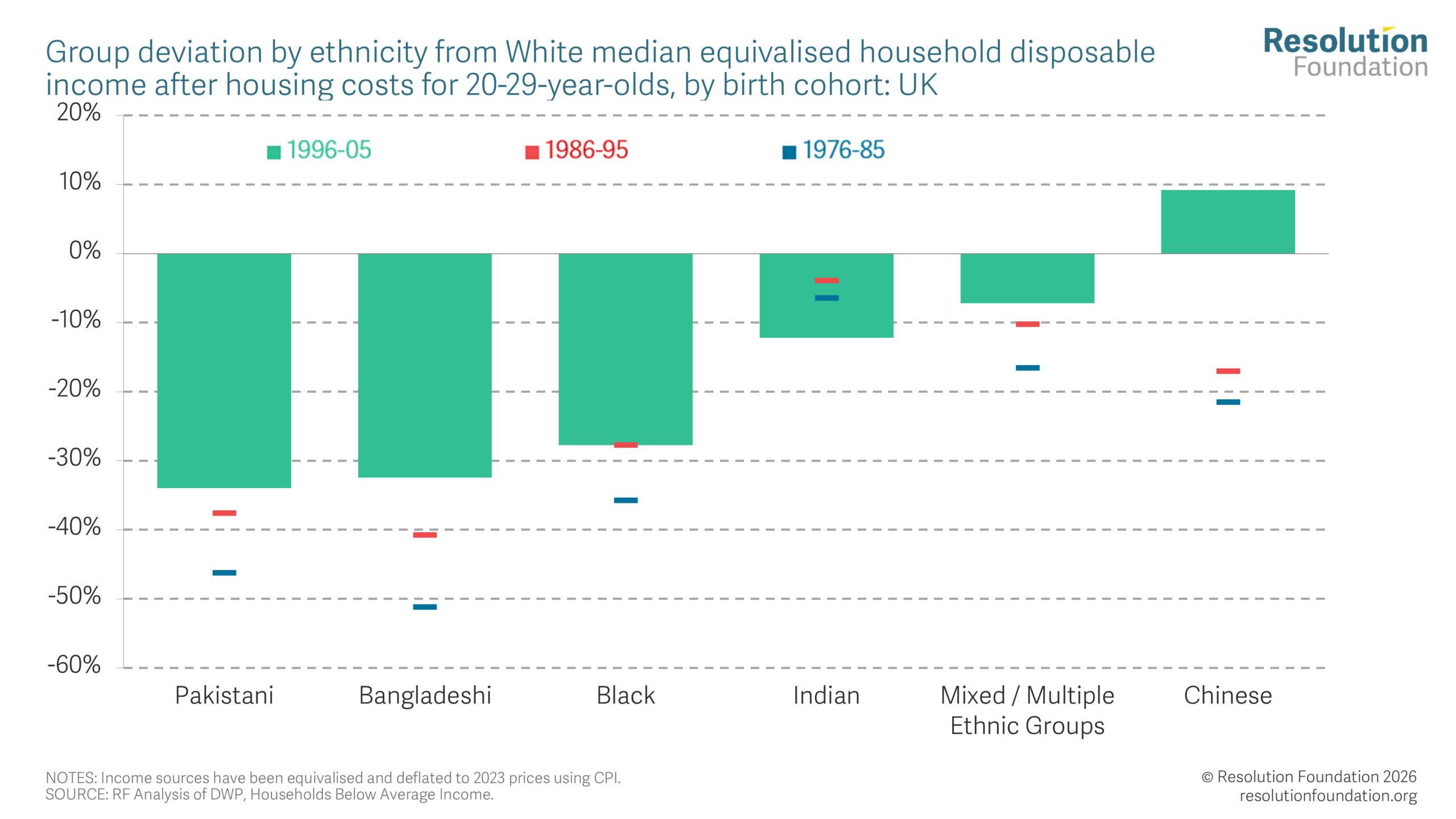
“This article was initially published on our Substack . Following the news this week, it can feel like political realities in the UK are changing by the minute. For anyone who, like me, is finding the live feeds a little dizzying, this article steps back and thinks about how economic outcomes change over decades and generations. Specifically: how income inequality by ethnicity for young people in the UK has changed over the past thirty years. First, the positive news. Income inequality between ethnic minorities and their White counterparts has declined over time. The chart illustrates the gap in average (median) incomes between 20–29-year-olds from different ethnicities and their White peers who were born around the same time, which we will call cohorts. If you’re looking for progress over time, you would expect successive cohorts to have smaller deviations from the White average income, reflecting improvements in structural inequalities. This is broadly true, as the income gap has shrunk for most ethnicities in recent cohorts. People from the Pakistani and Bangladeshi categories born between the mid-1970’s and mid-1980’s had incomes around half the White average (at 46 per cent and 51 per cent respectively), a striking disparity. Those from a Black background had incomes that were 36 per cent lower compared to their White counterparts. Smaller disparities existed for people from Indian, Chinese and Mixed ethnic groups. Fast forward 10 years. The disparities between incomes shrink for all ethnicities. Young people from the Pakistani ethnic group deviated from the average income by approximately 38 per cent, an 8 percentage point reduction compared to the previous cohort. Black people saw the deviation shrink from 36 per cent to 28 per cent. Again, the same trend applied to people from the Bangladeshi, Chinese, Indian and Mixed ethnic groups. When we move on to the latest generation of young people, born between the mid-1990’s and mid-2000’s, the gap gets smaller again for most ethnicities, neatly illustrated by our datapoints moving closer to zero over time for each group. The gap falls to 34 per cent and 32 per cent for people from the Pakistani and Bangladeshi ethnic groups respectively. In fact, there has been a reversal in fortunes. Bangladeshi people, who up until the latest cohort were worse-off than Pakistani people, have seen more progress, with a smaller deviation from the White average. The Mixed group have noticeably progressed, with their income gap narrowing to 7 per cent below that of White people. The Chinese ethnic group has seen the most progress. In fact, they have seen a complete inversion of the income gap, going from a negative income gap of 17 per cent to a positive one of 9 per cent across a decade. This astounding statistic serves to underscore the broader point that there has been some progress in Ethnic equality for the young. However, these results are not all sunshine and roses. While the trend is positive, the overall level of ethnic income inequality remains bad. Large income disparities persist for almost every ethnicity, demonstrating how this type of inequality is still a significant facet of the UK economy and peoples’ living standards across the country. People from Pakistani and Bangladeshi ethnic groups still have the largest income gaps. Both groups had incomes about one third lower than their similar aged White counterparts. A gap of this magnitude is severe, reducing the scope for people from these groups to have a good standard of living. Turning to Black people, progress stalled after those born in the late-1980’s and early-1990’s, leaving relatively large income disparities unchanged, at approximately 28 per cent below the White average. The bad news extends to people from the Indian group. This group had the lowest initial disparities at 6 per cent below the White average. The group initially see some progress in income equality with the gap for the next cohort falling to 4 per cent. However, the latest cohort shows this trend reversing, with their incomes deviating more than they ever have in the past, at 12 per cent. While the gap remains smaller compared to other ethnicities, such as Black, Pakistani or Bangladeshi, it is deeply concerning to see income equality get worse for a group over time. As a consequence of this reversal, Indians no longer have the lowest disparity, with those from Mixed ethnicities having a disparity of 7 per cent. No group is a monolith. The specific mechanisms that cause income disparities are as diverse as the people we are discussing. This is before we have even considered how other aspects of people’s lives – such as location, disability status and education – can impact household income. So where does this leave us? Across time, we have seen progress. But given the substantial income gaps and progress reversing or halting for some groups, more needs to be done to understand and address the mechanisms that cause these inequalities. Jamie Titus-Glover has been a Research Trainee at the Resolution Foundation between February and May 2026. The post The UK has become more equal but ethnic minorities still earn less than their White counterparts appeared first on Resolution Foundation .
Original story
Continue reading at Resolution Foundation
www.resolutionfoundation.org
Summary generated from the RSS feed of Resolution Foundation. All article rights belong to the original publisher. Click through to read the full piece on www.resolutionfoundation.org.
