
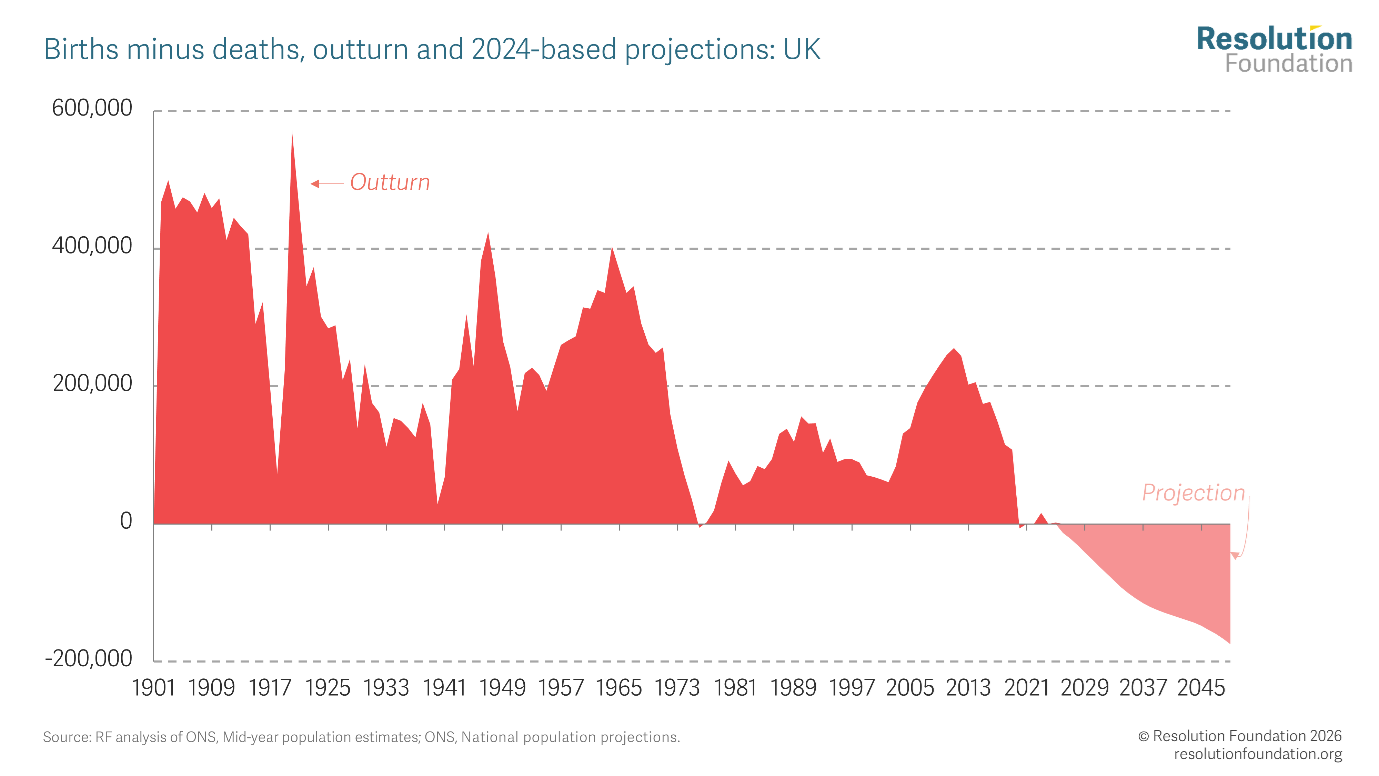
“This article was originally published on our Substack. There are some mixed messages floating around about the UK’s population. On the one hand, we’ve seen record levels of immigration. On the other, we’re facing a baby bust . So how does it all shake out? The ONS’s latest release offers some clarity. Their 2024-based population projections, published yesterday, show the UK’s population growing by 1.7 million over the next decade to 71 million by 2034 – but with all of that growth coming from net international migration. One huge shift that the ONS expects to arrive this year is that the number of births is set to fall below deaths. That means the UK is about to enter a new demographic era. So, what will happen to births, deaths and migration and, crucially, what does that mean for public services and the economy? More graves than cradles Since the start of the 20 th Century, births in the UK have exceeded deaths in almost every year, only briefly interrupted by Covid-19 in 2020. But in 2025 births exceeded deaths by just 2,000. And the new projections confirm that the gap between births and deaths is expected to close for good from 2026. Births in the UK have already been falling sharply: there were only 660,000 in 2024, effectively a record low, down roughly 150,000 since 2011. 2024-based projections don’t project any meaningful recovery, with births now expected to fall below 600,000 by 2056. It’s important to highlight that these projections are based on observed trends in births, deaths and migration and “they do not account for recent and future policy or economic changes”. The recent fall in births (itself a deep cultural and international shift) is currently being driven by women staying childless longer. So, it’s too soon to know whether the recent baby bust will result in permanently fewer children or whether young people today will have (more) children later in life. Net migration is now the only thing keeping the population growing – and that is falling too Net migration is projected to be the sole source of UK population growth, but is now forecast to be lower than previously expected. Net migration is projected to fall to 138,000 in 2026 (in line with other estimates ) before stablishing at 230,000 beyond this point – 110,000 below the previous long-term projection. A big fall, too, from the record highs of recent years, reflecting large decreases in immigration since 2023 (despite emigration also falling). This shouldn’t be a surprise; lower net migration is a stated government policy. But it will have ramifications for the workforce and public finances. Lower-than-expected migration by 2030 leaves the workforce 63,000 smaller, suggesting the economy will be 0.2 per cent smaller, decreasing tax revenues by around £3 billion assuming (net) migrants generally pay equivalent levels of taxes as the resident population, and participate slightly more in the labour market. 1 Savings from lower demand for public services could offset that, though those will only represent lower borrowing if the government reduces the total cash it currently plans to spend. The OBR will use the new projections as the baseline for its forecasts for the Budget later this year – so future migration matters for economic and fiscal planning today – and the last thing the Government needs given the fiscal impact of the Iran war is another hit to the public finances. The population is set to become increasingly made up of older people Fewer births might also, on the face of it, reduce pressure on public services – fewer children entering the schools system should require less teachers and classrooms, for example. But fewer births and lower migration also shift the country’s age structure (at least for a period) further towards older ages, which may largely offset that fiscal relief. The number of people at state pension age is expected to increase by 1.8 million between 2024 and 2034, leaving fewer working-aged people paying taxes relative to those drawing pensions and placing greater pressures on public services like the NHS and adult social care. As past Resolution Foundation work has shown, demographic shifts already explain roughly half of the increase in real health spending between 2009-10 and 2024-25. And the pressures on health and care could be greater still. Life expectancy improvements stalled in the 2010s, and recent Health Foundation analysis shows that healthy life expectancy has fallen by two years over the past decade – and now sits below the state pension age in 90 per cent of local areas. An older population that is increasingly an unwell one will likely place even greater demands on health and social care services. Elliott Christensen and Charlie McCurdy are Senior Economists at the Resolution Foundation. You can follow Elliott and Charlie on BlueSky to stay up to date on their analysis. Read Bye bye baby to learn more about Britain’s falling birth rate since the early 2010s. 1 The OBR previously modelled changes in net migration in Box 2.3 and Box 4.5 of their March 2024 Economic and Fiscal Outlook . Our modelling builds upon the methodology described there, and accounts for subsequently announced immigration and tax policy measures. The post The UK’s demographic squeeze appeared first on Resolution Foundation .
Original story
Continue reading at Resolution Foundation
www.resolutionfoundation.org
Summary generated from the RSS feed of Resolution Foundation. All article rights belong to the original publisher. Click through to read the full piece on www.resolutionfoundation.org.

