
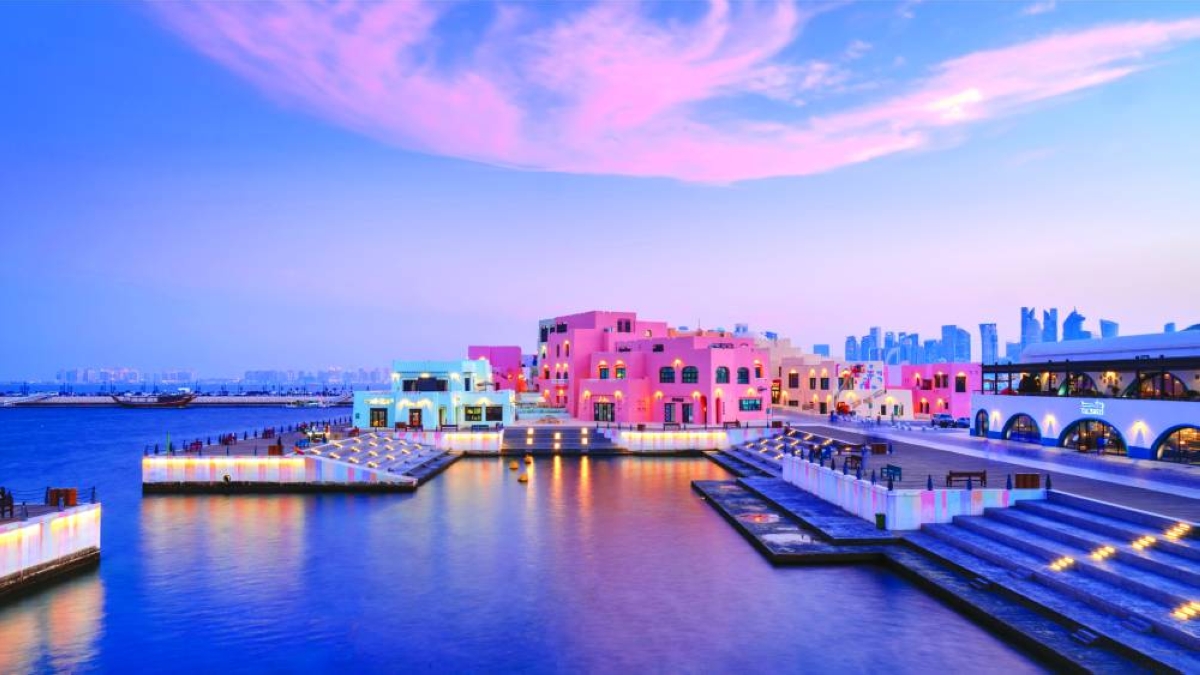
“There is a moment just before sunset, when the light over Doha turns a particular shade of gold and the air begins to cool. Behind you, the hum of the city fades and in front, there is only water, flat and wide, stretching toward the horizon. A seagull crosses overhead while water moves gently against the edge of the dock. Most people would pass through this moment without naming it. However, something in the body responds all the same, a loosening in the chest, a shift in the pace of your breathing, and a sense that the weight you carry has started to lift. Along the waterfront at Old Doha Port, moments like this are part of the rhythm of the place. What feels like a private, passing experience turns out to be something science has spent the last decade trying to measure. What the body already knows, researchers are only now looking to fully explain. What blue spaces do to the mind Scientists use the term blue space to describe any visible body of water including oceans, rivers, harbours, and coastal promenades. The research into what these environments do to us has grown steadily, and the findings point consistently in one direction, regular exposure to these environments is associated with lower levels of stress, improved mood, and better overall mental health. The question is not really whether water changes how we feel, it is why. Water has a quality that psychologists often call ‘soft fascination’. The idea that something can hold the eye without demanding anything from the mind. Unlike a screen or a meeting or a spreadsheet, it asks nothing of you. Your gaze follows the surface. The brain, relieved of the relentless processing that fills most of a working day, begins quietly to recover. The mind rests while the eyes stay open. The sound of recovery The body is listening too, even when the mind is not. The acoustic environment of a coastal setting plays a distinct role. Studies in psychoacoustics have shown that rhythmic, low-frequency sounds, such as lapping waves, distant marine engines, or the call of seabirds, activate the parasympathetic nervous system (Buxton et al., 2021). This is the body’s counterweight to the fight-or-flight response: it lowers heart rate, slows breathing, and eases muscular tension. The sounds do not need to be consciously noticed to have an effect. Instead, the nervous system responds to what is not being asked of it. Old Doha Port has its own acoustic character. The sound of a seagull carries across the water, and somewhere beneath it, the low knock of a dhow against its mooring keeps its own irregular time. For people who spend most of their time in an office or even hearing the noise of traffic, it is the quality of these sounds, unscheduled, undesigned, that register differently. It becomes a quieting effect that arrives from the outside and works its way in. Horizon, space, and the nervous system There is another, often overlooked, dimension to blue spaces: the open horizon. In dense urban environments, the visual field is constantly interrupted by buildings, traffic, screens, and signage. The brain processes each of these inputs, and over time, the accumulated cognitive load contributes to fatigue, irritability, and reduced capacity for decision-making. A waterfront reverses that equation. When the eye reaches an unbroken line between sea and sky, the brain receives a signal that the immediate environment is safe and spacious. Breathing deepens, and the nervous system begins to regulate itself. At Old Doha Port, this is part of the character of the place. The horizon is wide, the sky is uncluttered, and the view extends toward the water without interruption. For residents, the port’s waterfront offers a rare point of visual openness, a piece of coastline where the built environment gives way to the natural one. Why it matters here In a fast-moving city, spaces that allow for pause are not always easy to come by. Much of urban life is defined by enclosed environments, structured routines, and constant visual and mental input. What makes waterfront settings different is not just their openness, but their ability to interrupt that rhythm. At Old Doha Port, that shift is immediate. The transition from city to sea is not gradual; it happens within a few steps. One moment, you are within the pace of the city. The next, you are facing open water, with nothing between you and the horizon. That contrast is part of what makes the experience so effective. It is not about distance or escape. It is about proximity to a different kind of environment. One that slows the pace, softens the noise, and gives the mind a point to settle on, even briefly. None of this is to say that standing by the water will cure anything. Mental health is complex, and no single environment can substitute for professional care when it is needed. But the research is consistent on one point: the environments we spend time in shape how we feel, how we think, and how well we recover from the demands of daily life. What Old Doha Port offers, perhaps without anyone having designed it this way, is one of the few places in the city where the conditions for that kind of recovery exist naturally. The water, horizon, sounds, and space come together in a way that feels naturally harmonious. And on any given evening, if you watch the people walking along the waterfront, you can see it working. A father sitting on a bench, looking out. A couple walking slowly, saying nothing. A teenager with headphones, staring at the horizon.
Original story
Continue reading at Gulf Times Qatar
www.gulf-times.com/qatar
Summary generated from the RSS feed of Gulf Times Qatar. All article rights belong to the original publisher. Click through to read the full piece on www.gulf-times.com/qatar.