
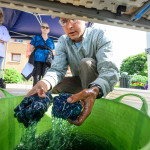
“Photo gallery True blue fun at Allen Centennial Garden A recent workshop at the Garden showcased the scientific wonder that comes from fermenting indigo plants. June 2, 2026 Share this article Last year staff at Allen Centennial Garden grew, fermented and bottled their own indigo plants, and on May 30, visitors to the garden took part in the final (and most magical) step: using the shimmering blue-green liquid to tie-dye. The fun was part of a workshop hosted by the Gardens. Attendees hand-dipped their fabrics of choice and watched as they instantly turned from a yellow-green to bright blue after removing them from the natural dye. The result is part of a chemical reaction from the fermentation of indigo plants. Fun fact: Indigo dye comes from several different plants that are unrelated through the phenomenon of convergent evolution, which happens when unrelated lineages develop similar traits or chemical compounds. Japanese Indigo (native to tropical Asia and parts of China), True Indigo (native to tropical Asia and Africa) and Dyer’s Woad (native to the Caucasus and Europe) all evolved across different times and space, but ended up with the same ability to synthesize indican. The wild indigo in our prairies is slightly related to True Indigo, but it produces a weaker blue dye and is more commonly known as “False Indigo.” From right to left, Ryan Dostal, programs and events lead at Allen Centennial Garden, shows workshop participant and UW employee Melissa Karlen how to gently lower fabric into the indigo dye vat. Photo: Althea Dotzour / UW–Madison Fabric is submerged in a vat of fermented indigo, often called “mermaid liquid,” where it absorbs the dye. “You throw the [indigo] leaves in a pot and weight them under water for three or four days. It will go from greeny-blue and then the surface has like an oil slick they call it the mermaid stage because it looks like truly like like iridescent,” says Dostal. Photo: Althea Dotzour / UW–Madison Fabric looks bright green rather than the classic “indigo blue” after it is immediately pulled from the dye vat because the dye is deprived of oxygen in the water. As the dye is exposed to the air, oxidation causes it to bond with the fabric, changing color from green to a striking, vibrant blue. Photo: Althea Dotzour / UW–Madison Japanese indigo (Persicaria tinctoria) seedlings grow at Allen Centennial Garden. Japanese indigo is part of the buckwheat family, and its leaves contain the chemical precursor indican, which yields a vibrant indigo color when extracted and oxidized. Photo: Althea Dotzour / UW–Madison Once the fabric has reached the desired depth of blue and is fully oxidized, Dostal rinses it in a clean water bath to remove excess liquid. Photo: Althea Dotzour / UW–Madison Young garden worker Hans Luiken holds up his indigo dyed fabric and watches as the remaining green turns to blue as the dye oxidizes. Photo: Althea Dotzour / UW–Madison A finished indigo dyed bandana dries in the bright last spring sunshine. Photo: Althea Dotzour / UW–Madison From left to right, Sam Ehmann takes of a photo of a shirt dyed by political science graduate student Luke Ruiter. Photo: Althea Dotzour / UW–Madison
Original story
Continue reading at UW-Madison News
news.wisc.edu
Summary generated from the RSS feed of UW-Madison News. All article rights belong to the original publisher. Click through to read the full piece on news.wisc.edu.