
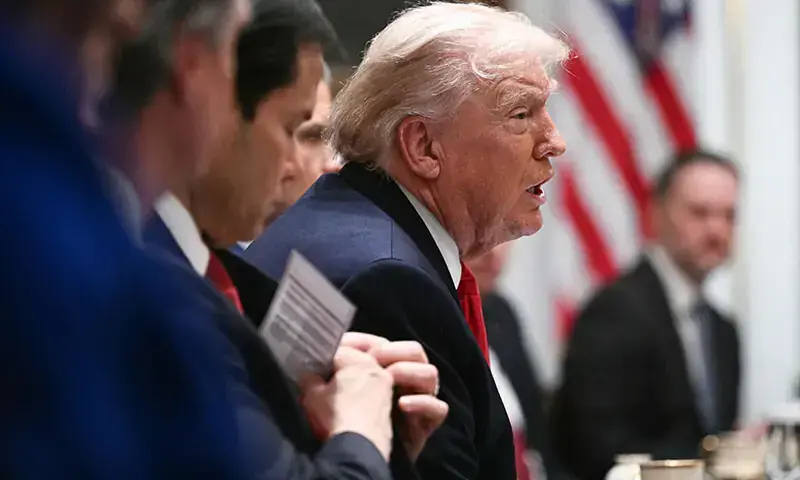
“WASHINGTON: United States President Donald Trump will hold a full cabinet meeting at the White House on Wednesday as his administration faces growing tensions in the Middle East and difficult negotiations with Iran over a possible agreement aimed at reducing the risk of a wider regional conflict. The meeting was originally planned at Camp David, the presidential retreat in Maryland, often used for high-level national security discussions. However, Trump announced on his social media platform, Truth Social, that the gathering was moved back to Washington because of possible bad weather. “Based on the possible bad weather conditions tomorrow, we will be having our Cabinet Meeting in the White House, and will be postponing the Cabinet trip to Camp David. Thank you for your attention to this matter!” Trump wrote. The cabinet meeting comes amidst efforts to finalise a Memorandum of Understanding (MOU) with Iran after weeks of indirect negotiations. The proposed agreement is intended to preserve the fragile ceasefire and create conditions for broader talks on Iran’s nuclear program and regional security issues. Diplomats familiar with the negotiations say most of the document had already been agreed upon over the weekend. At the time, there was optimism that an early signing of the MoU could help ease tensions in the Persian Gulf, including around the Strait of Hormuz, one of the world’s most important oil shipping routes. Iranian state TV reported earlier today that Tehran had obtained a draft of the initial, unofficial framework for the MoU. Under the alleged framework, Iran would restore commercial shipping through the Strait of Hormuz to pre-war levels within a month, while the US would withdraw military forces from Iran’s vicinity and lift a naval blockade. State TV also claimed that the framework, which excludes military vessels and envisages Iran managing ship traffic through the strait in cooperation with Oman, was not yet finalised and that Tehran would take no steps without “tangible verification”. It added that if a final agreement was reached within 60 days, it could be approved as a binding UN Security Council resolution. The White House, however, rubbished Iranian media reports, terming them “not true” and claiming that the MoU being reported on was “a complete fabrication”. Trump’s public schedule reflects the seriousness of the situation. After a morning period reserved for private work, he is expected to begin the cabinet meeting at 11am Eastern Time. The session will be open to reporters, making it one of the administration’s most closely watched meetings in recent weeks. Additional policy meetings are scheduled later in the day behind closed doors. The White House has not officially released details of the cabinet agenda, but discussions are expected to focus on Iran, Gulf security, energy markets, and the broader US strategy in the Middle East. Negotiations between the two parties have slowed in recent days. US Secretary of State Marco Rubio has said disagreements still remain over the wording of certain parts of the document. Officials say even small changes in language are important because previous agreements between Washington and Tehran have collapsed over disputes about interpretation and implementation. The ceasefire connected to the talks has now entered its eighth week but remains under pressure. Iran has warned it could respond to recent US military actions, while fighting involving Israel and Hezbollah has continued to intensify along the Lebanese border. These developments have increased fears that the conflict could spread across the region. However, an Iranian Revolutionary Guards official today said that renewed war with the US was unlikely but warned that Iran stood ready against any attack. International pressure has been increasing on both the US and Iran to avoid another military escalation. Countries in the Gulf region and global energy markets remain concerned that instability around the Strait of Hormuz could disrupt oil supplies and damage the world economy.
Original story
Continue reading at Dawn Pakistan
www.dawn.com
Summary generated from the RSS feed of Dawn Pakistan. All article rights belong to the original publisher. Click through to read the full piece on www.dawn.com.
