
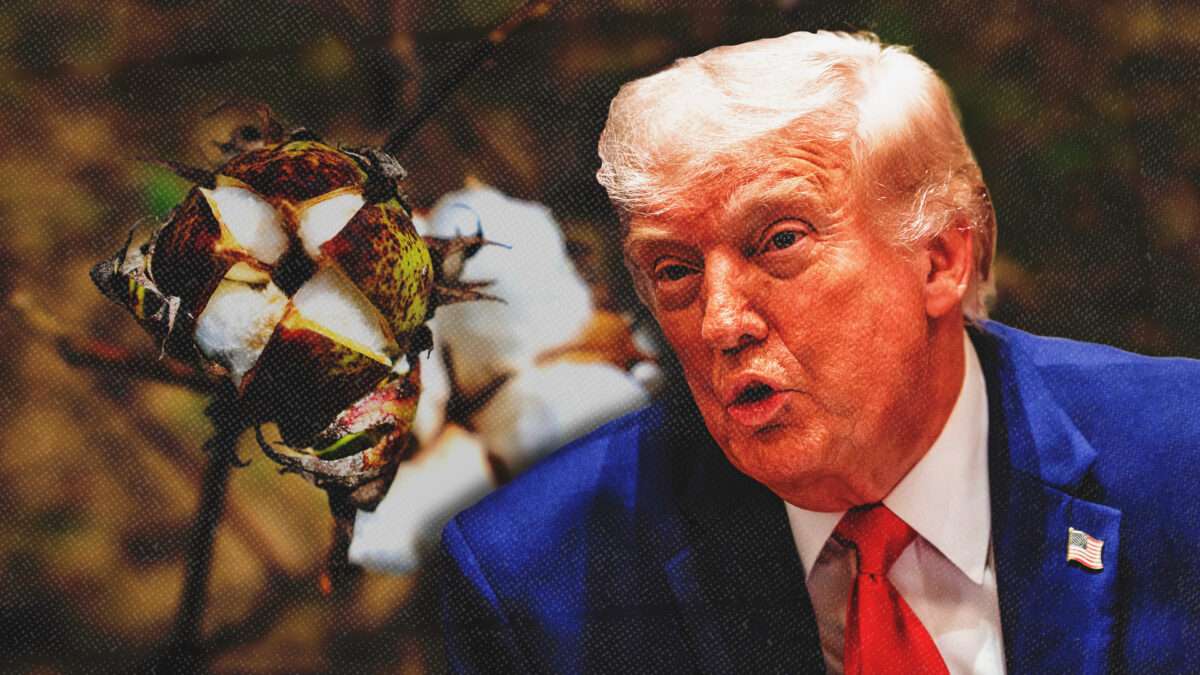
“As the agriculture sector continues to feel the pain of President Donald Trump's trade policies and the illegal war in Iran , Washington is bailing out cotton farmers. On Thursday, the U.S. Department of Agriculture (USDA) announced the Great American Cotton Plan , a protectionist initiative to subsidize American cotton farmers. Agriculture Secretary Brooke Rollins says the plan is necessary to help domestic growers who are being "crushed by rising costs, unfair foreign competition, and a flood of cheap synthetic products." To that end, the USDA will distribute $16 million annually to cotton farmers through the Pima Agriculture Cotton Trust Fund , which received a windfall in last year's One Big Beautiful Bill Act. As part of the plan, Cotton farmers will receive a price floor of 55 cents per pound for upland cotton and $1 per pound for extra-long staple. If market prices fall below those rates, American taxpayers will be on the hook to cover the gap. That could happen sooner rather than later. The world market price for upland cotton, which was about 69 cents per pound last week, is projected to drop to 63 cents per pound this week, according to USDA data. The Great American Cotton Plan also awards the National Cotton Council, an industry trade group, with $13 million in taxpayer funds this year through the Market Access Program—even though the group has already received over $140 million in the last decade. The Trump administration will also promote the Council's "Plant Not Plastic" campaign , positioning cotton as the choice for microplastic-conscious consumers. American cotton production has been declining for years. Given the government's penchant for propping up struggling sectors, it's no surprise that the industry is receiving this bailout. But it's not "unfair foreign competition" or "trade distortions" that are causing America's cotton industry to falter. Over the past decade, 84 percent of domestically produced cotton has been exported on average, which suggests that trade is going well for farmers. Instead, it's the president's own policies. During the first Trump administration, a two-year trade war with China helped Brazil become the leading global exporter of cotton. With retaliatory Chinese tariffs on American cotton as high as 65 percent, the trade war reduced the value of U.S. agricultural exports by about $25.7 billion, according to a report by the USDA Economic Research Service. The impacts of this are still being felt: In 2025, U.S. cotton exports to Turkey fell by 62 percent as the country turned to cheaper Brazilian cotton. Meanwhile, the president's Liberation Day tariffs led China to impose steep retaliatory duties, causing annualized U.S. agricultural cotton exports to fall by nearly $1.3 billion, according to North Dakota State University. Fewer exports aside, cotton farmers, textile manufacturers, and others in the industry face rising input costs for steel, aluminum, fertilizer, and agricultural goods due to retaliatory tariffs imposed by countries such as Mexico, Canada, Turkey, India, and China—all critical markets for America's cotton industry. The consequences and unpopularity of these tariffs among cotton farmers led the National Cotton Council to sign on to a letter last April, urging the administration to back off the policy, which risked a combined $80 billion in agricultural exports. The Trump administration has made a habit of bailing out farmers faced with the negative impacts of its tariff policies. But rather than admitting its trade policies don't work and letting the cotton industry stand on its own, the administration is preparing to double down on its bailout strategy. Farmers may like it, but ultimately, taxpayers will pay the price. The post Trump's Cotton Bailout Is Another Sign His Tariffs Aren't Working appeared first on Reason.com .
Original story
Continue reading at Reason
reason.com
Summary generated from the RSS feed of Reason. All article rights belong to the original publisher. Click through to read the full piece on reason.com.


