
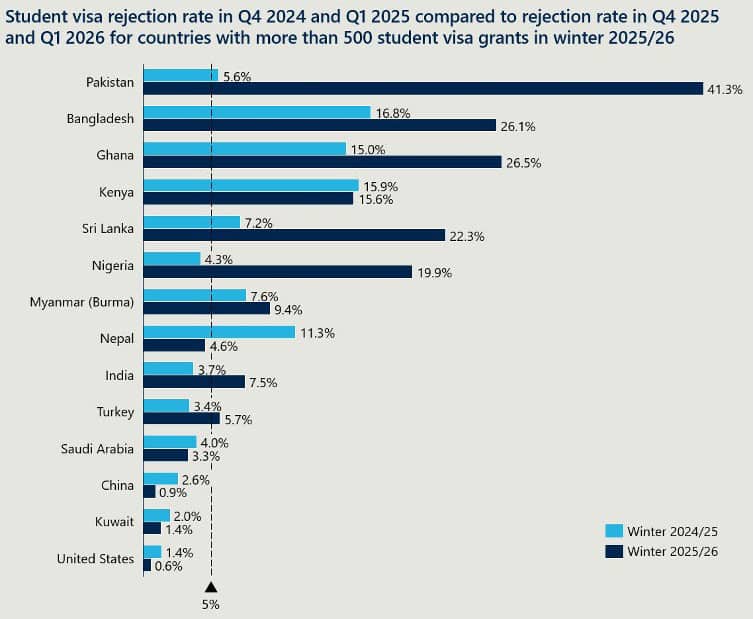
“If you are an international student prospect, where you live in the world increasingly determines where you can study abroad – as does your intention to stay in, or leave, a host country after completing your studies. This has always been true to some extent, with the costs of study and living a particularly frustrating barrier for many students. However, the list of barriers is growing, and visa rejections occupy an increasingly prominent position on this list – including for students applying to the UK. The UK’s sponsored study visa approval rate used to be higher than in Australia , and much higher than in Canada and the US. But in the six months up to the end of March 2026, the refusal rate for students from many of the UK’s fastest-growing student source markets has doubled, tripled, or increased even more drastically compared with the same period in 2024/25. In the case of Pakistan, the rejection rate has increased nearly six-fold from just under 6% to 41%. Higher visa refusal rates are conveniently dovetailing with the UK government’s overall immigration goals. The narrowing of study, work, and immigration opportunities is happening against a background of quietly coordinated and complementary visa processes and policies. This interplay is the main story behind the Home Office issuing -32% fewer sponsored study visas to international students in Q1 2026 than in Q1 2025. Massive rises in visa rejections for some markets In the six-month stretch of Q4 2025 and Q1 2026, sponsored study visa refusals skyrocketed compared with the same period in 2024/25 for Pakistani (41% refusal rate), Bangladeshi (26%), Ghanaian (26%), Sri Lankan (22%), and Nigerian students (20%). The following chart, provided by the Nous Group, shows the dramatic contrasts between this recent period and the same period in 2024/25. The chart also shows that American and Chinese students, who have always benefitted from high approval rates, have become even more likely to be approved. Rising rejection rates in many top sending markets for UK universities. Source: Nous Group/Home Office Why are Chinese and American students so much more likely to be approved? More than 99% of Chinese and American sponsored study applications were approved by UK immigration officials in the year ending March 2026. The growing discrepancy between this rate and those in emerging markets such as Pakistan, Bangladesh, and Nigeria, is greatly influenced by the immigration climate in the UK. The ruling Labour government is plummeting in popularity, not least because of frustration among a sizeable segment of voters that immigration levels are not lower. Rachel Wolf, writing in Politico , predicts that to attempt to remain in power, Labour will employ a range of right-aligned tactics including “[cutting] immigration and [going] after easy wins (such as international students).” Some international students are better targets than others in this regard. Chinese and American students do not increase net migration levels because the vast majority of them leave the UK after completing their studies. In contrast, students from countries experiencing dramatic jumps in visa rejection rates are also the most likely to want to remain in the UK to work and immigrate. The following chart from the Migration Observatory at the University of Oxford depicts striking differences in “stay rates” across four nationalities (as measured by proportions that still had a valid sponsored study visa in 2024 after first arriving in 2019). Stay rates across different student source markets for the UK. Source: The Migration Observatory at the University of Oxford Some institutions more affected than others The composition of a British university’s international student body is now a major determinant of how well that university can tolerate the clampdown on student flows from some countries. For example, Higher Education Statistics Agency ( HESA ) data shows that Chinese students – who have a 99% approval rate – accounted for more than 40% of all international students at elite Russell Group universities in 2024/25. Around 105,000 Chinese students were enrolled at these institutions that academic year – which is nearly three-quarters of all Chinese students in the UK. Heavy reliance on Chinese enrolments may be risky in the long term, but for now, it buffers elite institutions against the system-wide trend of students in high-growth emerging markets being either rejected for a visa or withdrawing their application. The rest of the country’s universities tend to be more diversified across nationalities and rely more on enrolments from emerging markets. Ironically, though this diversification was encouraged by the UK government’s 2019 International Education Strategy (and 2021 update), it now exacerbates the financial troubles many are experiencing. Writing on LinkedIn, Nous Group director Nicholas Dillon notes that lower-ranked universities that continue efforts to recruit in high-risk markets face escalating costs of acquisition per student (e.g., through increased documentation checks, interviewing, and other activities aimed removing visa rejection risk). As Mr Dillon says: “This matters, as margins are already tighter at many lower-ranked providers.” The massive impact of visa rejections and delays in processing Students in the regions most affected by visa rejection rates are also the most likely to be experiencing delays in visa processing. Wonkhe’s associate editor, Jim Dickinson, reports: “At some providers, reports suggested up to half of a winter cohort was still awaiting a decision despite a Confirmation of Acceptance for Studies (CAS) issued before Christmas – petitions described students stuck on “SLA not met” notifications weeks after submitting biometrics. The delays were reported to fall hardest on applicants from Pakistan, South Asia, and parts of Africa.” (Editor’s note: “SLA not met” stands for “Service Level Agreement not met” and indicates that UK Visas and Immigration (UKVI) has failed to make a decision on the file within their standard processing timeframe.) Where visa rejection rates are highest, so too are application withdrawals. Source: Wonkhe Higher rates of visa refusals and visa processing delays are prompting two related trends: Students from high-risk markets are increasingly withdrawing their applications so that their student profile is not marred by evidence of a rejection. Many universities are scaling back – or even stopping – student recruitment in those markets to avoid being sanctioned under new, stiffer Basic Compliance Assessment (BCA) rules. Among other benchmark requirements, institutions must stay within a 5% refusal rate range or risk penalisation including, at the extreme end, the removal of their license to enrol international students. Death by a thousand cuts? Mr Dickinson explains that dynamics such as visa rejections and processing delays for students from some countries are reinforcing the deterrent effect of more restrictive government policies: “The contraction [of student flows] is being administered through the plumbing of the system – a delay here, a withdrawn application there, a compliance threshold that does the deciding, a salary floor that quietly closes a route.” “Each lever is individually deniable. The aggregate is a bust delivered by stealth, with no single author and accountability that sits nowhere.” Students pay a steep price, says Mr Dickinson: “There is a bleak logic to it all. A withdrawn application doesn’t count as a refusal in the compliance metrics. So in a system that punishes refusals, the withdrawal route protects the institution’s number while the student absorbs the loss – the non-refundable flights, the priority fee that was never honoured, the place that evaporated. The delay creates the pressure – the withdrawal discharges it without leaving a mark on anyone’s record.” Amidst these conditions, an increasing number of students from high-risk markets will now be realising that the doorway to study in the UK is narrowing. For additional background, please see: “UK universities bracing for a further decline in international enrolments” “Universities urged to focus on factors they can control as policy settings continue to depress international student enrolments in the Big Four” The post UK: Sponsored study visa issuances down, rejection rates up, and more appeared first on ICEF Monitor - Market intelligence for international student recruitment .
Original story
Continue reading at ICEF Monitor
monitor.icef.com
Summary generated from the RSS feed of ICEF Monitor. All article rights belong to the original publisher. Click through to read the full piece on monitor.icef.com.

