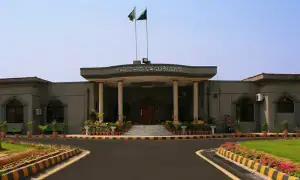
“ISLAMABAD: As the Judicial Commission of Pakistan (JCP) meets on Tuesday (today) to deliberate on the proposed transfer of five judges of the Islamabad High Court (IHC), uncertainty surrounding the move echoed in courtrooms, where senior puisne judge Justice Mohsin Akhtar Kayani remarked on Monday that he was “a guest for 24 hours only”. During proceedings of a routine court case, the anticipated reshuffle triggered notable exchanges between the bench and lawyers. In a case before Justice Kayani, a counsel pointed out that Justice Sardar Ejaz Ishaq Khan, who had earlier been hearing the matter, was no longer available as a single bench judge and was now sitting on division benches. The lawyer also alluded to reports regarding transfers and fresh appointments. Responding, Justice Kayani observed that court functioning could not be left in limbo, stressing that “someone has to work in the Islamabad High Court”, and noted the uncertainty about when new judges might join. In another matter the same day, after reserving judgment, the petitioner’s counsel asked whether the verdict would be announced immediately. Justice Kayani replied in the affirmative, adding tersely, “we have 24 hours left”. Justice Kayani, during a case proceeding, remarked that ‘he is guest for 24 hours’ Meanwhile, Yahya Afridi, Chief Justice of Pakistan and chairman of the JCP, has raised serious constitutional concerns over the proposed transfers, particularly the move to shift Justice Khadim Hussain Soomro from the IHC to the Sindh High Court (SHC). In his response to informal requests by IHC Chief Justice Sardar Mohammad Sarfraz Dogar, the CJP warned that such transfers could undermine federalism and equitable representation, reducing judicial appointments to temporary and reversible administrative decisions. The IHC chief justice had sought a JCP meeting on April 28 to consider transferring five judges. The proposals include moving Justice Kayani to the Lahore High Court, Justice Babar Sattar to the Peshawar High Court, Justice Arbab Tahir to the Balochistan High Court, and Justice Soomro along with Justice Saman Rafat Imtiaz to the SHC. Although the CJP had earlier declined to endorse the proposal, a requisition signed by five JCP members was submitted on April 7. Under Article 175A(22) of the Constitution, the chairman must convene a meeting within 15 days upon such a request. Raising substantive objections, the CJP warned that transferring five out of nine IHC judges without immediate replacements would create significant vacancies and institutional instability. He cautioned that reversing the earlier transfer of Justice Soomro — who was moved from the SHC to the IHC in February 2025 under Article 200 — would defeat the objective of ensuring representation of federating units. He further noted that shifting both Justice Soomro and Justice Imtiaz back to the SHC would leave Sindh without representation in the IHC, undermining the intent of earlier judicial placements. Questioning the lack of stated reasons, the CJP warned such transfers could assume a punitive character, effectively amounting to removal without due process. He emphasised that the Constitution provides a mechanism under Article 209 through the Supreme Judicial Council for addressing allegations against judges. According to him, allowing transfers that function as de facto removals would bypass constitutional safeguards and set a dangerous precedent, eroding judicial independence and public confidence. Separately, Mian Raza Rabbani, former chairman Senate, termed the proposed transfers “undesirable,” warning that they would undermine federalism and equitable representation. He recalled that the 18th Amendment aimed to ensure that the IHC reflected representation from all federating units, adding that amendments allowing transfers without consent impinge upon judicial independence. Published in Dawn, April 28th, 2026
Original story
Continue reading at Dawn Pakistan
www.dawn.com
Summary generated from the RSS feed of Dawn Pakistan. All article rights belong to the original publisher. Click through to read the full piece on www.dawn.com.

