
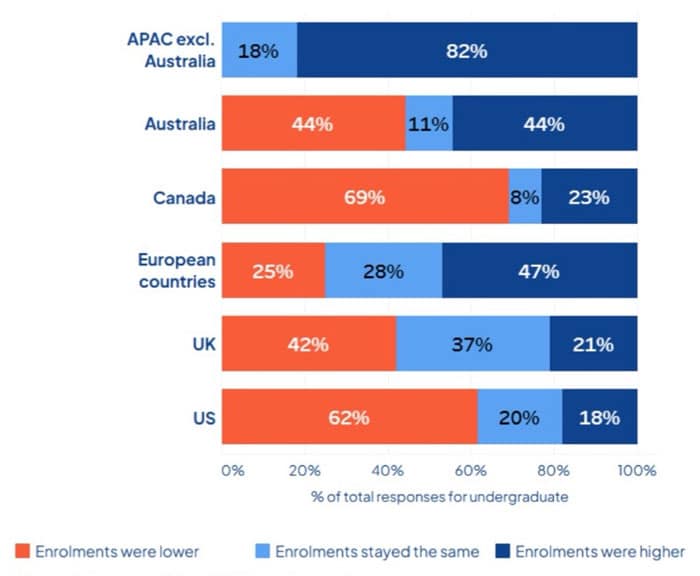
“Through the first quarter of 2026, restrictive immigration settings in Australia, Canada, the UK, and the US continued to (1) reduce inflows of new foreign students to universities in those countries and (2) increase student interest in Asian and European destinations and institutions. These trends are highlighted in results from the most recent Global Enrolment Benchmark Survey by NAFSA, Oxford Test of English, and Studyportals. This year’s survey asked respondents from over 254 universities across 36 countries about new international enrolments in the January–March 2026 intake; perceived barriers to enrolling students; and recruitment strategies. While the research found that while universities in the Big Four are struggling with policy-induced enrolment pressures, it also revealed a determination to remain hopeful by adapting strategies for the new recruitment context. Edwin van Rest, CEO of Studyportals, commented: “Universities that are agile, proactive and supportive of students are much better positioned to absorb visa disruption and sustain enrolment.” About the research findings The survey sample was heavily weighted towards the US, with 149 universities from the US compared with 39 in Europe, 24 in the UK, 13 in Canada, 9 from Australia, and 9 from the Asia-Pacific region (excluding Australia). In all, about three-quarters of responding universities were in the Big Four. For this reason, the regional breakdowns in the survey report are especially valuable. There was also a Global Enrolment Benchmark Survey wave in January to March 2025. While apples-to-apples comparisons between the early-2025 and early-2026 waves cannot be made because of the waves’ slightly different samples, broad trends are definitely apparent. New undergraduate enrolments As shown in Chart 1 below, 7 in 10 (69%) Canadian institutions reported welcoming fewer undergraduate students in the January 2026 intake. Considered alongside the 82% of Canadian institutions that reported a drop in the Q1 2025 survey wave, this marks two years of severe contraction. In Q1 2026, 62% of US universities reported welcoming fewer new undergraduate students, a greater proportion than the 48% reporting the same in Q1 2025. This suggests that recruitment challenges have intensified in the US over the past year. The undergraduate enrolment situation in Australia and the UK appears less dire. Under half of Australian (44%) institutions reported a falloff, and just as many (44%) said they had welcomed more new international students. The picture was more balanced in the UK, with 42% saying commencements were down, 37% reporting stability, and 21% enrolling more new students. Meanwhile, Asian and European institutions are faring very well. Fully 82% of Asian institutions saw more new undergraduate students in Q1 2026 than in Q1 2025, and none of them reported drops. In Europe, almost half (47%) of responding universities reported a year-over-year increase, which is nearly double the proportion reporting a decline (25%). Chart 1: Change in international undergraduate enrolments, January-March 2025 to January-March 2026. Source: 2026 Global Enrolment Benchmark Survey Graduate trends As shown in Chart 2 (below), around two-thirds of Australian, British, and American universities reported lower international postgraduate commencements in January 2026. The 2026 trend is worse for British institutions than in 2025, when only half said commencements were down, but it is stable in the US. Canadian institutions are grappling with further deterioration at the postgraduate level in 2026. Fully 8 in 10 (80%) institutions reported declines (up from 71% in Q1 2025), and none reported increases. Meanwhile, over half of Asian universities (55%) reported postgraduate commencement gains, as did 43% of European institutions. Chart 2: Change in international postgraduate enrolments, January-March 2025 to January-March 2026. Source: 2026 Global Enrolment Benchmark Survey Significant differences in Q1 2025 and Q1 2026 survey results Chart 3 (below) shows the difference in average reported commencements between Q1 2025 and Q1 2026. European and Asian institutions welcomed considerably more new students in Q1 2026, especially at the bachelor’s level. Masters’ commencements were down significantly in Australia. In Canada and the US, intakes at both levels worsened considerably. Canadian undergraduate programmes were particularly affected, while in the US, the most severe reduction was at the master’s level. While less pronounced than in North America, a downward trend is also evident in the UK at both levels. Chart 3: Changes in new enrolments from Q1 2025 to Q1 2026. Source: Source: 2026 Global Enrolment Benchmark Survey The most pressing issues An overwhelming majority of respondents in the Big Four cited restrictive policies as the biggest obstacle they face (Chart 4 below). The full Australian sample (100%) picked this option, as did 84% in both Canada and the US and 71% in the UK. Policies were also the top challenge in Europe, but only 59% chose this response option. In Asia, the top three cited issues did not include policies at all. Instead, cost of study/living, English-proficiency requirements, and academic requirements were the main challenges for Asian institutions. Chart 4: Top barriers for institutions across the sample. Source: January–March 2026 Global Enrolment Benchmark Survey What lies ahead More than 4 in 10 universities in Australia, Canada, and the UK are planning budget cuts in the next 12 months, with over a third saying the same in the US (Chart 5 below). Close to a quarter of institutions in Australia and Canada are also planning to cut staff. The relatively supportive policy environments in which Asian and European institutions are recruiting are reflected in their plans. Fully 64% of Asian institutions have more aggressive enrolment goals, as do 31% in Europe. In Asia, more than half (55%) intend to use more AI in their operations, and 26% of European institutions do as well. The mindset is clearly one of growth, while Big Four universities have their hands full with managing tough policy contexts and associated budget and staff cuts. Across the board, however, institutions see diversification as a necessity this year (the most cited sample-wide priority at 37%). Chart 5: Priorities over the next year across regions. Source: January–March 2026 Global Enrolment Benchmark Survey Sector resilience and top strategies Of the Q1 2026 findings, Dr Fanta Aw, Executive Director and CEO of NAFSA, commented: “Despite an increasingly uncertain policy environment, the survey shows that institutions willing to innovate and adapt can still create meaningful pathways for student success and access …. Institutions can and must exercise greater agency to counter serious external forces.” The top ways in which surveyed universities are exercising this agency are highlighted in Chart 6, below. Introducing new programmes; diversifying/expanding geographically; executing strong branding/marketing; and offering financial incentives and scholarships were the most cited institution-led strategies for boosting international enrolments. In addition, a notable proportion of universities reported that they had introduced January start dates to “manage visa unpredictability and to capture students who would otherwise defer or drop out of the cycle.” The report notes: “One global recruitment calendar rarely works well for all markets. Understanding demand by origin country can help to prioritise marketing and recruitment activities. Certain countries show a notably stronger preference for the January to March intake than their peers elsewhere.” Chart 6: Most-cited strategies for driving conversions. Source: January–March 2026 Global Enrolment Benchmark Survey The study report adds: “The right response to a shifting landscape is not to wait it out. It is to understand it better and move faster. Student demand for international education remains strong. The institutions that will capture it are the ones that treat uncertainty not as a reason to pause, but as a reason to think differently.” For additional background, please see: “ From the Big Four to the Big Fourteen ” “ Canada and the US are losing international student enrolments to Europe and Asia ” “ The four key trends that will shape international student mobility for the next decade ” The post Universities urged to focus on “factors they can control” as policy settings continue to depress international student enrolments in the Big Four appeared first on ICEF Monitor - Market intelligence for international student recruitment .
Original story
Continue reading at ICEF Monitor
monitor.icef.com
Summary generated from the RSS feed of ICEF Monitor. All article rights belong to the original publisher. Click through to read the full piece on monitor.icef.com.
