
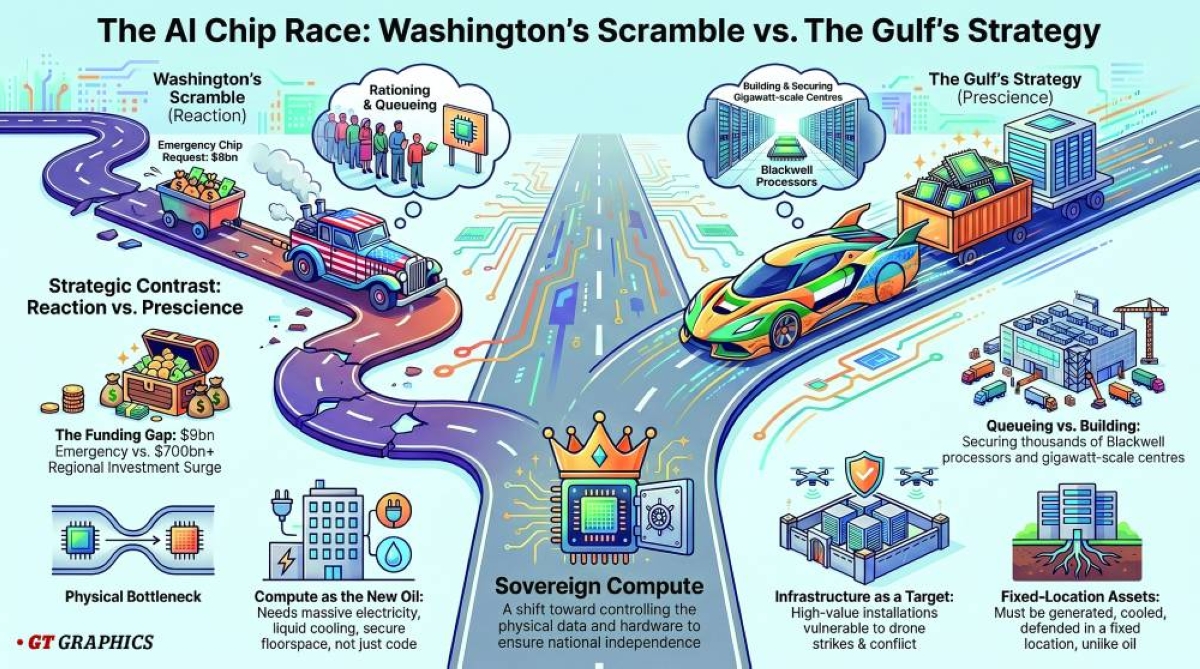
“When word surfaced this week that the White House had quietly cleared a request worth some $9bn to buy the advanced processors America’s intelligence agencies need to run the newest artificial-intelligence models, the figure was not the arresting part. The revelation buried within it was this: the world’s pre-eminent espionage apparatus — the machinery that listens to the planet and maps its secrets — cannot fully unleash the most capable AI on its own classified systems because it does not have enough chips. Read from the Gulf, that admission lands differently than it does in Washington. For two years the region has been pouring sovereign capital into precisely the bottleneck that has now embarrassed the CIA and NSA. The American story is being told as bureaucratic catch-up. The Gulf story is the same problem approached as deliberate strategy — and the contrast is instructive. The scarcity nobody can buy past The processor at the heart of the American shortfall is Nvidia’s Grace Blackwell, a class of chip so power-hungry that it demands purpose-built data centres with vast electrical supply and liquid cooling. Demand for it has outrun supply across the entire industry; even the labs producing frontier models have rationed access during peak hours, metering compute the way a strained grid sheds load. If the agencies that guard a superpower’s secrets must wait in that queue, the lesson for everyone else is plain. Owning the cleverest model means little without the silicon, the megawatts and the secure floorspace to run it. Intelligence is no longer the scarce commodity. Compute is. That is the precise wager the Gulf has been placing. Saudi Arabia’s Public Investment Fund stood up a state-backed AI company, HUMAIN, and tied it to enormous compute build-outs, including a tranche of 18,000 Blackwell processors feeding a half-gigawatt data-centre project. Abu Dhabi’s G42 has assembled supercomputing muscle and courted a procession of American chip approvals, while a UAE flagship facility has become the first venture under a programme designed to help governments stand up their own national AI capacity. Qatar is no spectator: the Qatar Investment Authority’s tie-up with Brookfield sits among the region’s landmark data-centre ventures, and Ooredoo has been raising finance to expand AI-ready infrastructure across the wider region in partnership with Nvidia. The collective number floated for this regional surge runs past $700bn. Set against Washington’s $9bn scramble, the Gulf’s commitment looks not merely ambitious but prescient — the region saw the bottleneck coming and started digging before the queue formed. Sovereignty, not scale The deeper convergence is philosophical. The most thoughtful framing of Gulf AI ambition has shifted away from a race to build the biggest model and towards a quieter goal: control. Control of the data, the systems and the infrastructure on which sensitive national life increasingly depends. The point is not to out-compute Silicon Valley but to avoid being held hostage by it. What is striking is that the American intelligence story now reveals Washington wrestling with the identical instinct. The classified contract being finalised with one leading AI firm reportedly carries a carve-out barring the model from being trained on or turned against citizens’ data — a sovereignty-of-data clause in all but name. The administration even abandoned, at the eleventh hour, an executive order that would have forced AI companies to share their models with government before public release, a recognition that frontier systems have become instruments of statecraft too potent to leave ungoverned. Sovereignty over compute and data, in other words, is now the universal anxiety of the AI age. The Gulf simply reached it first, and as policy rather than panic. This is also where the region’s distinctive geometry pays off. Gulf states have cultivated channels to both Western and Eastern technology partners, and sovereign wealth funds that can deploy capital on a leadership mandate rather than a quarterly earnings logic. That patience is an asset when the constraint is not money but the physical lead time to pour concrete, string power lines and certify secure facilities. The Gulf is far from alone in this calculation — Britain, France, India and South Korea are all racing towards sovereign capability for the same reason — but few combine the capital, the political will and the geographic positioning quite so tightly. The vulnerability priced too cheaply There is a harder lesson the Gulf has learned that Washington’s chip drama has yet to confront, and it is the angle most worth pressing. Compute infrastructure is not an abstraction living in the cloud. It is buildings, cables and cooling plants with fixed coordinates — and that makes it a target. In March this year, drone strikes attributed to Iran struck commercial data-centre facilities in the UAE and Bahrain, and the Revolutionary Guard subsequently circulated a roster of technology sites across the Gulf linked to the biggest American cloud and chip names. The episode punctured a comfortable assumption: that the AI build-out was a purely economic project insulated from the region’s security volatility. It is not. A facility humming with Blackwell processors is, in a conflict, simply a high-value installation that happens to think. Washington’s account frets about supply chains and security clearances. The Gulf has already absorbed the more visceral truth — that the data centre is a piece of critical infrastructure as exposed as a power station or a port, and that the same fibre and concrete underpinning prosperity can become a battlefield overnight. For Qatar, which has built its AI ambitions in a neighbourhood where missiles and drones are not hypothetical, that is not a distant cautionary tale. It is the operating environment. The gold standard The phrase doing the rounds is “compute is the new oil,” and like most slogans it is half right. Oil could be stockpiled and shipped; computing power must be generated, cooled and defended in place, and the chips that produce it flow only at the pleasure of an American export regime that has just declared its best silicon off-limits to most of the world. The Gulf’s bet is that owning the infrastructure — and the sovereignty that comes with it — will prove the decisive advantage of the coming decade. Washington’s scramble suggests the region read the market correctly. The unfinished question is whether it can keep its computing gold both supplied and safe. • The writer is Deputy Managing Editor, Gulf Times
Original story
Continue reading at Gulf Times Education
www.gulf-times.com/community/education
Summary generated from the RSS feed of Gulf Times Education. All article rights belong to the original publisher. Click through to read the full piece on www.gulf-times.com/community/education.

