
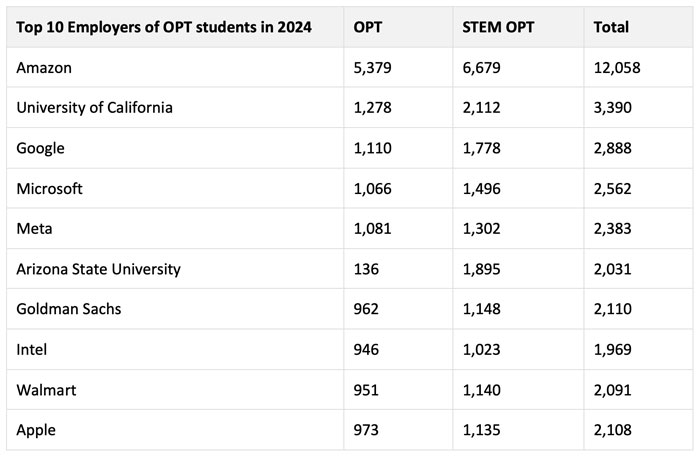
“US Immigration and Customs Enforcement (ICE) has intensified its scrutiny of the Optional Practical Training (OPT) post-study work programme for international graduates of American universities. On 12 May, Todd M. Lyons, ICE’s acting director, called a press conference to announce that ICE has found more than 10,000 cases of fraud in the system on the part of dodgy employers and students. Mr Lyons said that OPT has “become a magnet for fraud.” He continued: “When OPT was created under the Bush administration and expanded under the Obama administration, DHS had anticipated only a few thousand foreign students would receive training approval before returning home. Instead, OPT ballooned into an uncontrolled guest worker pipeline with hundreds of thousands of foreign students working in the United States. As the programme size has exploded, so has the fraud.” Mr Lyons, and acting executive associate director for Homeland Security Operations (HSI) John Con, detailed the results of multiple investigations across the country, which include cases of “empty buildings with locked doors at addresses where hundreds of foreign students are allegedly employed … residential addresses listed as work sites for hundreds of foreign students – yet no employees were present.” Mr Lyons said: “We are discovering evidence of organised fraud that spans national and international borders. This is not accidental. It is deliberate, coordinated, and criminal.” Closing out the press conference, Mr Lyons concluded: “We will not tolerate abuse of our programmes, and more actions are forthcoming.” In 2024/25, close to 300,000 international graduates participated in either OPT (one year) or STEM OPT (one year plus a two-year extension for STEM programme graduates). A step toward curtailing OPT? Many international education analysts believe the press conference is laying the groundwork for much stricter government oversight of the OPT programme, or even toward restricting programme access. There is strong political support for this direction within the governing Republican party, and as we reported last week , the director of US Citizenship and Immigration Services (USCIS), Joseph Edlow, has indicated that he wants a regulatory system that can “remove the ability for employment authorisations for F-1 students beyond the time that they are in school.” It’s possible that a cumulative and coordinated administration strategy that gradually reduces the attractiveness of OPT – and more broadly, the opportunities for international students to work in the US after graduating – could be in play. Following are four measures whose inter-dynamics suggest this may already be the case. 1: Pause in visa processing . In January 2026, the government expanded its 39-country travel ban so it could impact not just students coming into the US, but also those already studying there. It announced that while current students from those countries could still apply for OPT, the processing of their applications would be paused. This “pause” remains active. OPT applicants cannot work in the US until their application is approved, leaving them in limbo and without any sense of when processing will resume. Strategic negative impact on OPT? Yes. It becomes harder and less attractive for international students from travel ban countries to participate in OPT. 2: USCIS to decide how long international students can stay in the US. The Duration of Status (D/S) system, which allows many students to stay in the US past their programme end date if their Designated School Official decides they have a valid reason for needing more time, is expected to be terminated in September 2026 . It will be replaced by a fixed-admission structure under which students will be allowed no more than four years of admission unless they get an extension. The new system will see US Citizenship and Immigration Services officials decide whether to approve the extension. Officials will be permitted to “use discretion,” which means they can make independent judgments and choices when reviewing requests from students they have never met. They will review a paper or electronic submission from the student. Most F-1 students will need the extension to be eligible for OPT given that they would exhaust the four-year admission period just by completing their degree. Strategic negative impact on OPT? Yes. To enter OPT, students will need permission from immigration officials to stay in the US for longer than four years. 3: The framing of the OPT system as a “magnet for fraud” this week. In this week’s press conference, ICE may have been creating a context in which limiting OPT access would be justified. Mr Lyons characterised the incidences of fraud as “not victimless … [but] a blatant attack on the goodwill of the American people who generously allow foreign national access to our education system.” Strategic negative impact on OPT? Yes. OPT is being positioned as a backdoor immigration pathway. 4: New rules for US employers hiring H-1B workers. In the March 2026 registration cycle for the H-1B lottery, a December 2025 “ final rule ” was applied for the first time. This rule makes it more difficult for US employers to hire entry-level, highly skilled foreign workers and students to receive an H-1B visa. It does so because petitions to sponsor entry-level or lower-salaried foreign workers and students receive fewer chances to “win” the lottery. There are now four salary levels in the selection process: #4 (the highest salary) gives four chances; #3 gives three chances; #2 gives two; and #1, the lowest, provides just one chance. Young international students in OPT, who represent a popular pool of H-1B prospects for employers, will be disadvantaged given their lower likelihood of being offered senior-level positions. Strategic negative impact on OPT? Yes, indirectly. Receiving an H-1B is the primary route for highly skilled foreigners to work in the US for a considerable amount of time (three years with extensions possible to six years or even longer). It is also a dual-intent visa that allows employers to sponsor permanent residency for their H-1B workers. By limiting the chances of international students to get an H-1B, the government also makes it less likely for them to eventually get a Green Card. The degree > OPT > H-1B > permanent residency pathway – while not guaranteed – is the dream of many international students who choose the US for study abroad. Disrupting the OPT > H-1B pathway will jeopardise American universities and employers’ chances to attract some of the world’s top students. Is OPT really so nefarious? Many prominent companies, universities, and firms figure among the top employers of OPT participants, including: Apple CEO Tim Cook held a staff meeting in February in which he voiced his strong opposition to the Trump administration’s immigration approach. Mr Cook told employees: “For as long as I can remember, we have been a smarter, wiser, more innovative company because we’ve attracted the best and brightest from all corners of the world. I am going to continue to lobby lawmakers on this issue.” Speaking of innovation In 2022, a report from the National Foundation for American Policy found that one quarter of US billion-dollar companies were founded by international graduates of US universities. More broadly, the latest instalment of the American Immigration Council ’s long-running “New American Fortune 500” research programme found that in 2025, nearly half (46%) of Fortune 500 companies were founded by immigrants or the children of immigrants. The American Immigration Council the 14 companies that made the Fortune 500 list in 2025 for the first time, 10 were founded by immigrants or their children.” Nothing final yet With the press conference this week, the Trump administration continues to signal that OPT is in its sights. Miriam Feldblum, president and CEO of the Presidents’ Alliance on Higher Education and Immigration, told Inside Higher Ed in April: “This current administration has been signaling very clearly that they’re seeking to end postgraduate Optional Practical Training. The former secretary of homeland security, the current secretary of homeland security, Republican senators have all been kind of waving the specter that there will be a proposed rule to end OPT.” For additional background, please see: “ US to end ‘Duration of Status’ for F, J, and I visas and limit the time international students can study in the US ” “ What international students need to know about study and work visas in the United States ” “ US: Student visa issuances fell by -36% in summer 2025; OPT uncertainty among factors affecting international student demand ” The post US immigration officials allege OPT is being widely abused and say “more actions are forthcoming” appeared first on ICEF Monitor - Market intelligence for international student recruitment .
Original story
Continue reading at ICEF Monitor
monitor.icef.com
Summary generated from the RSS feed of ICEF Monitor. All article rights belong to the original publisher. Click through to read the full piece on monitor.icef.com.

