
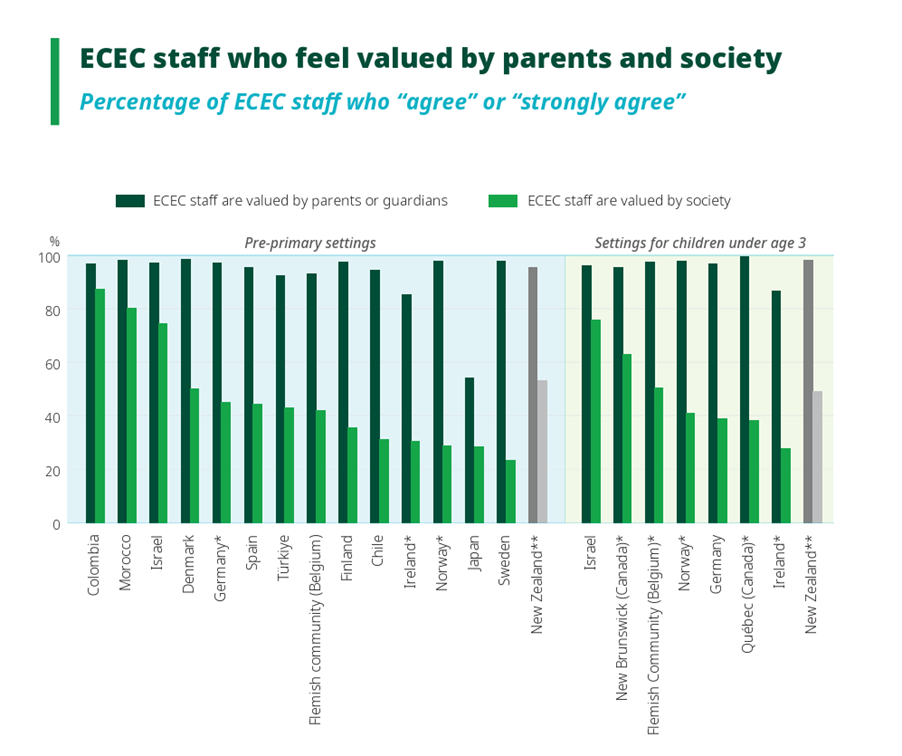
“By Andreas Schleicher, OECD Director for Education and Skills In Early Childhood Education and Care (ECEC) settings across the world, staff are greeted each morning with hugs, smiles, laughter and occasionally some tears. Nearly universally, they are admired by children and appreciated by parents. Yet, despite this near daily affirmation of their importance, many ECEC staff believe they are not valued by society. This lack of recognition is a threat to the sector’s long-term vitality. Breaking down the data, the OECD’s TALIS Starting Strong report shows that more than 80% of ECEC staff in all countries, except Japan, feel valued by parents or guardians in both pre-primary and under-3 settings. Likewise, close to 100% of staff feel valued by children, except in Japan (65%). However, perceptions shift dramatically when it comes to societal recognition. Across all countries, the share of staff who feel valued by society is significantly lower. While at least seven out of ten staff feel valued by society in pre-primary settings in Colombia and Morocco, and in Israel for both levels of ECEC, the share drops below one in three in pre-primary settings in Chile, Japan, Norway and Sweden, and in Ireland for both levels of ECEC. One reason for this contrast is the nature of daily interactions. ECEC staff often feel appreciated by parents and children because they communicate regularly, forming strong personal bonds and delivering visible, immediate impact. But beyond the walls of ECEC centres that recognition fades. In many societies, ECEC staff are perceived as caregivers rather than skilled professionals. Low pay, and limited public visibility or recognition, also leaves many staff feeling undervalued by the broader community. That said, it is interesting to note: most ECEC staff feel more valued by society than teachers in lower secondary schools. For example, in the Flemish Community of Belgium, Israel, Spain and Türkiye, ECEC professionals are twice as likely as high school teachers to report feeling valued by society. Even so, the overall findings raise concerns. When ECEC professionals do not feel valued or recognised, it becomes harder to attract and retain skilled staff. This is particularly true when low societal prestige is coupled with widespread dissatisfaction over pay. All these factors contribute to staffing shortages, high turnover and reduced morale, which directly impact the consistency and quality of education and care that children receive. The underappreciation of staff perpetuates the notion that working with young children is low-skilled, despite its critical developmental importance. The data show that ECEC staff who feel less valued by society tend to have more years of experience and higher educational qualifications. We can not say for sure, but ECEC settings are potentially losing some of their best staff due to dissatisfaction. When people feel unsupported – regardless of their profession – they can be less inclined to innovate, pursue training or stay in their jobs. Staff shortages are the main cause of lower quality education and care environments, according to ECEC leaders. In some countries, staffing problem are particularly bad. For example, in Germany and Norway (both levels of ECEC) and in Ireland and New Brunswick (Canada) for under-3 settings, more than half of centres struggle to maintain quality, citing a lack of staff for the number of children enrolled or frequent absences. In terms of solutions, increased funding is often discussed. But raising salaries is not an easy option for countries facing tight budget constraints. And while policymakers have long acknowledged the importance of the early years in shaping lifelong outcomes, investment in the workforce has lagged behind the rhetoric. Policymakers should consider ways of improving pay and elevating the status of ECEC professionals as a strategic imperative. One effective approach is to introduce a more diversified and structured career framework. By defining a broader range of roles – such as lead educators and family engagement coordinators – governments can create clear pathways for professional growth. Each role could come with progressively higher levels of pay, autonomy and responsibility, reflecting the complexity and impact of the work. This kind of tiered system not only incentivises ongoing professional development but also helps to elevate the status and standards of the sector. Countries and subnational entities like Colombia, the Flemish Community of Belgium, Morocco and Spain have somewhat managed to achieve these goals in pre-primary education, where staff are less likely to consider leaving the sector entirely. Instead, they often aspire to leadership or primary teaching roles. Notably, in these countries, staff also report feeling more valued by society and stronger satisfaction with salary. Given the highly gendered workforce, absences due to maternity leave and family caregiving are also more frequent than in many other sectors. To mitigate this, systems can invest in pools of qualified replacement staff. At the same time, efforts should be made to encourage more men to take up the profession, helping to balance gender representation. Public awareness campaigns and policy narratives can play a role in reinforcing the societal importance of ECEC professionals. In addition, broader policy measures – such as designing more flexible parental leave for both mothers and fathers – can lead to more equal sharing of parental caregiving responsibilities. Taken together, these strategies can help build a more resilient and valued ECEC workforce. * Estimates should be interpreted with caution due to a higher risk of non-response bias. New Brunswick (Canada)* Flemish Community (Belgium)* Norway* Germany Québec (Canada)* Ireland* ** Data only represent respondents included in the sample and not the population targeted by the survey. For more information, see Annex B. Source: OECD (2025), TALIS Starting Strong 2024 Database, Table D.8.2. This blog is based on a chapter from the TALIS Starting Strong 2024 Insights and Interpretations brochure: talis3s2024-insights-interpretations.pdf . The Starting Strong Teaching and Learning International Survey (TALIS Starting Strong) assesses the issues impacting early childhood education and care (ECEC). In 2024, it surveyed the ECEC workforce in under-3 settings and in pre-primary settings, which typically care for children aged 3-6, in a total of 17 countries and subnational entities .
Original story
Continue reading at OECD Education
oecdedutoday.com
Summary generated from the RSS feed of OECD Education. All article rights belong to the original publisher. Click through to read the full piece on oecdedutoday.com.

