
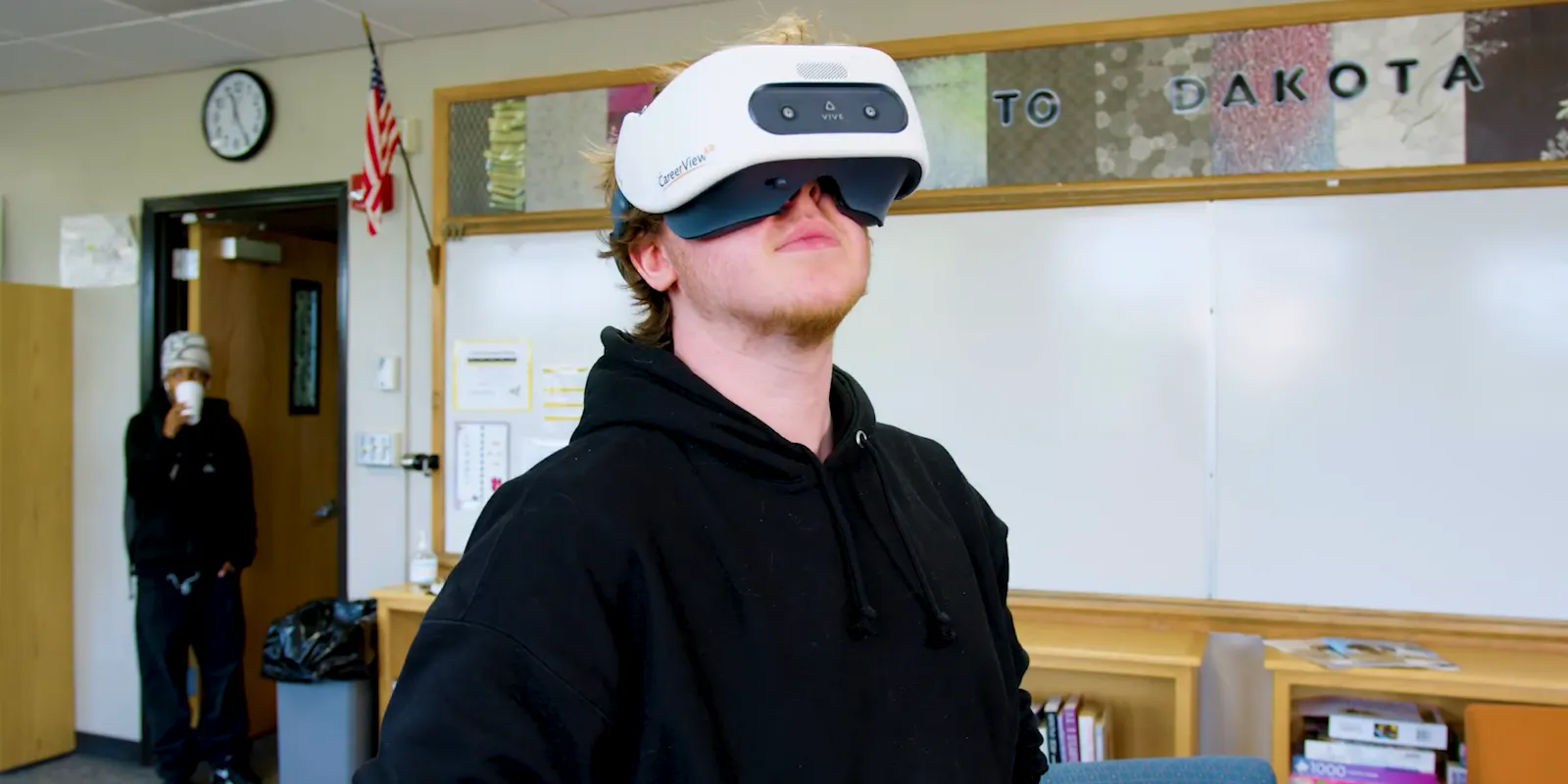
“As one fourth grader peers over the top of a 300-foot-tall wind turbine, a classmate stands next to surgeons operating in an emergency room. Nearby, another fourth grader shuffles through an autobody shop. They are not visiting high-risk job sites, at least not in real life. These experiences are the result of a series of investments into virtual reality in North Dakota. The state hopes that putting VR headsets with career-focused software in classrooms will eventually boost local employment. While many schools across the country are looking to limit screen time , North Dakota is pushing for increasingly younger students to use these digital tools. Because North Dakota is largely rural, students’ face significant travel hurdles to visit job sites that could be several hours away, says Mackenzie Tadych, director of Northern Cass School’s college career and readiness program. The VR investment "was an attempt to engage students at an earlier age and develop an awareness of [the careers] the state has to offer,” says Wayde Sick, state director for the Department of Career and Technical Education. “This is the first glance to show what is out there without throwing a bunch of students on a bus where you drive two hours for a field trip and two hours back.” Tech to Supplement Lower Resourced Areas In North Dakota, the virtual reality program works directly with employers in the state in an effort to bring awareness to careers and fields students may be unfamiliar with or have misconceptions about, such as manufacturing. The statewide program first started in 2023, after the North Dakota state legislature passed a bill that allotted a half-million dollars to the state's Department of Career and Technical Education to purchase virtual reality headsets that would be used by middle and high schools. Late last year, that was expanded to all elementary schools in the state. While more traditional career exploration modes – like career aptitude tests – are still used, VR is a way for more children to literally visualize potential new careers. The initiative, which is an expansion on the RUReady ND career exploration program, offers 118 different modules for students through Fargo-based CareerViewXR. Ann Pollert, a career exploration coach, has a mobile van that visits schools at every level throughout six counties in the northeastern part of the state. Her bus is outfitted with seven headsets and she works on average with five students at a time, helping find their interests and guiding them through the modules. “I would go into classroom after classroom and give a 50-minute spiel, but they had no visual,” Pollert, a former diesel technician recruiter, says. “With this, I could take it to the school and show those kids what it means to replace an excavator. It helps me identify the students I need to further encourage.” add caption here She says the headsets as a whole are not meant to replace guidance or career counselors, particularly in high schools. As those counselors find themselves with increasingly higher workloads and less time , this is seen as a supplement. “We still need career counselors, work-based learning counselors and great teachers that notice something about a student, saying, ‘You would be good at this,’” Pollert says, adding that some smaller schools do not have the resources for those counselors. “It’s everything together to make it work. It’s not the van that’s solving the problem.” So, is it working? Future Tech — And Potential Sick, the state director, says it’s too early to measure the impact of these programs, including whether it’s increased the number of students staying in the state to work post-graduation. Most of the efforts are focused on students who have yet to graduate high school, he points out. But he does believe this program serves as a starting place for younger students to explore their interests at an early age. “In my eyes, this content is most important for elementary and middle school-aged kids, so the high school students have seen those experiences, have an idea of what they want to pursue and can do so in a series of courses based on what they have seen in virtual reality as a fifth or sixth grader,” he says. Students in North Dakota can explore lesser known careers, like veterinary technician and manufacturing engineer, in the new initiative. Provided/CareerViewXR Sometimes in VR, the students find what they dislike. Tadych, of Northern Cass School, recalls a student vehemently reacting to a virtual reality module that placed them in a high-stress operating room. “It’s just as beneficial being able to find what you don’t want to do,” she says, adding that the district also requires students to job shadow before graduation, following around professionals as they go through their work day. And as the VR experiences get more lifelike, students will get more useful information about possible careers. For example, Sick believes the technology could evolve down the road to include augmented reality, where students would be able to more fully interact with their environment. He believes the interactions will not only alert children of more local career opportunities, but keep them in the state upon graduating. “We’re a rural state, and my goal is to make sure every student has the best experience they [can] have, to find what they should become, and try to help them figure it out sooner,” he says. He adds that the only way to do that is to provide a rich variety of experiences that start at the elementary level.
Original story
Continue reading at EdSurge Tech
edsurge.com
Summary generated from the RSS feed of EdSurge Tech. All article rights belong to the original publisher. Click through to read the full piece on edsurge.com.
