
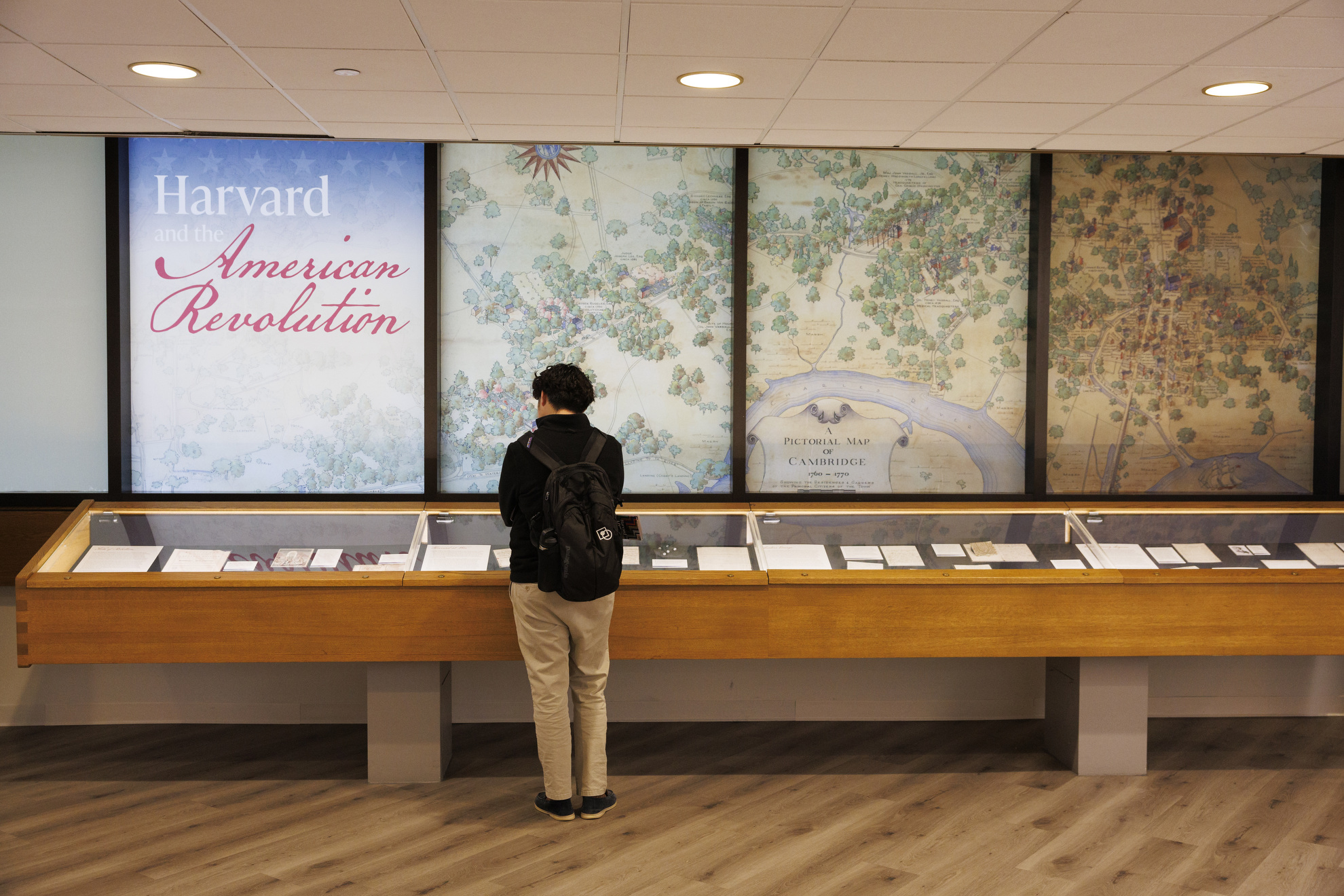
“Nation & World Walking in Harvard’s ‘Revolutionary footsteps’ A visitor looks at the materials on display at Pusey Library. Photos by Niles Singer/Harvard Staff Photographer Liz Mineo Harvard Staff Writer April 24, 2026 4 min read Exhibit traces University’s role in America’s birth — from campus barracks to Founding Father alumni Minutes from a 1775 Harvard faculty meeting describe a commotion caused by students protesting the drinking of India tea at breakfast, a not-too-distant echo of the Boston Tea Party of 1773. An official document asks for financial reparations, listing damages to the College caused by the Continental Army’s military occupation. A page from a 1766 annotated almanac used by Harvard math and philosophy professor John Winthrop and his wife, Hannah, notes the “glorious news” that the “horrid Stamp Act” had been repealed. These documents are part of the exhibit “ Harvard and the American Revolution ,” which explores the University’s participation in the nation’s struggle for independence. Launched to commemorate the 250th anniversary of the Declaration of Independence, the exhibit displaying objects, letters, and official documents from the Harvard University Archives is on view at the Pusey Library through Dec. 18 and available digitally . “What we have here is Harvard’s history,” said Sarah Martin , associate University archivist for community engagement at Harvard University Archives. “From our collection, we are able to look at exactly what students and administrators at the time were going through during this incredible moment of upheaval and change. The exhibit looks at the past and what happened even before the Revolution, what happened during the war, and how this moment in time continued to influence and inspire this campus today.” The exhibit begins with the years 1760-1775, during which Harvard became a center of new ideas that fostered the seeds of revolution against Great Britain. Many of its graduates joined the revolutionary movement, among them Samuel Adams (A.B. 1740, A.M. 1743) and John Hancock (A.B. 1754), who would lead the Sons of Liberty to oppose British rule in the colonies. The display includes a broadside from 1758 that mentions John Adams (A.B. 1755), whose master’s thesis address in 1758 spoke on the necessity of a civil government. John Winthrop’s 1775 annotated almanac. A detail from the almanac, which notes the Battle of Bunker Hill. A letter by Harvard tutor Caleb Gannett to Harvard Proessor Edward Wigglesworth. An engraved view of the College created by Paul Revere (1767). The honorary degree awarded to George Washington in 1781. By the time the “shot heard round the world” in the April 1775 Battles of Lexington and Concord marked the official start of the Revolutionary War, Harvard was involved in the independence effort. By May, Gen. George Washington’s Continental Army arrived in Cambridge and occupied campus as military encampments. During his stay in Cambridge, Washington lived at Wadsworth House, the residence of Harvard’s president, as well as at Longfellow House. The Continental Army occupied Hollis Hall, Massachusetts Hall, and Harvard Hall, among other buildings, as barracks and military offices. Harvard students were evacuated and moved to Concord. Documents from the era demonstrate the impact of the war on students, faculty, and administrators. The exhibit displays Winthrop’s almanac, in which he and his wife noted the Battles of Lexington and Concord, their move to Concord, the Battle of Bunker Hill, and a meeting with Washington. A letter written by Harvard tutor Caleb Gannett (A.B. 1763, A.M. 1766) to Professor Edward Wigglesworth asks for help when his return to Cambridge was upended by the Siege of Boston. Dated May 2, 1775, the letter reads, “I am told that all business is at an End at the College — that the Buildings are occupied for Barracks … am anxious about the things I left in my Chamber — hope such care has been taken care of them as that they are safe.” The exhibit ends with a reflection on the years after the Revolution. Eight Harvard graduates signed the Declaration of Independence: John and Samuel Adams, Hancock, Elbridge Gerry (A.B. 1762, A.M. 1765), Robert Treat Paine (A.B. 1749), William Ellery (A.B. 1747), William Williams (A.B. 1751), and William Hooper (A.B. 1760). A second part of the display highlights buildings that were used during the Revolutionary War that are still standing. More than 1,500 soldiers occupied the University grounds, including Massachusetts Hall, Hollis Hall, and Holden Chapel, between April 1775 and March 1776 during the Boston siege. A walking tour connecting all those buildings is in the works, said Martin. “What I’m hopeful can be taken away is the connection from the past to the present,” said Martin. “What we’re hoping people, including students, will do is walk in these Revolutionary footsteps as they walk around campus. We hope that it gives folks some connection to what they’re seeing outside, but also to understand the history underneath their feet.”
Original story
Continue reading at Harvard Gazette
news.harvard.edu
Summary generated from the RSS feed of Harvard Gazette. All article rights belong to the original publisher. Click through to read the full piece on news.harvard.edu.

