
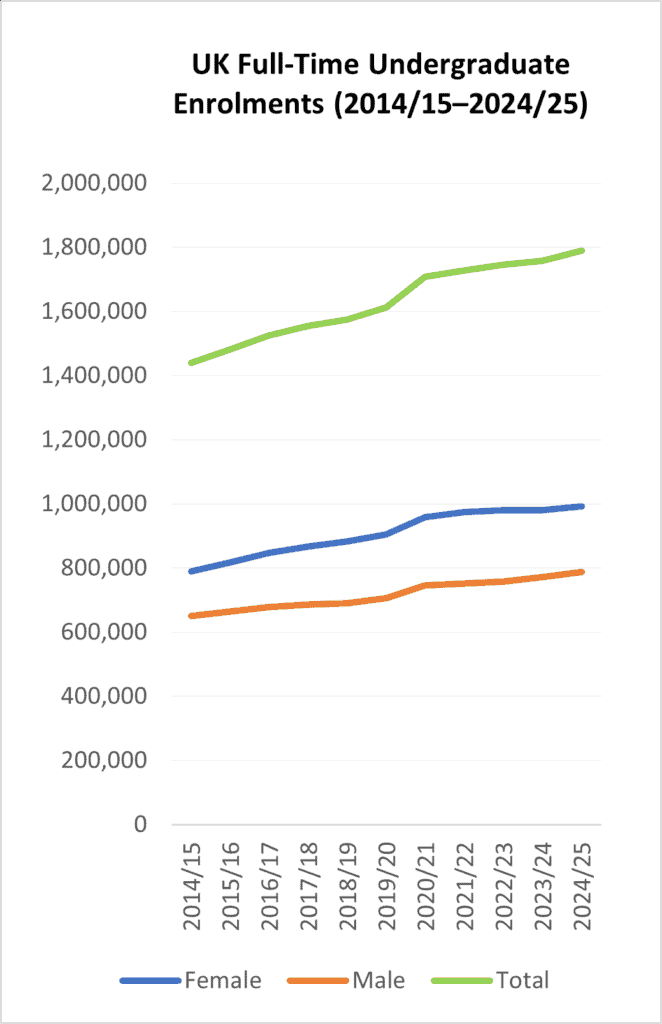
“This blog was kindly authored by Dr Fadime Sahin Senior Lecturer at University of Portsmouth, London. Some universities enrol far more women than men; others show the reverse. These differences are striking, but they follow a clear and consistent pattern: institutional gender profiles largely reflect students’ subject choices . My analysis of the latest Higher Education Statistics Agency (HESA) data shows that while the UK’s undergraduate population has expanded significantly over the past decade, its gender profile has remained strikingly stable. Full-time undergraduate student numbers rose by nearly a quarter, from around 1.44 million in 2014/15 to 1.79 million in 2024/25. Yet, women have outnumbered men every year. In 2024/25, women accounted for 55% of all full-time undergraduates, compared with 44% of men. This balance has changed little since 2014/15, even as the system added around 350,000 students. Growth has also been uneven: female enrolment increased by 26% over the decade, compared with 21% for men. The pandemic surge in enrolments did not materially alter the gender balance. By 2024/25, there were around 200,000 more women than men in full-time undergraduate study. Business and Management – the largest subject area in UK higher education – has played a major role in holding the overall gender balance steady. Over the decade, female enrolment in Business and Management grew by around 51%, but male enrolment rose by nearly 81%. Because this subject recruits more students than any other, its faster male growth has offset the gains women have made in smaller or mid‑sized disciplines, helping to keep the sector-wide gender split unchanged. Source: HESA Dashboard (2026). Author’s own compilation and analysis. Source: HESA Dashboard (2026). Author’s own compilation and analysis. To ensure comparability, the provider-level analysis below includes only institutions with at least 1,000 full-time undergraduates. Among 155 such providers, fewer than one in five enrolled more men than women. Only a small minority recorded strongly male-majority cohorts, with the highest male share reaching just over 60%. Smaller specialist providers are considered separately where relevant, particularly in subject-specific analysis. Design, and Creative and Performing Arts The gender profile of specialist art institutions is remarkably consistent. Large providers such as the University of the Arts London (76%), the Arts University Bournemouth (68%) and Goldsmiths, University of London (64%) enrol substantial female majorities. For Norwich University of the Arts, Arts University Plymouth, Leeds Arts University and Glasgow School of Art, the range is between 67–70% female. A small number of institutions diverge from this pattern. The University for the Creative Arts, as a large provider, sits at parity. Falmouth and BIMM University are also closer to gender balance, while Ravensbourne was 44%. The same pattern holds across smaller art schools, with fewer than 1,000 students. Institutions including the Royal College of Art, the Royal Academy of Dramatic Art and the Courtauld Institute of Art, enrol substantially more women than men, except for the Liverpool Institute for Performing Arts, which has 54% women. Source: HESA Dashboard (2026). Author’s own compilation and analysis. Subject-level data reinforces the point. Across the past decade, “ Design, and Creative and Performing Arts ” has remained predominantly female, with women accounting for around 62% to 64% of students each year. Despite fluctuations in overall enrolment, this balance has barely shifted, underlining the persistence of gendered subject choice within the creative disciplines. Art, Design Studies, Drama and Dance all show a persistent female pattern, with figures ranging from 68% to as high as 88%. Yet this pattern is not uniform. Cinematics and Photography have remained close to gender parity over the past decade. Music shows a more mixed pattern. In 2024/25, women accounted for 46% of full-time undergraduate Music students, up from 37% in 2014/15, while the male share fell from 63% to 53%, suggesting a notable shift over the decade. While most conservatoires and specialist music schools fall below the 1,000‑student threshold, their gender patterns are consistent enough to warrant comment. Elite institutions such as the Royal Academy of Music, Royal Northern College of Music and Guildhall School of Music and Drama, sit very close to gender balance. By contrast, institutions with a focus on Dance, Musical Theatre and Performance such as the Royal College of Music (55%), International College of Musical Theatre (80%), Trinity Laban Conservatoire of Music and Dance (58%) and Royal Conservatoire of Scotland (58%), reflect a wider pattern in the performing arts, where women are significantly over‑represented in Dance and Musical‑Theatre Training. A different pattern emerges in more technical and contemporary areas of music. The Institute of Contemporary Music Performance (60%), Point Blank Music School (77%) and Leeds Conservatoire (58%) are strongly male dominated, pointing to a male majority in more technical and production-focused areas (e.g. music production, sound engineering, DJing ). This institutional pattern aligns with the national picture : across full-time undergraduate music courses, women made up 46% of students in 2024/25, up from 37% in 2014/15, indicating a gradual shift towards greater gender balance in the subject overall. Overall, the variation within the Arts is as striking as the imbalance itself: while Dance remains overwhelmingly female, Cinematics and Photography sit near parity, and Music is gradually moving in that direction. This suggests that even within a broad subject area, gender patterns follow specialisation more closely than institution. Healthcare Healthcare remains a gender‑polarised subject area in UK higher education. Women form the majority of full-time undergraduate students in Medicine. On the subject level, the share of women in Medicine, Dentistry and Medical Sciences ranged from around 62% to 77% in 2024/25. Beyond Medicine, the imbalance becomes even more pronounced. Nursing, Midwifery, Allied Health Professions and Psychology are overwhelmingly female, often exceeding 80% or even 90% women. Related fields such as Social Work, Childhood Studies and Counselling display similarly skewed profiles. This is evident even in adjacent disciplines: at the Royal Veterinary College, women accounted for around 83% of just over 2,000 students in 2024/25. Institutional patterns largely reflect this distribution. Providers with large health portfolios consequently appear strongly female-majority, reflecting the subjects they deliver. Source: HESA Dashboard (2026). Author’s own compilation and analysis. STEM Subjects STEM remains male dominated overall, but the degree of imbalance varies by discipline. Engineering and Technology and Computing remain the most male-segregated fields, ranging from 78% to 85%, while Mathematical Sciences rose from 62% in 2014/15 to 66% in 2024/25. Across the Physical Sciences, the gender gap narrows, with men accounting for around 53% of students, down from 63% in 2014/15. When we examine each discipline closely, there are significant differences. Physics and Astronomy remain strongly male dominated, while subjects such as Forensic Science and Archaeology are female majority. Chemistry sits close to parity in 2024/25. This pattern is reflected at the institutional level. Providers with Science, Engineering and Computing cohorts – including Imperial, Heriot‑Watt, Loughborough, Brunel, Lancaster, Aston and the University of Bath – all recorded male student shares of around 55–61% in 2024/25. Growth across STEM subjects has been uneven. Computing has expanded rapidly over the past decade, with female enrolment growing by almost 160% and male enrolment by around 70%. Yet, the subject remains predominantly male. Engineering and Technology have also seen strong female growth in enrolments (around 44%), but this has not been sufficient to shift the overall gender balance. Across subject areas, female participation has increased in several disciplines over the past decade, particularly in parts of STEM, while remaining stable or already high in fields such as Health, Education and the Social Sciences. However, subject-level comparisons between 2014/15 and 2024/25 show movement in both directions: in Physical Sciences, the female share rose from 37% to 46%, in Computing from 15% to 21%, and in Engineering and Technology from 16% to 21%. In Mathematical Sciences, it fell from 38% to 33% and in Business and Management from 49% to 44%, leaving the overall gender balance largely unchanged. Institutions with large Engineering and Computing cohorts tend to have more male-dominated student bodies. Source: HESA Dashboard (2026). Author’s own compilation and analysis. Education and Teaching Education and Teaching mirror the pattern observed in Healthcare and the Creative Arts. Over the past decade, women have consistently represented the vast majority of students in these fields, ranging from 84% in 2014/15 to 88% in 2024/25. This reinforces the extent to which subject choice shapes gender composition in UK higher education. It is also worth noting that participation in Education and Teaching has declined markedly over the past decade: female enrolment has fallen by around a third since 2014/15, compared with a drop of more than half among men. The decline in participation also illustrates that gender imbalance is not synonymous with growth or decline; it is often a structural feature of the subject area itself. Russell Group The same dynamic is evident among research-intensive universities. Most Russell Group institutions have a relatively narrow band of female-majority enrolment, typically between the low-50s and mid-60s. King’s, Edinburgh, Leeds, Cardiff, Glasgow, Queen’s University Belfast, Liverpool, UCL and York, all sit at the top of the range, typically between 57–64%. Oxford, Cambridge, Sheffield, Southampton and Warwick also sit near parity, each with around 48–51% female students. Those with strong representation in Biosciences, Psychology, Social Sciences and Humanities tend to sit at the upper end of this range. Institutions with a heavier concentration in Engineering, Computing and Physical Sciences move closer to parity – or, in some cases, into male-majority territory. Imperial College London stands out as the clearest example, with a 61% male student body, driven by its heavy concentration in Engineering and Technology, Computing and Physical Sciences. This pattern reinforces a broader trend: Russell Group universities appear male‑ or female‑majority largely in line with the subjects they specialise in, without indicating a distinct institutional effect. A system structured by subject choice Across UK higher education, gender imbalance appears as a structural outcome of subject‑level participation. Those with large cohorts in Health, Education and Creative Arts tend to enrol more women, while those focused on Engineering and Computing tend to enrol more men. This helps explain the system’s remarkable stability. Despite significant expansion in student numbers, the overall gender balance has barely shifted over the past decade. Men and women continue, in aggregate, to enter different fields of study. Meaningful change depends on widening participation within specific disciplines. Without shifts in subject‑level pipelines, institutional gender profiles are unlikely to change. Get our updates via email Enter your email address to subscribe to this blog and receive notifications of new posts by email. Email Address Subscribe The post WEEKEND READING: Subject choice shapes gender balance across UK universities appeared first on HEPI .
Original story
Continue reading at HEPI Blog
www.hepi.ac.uk
Summary generated from the RSS feed of HEPI Blog. All article rights belong to the original publisher. Click through to read the full piece on www.hepi.ac.uk.
