
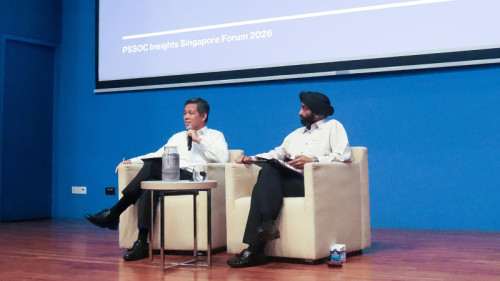
“In a time of heightened geopolitical tensions and declining multilateralism – when some states are turning to might and power to intimidate and conquer – the danger of destabilisation has become imminent. How, then, should Singapore safeguard itself in such an uncertain and rapidly changing world? For many, the answer lies in strengthening our defence capabilities – purchasing more weaponry or building up our reserves in preparation for crises. However, by prioritising the “how” in defence, we may risk overlooking a more fundamental question: what exactly is Singapore defending, and why? This question was central to the discussions raised at the recent Insights Singapore Forum (ISF) themed “The Future of Singapore’s Total Defence”. Organised by the NUS Political Science Society (PSSOC) , this year’s forum presented students with the opportunity to engage in dialogue with Mr Chan Chun Sing, Singapore’s Coordinating Minister for Public Services and Minister for Defence. Throughout the dialogue, participants reflected on how this question – ‘What exactly is Singapore defending, and why?’ – has become more pressing as the country navigates a more complex security environment shaped by geopolitical rivalry, economic uncertainty, technological disruption and non-military threats. A recurring theme was the continued relevance of Total Defence: the idea that national defence is not just the military’s job, but a whole-of-society effort in which everyone helps keep Singapore secure, resilient, and united in the face of threats and crises. While the concept remains central to Singapore’s security approach, participants noted that its messaging may not resonate with younger Singaporeans in the same way it once did. In a society further removed from the vulnerabilities of the independence era, questions have also been raised about whether newer generations would fully grasp what is at stake in ensuring the nation’s sovereignty, resilience and survival. The conversation also broadened the meaning of defence beyond the military domain. Questions and comments touched on identity and belonging, the impact of inequality on social cohesion, the resilience of defence supply chains, the role of technology such as AI in safeguarding economic security, and the need to prepare for cyber and infrastructure attacks alongside conventional threats. Participants explored what it means to defend Singapore, with the conversation extending beyond territory and institutions to include values, way of life and a shared commitment to the nation’s future. There was also reflection on how new citizens can be more meaningfully integrated into Singapore’s broader defence ecosystem, and on how national participation in defence may evolve over time. The discussion ultimately concluded that defence was not only a matter of hardware, strategy or geopolitics, but also of identity and resolve. The question posed was not just what Singapore is defending, but whether each generation is prepared to choose Singapore out of conviction rather than convenience. In that sense, defence was framed not simply as military readiness, but as the collective will to protect a shared way of life and to ensure that future generations can continue to call themselves Singaporean. Incoming NTU undergraduate, Mr Soon Fung, who attended the forum, shared that the event helped him better understand the hard work of previous and current generations that shaped Singapore today, and the delicate balance that Singapore treads daily to safeguard its right to exist. Another participant, Ms Mikayla Tng, a second-year student majoring in Political Science at the NUS Faculty of Arts and Social Sciences, echoed his comments, noting that Minister Chan raised intriguing insights and prompted her to think harder about what it really means to be a Singaporean and the realities of national security from a civilian’s perspective. Ms Faustina Tan, 57th President of PSSOC and a Year 2 Political Science student, said, “Minister Chan’s candid communication style encouraged the youth to reflect on the core meaning behind being a Singaporean, not just in name, but in spirit. In today’s volatile times, such reflections are both crucial and necessary in helping us, as a nation, to discern our priorities and unite as one. Only then will we have the strength to withstand the test of time and progress towards SG100.” By the NUS Political Science Society at the NUS Faculty of Arts and Social Sciences
Original story
Continue reading at NUS Newsroom
news.nus.edu.sg
Summary generated from the RSS feed of NUS Newsroom. All article rights belong to the original publisher. Click through to read the full piece on news.nus.edu.sg.


