
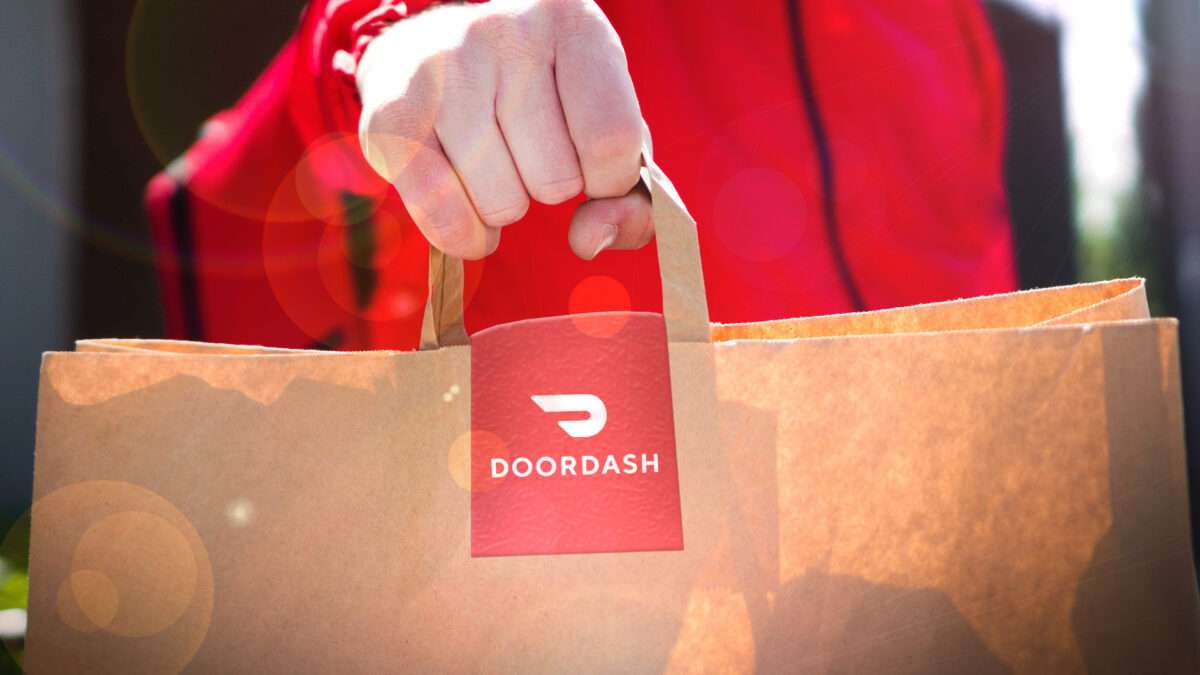
“Who's failing at frugality? Though it's sort of lame to bring online discourse into newsletter format, this made the rounds earlier this week and is worth pushing back on: This is bc they do not have the time or capacity to create home cooked meals. It's an issue countless ppl have tried to raise w leftists but big leftists online continue to shame/abuse poor ppl for being forced to rely on these services for meals, which act as a tax on the poor https://t.co/F3azUiucBJ — Taylor Lorenz (@TaylorLorenz) May 20, 2026 It's wrong on a few levels. Poor people are not "forced" to rely on food delivery. Something voluntarily chosen should not be described as "a tax on the poor." If poorer people are routinely choosing more expensive food delivery vs. cooking at home, then it is possible that they are partially to blame for their plight. But the actual truth of the chart matters, and it's suspect at best: Ok, let's settle down folks, and let's care about sourcing, yeah? Turns out this is from credit card data from one British Columbia credit union that markets itself as championing progressive values. You'll be much more informed in the era of AI if you use it to check stuff. https://t.co/IS1js7sqlh — Scott Winship (@swinshi) May 20, 2026 Many people have used this discourse cycle to argue that Gen Zers don't know how to scrimp and save and budget and grocery shop and cook and instead rot their brains watching three hours of TikTok a day. Others have argued that inability to cook for oneself is possibly more related to psychological problems than anything else (which is something I buy): But if you regularly feel unable to cope enough to obtain basic foods and eat them, that's a psychiatric problem, not an economic one. You needn't even cook: open a can of tuna, add mayonnaise, microwave frozen peas; add extra veggies and deli chicken to pot noodles, etc. 2/ — Iona Italia, PhD (@IonaItalia) May 21, 2026 A few months ago, Milan Singh and Josh Kalla from The Argument did crunch a bunch of data "on food delivery spending from an anonymized dataset derived from a major debit and credit card-network panel that captures billions of transactions annually from 39 million individuals across hundreds of merchants," which they then merged "with population estimates from the American Community Survey's five-year microdata (from 2019 through 2023), which allowed us to calculate per-capita spending rates." They found that those who earn less than $50,000 tend to spend the most on food delivery and that these trends—when broken out by age, per their dataset—are actually more of a millennial phenomenon than a Zoomer one. "The people who order the most DoorDash aren't the very young; they're people in their early 30s to early 40s," Singh and Kalla write . "More specifically, they're people in their 30s and 40s who don't make very much money." It shouldn't be shocking that relatively low-income people in their 30s and 40s are often bad at delayed gratification. But some of them probably also perceive that scrimping and saving can be rather futile when the economy looks the way it does. Put differently: In general I think there's something fairly corrosive about living in a world where all material goods are extremely cheap compared to housing and healthcare, because it feels completely futile to be frugal on the small stuff. https://t.co/3RFAeGTF5o — Kelsey Piper (@KelseyTuoc) May 19, 2026 This too: There are four major costs that are killing the American middle class, *regardless* of how well or poorly the economy is doing generally: healthcare, education, childcare, and housing. When utilities and food spike, or unemployment goes up, that just takes people from barely… https://t.co/E11Pj6sFuj — Inez Stepman (@InezFeltscher) May 20, 2026 The decline in cooking at home might have to do with the fact that food prices have risen with inflation over the last few years, such that grocery shopping is no longer as much of a deal compared to pre-made food. And it might also have to do with choices surrounding family formation: Millennials have chosen to get married and start families way later in life than preceding generations, so the median 30-year-old might not have a family to cook for. I don't think aggressively relying on food delivery if you're making under $50,000 a year is a correct choice, but it is a cultural phenomenon worth understanding for the ways it might galvanize political support for more handouts down the road. Scenes from New York: A deep dive into Jalen Brunson's beautiful ball-sharing that helped the Knicks absolutely destroy the Cavaliers last night. Where you watching the Knicks games? pic.twitter.com/i5lNzYn6aq — Nancy Rommelmann (@NancyRomm) May 22, 2026 QUICK HITS "More than 65 years after the confiscation by Cuba's communist government of assets owned by U.S. businesses there, the Supreme Court on Thursday ruled in favor of a U.S. business that is seeking to recover for its losses under a 1996 law that targets the Cuban regime," reports SCOTUSblog . "By a vote of 8-1, the justices ruled in Havana Docks Corporation v. Royal Caribbean Cruises that Havana Docks, a U.S. company that before 1960 had owned a right to use and operate the docks in the port of Havana, is potentially entitled to receive hundreds of millions of dollars for the use of the port by cruise lines between 2016 and 2019, even if the company's control of the docks would have expired in 2004." This week, Republicans in the House decided to cancel a vote on a resolution introduced by Democrats that would have ended the war in Iran, because they did not have enough votes to defeat it. Oura, the company that makes the Oura Ring, prepares to go public . Oura Rings measure your steps, body temperature, and heart rate. I, for one, am watching the "fitness wearables" category and am very curious to see how this IPO goes. NASCAR driver Kyle Busch just died at 41. Stephen Colbert's show finally ended . I'll shed no tears when boring late-night "comedy" TV fully dies. Why have hotel rooms across price points all started to look the same ? A quiz from Bloomberg. The post Who Abuses Food Delivery? appeared first on Reason.com .
Original story
Continue reading at Reason
reason.com
Summary generated from the RSS feed of Reason. All article rights belong to the original publisher. Click through to read the full piece on reason.com.
