
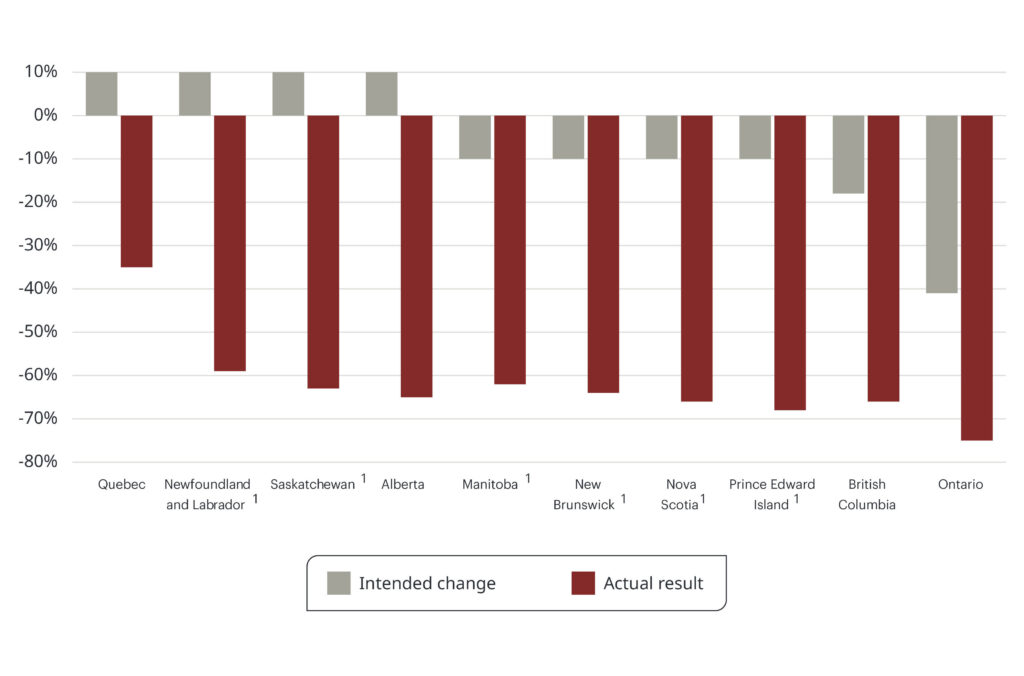
“Inside Cape Breton University’s Great Hall, the blue-and-white crossed flag of Nova Scotia is surrounded by dozens of other flags forming a quiltlike patchwork: China, Greece, Egypt, Liberia, Nepal, Turkey, Ghana, Switzerland, Italy, Lebanon, Mozambique and Jordan. The display is a celebration of diversity – the culmination of years of effort to recruit and welcome students from around the world into the small university and community of Sydney, N.S. The rise of international students at CBU was dramatic: from 2017 to the fall of 2023, the university tripled its student population from under 900 to nearly 7,000. Eight of 10 new students were international — a crucial part of the effort on Cape Breton Island to sustain its aging population. Islanders are 10 years older than the Canadian average, and much like the rest of the Atlantic region, struggling to cope with a worrying decline in the youth population. “We’re the oldest region in an aging country and it is essential to our sustainability to welcome newcomers. And which better newcomer than international students?” says Victor Tomiczek, CBU’s director of international recruitment and global partnerships. On Cape Breton Island, the population had been declining until 2019, when it finally began to grow again due to international student enrolment and retention at the university. When foreign student enrolment peaked in 2023 after a post-pandemic surge, international students contributed more than $300 million annually to the local economy. Newcomers work everywhere from mom-and-pop shops to national banks and the public service. “Not to mention the unquantifiable wealth of cultural diversity they bring to the Island,” says Mr. Tomiczek. “We were achieving goals in our region – in terms of our population and the needs of our population – and then they just cut our throat.” Cape Breton is a dramatic example of the importance of international students to the immediate and long-term sustainability of smaller communities throughout Canada. For decades, the federal government has identified this cohort as quintessential for maintaining and growing the labour force. As officials wrote in the government’s international education strategy for 2019-2024, these students are “exceptional candidates” for permanent residency: they are young, fluent in at least one official language and have a Canadian education. As a result of joint federal-provincial initiatives including the Atlantic Immigration Program, which matches newcomers and international graduates with jobs that cannot be filled locally, more than 70 per cent of international students who graduate from universities in Atlantic Canada remain in the region. So it came as a shock to many across the Canadian post-secondary education sector when former Minister of Immigration, Refugees and Citizenship Marc Miller announced in 2024 a series of reforms to the program that would place strict requirements on international student entry and cap the number of approved visas. For CBU, the consequences have been disastrous. In the 2023 school year, the university’s undergraduate population stood at 7,148. By the following year, the population was nearly cut down by half to 3,849. That represents a total decrease of 3,299 students of which all but five were international. “We were achieving goals in our region — in terms of our population and the needs of our population — and then they just cut our throat,” says CBU president David Dingwall. A recent report by the Auditor General of Canada on the international student program reforms has affirmed what President Dingwall and many in Canada’s smaller provinces have been saying: that Immigration Refugees and Citizenship Canada failed, despite its mandate to do so, to consider the immigration and economic goals of regions impacted by the reforms. The report further notes that IRCC didn’t adjust for the unintended consequences its reforms have had on these regions – despite having data showing the changes were having an outsized negative impact. “It was written in black and white: that those of us in the Atlantic were outwardly discriminated against by the federal department, and that is totally unacceptable,” says Dr. Dingwall. IRCC projected that decreases in approved study permits would be 10 per cent or less not only in Nova Scotia, but in PEI, New Brunswick and Manitoba, while Saskatchewan and Newfoundland and Labrador were projected to see a 10 per cent increase. Instead, all provinces experience a 59 per cent or greater drop in approvals in 2024 compared to 2023. Change in new study permit approvals (Source: 2026 REPORT OF THE AUDITOR GENERAL OF CANADA TO THE PARLIAMENT OF CANADA: International Student Program Reforms, Based on data from Immigration, Refugees and Citizenship Canada, excluding primary and secondary school applications) “It was clear that IRCC policies weren’t thinking about, to a great extent, the regional needs within Canada,” says Andrew Hakin, president and vice-chancellor of St. Francis Xavier University and chair of the Council of Nova Scotia University Presidents, who also highlighted how far off the department was in their initial projections. “There’s nothing there that suggests that there was a very good handle on where things were going to go.” The auditor general report identified flaws in the allocation model that placed two compounding challenges on smaller provinces. First, spaces were distributed based on population, leaving these provinces with fewer spots. Second, IRCC initially overestimated how many study permit applications it would approve at 60 per cent — a rate it applied uniformly across all provinces, despite having data showing approval rates vary and are considerably lower in Atlantic Canada. This has never been fully explained, according to Ava Czapalay, CEO of the Association of Atlantic Universities, who says that provincial officials struggled to make sense of the reforms. “Sometimes it felt like the people explaining it weren’t all that clear themselves on all of the changes,” she adds. The auditor general found that IRCC “didn’t know why its approval rates were lower than projected,” and did not assess whether its new measures were contributing to the reduction in applications submitted or to lower approval rates. However, in 2025, IRCC provided top-ups to some provinces with fewer than 60 per cent approval rates and changed its approach to adjust for province-specific, data-backed approval ratings. Still, the auditor general writes that “even with the information on emerging impacts on smaller provinces” for 2025, the department “did not give sufficient weight to these impacts” and “did not consider alternative models that did not disadvantage smaller provinces.” That miscalculation has had a seismic impact on Canada’s international reputation as a premier study destination. In 2024, the department forecasted approving 348,900 new study permits but only 149,559 were approved – a 67 per cent reduction from 2023. And in 2025, the department forecasted approving 255,360 new study permits. As of September 2025, only 50,370 were approved. “It was clear that IRCC policies weren’t thinking about, to a great extent, the regional needs within Canada.” Ms. Czapalay says that the overall decrease in study permit applications can be attributed to the perception from prospective students that Canada is no longer welcoming to international students, a widely shared view across the university sector. Not only were there stricter prerequisites — such as a doubling of minimum capital requirement that students need to enter Canada, from $10,000 to $20,000 — but opaque rules and increased bureaucracy that led to confusion. Further, IRCC made it more difficult for students to arrive with their families or partners. “You could imagine, if senior government officials were confused, how international students would have felt,” says Ms. Czapalay, “It’s like Canada just pulled the welcome mat right out from under their feet.” In an emailed statement to University Affairs, Julie Lafortune, communications advisor for IRCC, wrote “It’s important to note that the cap itself has not caused declines in international student numbers. In both 2024 and 2025, provinces and territories did not use all the spaces available to them,” and that “recent changes, such as higher financial requirements, have led to lower approval rates overall.” Universities – whose finances became increasingly reliant on international enrolment, in many cases to offset declining provincial funding, decreased domestic enrolment and government-imposed tuition freezes – continue to make challenging decisions to mitigate the fallout, nearly three years after the initial reforms. Early this year, officials at Memorial University in Newfoundland and Labrador announced the institution would be selling off a number of its properties in St. John’s and the United Kingdom. Acadia University in Wolfville, N.S. cut 31 positions last month after reporting that its international student enrolment had dropped by 56 per cent. Those layoffs included the entire team at the university’s international centre, responsible for assisting new students with adapting to life in Canada. And at Cape Breton Island University, the impact has led to waves of cutbacks: by October 2025, CBU had eliminated over 100 positions and cancelled post-baccalaureate business programs that, according to Dr. Dingwall, were designed to directly align with provincial labour needs. Enrolment declines and program cutbacks have resulted in $77 million in lost revenue. Just weeks ago, the university revised its overall enrolment target to approximately 3,500 and announced the elimination of an additional 50 positions. And, with the exception Nova Scotia students, tuition will be increasing by 3 per cent for professional programs, 5 per cent for undergraduate programs and 5 per cent to the international student tuition fee. Mr. Dingwall says the decisions are necessary for the university’s sustainability, but that the impacts of the student visa cap have already hurt the Island, which is now in population decline. Recent developments in New Brunswick, he notes, underscore how dangerous this can be for the Atlantic region: In April, global credit rating Moody’s downgraded New Brunswick’s fiscal outlook from stable to negative, citing “lower population growth due to stringent federal immigration policies.” The province saw a decline of 64 per cent in approved international study permits. Mr. Tomiczek says that despite the losses, the Atlantic provinces and other rural areas need to continue to welcome international students – not only for the sake of public institutions like CBU, but for their communities. “We have come too far to turn back now.” The post Why have the Atlantic provinces been hardest hit by IRCC’s student visa cuts? appeared first on University Affairs .
Original story
Continue reading at University Affairs CA
www.universityaffairs.ca
Summary generated from the RSS feed of University Affairs CA. All article rights belong to the original publisher. Click through to read the full piece on www.universityaffairs.ca.
