
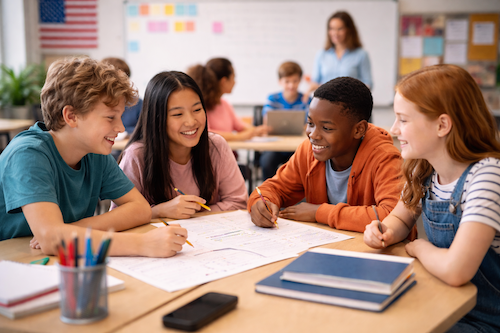
“Key points: When students feel known and valued, conditions for learning become optimal How early cognitive training leads to lifelong brain strength Meeting changing student mental health and behavioral needs For more news on student support, visit eSN’s SEL & Well-Being hub I once met a student who had attended three different schools before arriving at mine. His parents described him in familiar terms: quiet, disengaged, unmotivated. During one of his first classes, a teacher noticed the sketches in the margins of his notebook–detailed drawings of architectural structures and futuristic cities. Instead of redirecting him back to the worksheet, she asked about the drawings. For the first time in years, the student began talking about something he valued. Within weeks, the same student was volunteering ideas and asking deeper questions. Nothing about the curriculum changed. Someone simply saw him. Moments like this reveal something we overlook in education. Walk into almost any school today, and you will hear educators focused on achievement gaps and learning loss. These are important conversations, but there’s another gap shaping student outcomes that receives far less attention. It’s what I call the belonging gap. The belonging gap emerges when students experience school as a place where they’re not fully known, seen, or valued for who they are. In these spaces, learning becomes transactional rather than relational. Students comply–they complete the work and follow directions, but they rarely ask questions, take risks, or connect meaningfully with their learning or the people around them. The student who found success with us didn’t need a new curriculum–he needed to feel seen. Because before students can fully learn, they need to believe they belong. Data suggests this disconnection is more common than many realize. According to Gallup’s national student engagement research, only about half of U.S. students report feeling engaged in school and engagement drops sharply as students get older. Further, r esearch from the CDC on school connectedness shows that students who feel a sense of belonging experience significantly better outcomes. In a national study of more than 17,000 high school students, those who felt connected were nearly twice as likely to report positive mental health (22 percent versus 40 percent) and half as likely to miss school due to feeling unsafe (6 percent versus 11 percent). When students feel known and valued, the conditions for learning become fertile. Curiosity grows. Confidence takes root. Persistence follows. And yet for many students, particularly those who learn differently or develop on different timelines, school can unintentionally amplify disconnection. A student with ADHD may be labeled “unmotivated” when, in reality, they need support with focus, movement, or task initiation. Classrooms that build in flexibility, such as opportunities for movement, varied pacing, or chunked tasks can transform that experience from frustration to success. A student with dyslexia may internalize the belief that they are not capable when reading becomes a daily source of struggle. But when schools provide accessible materials, alternative ways to demonstrate understanding, and explicit skill support, that same student can begin to see themselves as capable and competent. In both cases, belonging is not created through words alone. It is built through the design of the learning experience. The belonging gap is not about the student; it’s about whether the environment is designed to include them. Now, where do you start as a school leader? Closing the belonging gap requires intentional design. Belonging cannot live only in mission statements. It needs to show up in schedules, instructional models, and how success is defined. Schools that cultivate belonging tend to share common practices: Relationships are prioritized: Educators take time to understand students’ strengths, interests, and learning needs–creating a foundation of trust that supports engagement. This can be as simple as starting class with a brief check-in, referencing a student’s interests in a lesson, or following up on something a student shared the day before. Student voice is elevated: Students are invited into the learning process. They have input in how they learn, opportunities to express themselves, and space to share what matters to them. In practice, this might look like offering a choice in how students demonstrate understanding, inviting them to co-create goals, or pausing to ask, “What would help you learn this best?” Strengths are made visible: Schools look beyond deficits and intentionally highlight what students do well, helping students build confidence and identity. This can show up in small moments: naming a student’s progress out loud, showcasing different types of strengths in the classroom, or helping students connect their interests to academic work. These practices send a powerful message: You belong here–and we will help you grow from that starting point. Leaders can begin by asking: Do our educators have the tools, time, and support they need to intentionally create belonging in their classrooms? Which students feel connected–and which students may feel invisible? How flexible are our learning structures? Are we valuing diverse forms of intelligence and growth? When belonging becomes a strategic priority, students take more academic risks, teachers build deeper connections, and schools see gains in engagement, persistence and achievement. When we close the belonging gap, we don’t just open the door. We invite students in. We pull up a chair. We remind them that they’ve had a place here all along. And when students feel that they truly belong, they stop asking, “Do I fit here?” and start asking, “What am I capable of becoming?”
Original story
Continue reading at eSchool News
www.eschoolnews.com
Summary generated from the RSS feed of eSchool News. All article rights belong to the original publisher. Click through to read the full piece on www.eschoolnews.com.