
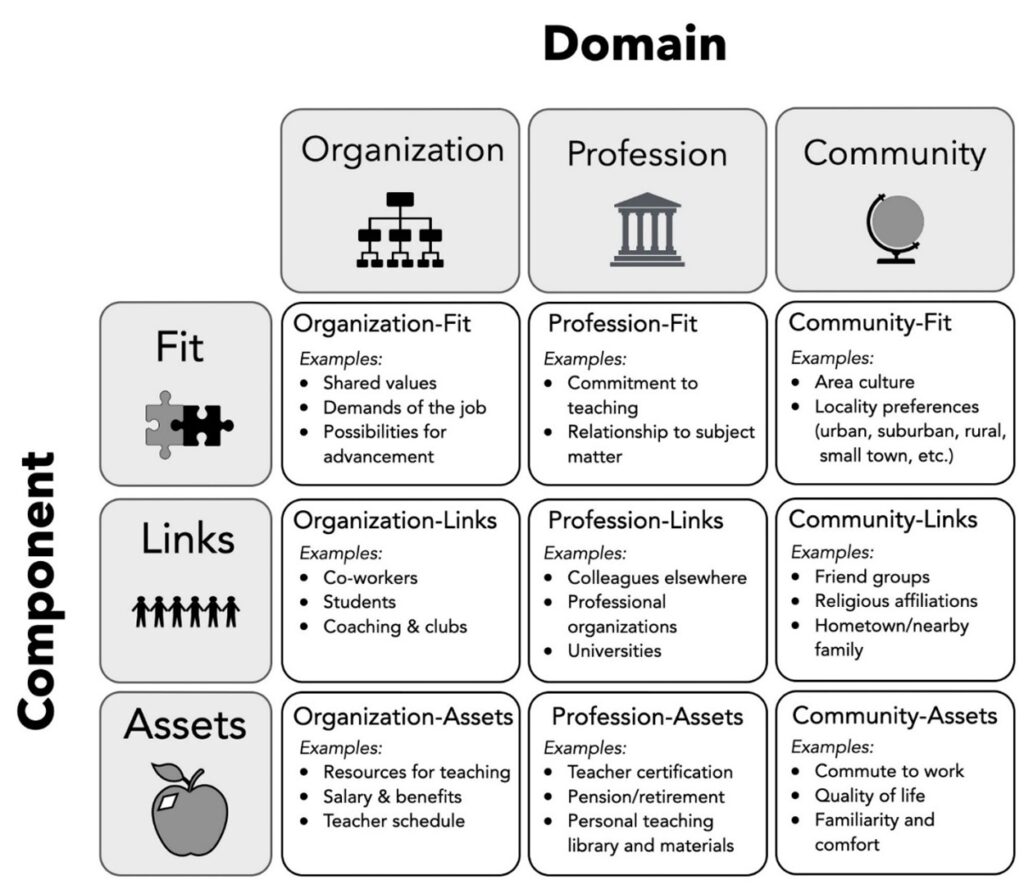
“A study of 13 districts with high retention rates among new science teachers reveals six factors that encourage teachers to stay in their districts and the profession. At a Glance Improving teacher retention is not simply doing the opposite of what causes attrition. Teacher embeddedness is a useful theory for thinking about supporting novice and experienced teachers — and for improving retention. In schools with higher-than-average novice science teacher retention, many of the reasons teachers stay are replicable and actionable at the school level. The top factor teachers in this study cited as encouraging them to stay was supportive relationships with colleagues, including teachers and administrators. Researchers have known for over a decade that teacher attrition is a significant driver in teacher shortages (Ingersoll, Merrill, & May, 2014; Ingersoll & Smith, 2003; Rinke, 2014), and the general contours of the issue are well-known to educators. Novice teachers tend to leave the profession at higher rates, and about 40% leave during the first five years (Ingersoll, Merrill, & May, 2014; Taie & Lewis, 2023). Shortages are often felt more keenly in certain subject areas, such as science and mathematics, and in particular school contexts, such as rural and urban schools (Borman & Dowling, 2008; Ingersoll & Smith, 2003). The reasons that teachers leave a particular school, district, or the profession may be as individual as teachers themselves. However, as researchers interested in teacher retention, we have posed a related but slightly different question: Why do teachers stay ? Much of the research on teacher retention has actually focused on the reasons teachers leave their particular school or the profession. The assumption behind such research is that simply addressing those issues would improve retention. However, retention is not simply a result of an absence of reasons to leave. Our recent study of districts where teachers chose to stay at higher rates than comparable districts found a set of complex and interweaving factors that encourage teachers to stay. Teacher satisfaction vs. teacher embeddedness Research in the field of organizational psychology has noted that “job satisfaction” is an inadequate explanation for why people stay in their positions (Mitchell et al., 2001). In the teaching profession, some teachers stay even when they are deeply unsatisfied, and some leave even when they love their job. Further, job satisfaction does not explain why some can weather great turmoil, while others are much more sensitive to changes in their conditions. The reasons that teachers leave a particular school, district, or the profession may be as individual as teachers themselves. However, as researchers interested in teacher retention, we have posed a related but slightly different question: Why do teachers stay ? The theory of job embeddedness portrays retention as a consequence of three key components that operate across the organizations and communities in which individuals work (Holtom, Mitchell, & May, 2006; Mitchell et al., 2001). We have modified this theory slightly for the context of teaching and termed it teacher embeddedness, with three key components: fit, links, and assets: Fit describes an employee’s perception of how their goals, values, and worldviews align with the place where they work. Links are the personal connections that individuals form with one another, both within and outside the organization. Assets describe the tangible and intangible benefits that a person values about the job, which would be lost if they left. We added the profession as a domain because sometimes teachers stay in the field of teaching even if they do not remain in a particular job. We have found this illustration of teacher embeddedness — with the components of fit, links, and assets on one axis, and the domains of the organization, the profession, and the community on the other — to be a useful tool for studying teacher retention. Figure 1 shows a visual representation of this framework that includes examples of embeddedness from the domain and component intersections. Figure 1. The theory of teacher embeddedness (from Larkin & Patzelt, 2026) Our research Attending to the reasons teachers stay is consistent with our research commitment to focus on what is working in schools, rather than simply describe what is broken. With support from the National Science Foundation, our research team looked specifically at factors related to retention among novice science teachers (hired from 2007 to 2012). Although we focused our study on science teachers, we quickly found that the reasons were not discipline-specific and appeared applicable to teachers of any subject or grade level. Over the course of the study, we identified over 25 high-retention districts across New Jersey, Pennsylvania, North Carolina, and Wisconsin. These districts included public, charter, and vocational schools of various sizes in a wide variety of settings. Given the challenges of conducting research at the height of the COVID-19 pandemic, we ultimately interviewed staff in and wrote up case studies for 13 of these districts. Nine of these met federal criteria for being designated as a “high-need” district and three had higher-than-average retention rates for science teachers of color. (For a more thorough description of our methodology and definitions, see Larkin et al., 2022; Larkin & Patzelt, 2026; or the project website at www.montclair.edu/IMPREST .) In these focus districts, we interviewed novice and experienced science teachers and talked with administrators to learn what they each considered to be the reasons for the above-average teacher retention in their districts. Across these districts, we identified several factors associated with their higher-than-average novice science teacher retention. These included a number of common-sense factors already known to influence retention, such as personal satisfaction in the teaching profession, working in one’s hometown school system, or the perception that salary and benefits are reasonable and fair. Of course, building-level administrators know that their teachers would welcome higher pay, but this is often not within their control. However, more than half of the factors that we found were ones that school leaders across grade levels and subjects could act upon. Factor 1: Supportive relationships with colleagues Across all the districts we visited, the top factor teachers cited as a reason they stayed was the supportive relationships they had with colleagues. This sense of camaraderie was present both within and across their departments, as well as with administrators. Relationships between teachers in these high-retention districts were strong, and many described their schools or departments as tight-knit communities. Regardless of whether novices had a formal mentor, we heard repeatedly that science departments in these schools acted collectively to mentor their novice teachers. These collegial relationships often included significant curricular and pedagogical help, in addition to the emotional and moral support that exists in many workplace friendships. Examples included ensuring that new teachers had access to shared lesson plans and activities and shared planning time within professional learning communities. Teachers also spoke about department-wide group text chains and opportunities to interact during the school day. It was clear in these schools that teachers felt connected both professionally and personally to one another. Factor 2: Systems and culture of support These schools and districts invested time, work, and money to create district- and school-wide structures that meet teachers’ professional needs. One school district had an extensive yearlong induction program for novice teachers that provided pedagogical advice, socioemotional support, and opportunities to connect with other novice teachers, administrators, and the community. Teachers in many districts also expressed appreciation for financial support for graduate-level classes and other professional development opportunities. Having autonomy enabled teachers to create engaging learning experiences for their students, which they found personally rewarding. We were told that these high-retention districts had a culture of care for teachers—which often mirrored similar care for students. That caring showed up as appreciation for teachers, socioemotional support, personalized assistance, and content support. Factor 3: Teacher autonomy and professional agency In a recent study, Richard Ingersoll and Lennon Audrain (2025) noted that teacher autonomy was an important factor in reducing teacher attrition. Our research supports this finding. Teachers in the high-retention districts we studied were largely permitted to exercise their professional judgment within their classrooms over their subject matter, instructional materials, teaching methods, and classroom management strategies. Outside the classroom, issues concerning professional agency (Eteläpelto et al., 2013) — such as a teacher’s potential career trajectory, professional identity, and influence over their work environment — were also seen as important and in the teacher’s hands. These teachers could make day-to-day decisions and choose their own professional learning activities. Notably, many were not required to submit weekly lesson plans. One teacher shared, “There’s no micromanaging over what you want to teach as long as people know that you’re teaching to the standards.” Teachers in our study valued being trusted with such freedom because they saw it as a sign that their administrators viewed them as professionals and valued their hard work. Having autonomy enabled teachers to create engaging learning experiences for their students, which they found personally rewarding. Having a voice in shaping their careers and school environments was highly valued, especially when their concerns were taken seriously and could be shared without fear of retribution. Teachers also said they valued being included in the hiring process of new teachers and in the shaping of mentoring and induction programs. Factor 4: Availability of resources Prior research has made the connection between school funding and student outcomes quite clear (Baker & Knight, 2025). In addition to compensation, our participants valued funding for adequate supplies and other teaching resources and even capital resources such as classroom space. Many teachers in the high-retention districts told us that they had ample classroom supplies and did not have to spend their own money to support their students’ learning. One teacher cited this as a reason she accepted her job in the first place: “It seemed like there was good funding, that I would have support.” Teachers in other districts said they were glad to have their own classroom space, rather than sharing a space with other teachers. Teachers also valued resources from the community. For example, one vocational school highlighted the local industries that supported internships and worked to hire the school’s graduates. Another district in Wisconsin highlighted the community’s support in dismissing students an hour early on Wednesdays so teachers could meet in professional learning communities. We heard about partnerships with local universities that provided materials, guest speakers, opportunities for professional development and graduate education, and student teachers. Even in the high-retention, high-need districts, teachers did not regularly lack the materials they needed to be effective. The availability of resources appeared to reduce teacher stress levels, which most likely contributed to their retention. Teachers also noted that their schools had an adequate number of counselors and other staff to support students. One teacher told us that having a social worker in each school “to deal with other [non-academic] student issues — I think that plays a big part in the retention, just to make sure the students are happy, and then all you have to do as a teacher is [teach] the content, knowing that the students are supported.” Factor 5: Opportunity and agency for professional growth In one district we visited, teachers reported feeling that their professional development offered opportunities not only to grow in their teaching practice, but also to foster community within their department. Some opportunities came in the form of daylong planning sessions or retreats with their department off school grounds. Opportunities like these gave them the freedom to plan without interruption. Even when they did report to school for in-service sessions, they did not have the all-too-common experience of top-down professional development that sidelined their individual expertise and priorities. Rather, they were encouraged during their in-service professional development days to work with each other or independently on what they deemed most important. Across sites in the four states we studied, teachers referenced having the opportunity and support to pursue a variety of certifications as well as advanced degrees. Teachers reported that being supported in their professional growth in this way was a key element in their decision to stay. Factor 6: District and school-level race-consciousness In some districts, we found a deep appreciation by administrators and teachers alike for the ways school and district leaders acknowledged, recognized, and acted upon the existence of race and the impacts of racism. In these places, teachers and school administrators not only acknowledged race but also intentionally implemented policies and practices to support both students and teachers of color. One administrator likened the culture for students and teachers in their district to the uplift and support commonly found at historically Black colleges and universities (Albritton, 2012; Crewe, 2017). He specifically mentioned “the feeling, the unity, the togetherness” and how connected the school district is with the larger community. Two districts intentionally recruited administrators and teachers of color so that the demographic profile of the school leadership could reflect the student population. Teachers also noted the involvement of students’ families in the schools, fostered through the district’s “parent university” program. These practices correlated significantly with the retention of teachers of color. What teachers and administrators can do As administrators, policy makers, and teachers themselves make decisions about how to increase the likelihood of retention, it is worth thinking about the possibilities within each square of the teacher embeddedness matrix in Figure 1. Links For example, to strengthen organizational links, administrators can make time and space for teachers to build networks of informal relationships during the school day and to support efforts within departments or grade-level groups to mentor new teachers. The simple act of inviting a new teacher to have a cup of coffee before school or eat lunch together is important because it builds personal connections that support teachers over time. If people feel micromanaged or excessively constrained, they will have difficulty acting on their ideas. Yet without curricular guidance, they may feel overwhelmed. Administrators can also create opportunities for new teachers to build links with the community, both inside and outside the school, by organizing family literacy nights, bus tours of the community, and picnics with students’ families. Whenever feasible, time and space for connecting should occur during the school day so as not to intrude on teachers’ personal time. It is also essential for administrators to foster an inclusive environment where novice and experienced teachers of color, in particular, can build authentic relationships. Fit Tapping into the reasons people became teachers in the first place remains an important part of ensuring the professional fit of new teachers to a school. If people feel micromanaged or excessively constrained, they will have difficulty acting on their ideas. Yet without curricular guidance, they may feel overwhelmed. Finding ways to provide novice teachers with the support they require remains a central task for administrators. Such support can be found across the domains of the organization, the profession, and the community. Providing teachers with the agency to control their career trajectories through professional development and involvement in activities such as hiring, scheduling, and problem solving is another way to show teachers that they belong. Administrators also need to recognize that teachers of color — and new teachers of color in particular — have qualitatively different experiences in their work lives than their white counterparts. This means being open to discussing barriers that teachers of color may face, taking necessary administrative actions, and following up to see whether problems have been addressed satisfactorily. Assets Teachers in our study felt strongly about having resources and materials available to them for instructional purposes and having support for individualized professional development, including reimbursements. Resources do not have to be monetary. For example, teachers valued being consulted about their needs regarding class and classroom schedules. While school personnel likely have little influence over certain aspects of community life (such as safety, commutes, or housing prices), the involvement of new teachers with the community is also likely to influence their retention. Many of our respondents referred to the diversity of the local communities as a reason they loved their schools. Therefore, providing new teachers with the opportunity to gauge how they fit into the building and the wider community is quite valuable. Frequenting the local supermarkets, coaching school or local sports, and attending community events to interact with students and families all help teachers to recognize the assets within their community, which strengthens embeddedness and the ability to weather the stresses and shocks that come with any job. Taken together, all of these strategies will assist novices in becoming more embedded both in their jobs as well as in the teaching profession. When they stay, teachers are more likely to grow professionally, strengthen their schools and communities, and become better teachers for the students who learn from them. References Albritton, T.J. (2012). Educating our own: The historical legacy of HBCUs and their relevance for educating a new generation of leaders . The Urban Review , 44 (3), 311-331. Baker, B.D. & Knight, D.S. (2025, January). Does money matter in education? (3rd ed.) Albert Institute. Borman, G.D. & Dowling, N.M. (2008). Teacher attrition and retention: A meta-analytic and narrative review of the research . Review of Educational Research , 78 (3), 367-409. Crewe, S.E. (2017). Education with intent — The HBCU experience . Journal of Human Behavior in the Social Environment , 27 (5), 360-366. Eteläpelto, A., Vähäsantanen, K., Hökkä, P., & Paloniemi, S. (2013). What is agency? Conceptualizing professional agency at work . Educational Research Review , 10 , 45-65. Holtom, B. C., Mitchell, T. R., & Lee, T.W. (2006). Increasing human and social capital by applying job embeddedness theory . Organizational Dynamics , 35 (4), 316-331. Ingersoll, R., Merrill, L., & May, H. (2014). What are the effects of teacher education and preparation on beginning teacher attrition? (Research Report #RR-82). Consortium for Policy Research in Education, University of Pennsylvania. Ingersoll, R.M. & Audrain, L. (2025). The teaching model that’s keeping educators in schools: A study reveals how one model of team-based teaching and professional autonomy is reducing teacher turnover . Educational Leadership , 82 (7), 53-59. Ingersoll, R.M. & Smith, T.M. (2003). The wrong solution to the teacher shortage . Educational Leadership , 60 (8), 30. Larkin, D.B., Carletta, L., Patzelt, S.P., & Ahmed, K. (2022). Making sense of science teacher retention: Teacher embeddedness and its implications for teacher support. In T.L. York, L. Manier, & B. Calinger (Eds.), Research in practice: Preparing and retaining K-12 STEM teachers in high-need school districts . American Association for the Advancement of Science. Larkin, D.B. & Patzelt, S.P. (2026). The reasons teachers stay: Lessons from high-retention schools, districts and communities . Harvard Education Press. Mitchell, T.R., Holtom, B.C., Lee, T.W., Sablynski, C.J., & Erez, M. (2001). Why people stay: Using job embeddedness to predict voluntary turnover . Academy of Management Journal , 44 (6), 1102-1121. Rinke, C.R. (2014). Teaching as an exploratory career. In Why half of teachers leave the classroom: Understanding recruitment and retention in today’s schools . Rowman & Littlefield Education. Taie, S. & Lewis, L. (2023). Teacher attrition and mobility. Results from the 2021-22 teacher follow-up survey to the National Teacher and Principal Survey (NCES 2024-039). National Center for Education Statistics. Note: This material is based upon work supported by the National Science Foundation under Award No. 1758282. This article appears in the Spring 2026 issue of Kappan, Vol. 107, No. 7-8. The post Why teachers stay: Lessons from high-retention districts appeared first on Kappan Online .
Original story
Continue reading at Phi Delta Kappan
kappanonline.org
Summary generated from the RSS feed of Phi Delta Kappan. All article rights belong to the original publisher. Click through to read the full piece on kappanonline.org.

