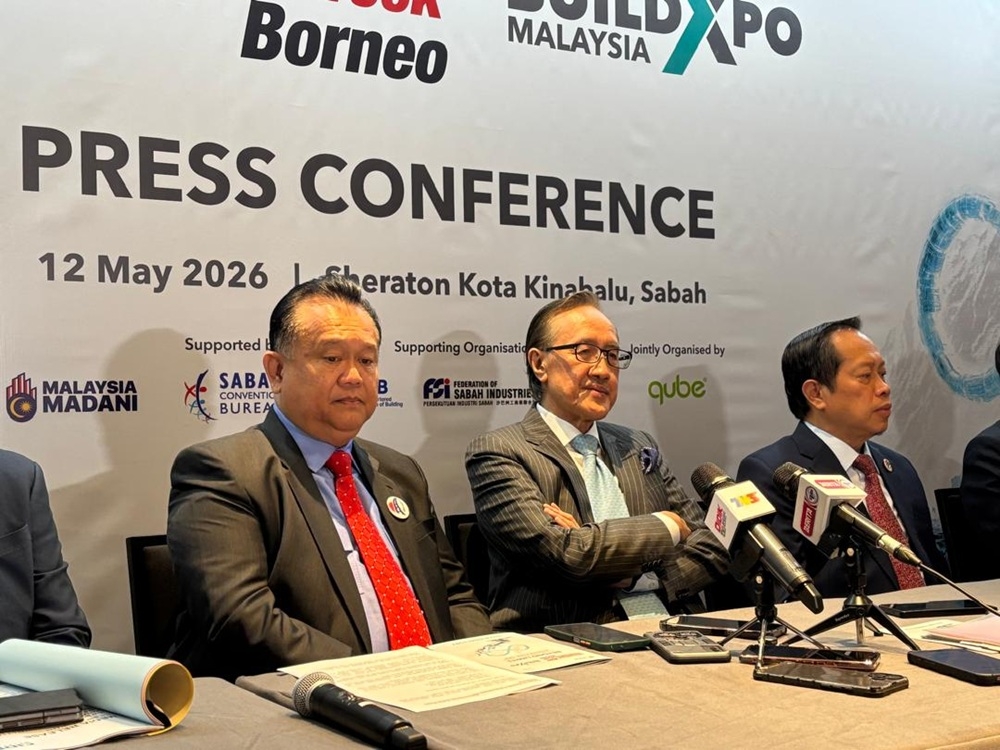
“KOTA KINABALU, May 12 — The federal government is intensifying efforts to strengthen Sabah’s construction sector through greater investment, stricter project monitoring and enhanced industry capacity-building, said Works Minister Dato Sri Alexander Nanta Linggi. He said the ministry is committed to improving technical capabilities in Sabah to ensure smoother project delivery. “If we lack capacity, when we want to build or implement projects, many problems and challenges arise, which can be very costly. It may require extensions of time and sometimes projects become abandoned,” he told a press conference at the International Construction Week (ICW) Borneo and BuildXpo here today. “That is why building capacity is important. We are committed, through the Ministry of Works, CIDB (Construction Industry Development Board) and the expertise from the Public Works Department (JKR), to assist Sabah.” Under the 13th Malaysia Plan (13MP), the ministry has allocated RM2.4 billion for federal road projects in Sabah under the 2026 first rolling plan, which includes RM35.5 million for slope repair programmes, RM6.6 million for bridge projects, RM1.845 billion for road works and RM34.5 million for preliminary works. For this year, RM512.17 million has been allocated for federal road maintenance covering routine repairs, slope stabilisation, bridge maintenance and traffic systems, reflecting a 31.29 per cent increase compared with 2025. He said the increase was in response to public feedback. “We understand when people say the roads in Sabah are ‘like the surface of the moon’. We admit there are problems. But it must also be clearly understood that the Ministry of Works and JKR Malaysia are only responsible for federal roads,” he said. He clarified that state and local roads fall under the Sabah government through the Malaysian Road Records Information System (Maris), a federal funding mechanism distributed by formula. He said maintenance allocations have also increased sharply, with smaller repair works rising from RM50 million to RM200 million this year, a 300 per cent increase. “In the past, even last year, maintenance allocations for certain categories were only RM50 million. This year, for smaller but important repair works on federal road surfaces, the allocation has increased to RM200 million,” he said. He added that all allocations have been committed and works are already underway, saying contractors were selected via a ballot system to ensure fairness and transparency. “Previously, there were fewer than 100 work packages. This year, Sabah has more than 170 projects. That means many more small-time contractors in categories G1 to G4 now have opportunities,” he said. He said the programme would also benefit the local economy by circulating funds within communities. “We are not saying this is enough. Hopefully, next year we can continue doing the same. But at least this year we have made a huge leap in terms of budget, with a 300 per cent increase for this purpose,” he added. On monitoring, he said the ministry has tightened oversight through senior officials and task forces conducting regular site visits. “We are really monitoring things very closely now. This is one of the improvements we have implemented at the ministry level to ensure all projects are carried out properly and according to required standards. “We have to police that as much as possible so we can avoid leakages in all aspects. Monitoring is now very close and very tight,” he said. Asked about progress, he said the ministry is taking a more forward-looking approach. “What happened in the past is water under the bridge. But going forward, we want to ensure improvements,” he said. Nanta also said the ICW Borneo and BuildXpo aims to enhance the local construction industry amid growing infrastructure development, noting the sector is increasingly driven by digitalisation and technology. “Malaysia is not lagging because the construction industry is indeed an engine of growth for our economy,” he said. He added that initiatives such as Akademi Binaan Malaysia (ABM) in Sabah have helped train local youth, while a new testing laboratory ensures construction materials meet safety standards. “We do not want to build something using poor-quality construction materials because naturally the quality of the project would be compromised. It could become dangerous, collapse or suffer various forms of damage,” he said. He also said Building Information Modelling (BIM), which generated savings in Sarawak’s Pan Borneo Highway project, will be used for the Sabah stretch of the project. — The Borneo Post
Original story
Continue reading at Malay Mail Education
www.malaymail.com/news/malaysia
Summary generated from the RSS feed of Malay Mail Education. All article rights belong to the original publisher. Click through to read the full piece on www.malaymail.com/news/malaysia.


