
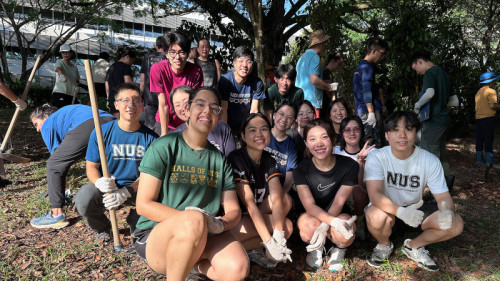
“Outside of lecture theatres and student residences, it is hard to miss the vibrant greenery woven through NUS’ Kent Ridge campus. Spanning over 150 hectares, besides housing students and faculty, it is also home to over 165 wildlife species. On this World Environment Day, the University takes stock of the latest green initiatives shaping its campus, from smart technology that monitors tree health to lush sanctuaries teeming with flora and fauna. 1. Tree-tracking technology To preserve campus greenery and ensure safety, NUS has moved beyond visual tree inspections to smart technology that tracks the structural integrity of key trees in real time. In 2025, sensors were installed on two iconic trees: a rain tree (scientifically known as Samanea saman) , beside the AS8 building at the Faculty of Arts and Social Sciences , and a rare Margaritaria indica at NUS College . Through the Tree Information Management System dashboard, the Environmental Enhancement Unit under the University Campus Infrastructure (UCI) team receives real-time updates and weather alerts. The System also detects any unusual tilts or structural stress that may not be visible to the naked eye, enabling timely intervention to protect both the trees and the community from any potential safety risks. Following the successful trials, NUS will be expanding the technology to 16 other high-priority trees located in pedestrian-heavy areas across the campus. 2. A fruitful rooftop garden Another of NUS’ green initiatives is also bearing fruit! Located on the rooftop of the Education Resource Centre in University Town , a mini orchard adds a touch of greenery to the built environment. Beyond expanding green cover, this urban farming effort also brings the NUS community together as staff and student volunteers who tend to the garden are rewarded with harvests of chiku, key lime and passionfruit. To support the greening of the campus, NUS is looking at adding more rooftop gardens and green spaces across its buildings. 3. A swale garden with multiple benefits As Singapore experiences more intense rainfall, a new swale garden was introduced near NUS College in March 2025 to help manage stormwater and reduce flood risks. Designed to slow down and absorb runoff, the garden features moisture-loving plants such as vetiver grass and pandan, which enhance its ability to retain excess rainwater naturally. Complementing the conventional drainage systems on campus, the swale also improves water quality by filtering pollutants from rainwater. At the same time, the garden’s Singapore Rhododendron and Lespedeza shrub also attract carpenter bees and butterflies with their vibrant purple flowers, supporting pollination and enhancing urban biodiversity. These ecological interactions help foster a more resilient and self-sustaining urban ecosystem. With growing rainfall intensity, the Environmental Enhancement unit is exploring more locations across campus for nature-based drainage features such as swale gardens to strengthen the campus’ resilience against extreme weather. 4. More trees planted NUS is fast realising its vision to be a Campus in a Tropical Rainforest. In support of the National Parks Board’s OneMillionTrees movement, NUS has pledged to plant 100,000 trees by 2030. At the most recent tree-planting event held on 23 May 2026 by NUS Toddycats, a volunteer group from the Lee Kong Chian Natural History Museum and the Department of Biological Sciences , 100 more trees were planted in our urban forest, bringing the total number on campus to 70,214 as of end May 2026. The University’s intensive greening efforts has also helped prevent up to a 1 degree Celsius rise in ambient air temperature between 2019 to 2024. Building on these greening efforts, future plans include developing a digital map of all campus flora using a Geographic Information System. This will help coordinate landscape maintenance with contractors and serve as a valuable resource for learning and research. 5. Biodiversity-boosting rewilding efforts Behind NUS’ growing green landscape and rewilding efforts is a small but mighty team of five from the Environmental Enhancement unit, formerly known as the Horticulture & Grounds Unit when it was first established under the Office of Estate & Development in the 1990s. Renamed in 2022, the multidisciplinary team comprising landscape architects, horticulturists and two certified arborists, works closely with other teams in UCI to review designs and provide technical advice on rejuvenating and enhancing the campus environment. Through the rewilding efforts led by both staff and students, NUS has become an increasingly vibrant sanctuary for diverse plants and animals. Native wildlife sightings include the Malayan water monitor and Oriental pied hornbill, while native plant species like the collared fig and the pink mempat have been introduced across campus to develop multi-layered habitats that support greater biodiversity. Click on the carousel below to see some of the native wildlife and plants found on campus! Together, these conservation efforts help bring nature closer to everyday campus life and form part of our broader efforts to build a more sustainable and resilient campus.
Original story
Continue reading at NUS Newsroom
news.nus.edu.sg
Summary generated from the RSS feed of NUS Newsroom. All article rights belong to the original publisher. Click through to read the full piece on news.nus.edu.sg.

