
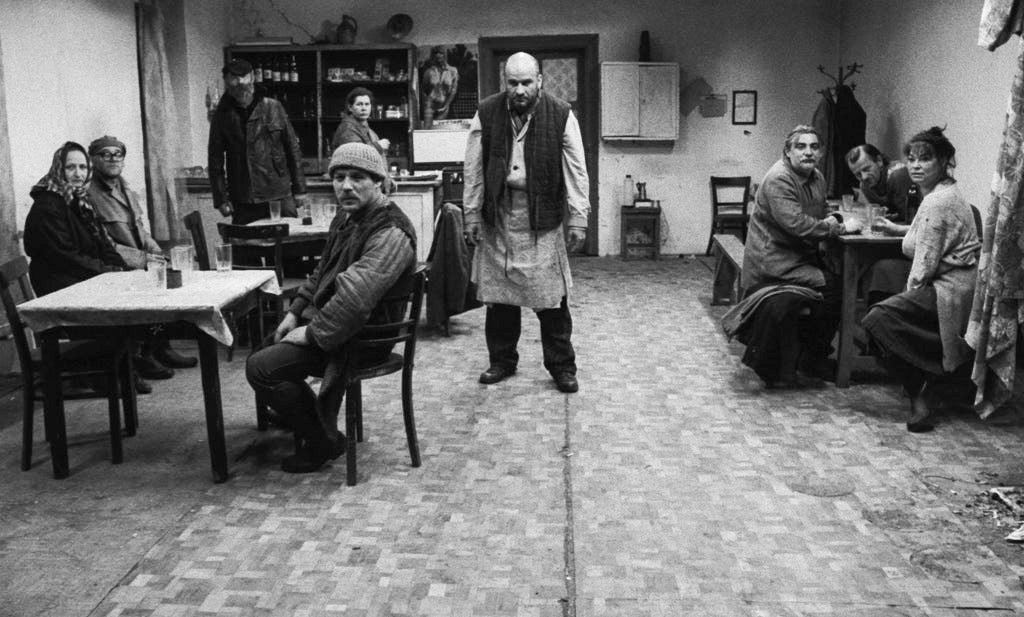
“Arts & Culture 7 hours later, they didn’t want it to end Sarah Lamodi Harvard Correspondent June 3, 2026 5 min read Who watches a 439-minute movie in an age of epic distraction? We asked. At work, at school, on the T, even at home: Nobody is paying attention . Our relationship with arts and culture is no exception. Fewer Americans are reading books ; songwriters are responding to social media with shorter, catchier hooks ; and even film students are less likely to watch movies , according to their professors. And yet: One hundred and forty people showed up at the Harvard Film Archive one recent Saturday afternoon for a sold-out screening of “Sátántangó” — not just any great film, an extremely long one, demanding of an audience a very un-21st-century attention span. Released in 1994, Béla Tarr’s black-and-white behemoth of “slow cinema” clocks in at 439 minutes, nearly 7½ hours. For a certain kind of moviegoer, a welcome challenge. “I kind of love [watching] films in the contemporary age, because very few things require that much attention,” said Stephanie Tuerk, a Somerville resident. Based on the 1985 novel by Nobel laureate László Krasznahorkai, “Sátántangó” follows the action, such as it is, at a sequestered collective farm in rural Hungary after the collapse of the Iron Curtain. The film, known especially for its long takes, is not your standard matinee fare — characters spend hours plodding through mud and rain; there are 10-minute shots of drunken dancing to repetitious accordion music; and, although all 12 acts of the film explicitly overlap, there is no satisfying conclusion before the credits roll. Seeing “Sátántangó” — rarely shown in theaters, unavailable to stream, and only recently restored in 4K from the original 35mm — is an achievement in itself. And, at a time when attention is shallower than ever, it may also be a sort of exposure therapy for building the skill back up. “It’s a little bit of a pressure test,” Tuerk said. “Maybe I fall asleep, maybe I leave, but that’s part of the excitement. It’s almost like a meditation exercise, trying to let any kind of feelings of boredom or sleepiness or whatever pass over me.” The screening — a celebration of Krasznahorkai’s 2025 Nobel Prize and a tribute to Tarr, who died in January — was introduced by Patrick Marshall, a filmmaker and film study coordinator in the Department of Art, Film, and Visual Studies who was one of Tarr’s mentees during the first iteration of film.factory, an experimental, workshop-based Ph.D.-level program at the Sarajevo Film Academy. Marshall had watched “Sátántangó” three times before, but never enjoyed it as much. The emotional heft of Tarr’s death was one factor, he said, but so was the humor of the film — Marshall had always found “Sátántangó” funny, “but I was laughing a lot more this time than ever before” — along with a sense of uplift that might on the surface seem at odds with slow cinema. “It’s almost like a meditation exercise, trying to let any kind of feelings of boredom or sleepiness or whatever pass over me.” Stephanie Tuerk Robbie Rhodes, an employee at Harvard Divinity School, was similarly moved. The film, he said, is about perseverance: “It’s not totally depressing — there is a shimmer of hope in there.” Tyler Sprouse, also a staffer at the Divinity School, was no less impressed. “The sheer amount of time that you get [with the characters], you just get immersed in their world, and their concerns, their fears, their superstitions, everything. You feel like you care for them.” The effect is no accident. In his introduction to the screening, Marshall spoke to Tarr’s belief in the life-altering power of cinematic storytelling. “Béla always said that there were two ways one would walk out of the theater after having seen a movie,” he said. “Weaker and less able to confront the problems of one’s life and of the world, or stronger and more resolved to confront the problems of one’s life, the time one lives in, and the world at large.” After the screening, attendees could mail in their reflections on it via postcard. One card Marshall received was from a pair of friends who just happened to be passing by the HFA at around 5 p.m., saw the sign for “Sátántangó” and, despite the film being almost halfway over, snatched up some leftover tickets. Marshall says Tarr, who always dismissed the “rules” of film, “would have loved that.” Engaging with art in this way — headfirst, without sacrificing rigor for convenience — gets at the power of film as a form, and the standards to which we should hold ourselves when choosing where to spend our precious attention, Marshall said. Tarr’s epic “is not convenient. It asks more of you. I think we could use more things in the world that ask a bit more of us as people.” “Sátántangó” will screen at 11 a.m. on June 7 at Coolidge Corner Theater as part of “Bleak Week.”
Original story
Continue reading at Harvard Gazette
news.harvard.edu
Summary generated from the RSS feed of Harvard Gazette. All article rights belong to the original publisher. Click through to read the full piece on news.harvard.edu.