
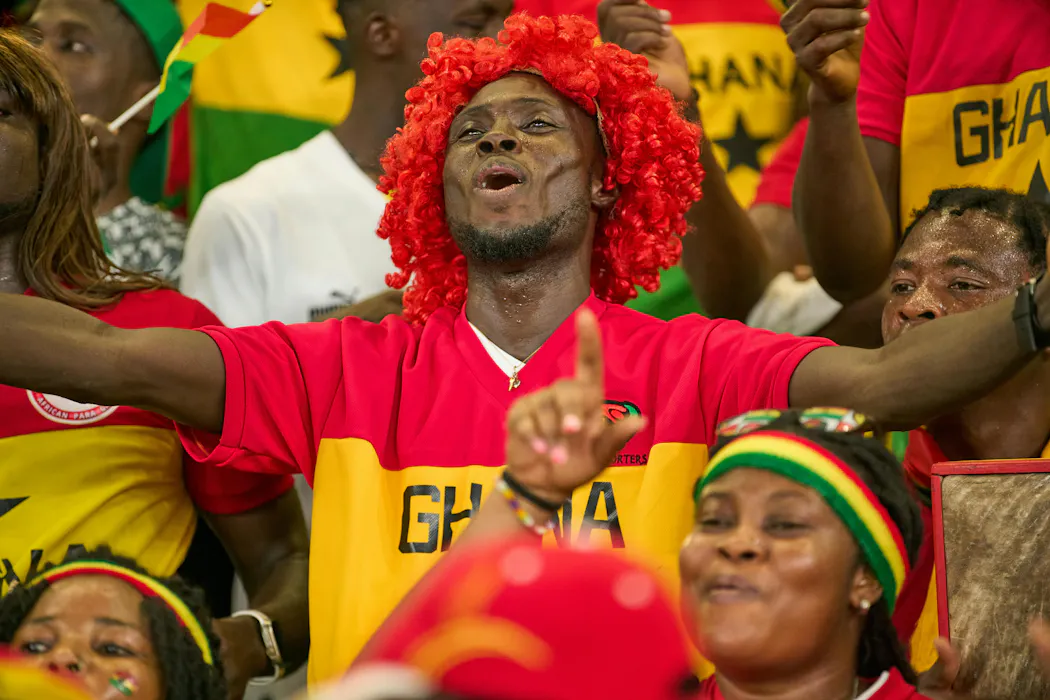
“Ghana fans will be cheering their team alongside nine other African nations at the World Cup finals. Adera Abdoulaye Dolo/Pexels , CC BY The 2026 men’s Fifa World Cup marks a seismic shift in the global football landscape. The decision to expand the final stage of the tournament from 32 teams to 48 has significantly benefited the Confederation of African Football (Caf). In 2018 and 2022, Africa was represented by five nations; this year, a record 10 teams will take the stage. They are, in order of their Fifa world ranking : Morocco (ranked 8), Senegal (14), Algeria (28), Egypt (29), Côte d'Ivoire (34), Tunisia (44), Democratic Republic of Congo (46), South Africa (60), Cape Verde (69) and Ghana (74). Read more: Can an African team win the World Cup? New football study crunches the numbers As a sport scientist who has spent decades researching African football, including the continent’s performances at the World Cup, I view this expansion as both a lasting legacy and a justified reward for African football’s sustained advocacy, boardroom activism, and robust on-field execution. It’s not just a numerical increase; it’s a major structural event. The narrative surrounding African football has shifted since the hopeful prophecies made by Brazilian star Pelé in the 20th century. After touring the continent in 1977 and witnessing the tremendous talent and established pipeline to European football, he predicted that an African nation would win the World Cup before the year 2000. He later adjusted his timeline to 2010. In 2026 it is a concrete possibility thanks to African football’s tactical maturity. Here I consider five trends and challenges facing the 10 African teams as they head to the US, Canada and Mexico to take part, and how the event may play out for them. 1. The significance of 10 teams Until now, Africa’s qualification process for the tournament was arguably the most brutal in world football. Strong teams often missed out on the global showpiece due to a system that allowed no room for error. The jump to nine guaranteed spots – plus a tenth secured by Cape Verde through the inter-confederation play-offs – has finally aligned the continent’s representation with its competitive depth. Read more: Africa at the Football World Cup: 10 defining moments This expansion addresses a long-standing “geopolitical bottleneck”. By doubling its presence, Caf ensures that the World Cup is no longer just a snapshot of African football, but a comprehensive gallery. Fans will witness the return of historical giants like South Africa and the DRC alongside perennial contenders like Egypt and Algeria and contemporary favourites like Morocco and Senegal, creating a diverse tactical mosaic. 2. The ‘Morocco effect’ The 2022 World Cup in Qatar was a watershed moment. Morocco’s journey to the semi-finals shattered the “quarter-final ceiling” that had frustrated African ambitions since Cameroon’s 1990 run. This achievement fundamentally altered the performance expectations of the 10 teams heading to North America. Read more: Morocco at the 2022 World Cup: 6 forces behind a history-making performance No longer are African teams arriving with the primary goal of avoiding embarrassment. There is a palpable sense of entitlement to the late stages of the tournament. Morocco enters the tournament not as a “Cinderella story” but as a top-tier seed. This shift from “participant” to “contender” is the single most important development in the African game over the last four years. 3. Old guard meets a new one The 2026 roster is a fascinating blend of heritage and novelty. The return of South Africa (Bafana Bafana) – after a 16-year hiatus – and DRC (The Leopards) – appearing for the first time since 1974 – adds immense historical weight to the cohort. These are nations with deep footballing cultures that have spent years in the competitive wilderness. Conversely, the first ever qualification of Cape Verde (The Blue Sharks) represents the “new guard”. A nation with a population of just over 500,000 has outperformed continental powerhouses. Their success is a testament to the efficient scouting of the Lusophone diaspora and a sophisticated tactical identity. Their presence serves as a reminder that, in the modern game, organisational stability and technical clarity can overcome lack of scale. 4. The rise of the homegrown tactician A quiet revolution has also taken place on the touchline. In previous decades, African federations were criticised for a “white-coach-in-a-suitcase” approach – hiring European managers shortly before major tournaments. Today, the trend has reversed. The success of Walid Regragui (Morocco) and Emerse Faé (Côte d’Ivoire) has validated the “homegrown” model. Eight of the 10 African teams are led by local coaches or members of the diaspora who share a cultural and emotional connection with their squads. This technical “decolonisation” has led to better man-management and a more authentic tactical expression. These coaches understand the “transnational dynamics” of players who navigate elite European leagues but return to a different set of expectations for their national colours. 5. Navigating the North American vastness Of course, there are many challenges. One clear hurdle is logistical. The 2026 World Cup spans four time zones and vastly different climates. The vast distances between Vancouver, Mexico City and Miami will be a test of endurance . African teams, whose administration and organisation have always attracted criticism for ineptitude, will have to step up. Read more: A football World Cup is a global cultural exchange. How will that work in Trump’s America? However, there’s a hidden advantage: the diaspora. North America is home to massive African immigrant communities. In cities like New York, Toronto, Houston and Atlanta, teams can expect significant “home” support. Despite potential visa and travel barriers for fans coming directly from the continent, the local diaspora has the potential to turn stadiums into vibrant hubs of African football culture. What to expect from the teams The success of the African cohort will be measured by the opening round . The draw has presented a mix of high-stakes drama and genuine opportunity. South Africa faces a daunting atmospheric test in Group A, opening against co-host Mexico in Mexico City – a fixture that will require immense mental fortitude. Similarly, Senegal and Algeria face early trials against heavyweights France and Argentina respectively, matches that will serve as early benchmarks for Africa’s elite. Read more: Morocco will co-host the 2030 World Cup – Palestine and Western Sahara will be burning issues But the 48-team format offers a wider path to the knockout stages. Egypt, drawn with Belgium, and Morocco, facing Brazil, have the technical depth to navigate their pools even if they drop points to the group favourites. For debutantes like Cape Verde, a group featuring Spain and Uruguay is a mountain to climb, but the chance to progress as one of the best third-placed teams keeps the dream alive. If these 10 teams can maintain the tactical discipline seen in qualification, the 2026 tournament will make Africa a major stakeholder ready to disrupt the status quo. Wycliffe W. Njororai Simiyu does not work for, consult, own shares in or receive funding from any company or organisation that would benefit from this article, and has disclosed no relevant affiliations beyond their academic appointment.
Original story
Continue reading at The Conversation Africa
theconversation.com/africa
Summary generated from the RSS feed of The Conversation Africa. All article rights belong to the original publisher. Click through to read the full piece on theconversation.com/africa.