
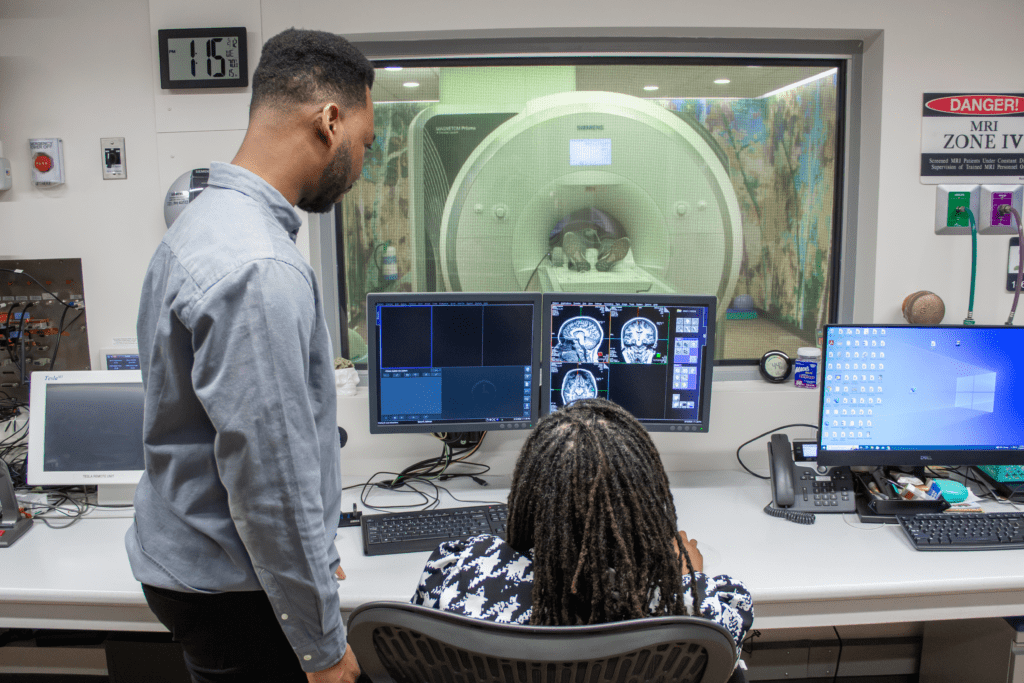
“Healthcare today is changing fast, and much of that progress is happening where engineering meets biomedical science. Advances in medical imaging, diagnostics, biomedical sensors, and drug delivery systems are opening new possibilities for patient care. Meanwhile, technologies like wearable and non-wearable biosensors, as well as biochips, are helping doctors detect and treat diseases in smarter and more efficient ways. As the industry becomes more personalised and driven by technology, biomedical engineers are becoming more important than ever. The US Bureau of Labour Statistics reports that employment is projected to increase by 5% from 2024 to 2034, with 1,300 openings expected each year. To empower students to seize these opportunities, some universities are stepping up in exciting ways. Biomedical engineering students learn from faculty working at the forefront of neuroengineering, biomedical computation, and more. Source: Carnegie Mellon University Carnegie Mellon University Innovation that makes a difference has long been part of Carnegie Mellon University’s College of Engineering. Its Department of Biomedical Engineering (BME) continues that tradition through team-based research transforming healthcare. Work here spans biomechanics, biomaterials, bioelectronics, neuroengineering, biomedical imaging, and cell, tissue and organ engineering. Much of this research is supported by large, collaborative grants. CMU-led teams have been particularly successful in securing major funding from the Advanced Research Projects Agency for Health (ARPA-H). One CMU-led team received US$28.5 million to build a functional 3D-bioprinted liver , while another secured US$34.9 million to develop a bioelectronic implant that could improve treatment and lower costs for obesity and Type 2 diabetes patients. CMU researchers are also leading a US$26.7 million multi-partner effort through ARPA-H’s POSEIDON programme to develop an at-home cancer screening test that could detect more than 30 early-stage cancers. Clinical partnerships help move these ideas beyond the lab. CMU BME collaborates closely with leading medical centres: Allegheny Health Network and University of Pittsburgh Medical Center. With the preeminent Mayo Clinic, the largest organ transplant provider in the US, CMU collaborates on the Transforming Transplant initiative and projects linked to CMU’s MS in Artificial Intelligence Engineering programme . Indeed, the impact of this research environment extends to both PhD and MS students. While doctoral candidates lead many projects, the majority of master’s students also take part in research, gaining experience that prepares them for future PhDs or innovation-driven roles in industry. The size of these grants reflects a broader shift in biomedical research. Funding agencies are increasingly investing in technologies that can reach the clinic faster. That means at CMU BME students are working on solutions that could shape the next generation of healthcare. Source: University of California, Irvine University of California, Irvine Every time a doctor saves a life with a device that didn’t exist a decade ago, an engineer made it possible. At University of California (UC), Irvine’s Department of Biomedical Engineering , that idea drives everything. The department trains students and researchers to combine critical thinking with creative problem-solving, equipping them to develop breakthroughs that quietly redefine what modern medicine can do. You’ll be doing this work in one of the best possible places for it. Orange County is home to more than 300 biomedical device and biotech companies , and UC Irvine sits right in the middle of that ecosystem. Here, collaboration with industry isn’t something you have to seek out. It finds you. The faculty driving this department are among the most respected in their fields, pulling in over US$30 million in annual research funding. Many lead or contribute to high-profile centres like the Beckman Laser Institute and the Edwards Life Sciences Centre for Advanced Cardiovascular Technology. What further sets this department apart is the way it fuses UC Irvine’s strengths in medicine, biological sciences, and engineering into a single, focused pursuit. That foundation is growing, with research expanding into four defining clinical areas : neurosciences, ophthalmology, cardiology, and cancer. These are the fields where engineering meets humanity’s most urgent health challenges. The Rice University Department of Bioengineering is a top-ranked department dedicated to pioneering research and advancing global betterment. Source: Rice University Rice University What if your degree put you at the centre of engineering living tissue and reinventing how doctors diagnose disease? At Rice University’s Department of Bioengineering , that’s your everyday reality. Ranked among the best in the nation, Rice Bioengineering brings together researchers and students driven by one shared goal: pushing the boundaries of what’s medically possible. Your location alone gives you an edge that few institutions can match. Rice sits directly across from the Texas Medical Centre , the largest medical centre in the world. That means you’re working and learning steps away from MD Anderson, Baylor College of Medicine, and Houston Methodist, collaborating with practitioners who are actively shaping the future of medicine. Whether you’re drawn to fundamental science or want to move technologies from the lab into clinical settings, you’ll find a community built around excellence and real-world impact. Here, curiosity meets the resources and mentorship to turn ideas into breakthroughs. Those discoveries often start in the lab. You’ll learn from award-winning faculty who are pioneering next-generation biomaterials using 3D printing and molecular self-assembly, and designing materials with precisely tailored mechanical, chemical, and biological properties. Imaging innovation is another frontier you can explore. Faculty are developing compact optical tools for early cancer detection, along with miniaturised hyperspectral systems and 3D-printed optics, advancing diagnostics across biological and clinical research. The Department of Biomedical Engineering at the University of Alberta develops medical robotics, advanced imaging, smart materials, wearable devices, and AI-driven solutions for diagnostics, drug discovery, and treatment planning. Source: University of Alberta University of Alberta Engineering and medicine have always needed each other. At the University of Alberta, they share a department. The Department of Biomedical Engineering is jointly run by the Faculty of Engineering and the Faculty of Medicine and Dentistry. That structure gives your work a dual foundation, connecting the precision of engineering with the complexity of human health. Research spans bionics, biorobotics, imaging, biomechanics, and precision health design, using both computational and experimental methods to advance ideas. Getting research into practice matters here. The department builds active partnerships with hospitals, industry and clinical researchers so that discoveries have a clear path from lab to application. Faculty are recognised nationally for that work, holding prestigious positions including the Sorensen Chair for the Commercialisation of Biomedical Technology and the Glenrose Rehabilitation Hospital Chair in Neurorehabilitation. That same focus applies to how you train as a student . Labs are equipped for motion capture and prototype fabrication, and you work directly with machine learning for image analysis, sensor-based rehabilitation systems and materials used in medical implants. Graduate programmes and an undergraduate engineering option are both available, giving you a way in at whatever stage you are. *Some of the institutions featured in this article are commercial partners of Study International
Original story
Continue reading at Study International
www.studyinternational.com
Summary generated from the RSS feed of Study International. All article rights belong to the original publisher. Click through to read the full piece on www.studyinternational.com.

