
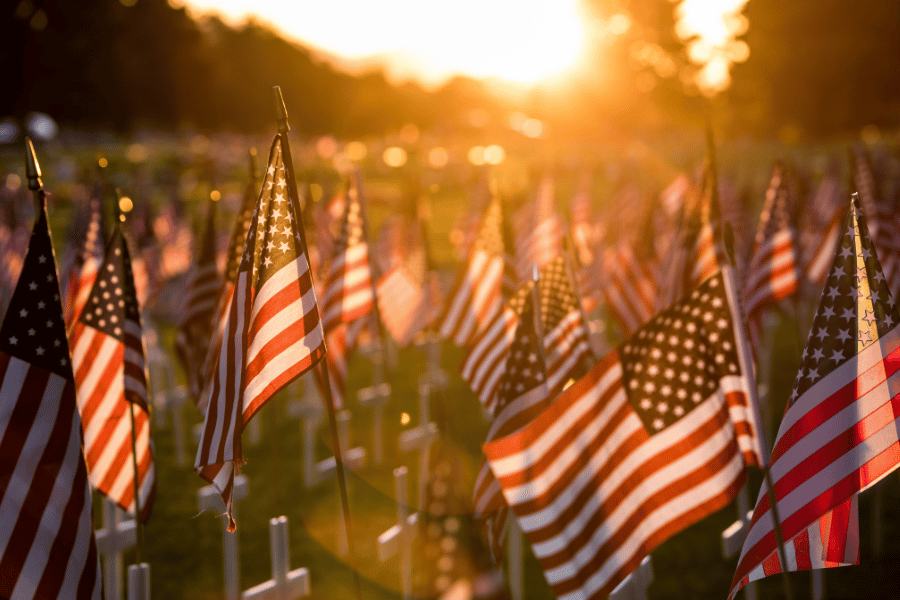
“As Memorial Day approaches, recent research shows many younger Americans are disconnected from the holiday’s meaning. To help bridge that divide, the Florida State University Institute for Governance and Civics (IGC) is incorporating immersive teaching methods to better engage this audience. According to 2,000 Americans surveyed by Talker Research, only 48% of respondents knew that Memorial Day is a holiday honoring military personnel who died in service to their country. Just 27% of Generation Z respondents and 38% of millennials selected the correct response. Leaders at FSU’s IGC say that gap also presents an opportunity to rethink how civics is taught. Aimed at becoming the nation’s premier policy institute, the IGC advances conscience, economic, constitutional and educational liberty through bold research and transformative teaching. Ryan Owens is the director of the IGC, a professor of political science and affiliate faculty at the FSU College of Law . One of his institute’s signature initiatives is the Founding Voices program, an immersive and interactive learning experience that brings America’s founding era to life through engaging, in-school seminars designed specifically for middle school students. Owens said immersive learning can help students connect more deeply with history and America’s founding principles. “A student who studies the Battle of Little Round Top through maps and lectures may learn what happened,” Owens said. “But a student who must assume the role of Joshua Chamberlain, confronts impossible choices and understands what was at stake begins to grasp why courage, duty and sacrifice mattered. The lesson becomes not simply historical, but civic and moral.” Owens is available for interviews on how civics institutions like the IGC can help younger audiences reconnect with the meaning of Memorial Day. He can be reached via email at Ryan.Owens@fsu.edu . Ryan Owens, director, Florida State University Institute for Governance and Civics In what ways does modern civics education help connect and deepen students’ understanding of Memorial Day? Benjamin Franklin famously said we have “A Republic, if [we] can keep it.” Memorial Day reminds us that many Americans gave their lives to keep that republic. Modern civics education should ensure the next generation understands both the cost of that inheritance and their responsibility to carry it forward. In that vein, civics education should transfer information and cultivate gratitude, responsibility and citizenship. Students should understand not only how American government works, but why generations of Americans believed it was worth defending with their lives. At the IGC, we want students to understand that freedom is not self-sustaining. Every generation inherits it, but every generation must also preserve it. Memorial Day becomes deeper and more meaningful when students understand the ideals behind the sacrifice so many have made: constitutional liberty, freedom of conscience, self-government and the responsibilities that come with citizenship. How can presenting civics history in both an immersive and interactive form allow students to better understand the cost of liberty and military sacrifice? We believe students better understand the cost of liberty and military sacrifice when they are not merely passive recipients of information, but active participants in historical inquiry and civic reflection. For example, when students debate the Constitutional Convention, reenact the arguments between Federalists and Anti-Federalists, analyze battlefield decisions at Gettysburg, simulate Supreme Court arguments or wrestle with the moral and political dilemmas faced by prior generations, history becomes more tangible. Students learn liberty was not — and is not — inevitable. It is contested, defended and often purchased at extraordinary human cost. Through interactive civics education, students will come to appreciate what Lincoln once told us at Gettysburg, that “From these honored dead we take increased devotion to that cause for which they here gave the last full measure of devotion.” While tough to predict, could this type of enhanced civics education (such as the Founding Voices program) create a new wave of patriotism in the younger generation? We hope it builds a reflective patriotism — a form of love of country grounded in thoughtfulness, honesty and civic responsibility rather than blind loyalty or reflexive nationalism. Reflective patriotism asks citizens to appreciate their nation’s principles and achievements while also recognizing its imperfections and working to improve them. A reflective patriot does not believe the country is flawless. Nor does he or she believe the country is irredeemable. Instead, a reflective patriot understands the American experiment as an ongoing project — one built on enduring ideals like liberty, equality before the law, constitutional government and self-rule, but one that has always required correction, debate, sacrifice and renewal. The Founding Voices program will deliver 100 in-school seminars over three years, reach approximately 40,000 students and teachers, use live and AI-generated historical interpreters and integrate primary-source instruction. Our goal is to determine whether students who are exposed to the civics-in-real-life approach become more excited to learn. And if we can create more reflective patriots, all the better. The post FSU expert explains how interactive civics education can reconnect younger Americans with Memorial Day appeared first on Florida State University News .
Original story
Continue reading at FSU News
news.fsu.edu
Summary generated from the RSS feed of FSU News. All article rights belong to the original publisher. Click through to read the full piece on news.fsu.edu.
