
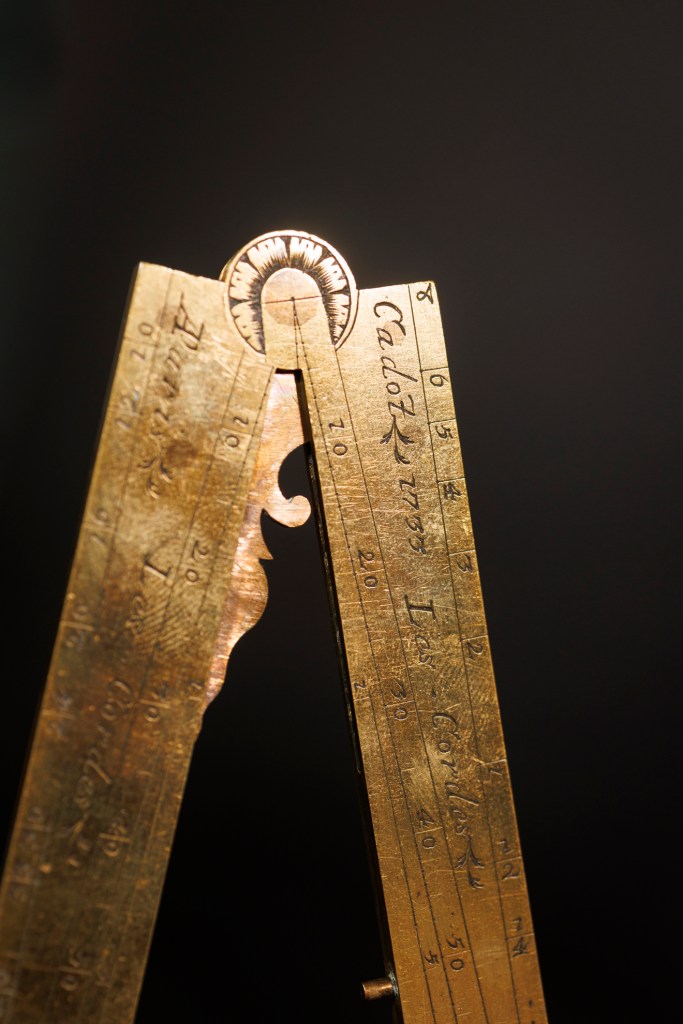
“Science & Tech High-tech for the 1700s An air pump from 1770. Photos by Niles Singer/Harvard Staff Photographer Christy DeSmith Harvard Staff Writer June 4, 2026 3 min read Exhibit showcases tools that powered Revolutionary America Electrical conductors. Surveying tools. Mathematical instruments. Harvard College, founded in 1636, was a pioneer in teaching the applied sciences. Over the centuries, the institution amassed thousands of tools used for lessons in physics, trigonometry, and more. Some of these items even helped propel the Continental Army to victory in the Revolutionary War. A new exhibit on view through 2026 at the Collection of Historical Scientific Instruments spotlights the 18th-century tech that powered early America. “Revolutionary Technology,” curated by postdoctoral fellow Emma Mendoza Broder, Ph.D. ’25, was made possible by support from the Richard Lounsbery Foundation and Revolution250. “This was a really interesting era,” said Joyce Chaplin , James Duncan Phillips Professor of Early American History, during a recent gallery event. “Technological inventions were part of this improvement or enlightenment project that the war, if anything, slowed down.” A sector. The show features a London-made octant, employed in 1786 by Hollis Professor of Mathematics and Natural Philosophy Samuel Williams to chart the boundary between New York and Massachusetts. A pair of 18th-century sectors — one from London, the other Paris — were used for mathematical equations like calculating the trajectory of a cannonball. A surveyor’s Y-level, resembling a fancy golden telescope, was likely loaned to the Continental Army during the Siege of Boston . Detail of a Cassegrain reflecting telescope from 1758. A Cassegrain reflecting telescope from 1758. Detail of a Cassegrain reflecting telescope from 1758. In June 1775, students were dismissed early to make way for Minutemen and other Colonial troops. For the next 11 months, Massachusetts Hall alone bunked more than 600 soldiers, with some 160 squeezed into teensy Holden Chapel. “The Continental Army took all the locks and hardware off all the buildings at Harvard and turned them into the bullets,” added Joyce, author of “ The Franklin Stove: An Unintended American Revolution ” (2025). Students had previously established their own militia to help with the war effort. But the community was counseled to stick with pursuing what Broder termed “practical, experimentally gleaned knowledge.” They resumed their studies in the fall at a temporary location in Concord. A hydraulic siphon from 1750-1770. A double-barreled air pump from 1770. Faculty of the era demonstrated physical theories and phenomena using some of the instruments featured in the exhibit. A hydraulic siphon, produced in London between 1750 and 1770, enhanced lessons on hydrostatic pressure. An air pump, made by another London shop circa 1770, enabled research involving vacuums. A precisely synced orrery, also crafted overseas, modeled motions of the Earth, moon, and sun. A portable orrery from 1787. Detail of a portable orrery from 1787. Detail of a portable orrery from 1787. The show also includes a cabinetful of instruments associated with Harvard benefactor Benjamin Franklin, whose inventions inspired a sense of pride in early America. Some objects, like a brass conductor, represent the founding father’s popular experiments with electricity. Symbolizing the innovation that spared countless households from fiery ruin is a miniature profile of a simple wooden cottage topped by a spiky lightning rod — a lifesaving technology introduced by Franklin in 1752. A collection of late 18th-century instruments associated with Benjamin Franklin, including an insulated stool, a quadrant electrometer, a conductor on an insulated stand, sub objects of an electrostatic kit, and a Thunder House.
Original story
Continue reading at Harvard Gazette
news.harvard.edu
Summary generated from the RSS feed of Harvard Gazette. All article rights belong to the original publisher. Click through to read the full piece on news.harvard.edu.
