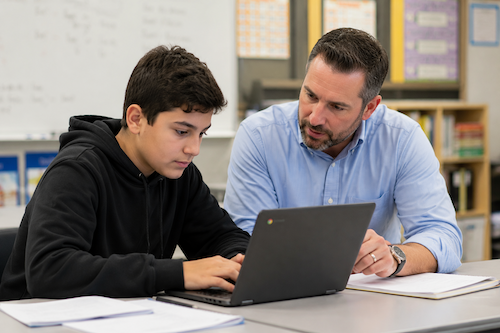
“Key points: We should use AI in ways that strengthen instruction without weakening connections between teachers and students In Illinois, charting a path for responsible AI use How districts can build a shared AI structure For more news on AI use, visit eSN’s Digital Learning hub As I wrapped up my student conferences, one conversation stuck with me. Steven had barely touched his final project for our computer science course, a virtual simulation of a piano, despite showing real promise earlier in the year. I knew he was capable of more, so I began our conference by telling him this. Slowly, he opened up. Instead of talking about coding, his project, or his grades, Steven spent most of our time describing the anxiety and insomnia he was experiencing because his mom was sick. At that moment, the final project and the skills I wanted to assess didn’t matter. Steven needed to talk and I needed to listen. The conversation also brought to the forefront my complicated feelings about AI in schools. I have 130 11th graders in my computer science classes at the Chicago High School for the Arts. Feeding their projects into an AI tool could save me a lot of time. But if I had done that, I would have missed the details that made Steven who he was. No algorithm can replace the human dialogue that helps my students feel seen, challenged, and understood. Over the past year, I’ve been exploring AI tools that can help me plan more creative lessons, leave detailed comments on student work, and respond more effectively to a wide range of learning and language needs. But Steven keeps coming to mind. I can easily imagine a near future where AI systems deliver instruction and feedback more efficiently than I ever could. What I struggle to imagine is how an algorithm could have responded to Steven if I had fed it his incomplete final project. Would it have recognized anxiety or would it have called his poor performance apathy? While AI promises incredible efficiency, we should use it in ways that strengthen instruction without weakening the human connections between teachers and students. The Teach Plus Illinois Policy Fellowship, where I am a Fellow, recently surveyed Illinois educators about their attitudes and practices around AI. In our report , educators shared real examples of using AI to save time on routine tasks and improve their lesson planning while protecting more time for connection with students. In my own classroom, I am reinvesting any time AI saves me into real dialogue with my students. Especially when evaluating student work, I’ve found that talking with them–not just grading an assignment or outsourcing feedback to an AI tool–gives me a more accurate picture of what students know and what they need. Those conversations also create space for the stories they share. Understanding students deeply and giving them meaningful feedback takes time, but that is exactly the kind of human work worth protecting. Schools have always been places where students do more than absorb content and learn skills; they also learn how to relate to others, manage conflict, and find mentors and role models. That human connection is so important, and in an era when 12 percent of students report using AI chatbots for emotional support , protecting our interactions is especially urgent. We cannot respond to this moment by handing off teacher-student connection to AI. One way we can approach the AI era is to embrace conferencing as a core part of assessment. Not only does this build connections, it’s also necessary to truly know what students can do. When students have increasing access to AI tools, a nice polished assignment tells me less and less about student abilities. When a student in my class can’t explain why their code does what it does, I know they still have work to do. At the system level, schools need to build schedules and staffing models that protect genuine connections between teachers and students. That means treating conference time as non-negotiable, not something teachers carve out on their own. As districts begin factoring AI into staffing decisions, we need explicit policies that protect small class sizes and dedicated time for human connection. I think a lot about Steven when I try new AI tools. Schools will change in the coming years, but the relationships that are the heartbeat of great classrooms must remain. There are so many students, like Steven, who don’t need quick and efficient feedback from AI. They need a teacher who will listen and care.
Original story
Continue reading at eSchool News
www.eschoolnews.com
Summary generated from the RSS feed of eSchool News. All article rights belong to the original publisher. Click through to read the full piece on www.eschoolnews.com.
