
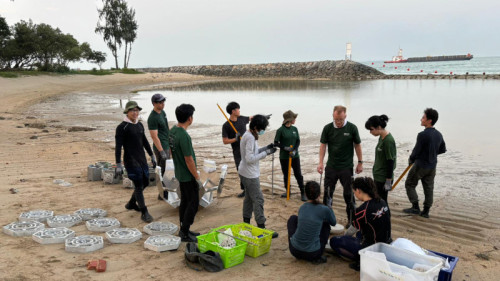
“In this series, NUS News explores how NUS is accelerating sustainability research and education in response to climate change challenges, and harnessing the knowledge and creativity of our people to pave the way to a greener future for all. By 2100, Singapore’s sea level is projected to increase by up to 1.15 metres. Coupled with extreme weather conditions, sea levels could surge to as much as 5 metres, according to The Straits Times. With about 30 per cent of the country lying less than 5 metres above mean sea levels, this places increasing pressure on Singapore’s coastlines, threatening our infrastructure, ecosystems and most importantly, the people living here. Traditionally, coastal protection has relied on “grey” infrastructure such as seawalls and breakwaters. While effective, these structures can disrupt natural processes and damage ecosystems. In contrast, “green” infrastructure such as mangroves, wetlands, and coral reefs, offers a nature-based approach that reduces wave energy, absorbs floodwaters, stores carbon and supports biodiversity. Nature-based solutions alone, however, may not withstand extreme weather conditions. As a result, hybrid “green-grey” approaches, which combine the strength and reliability of grey structures with the ecological benefits of green systems, are increasingly being adopted. At NUS, Associate Professor Peter Todd from the Department of Biological Sciences has been researching how to increase the ecological functioning of existing artificial shorelines for over a decade. Creating new green-grey shorelines from scratch is a much bigger challenge. “Designing and building a hybrid shoreline is a substantial undertaking that requires inputs from engineers, ecologists, architects, planners, and even social scientists. It is critical to understand the local conditions, especially hydrodynamics and ecological processes, as well as human use and needs,” he shared. With funding from the Public Utilities Board through their Coastal Protection and Flood Management Research Programme, Assoc Prof Todd is developing hybrid green-grey systems for more sustainable coastal protection, as well as optimising the growth and survival of coastal species within these systems. The team will first research existing hybrid solutions and their efficacy. Thereafter, they will determine the best species-structure combination that is suitable for Singapore’s coastal environment and conditions. Through satellite imagery, the team will then identify suitable sites to implement these green-grey systems. Together, these efforts aim to strengthen shoreline resilience in the face of rising sea levels. Through this work, he aims to develop innovative, cost-effective, and sustainable coastal protection strategies grounded in ecological knowledge, while mitigating some of the impacts of climate change and restoring vital coastal ecosystems.
Original story
Continue reading at NUS Newsroom
news.nus.edu.sg
Summary generated from the RSS feed of NUS Newsroom. All article rights belong to the original publisher. Click through to read the full piece on news.nus.edu.sg.
