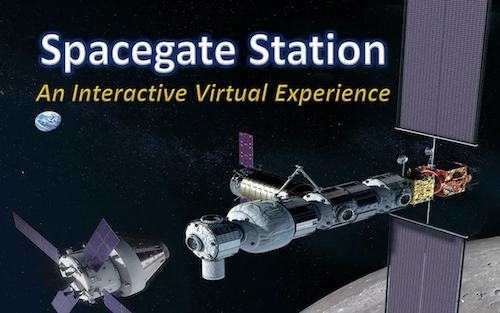
“Key points: Teacher-led design drives relevance Why early STEAM education unlocks the future for all learners How teachers and administrators can overcome resistance to NGSS For more news on STEM curriculum visit eSN’s Innovative Teaching hub A fictional space station orbiting the moon is turning into a real-world digital success story. Spacegate Station , a STEM series created in 2022 by Duval County Public School (DCPS) to support daily instruction, has unexpectedly taken off on YouTube, drawing sustained engagement from viewers far beyond the district. Today, the Spacegate YouTube channel has more than 1,600 subscribers, more than 196,000 views, 25,000+ hours of watch time, and roughly 2.3 million impressions, according to district analytics. Its 4.9 percent click-through rate places it at the high end of STEM instructional content (Tubular Labs,2023). For a district-produced series with no marketing budget, those numbers prompted DCPS leaders to take a closer look at what was happening. A classroom-first program that found an online audience Unlike many STEM video platforms, Spacegate wasn’t designed as enrichment or a supplemental library. It was built to solve a specific instructional challenge: providing teachers with clear, standards-aligned science and engineering lessons that students could follow in sequence. Each lesson is framed as a “mission” aboard a futuristic space station orbiting the moon. Students step into roles, tackle challenges, and apply concepts in context. Teachers use the videos alongside hands-on activities and included resources, making the program part of daily instruction rather than an add-on. That classroom-first design is also what makes the videos perform well online. The pacing is deliberate, explanations are clear, and segments are short. These are the same qualities that help YouTube’s recommendation system identify content viewers are likely to watch through. Instead of clicking in and leaving, viewers are sticking with the materials–something that matters both for learning and for how platforms like YouTube decide what to show to its community. High watch time is one of the strongest signals of value, both to teachers and to algorithms. “Spacegate works because it was built by teachers who understand exactly where students struggle and what helps them move forward,” said Yvonne Day, director of science for DCPS. “When you can combine instruction with strong relevant storytelling, you get deeper engagement, not just online, but in the classrooms where it matters most.” Narrative as an instructional strategy and a discovery engine One of Spacegate’s most distinctive elements is its ongoing storyline or arc. Lessons build on one another. Students return to familiar settings and characters and continue the work of previous missions. In classrooms, this structure shifts how students engage–they’re not completing isolated tasks; they’re advancing a shared goal. That same continuity also supports online discovery. When viewers finish one episode, they’re more likely to watch the next. When online programs are driven by viewer retention, a storyline can encourage people to keep watching, whether to finish a lesson or to see what comes next. This narrative structure is helping Spacegate surface more frequently in YouTube recommendations, expanding its reach beyond DCPS. Teacher-created media with district-level impact Spacegate occupies a unique space in the edtech landscape. Districts often create instructional materials, but those resources rarely reach a broader audience. Spacegate sits between internal curriculum and public-facing media: freely available, aligned to real classroom use, and accessible to anyone. The episodes are written, acted, directed, and filmed by teachers. “Our goal for this program was never to chase views, it was to make science feel alive for students,” said John Phillips, district video production specialist. “When teachers step behind the camera, the tone changes. The content feels real, grounded, and built for learners, and audiences online are responding to that authenticity.” That authenticity resonates with educators who want materials that feel grounded in real classrooms rather than commercial production studios. For years, districts have largely been consumers of digital content. Spacegate suggests a different possibility–one where districts create, refine, and share their own instructional media to educators everywhere. Why this matters for other districts Spacegate’s growth raises a larger question: What happens when district-created instructional media succeeds both in classrooms and in open digital spaces? Several takeaways stand out: Teacher-led design drives relevance. Educators built the program for their own classrooms, and that clarity shows. Narrative increases engagement. Story-driven lessons keep students and online viewers coming back. Short, clear segments perform well on YouTube. Instructional design and platform algorithms reward the same qualities. Districts can be content creators. Spacegate demonstrates that high-quality STEM media doesn’t have to come from outside vendors. Looking ahead Spacegate continues to expand its content library and refine how episodes are presented. While the program’s primary focus is supporting DCPS students and teachers, its growing reach suggests greater long-term potential. This online STEM resource developed for one school system may reach far beyond it. For educators and policymakers, Spacegate offers a glimpse of what district-created instructional media can become: classroom-ready, widely accessible, and increasingly influential in digital learning spaces. References Tubular Labs. (2023). Education category benchmarks: YouTube performance insights . Tubular Labs. https://www.tubularlabs.com
Original story
Continue reading at eSchool News
www.eschoolnews.com
Summary generated from the RSS feed of eSchool News. All article rights belong to the original publisher. Click through to read the full piece on www.eschoolnews.com.
