
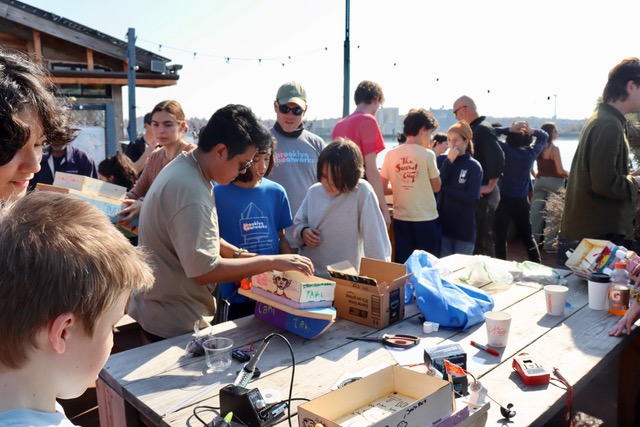
“By: Kevin Dahill-Fuchel Children spend only 20 percent of their time in school between kindergarten and 12th grade. One-fifth of the day. Everything educators are asked to accomplish, academic growth, social development, and taught skills for adulthood, has to happen in that narrow window. And children need to be ready to learn. The other 80 percent of the day can’t be boxed up neatly during school hours. Life follows students through the school doors. I’ve worked in New York City schools for nearly 40 years, and the students I think about most aren’t the ones who struggled with the curriculum. They’re the ones who never got a fair chance to engage with it because they were hungry, or exhausted, or carrying something heavy from home that no teacher was positioned to address in a busy classroom with academic hurdles. These students weren’t ready for the classroom, and the classroom couldn’t support their needs, so they couldn’t learn. Mary M. was in her first year at Middle City High School. By all appearances, Mary was just like any of her 9 th -grade peers. She came every day on time, dressed appropriately, and carried a backpack. When she took a seat in a classroom, she looked ready to learn. What was visible on the outside was not at all what was going on inside. Mary’s mind was fully on her developing family challenges. Mary’s father was laid off in July, which left the family without health insurance. Mary’s summer job helped for a bit but ended when school began. Mary’s Mom worked an off-the-books job at night but had a heart condition that required medications that the family was now going to struggle to afford. Academically, Mary struggled mightily. What she needed was not more instruction, but more connection. Instead of first referring Mary to tutoring, she was connected to a “near peer mentor” to check in with daily. These check-ins built trust that allowed Mary to share her reality, which in turn opened the door to a counseling program with connections to community resources that began to address her family’s needs. With her stress significantly reduced, Mary’s outward presentation as a conscientious student began to be reflected in her grades. When students struggle academically, the solution most often isn’t more instruction. It’s more connection. And, connections can be made in lots of ways. At a middle school blocks from the Brooklyn waterfront, student engagement centers on implementing an environmental curriculum that weaves the natural elements in children’s lives outside of school into their daily learning in the classroom. In the classrooms, students tend hydroponic vegetable gardens and maintain a turtle pond. The produce they grow stocks an on-site food pantry, where families in need can stop in once a week to collect fresh vegetables and canned goods, a reminder that learning and community care are inseparable. The fifth-grade experience takes things further. Over the course of a full year, students work together to build a small wooden boat from scratch, developing woodworking skills, teamwork, and a quiet confidence that comes from finishing something hard. Along the way, they make regular visits to a local shipyard, meeting the businesses and workers who animate the waterfront economy. When the boat is finally complete, one of those businesses hauls it to the water’s edge, and the kids get to sail it. These are two examples of the same larger idea: that a school and its surrounding community are not separate things. Each one shapes the other, and both are better for it. New York City’s Community School strategy does exactly that. Rather than treating a school as a self-contained unit responsible only for what happens within its walls, it turns the school into a hub that deliberately links students and families with experiences and resources found in their surrounding communities – health providers, social services, mental health support, rec recreation centers and local organizations. The community and its environment doesn’t supplement the school. It becomes part of it. The results are documented. A Cornell and Harvard study following more than 16 million students over two decades found that wrapping personalized community supports around students produces higher graduation rates, greater college enrollment, and better earnings years down the road. Here in New York, a RAND analysis of our 419 Community Schools found improvements in attendance, academic achievement, and student connectedness concentrated in the neighborhoods that have historically had the worst results on these metrics. At Counseling In Schools in New York City, we lead this strategy in 16 schools and provide mental health services in 15 more. What we see every day is simple: when students’ lives outside school are stabilized and acknowledged, their lives inside school change. Schools are not meant to raise children alone. They sit at the center of communities that are able to help. NYC’s Community Schools are led by mission-based organizations that are free from academic mandates and can build the relationships inside and outside the school that are necessary to engage the “whole child.” The Community School strategy puts those relationships to work, and the 80 percent, instead of working against students, starts working for them. Kevin Dahill-Fuchel is the Executive Director of Counseling In Schools. The post What If School Offered More? The Case for Community Schools appeared first on Getting Smart .
Original story
Continue reading at Getting Smart
www.gettingsmart.com
Summary generated from the RSS feed of Getting Smart. All article rights belong to the original publisher. Click through to read the full piece on www.gettingsmart.com.