
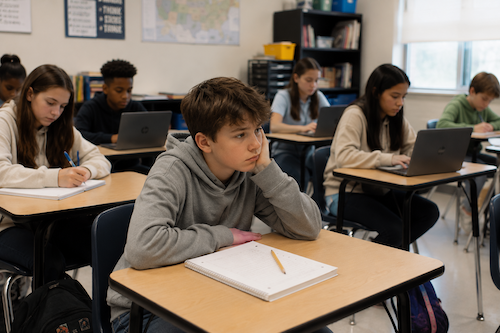
“Key points: Students are constantly evaluating what deserves their attention Room to grow: Creating a classroom built for success Research highlights the importance, challenges of K-12 student engagement For more news on student disengagement, visit eSN’s Innovative Teaching hub Across classrooms right now, many educators are noticing the same shift: Students are even harder to reach than they were just a short time ago. In a recent survey , teachers pointed to rising disengagement as a growing concern, with more students opting out of learning in both loud and quiet ways. Sometimes disengagement looks like misbehavior, with jokes or side conversations. Just as often, it’s quieter, with students doing only what’s required to get through the day, exhibiting minimal effort, or acting withdrawn. All forms signal the same underlying challenge. It’s easy to attribute this trend to phones or shortened attention spans. But in many ways, students are demonstrating something more complex: They are constantly evaluating what deserves their attention. For some students, there may also be challenging experiences or trauma impacting their attention, but educators are increasingly observing this pattern of disengagement across a wide range of students. Outside of school, they’re used to environments at home or online that are interactive, flexible, and tailored to their interests with instant gratification. The contrast with more traditional classroom structures can feel stark. For middle and high school students in particular, questions of relevance come up quickly. Beyond completing tasks, they want to understand the purpose behind them. When that sense of purpose isn’t clear, it can be difficult to sustain engagement. What may be interpreted as a lack of motivation is often a reflection of that disconnect. In response, schools may opt for tighter controls, more rules, fewer distractions, and increased emphasis on compliance. While structure has a place, these approaches don’t always address the root issue. Disengagement is often less about student behavior and more about how the learning experience is designed. Revisiting that design can open up new possibilities. Classrooms that rely heavily on listening and passive participation are competing with experiences that feel far more dynamic. Students respond differently when they are actively working through problems, collaborating with peers, and applying ideas in meaningful contexts. Approaches such as project-based learning, inquiry-driven instruction, and career-connected pathways can help bridge the gap between content and real-world relevance. Student voice and choice also play an important role. When students have opportunities to make decisions about their learning–whether through topics, formats, or how they demonstrate understanding–they tend to show greater investment. Even small moments of autonomy can make a difference in how connected they feel to the work. The physical classroom environment is another significant factor that can further support engagement but is too often overlooked. As opportunities for in-person connection outside of school have decreased for many students, the classroom is taking on a larger role as a social space. Environments that allow for conversation, movement, and collaboration can help students feel more connected to their peers and to the learning itself. Traditional layouts, with desks in rows facing a single point of instruction, were historically designed during the industrial age for efficiency and order to prepare students for the workforce. But they can also reinforce the idea that learning is something students are required to complete rather than actively participate in. Adjustments don’t need to be large-scale to be meaningful. Flexible seating, spaces for small-group work, and movable furniture can encourage interaction and make it easier for students to engage with one another. These kinds of changes also support the broader sense of belonging that students often lack outside of school. There’s also a growing push to “defront” the classroom, moving away from a single focal point of instruction and toward a more active format for learning. In subjects like math, approaches where students work collaboratively on write & wipe surfaces show that even students who typically withdraw are more likely to engage when they’re given a role and choice in how to complete the work. It’s also worth noting how closely engagement and behavior are linked. When students feel disconnected, that can show up as disruption or withdrawal. Addressing only the surface behavior without examining the underlying experience produces limited results. If the structure of the learning experience stays the same, disengagement often reappears in a different form. A helpful starting point may be a simple question: What would make this worth a student’s attention? Schools that explore that question through more collaborative environments, relevant learning experiences, and opportunities for student agency are beginning to see shifts in how students show up. Student disengagement isn’t a new issue, but it is becoming more visible. As classrooms continue to evolve, aligning learning environments more closely with how students experience the world may be one of the most important steps toward reengaging them.
Original story
Continue reading at eSchool News
www.eschoolnews.com
Summary generated from the RSS feed of eSchool News. All article rights belong to the original publisher. Click through to read the full piece on www.eschoolnews.com.