
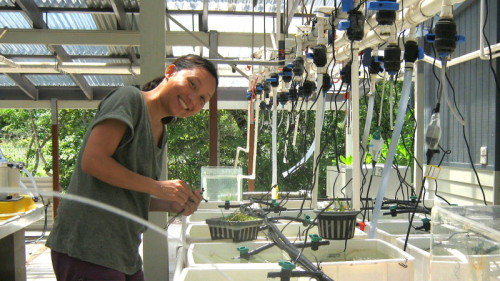
“Annually on 8 June, World Ocean Day is celebrated to cultivate public interest in the protection, restoration and conservation of our oceans. This year’s theme, “Strong Marine Protected Areas for Our Blue Planet,” calls for a global commitment to create effective Marine Protected Areas (MPAs) that deliver real conservation outcomes. For marine biologist Dr Ow Yan Xiang, Senior Research Fellow at the Tropical Marine Science Institute at NUS, and resident scientist at the St John's Island National Marine Laboratory , World Ocean Day is “a day to appreciate how our oceans and the marine life within have kept us alive through their roles in climate regulation and supporting global economies”. On a more serious note, she added that “it is also a day where we caution ourselves about the consequences should our oceans no longer be healthy”. Dr Ow’s work focuses on seagrass. Unlike seaweed, which are marine algae, the lesser-known seagrass are flowering plants with roots, stems and leaves. Found in shallow, near-shore waters, seagrass meadows are an essential part of the marine ecosystem, providing food and shelter, and serving as nurseries to many aquatic creatures. Seagrass also play an important role in coastal protection by buffering wave energy and stabilising sediments. A natural carbon sink, seagrass meadows are remarkably good at trapping carbon: in the Central Indo-Pacific region, which includes Singapore and Malaysia, they capture an average of 86 metric tonnes of carbon per hectare, the equivalent of annual carbon emissions from 22 cars. However, Singapore has lost approximately 45 per cent of its seagrass since the 1960s due to land reclamation and ongoing coastal development. Currently, seagrass beds continue to be wiped out at a high rate, for example, in Southeast Asia, the rate of loss is 5 per cent every year. When the seagrass is greener on the other side Last year, Dr Ow co-led Singapore’s inaugural seagrass restoration project in collaboration with the National Parks Board, transplanting seagrass from denser meadows like East Coast to areas with little to no seagrass, like Sisters’ Islands. Until the end of this year, Dr Ow and her team will monitor the transplanted seagrass plot on Sisters' Islands, before deciding on whether to proceed with another transplantation exercise. To further improve seagrass restoration efforts, Dr Ow and her team have a two-pronged approach. Firstly, they are developing and refining transplantation methods, to determine the best way of planting mature seagrass shoots, so that they will not get washed away or perish easily. “Transplanting seagrass is a far less well-studied science compared to that of trees, mangroves or even corals,” Dr Ow pointed out. “By optimising our transplantation techniques, we can revitalise the seagrass population in Singapore’s waters.” Uncovering the wonders of seagrass reproduction Secondly, Dr Ow and her team are studying the sexual reproduction of seagrass in Singapore. Despite the presence of 12 seagrass species in Singapore, the sexual reproduction of the vast majority remains poorly understood. Consequently, the team has been conducting monthly surveys at different seagrass meadows to look for seagrass flowers and fruits. Recently, they published an open-access scientific paper in the Bulletin of Marine Science that documents the sexual reproduction of the noodle seagrass Syringodium isoetifolium , including images of the flowers, fruits and seeds as well as detailed information on the timing and process of pollination, fertilisation, fruit development and seed dispersal. This is the first comprehensive description of the sexual reproduction of the noodle seagrass. “If we are able to understand when and how various seagrass species reproduce sexually, it will greatly aid long-term restoration effort,” Dr Ow said. Undoubtedly, Dr Ow’s tireless work on seagrass promotes the health of our blue planet. And how can individuals protect our oceans and the conservation of marine life? Dr Ow shared, “Nothing is too little. Collective stewardship can make a big impact if we all play our part.” She urged, “Whether it’s advancing knowledge through research, advocating for education and conservation, or even making a conscious effort to reduce one’s environmental footprint, small actions are better than none!”
Original story
Continue reading at NUS Newsroom
news.nus.edu.sg
Summary generated from the RSS feed of NUS Newsroom. All article rights belong to the original publisher. Click through to read the full piece on news.nus.edu.sg.