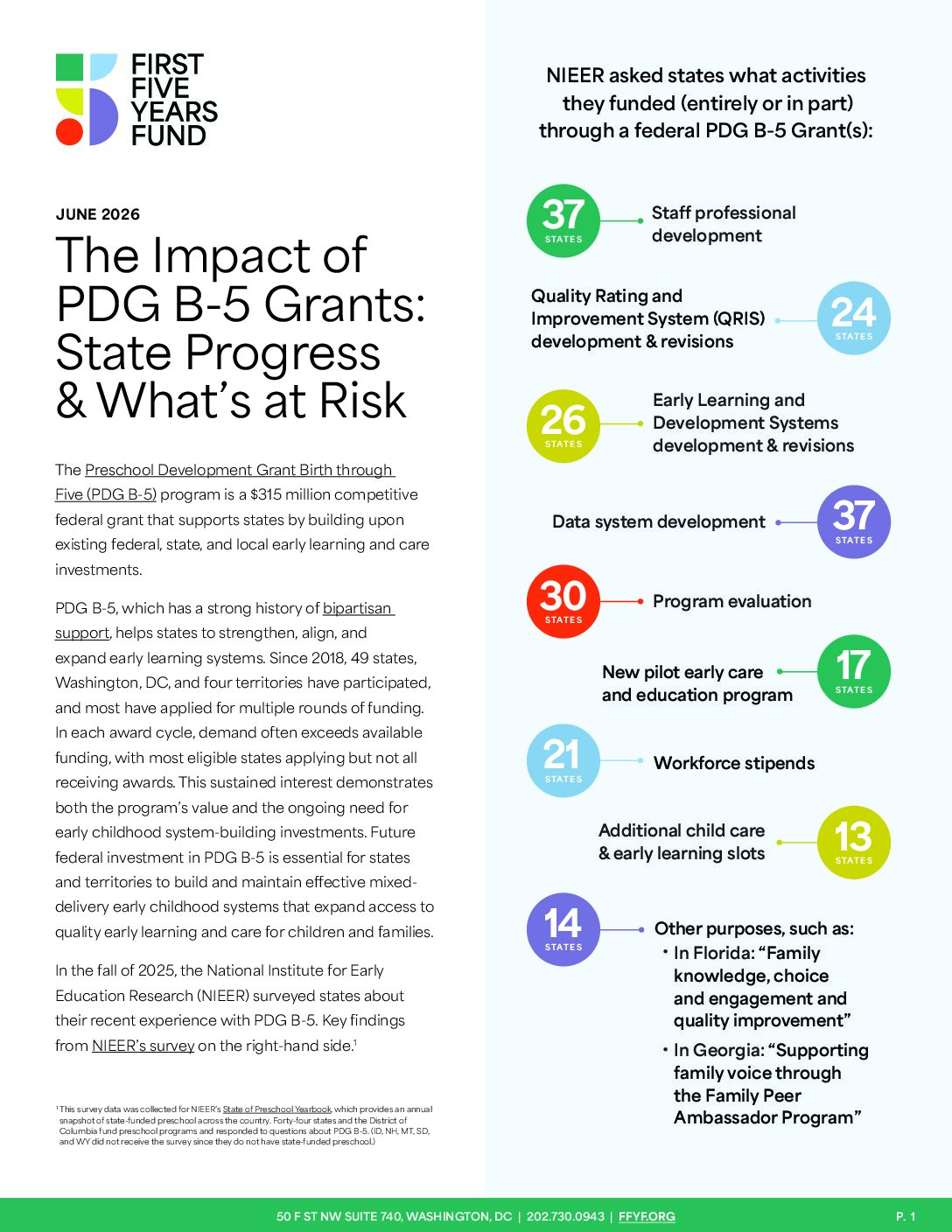
The Impact of PDG B-5 Grants: State Progress and What’s at Risk
The Preschool Development Grant Birth through Five (PDG B-5) program is a $315 million competitive federal grant that supports states by building upon existing federal, state, and local early learning and care investments. PDG B-5, which has a strong history of bipartisan support , helps states to strengthen, align, and expand early learning systems. Since 2018, 49 states, Washington, DC, and four territories have participated, and most have applied for multiple rounds of funding. In each award cycle, demand often exceeds available funding, with most eligible states applying but not all receiving awards. This sustained interest demonstrates both the program’s value and the ongoing need for early childhood system-building investments. Future federal investment in PDG B-5 is essential for states and territories to build and maintain effective mixed-delivery early childhood systems that expand access to quality early learning and care for children and families. In the fall of 2025, the National Institute for Early Education Research (NIEER) surveyed states about their recent experience with PDG B-5. Our full report and findings from NIEER’s survey are below . Download (1.92 MB) The post The Impact of PDG B-5 Grants: State Progress and What’s at Risk appeared first on First Five Years Fund .
17 Jun 2026

The First Five Things to Know About: Preschool Development Grant Birth through Five (PDG B-5)
Due to limited budgets and capacity, many states struggle to support the important activities – like data collection, research, infrastructure development, and other quality initiatives – that can make their child care and early learning programs operate more effectively. A federal program known as Preschool Development Grant Birth through Five (PDG B-5) plays an essential role in making sure child care programs are as effective and efficient as possible. Among other things, federal PDG B-5 dollars are used by states to: Help states improve quality and safety across child care programs. Improve state collaboration across multiple child care and early learning programs, systems, and agencies to identify what’s working, what’s not, and what to do about it. Assist states in collecting data, so they can make programs work more effectively and efficiently. The end goal: A system that brings high-quality early education to more working families and helps millions of children have access to safe, quality child care and early learning that can help set them on a strong path. Here are the First Five Things to Know about the PDG B-5 program. (For more examples, check out the FFYF PDG B-5 map !) PDG B-5 grants help maximize parental choice . While all parents want their young children cared for in a safe and caring environment, they have varied needs and preferences. PDG B-5 grants help states build out these choices. Oregon is using their current funding to develop a cohesive early education system that maximizes family choice, using data gained through a needs assessment originally funded by a 2020-23 PDG B-5 grant. The consistency and longevity of PDG B-5 enabled the state’s ability to renew funding and build long-term infrastructure. Michigan is expanding the state’s existing Pre-K For All program to include home-based child care providers, offering working families an option with more flexible hours, individualized support, and community relationships. PDG B-5 grants help states collect data, so they can make programs work more effectively and efficiently. Strong data collection allows states to identify what’s working, what’s not, and what to do about it. PDG B-5 is supporting Alabama’s efforts to design strong analytical systems that would inform policy and services across agencies. Oklahoma is using their funds to develop a better data collection system that would guide programming related to system alignment, efficacy, and expansion. A 2022 PDG B-5 grant helped Kansas develop their All in for Kansas Kids Strategic Plan , including a comprehensive dashboard to publicize data and collaborate across providers. PDG B-5 grants help states collaborate across multiple programs, systems, and agencies. Within a state, child care and early learning systems may work with different state agencies, nonprofits, or private systems. PDG B-5 allows these systems to coordinate efficiently. Delaware is employing the funds to improve program coordination across the state in collaboration with educational and economic advisors. Hawaii is using PDG B-5 to support coordination across agencies and service providers, bolstering statewide program quality. A 2022-2024 PDG B-5 grant supported New York in improving their New York Family Guide to New York State Early Childhood Services, aiming to increase parents’ awareness of the mixed-delivery system and ease of access to services. PDG B-5 grants help states improve quality and safety across child care programs. High-quality child care has wide-ranging benefits for children socially, emotionally, and academically. PDG B-5 funds are helping Ohio launch a technology and research initiative that will improve curriculum development and professional learning opportunities, resulting in a more informed workforce. Vermont is using its newest grant to collect data across its recently expanded child care workforce, including a more efficient background-check system and professional development opportunities. Continued federal funding for PDG B-5 grants is essential . Forty-nine of the 50 states as well as Washington, DC and four territories have benefitted from PDG B-5 funding, which has given them the ability to support the data collection, research, infrastructure development, and quality initiatives that can make their child care and early learning programs operate more effectively. Most states have applied for multiple rounds of funding to continue to meet ongoing needs. The Bottom Line PDG B-5 provides a unique opportunity for the federal government to support state child care and early learning investments. This funding helps maximize parental choice, open doors for children who are most in need, and optimize the reach of state and federal investments. Sustained federal funding is necessary for states and territories to continue to build and improve effective mixed-delivery systems. Learn More Capsule Collection : A handy list of resources about how and where PDG B-5 works. Preschool Development Grant Birth through Five (PDG B-5) overview : This overview provides a deeper look at PDG B-5 – what it is, how it works, what it does. The National PDG Map : This map highlights PDG B-5 funding for each state and how states used it to help child care and early learning programs work more effectively. Through the Years: Preschool Development Grants Birth Through Five : This handy chart shows the PDG funding received by each state since the program began in 2018. Governors show support for Federal Preschool Development Grant B-5 Funding : This report quotes state governors on the opportunities presented by PDG B-5 in their own state. Contact Jane Fillion, jfillion@ffyf.org Download PDG First Five things (177.57 kB) The post The First Five Things to Know About: Preschool Development Grant Birth through Five (PDG B-5) appeared first on First Five Years Fund .
17 Jun 2026
FFYF’S SARAH RITTLING NAMED TO TIME’S INAUGURAL VISIONARIES LIST
Washington, D.C. – TIME named First Five Years Fund Executive Director Sarah Rittling to the inaugural TIME Visionaries list recognizing leaders driving meaningful impact in the lives of children across education, health and wellness, technology, economic opportunity, and more. Read the full time profile here and below. Sarah Rittling Is Making the Bipartisan Case for Childcare By Belinda Luscombe There is no official anti-childbearing movement in America, but it’s often hard not to feel like somebody is out to get parents. The financial math is brutal: most people can’t afford to raise children without full-time employment, but childcare takes up a huge slice of parents’ income—all while childcare workers are underpaid. This is the kind of affordability chasm where the economies of scale provided by an umbrella governmental scheme would offer a real benefit, yet the patchwork of federal programs helping to provide care for the very youngest Americans remains threadbare. For Sarah Rittling, executive director of the First Five Years Fund (FFYF) since 2018, the sharp outlines of this issue are an asset. “Because childcare’s such a real, definable problem, literally anything that we do to make it marginally better is a step in the right direction,” she says. Not that the organization she heads is doing “literally anything”; its goal is expanding access to high-quality childcare for infants through kids up to age 5 by shaping early childhood policies. It also works to protect and extend existing federal funding, largely by building bipartisan support and championing initiatives in Congress. It’s slow work built on gathering data, forming coalitions, and finding common ground. “I think the single biggest impact that we’ve made is to truly make sure that this is a bipartisan issue,” says Rittling. Most recently, the FFYF partnered with lawmakers in the House to help pass the Supporting Early-Childhood Educators’ Deductions (SEED) Act, which was introduced by members of both parties and allows childcare workers to deduct the cost of some classroom supplies from their taxes. (The bill is now in the Senate .)The FFYF also advocated for certain measures in H.R.1, or the One Big Beautiful Bill Act of 2025, which offered some relief from childcare costs via tax incentives. Before joining the FFYF, Rittling spent her career laboring among elected officials, most of them Republicans, as well as in consulting, so she brings an insider’s expertise to her role. She understands, for example, the importance of introducing new initiatives but also of running defense—of sustaining and fortifying existing federal programs like Head Start and the Child Care and Development Block Grant . Her history has also helped her build a coalition of more than 100 diverse organizations to equip them to advocate for robust childcare policies at all levels of government. The work couldn’t be more crucial. A new report from the National Women’s Law Center found that the number of kids on waiting lists for federally funded childcare assistance almost doubled between 2024 and 2025 alone. Part of that enormous hike is because of the expiry of the emergency measures the U.S. government put in place during the COVID-19 pandemic that allowed parents doing essential work to keep doing it. “We learned that childcare was central, we learned that we had a system in this country that was going to crumble to the ground if we didn’t have government step in and save it,” says Rittling of that era. “This is more than just a mom’s problem.” It requires resilient vision to maintain hope when successive administrations on either side of the aisle have treated childcare as an expendable part of the budget. But Rittling is not one for giving up. “There’s too much work to do right now: to continue to build support amongst lawmakers, and to continue to highlight the realities that we face as families and economies,” she says. “We have to keep showing everything we know that’s going to move and change hearts and minds in our political system and in our legislative bodies, to try to shake something loose.” Explore the full 2026 TIME Visionaries list here . The post FFYF’S SARAH RITTLING NAMED TO TIME’S INAUGURAL VISIONARIES LIST appeared first on First Five Years Fund .
16 Jun 2026
PDG B-5: Success Stories from the States
Preschool Development Grant Birth Through Five (PDG B-5) is a federal grant that supports quality statewide early childhood services for children from birth through age five. This grant empowers states to strengthen, align, and expand their early learning programs, maximizing efficiency and efficacy within each state’s program design. PDG B-5 helps each state develop strategic plans that prioritize parental choice, transitions from early learning to elementary school, and overall program quality. The impact of the program has historically stretched across 49 of the 50 states, Washington, DC, and four territories. For a look at how each state has used PDG B-5, take a look at our national map . President Trump’s recommendations on discretionary funding levels for fiscal year (FY) 2027 and a recent House proposal would eliminate PDG B-5 entirely. In 2026, 23 states were selected to receive PDG B-5 grants. Here’s how 10 of them are using this funding: Alabama Reported in WSFA , the Alabama Department of Early Childhood Education was awarded $3.8 million from PDG B-5 to strengthen and coordinate the state’s early childhood system. This grant aims to build the professional skills of a stable early child care workforce, align results across mixed-delivery programs, bolster family engagement, and design strong analytical systems that inform policy and services across agencies. Arizona As discussed in Arizona PBS , Arizona received an $8.4 million grant to stabilize their early education workforce and improve literacy initiatives. According to 12 News , “Federal grants and cross-agency partnerships like this one [are] central to sustaining and expanding early learning programs across the state.” Officials hope to use the funding to build long-term infrastructure to support the literacy of early learners beyond the one-year grant period. Arkansas Arkansas was awarded a $14.8 million grant to centralize the state’s early education programming, with a focus on accessibility and workforce quality. According to the Arkansas Democrat Gazette , “In the grant application, the state said the money would be used to ‘accelerate’ efforts to transition to a single, unified early childhood system.” Recent statements from local workers have confirmed the state’s focus on a centralized program, such as Jessica Griffin (Local Lead, Southeast Educational Service Cooperative) in THV11 : “I’ve had the privilege of witnessing firsthand how a unified early childhood system is laying a strong foundation for children’s success in school and life.” Delaware Delaware Public Media reports an $11.3 million grant from PDG B-5 to expand the state’s early child care and early education programs. In collaboration with educational and economic advisors, the funding will go towards program coordination across the state. Previous use of a PDG B-5 grant in Delaware empowered almost 600 children to receive child care. Hawaii Hawaii’s $1.4 million PDG B-5 grant, as reported in Kaua’i Now , will “support statewide systems-building efforts focused on improving coordination across agencies and service providers, strengthening family access and choice in early learning programs, enhancing quality across the early learning system and helping ensure children enter kindergarten ready to succeed.” The grant will support statewide integration of this high-quality early learning program. Michigan In APNews , a pilot program rolled out this spring to test no-cost pre-K in home-based child care programs, expanding the state’s existing Pre-K For All program. This $1.5 million initiative will support up to 75 to 80 children to attend preschool. The expansion of the existing Pre-K For All program to home providers aims to offer working families an option with more flexible hours, individualized support, and community relationships. Ohio As reported in Ohio Capital Journal , Ohio received a $14.7 million grant to support access to early care and education services. Specifically, the funding will go towards technology and research, as well as supporting early childhood education workers with “curriculum development, professional learning opportunities, and business support resources.” They aim to improve the coordination of services across the state to make it easier for interested families to identify local programming. Oklahoma Oklahoma received $14.7 million from PDG B-5, according to Seminole Producer . Of the new funding, Jeffrey Cartmell (Director of the Oklahoma Department of Human Services) said, “This funding will allow us to continue building better data systems while implementing specific strategies to help Oklahoma’s early care and education system improve and ultimately, serve children, families and our workforce better.” Along with programming relating to workforce integration and retention, the grant proposal included a collection of projects targeting system alignment, program efficacy and expansion, and data collection. Oregon As reported in KDRV , Oregon was awarded a $7.4 million grant to support the development of a cohesive early education system, “rooted in accountability and efficiency, while maximizing family choice.” Previous funding for Oregon helped the state assess its early education needs before the founding of their Department of Early Learning and Care (DELC). The current year’s funding will support the state’s new early childhood plan, created by the recent DELC. Vermont VT Digger reports that a nearly $13 million grant will support urgent developments to Vermont’s child care system. After the 2023 passage of Act 76, thousands of children gained access to child care through the expanded tuition assistance program, resulting in a steep increase in new child care providers. The funding will support data collection and analysis to coordinate the new network of child care providers by assisting the transmission of information between agencies, providers, and policy makers. This grant will also support child care providers through business management support and workforce development, especially through a new, efficient background-check system. The post PDG B-5: Success Stories from the States appeared first on First Five Years Fund .
15 Jun 2026

Under Mamdani, New York will be the first to open a free child care center for city workers
This story was published by The 19th and reprinted with permission. Tucked in New York City Mayor Zohran Mamdani’s sprawling universal childcare plan is a little-talked-about milestone: In September, the city will open what appears to be the first free daycare for municipal workers in the country. The center, called The Little Apple , is a pilot program that could prove to be a model for cities across the country that are childcare curious, but not ready to take the big universal swing. Housed in a renovated space on the first floor of the David N. Dinkins Municipal Building in Manhattan, home base for more than 2,000 city workers, the Little Apple will offer free care to the kids of full-time staff. All workers in the Department of Citywide Administrative Services (DCAS), a city government support agency, can also take advantage of it regardless of their work location. The center will be small — just 40 seats for children ages six weeks to 3 years old. To pay for it, the city budgeted about $1.5 million, or $35,000 per child. “This is what Wall Street could call a good investment,” Mamdani said in a press conference announcing the new center . “We know that after housing, the cost of childcare is what is pushing working families out of this city.” DCAS Commissioner Yume Kitasei told The 19th said the solution came about as a retention strategy, responding to the needs workers shared. In surveys, workers enthusiastically embraced the idea. One worker described access to free childcare as “life-changing.” That’s probably not hyperbole. Childcare affordability is a national problem that has only grown more acute. Childcare costs an average of more than $13,000 annually nationwide; in New York for an infant at a center it’s closer to $21,000 on average. Paying for a daycare now vies with housing costs as the top constraint on family budgets , so much so that some parents have had to move or drop out of the workforce . Cities, meanwhile, have been struggling to retain their workers since the pandemic. Benefits like childcare, which some cities and private companies have dabbled with, can help address the quality-of-life issues that are pushing workers out of jobs. “This is a great time for us to sort of be thinking about: How can we make our jobs even more attractive to people and also retain the city workers that we have?” Kitasei said. “This is one piece of that puzzle.” Kitasei added that a “healthy” number of staffers applied for The Little Apple and the department expects to fill its 40 childcare seats. Anyone who doesn’t get a spot will be put on a waitlist. There is an appetite across the country for childcare solutions that could help bring down costs for certain workers, and cities are already taking on creative fixes. Several already have childcare centers in municipal buildings or for city employees, including Boston , Los Angeles , Philadelphia and Grand Junction , Colorado, though none of them are free like New York’s. In Chattanooga, Tennessee, the county school district and a local childcare center known nationally for creating stable childcare models have partnered to provide childcare for the children of teachers inside unused classrooms in schools. Boone County, Missouri, is building a childcare center exclusively for children of first responders . In the private sector, Google, General Mills and Siemens closed longstanding childcare centers they operated on their campuses in recent years, but efforts continue elsewhere. Patagonia has operated a childcare center at its California headquarters since the 1980s, a move it argues has lowered turnover from employees who use the site by 25 percent. Overstock.com also has an onsite childcare center at its Utah headquarters. Both are subsidized, not free. “As cities in every region of the country compete with the private sector and other municipalities to attract and retain workers and elected officials, ensuring access to childcare offers an opportunity for local governments to build a representative workforce and invest in the future of their communities,” said Quincy Midthun, an outreach specialist with the Mayors Innovation Project at the High Road Strategy Center, a think tank focused on solutions to social problems. The Little Apple, and New York City broadly, reflect a changing political tide when it comes to childcare. Mamdani and New York City children cut through “red tape” at a formerly vacant early childhood education center in Brooklyn, marking its official opening ahead of the fall term in 2026. (Michael Appleton/Mayoral Photography Office) The announcements of universal childcare in New York City and in New Mexico in the last year received an enormous amount of attention across the country. Both places took an idea that for many years was floated as a pipe dream — treating childcare similarly to public education — and turned it into reality. In New York, it’s one of the few issues that Mamdani, a Democratic socialist, and Gov. Kathy Hochul, a centrist Democrat, can agree on . Voters are also hungry for more solutions: In poll after poll, they assert that spending money on childcare is a good investment . Emmy Liss, who heads Mamdani’s childcare office, said childcare is at a “political tipping point.” “We’re in this moment where folks across all political, socioeconomic, demographic spectrums recognize that childcare is essential, that childcare is something families are struggling to access, and know that the market economics of childcare don’t work without public investment,” Liss said. “We see recognition of that.” With Little Apple, New York is testing what it looks like to commit to its promises of free care for all, but doing it first for its own employees. “If we are asking folks to report to work in person in parts of the city where childcare is expensive, as it is all over the city, I think that we have to recognize that childcare is an important part of how we keep people in the workforce,” Liss said. Mamdani and Hochul have been working to make childcare universally available to children in the city through a phased rollout set to conclude in four years. For 2-year olds, the mayor announced that 2,000 free seats will be available in the fall in four largely low-income areas of the city. Another 12,000 are planned for 2027. For 3-year-olds, about 2,000 new seats will be added in the fall, as well. The city has an existing universal childcare program for 4-year-olds. Universal childcare as Mamdani envisions it will cover kids ages 6 weeks to 5 years with a price tag of about $6 billion annually, making it the most expensive pillar of his affordability agenda. Mamdani is expected to push to fund the program with a tax increase on the wealthy, a strategy Hochul has not been on board for, though the state is chipping in $4.5 billion . Mamdani has not yet unveiled what his universal childcare program would look like for infants and young toddlers. How New York City’s program rolls out and its sustainability are being closely watched by proponents of universal care, who argue it’s also an anti-poverty measure. “We know that other places are watching as we try different things out, including the work at the Little Apple,” Liss said. In New York City, 21 percent of working parents experienced some kind of childcare hardship in 2024 that forced them to forgo care or use inadequate care, particularly families living in poverty, single mothers and Black parents, according to a recent report from Robin Hood, an anti-poverty organization, and Columbia University’s Center on Poverty and Social Policy. An average of 3,400 2- and 3-year-olds were pushed into poverty between 2022 and 2024 specifically due to the cost of childcare, a separate report from the same organizations found. An estimated 4,100 2- and 3-year-olds would be lifted out of poverty each year if they had access to universal 2-K and 3-K education. That would reduce poverty for this age group by 9 percent . Rebecca Bailin, the executive director of the parent organizing group New Yorkers United for Child Care, said the problem has reached such a fever pitch that thousands of parents started to organize around the issue in 2023 and helped push the agenda that was central to Mamdani’s election. Bailin, who has a 1-year-old, said she can now depend on a 3-K program when her child turns 3 and likely a 2-K program, as well — a savings of about $100,000. The 2-K program Mamdani is rolling out will also be full-day care rather than partial-day care that wraps up around 2 p.m. like the existing 3-K program, addressing a top ask from parents. “People are stoked,” Bailin said. “People feel like they can stay in the city.” The Little Apple is a small part of the larger effort, but, “if we want to retain people, we have to do this,” Bailin said. “This is something we want to see scaled. If city workers can’t afford to live here, that’s a real problem,” she continued. “This is really critical and we need this for everybody.” The post Under Mamdani, New York will be the first to open a free child care center for city workers appeared first on The Hechinger Report .
15 Jun 2026

Strong early math skills equal later algebra success
Algebra I is known as a gateway class: Students who pass the course are more likely to take advanced math courses, graduate from college and earn more money as adults. But for many children, their path to success in Algebra I is formed years before they take the class. Third grade math scores can strongly predict which students will go on to pass Algebra I and which ones may struggle. A recent working paper analyzing test scores of over 1.7 million Texas students explored the phenomenon. It found that the gaps in Algebra I pass rates between low-income, Black and Hispanic students and these students’ more affluent, white and Asian peers can largely be traced to how well students master early, foundational math skills. Third grade math scores are the first point when researchers can capture how well children are learning early math, said Ben Backes, a principal economist at the American Institutes for Research and one of the authors of the working paper. But “education doesn’t start in third grade,” he said — those foundational skills are built much earlier. Other research has shown the connection between early achievement and later school success, but this study, conducted by AIR and the National Center for the Analysis of Longitudinal Data in Education Research, or CALDER, explored Algebra I specifically because that course is so pivotal for students. The study also captured how the pandemic derailed the academic growth of some students. For example, low-income students who had the same test scores as more affluent peers fell further behind. Students with already low test scores saw a steeper decline in their math skills compared to students with higher scores. Policy makers have tried other ways to boost Algebra I pass rates, such as delaying the class until ninth grade , or enrolling all students in the course . But those policies might not be getting at the root of the problem, the authors concluded: “Our results underscore the importance of targeting resources to early elementary math instruction, especially for low-achieving students.” That message, however, still has to get through to school leaders, said Deborah Stipek, the faculty director for Development and Research in Early Mathematics Education , a network of scholars focused on improving math instruction for young children. In California, for example, education majors take two or three courses on teaching reading, compared to one course on math education, said Stipek, a professor emerita at Stanford University. And, in a recent survey of nearly 100 California superintendents , the majority ranked English language arts as their top instructional priority; math was third. There are instructional tools to help teachers who might have a handful of students who are behind their peers. But “in places where you have a very large group of kids that are living in poverty or learning English, you have classrooms where the majority of kids by first grade are way behind,” Stipek said. “We need more and better teaching, in general.” This story about early math was produced by The Hechinger Report, a nonprofit, independent news organization focused on inequality and innovation in education. Sign up for the Hechinger newsletter . The post Strong early math skills equal later algebra success appeared first on The Hechinger Report .
12 Jun 2026
Early Progress Found with Cost-Sharing in Missouri
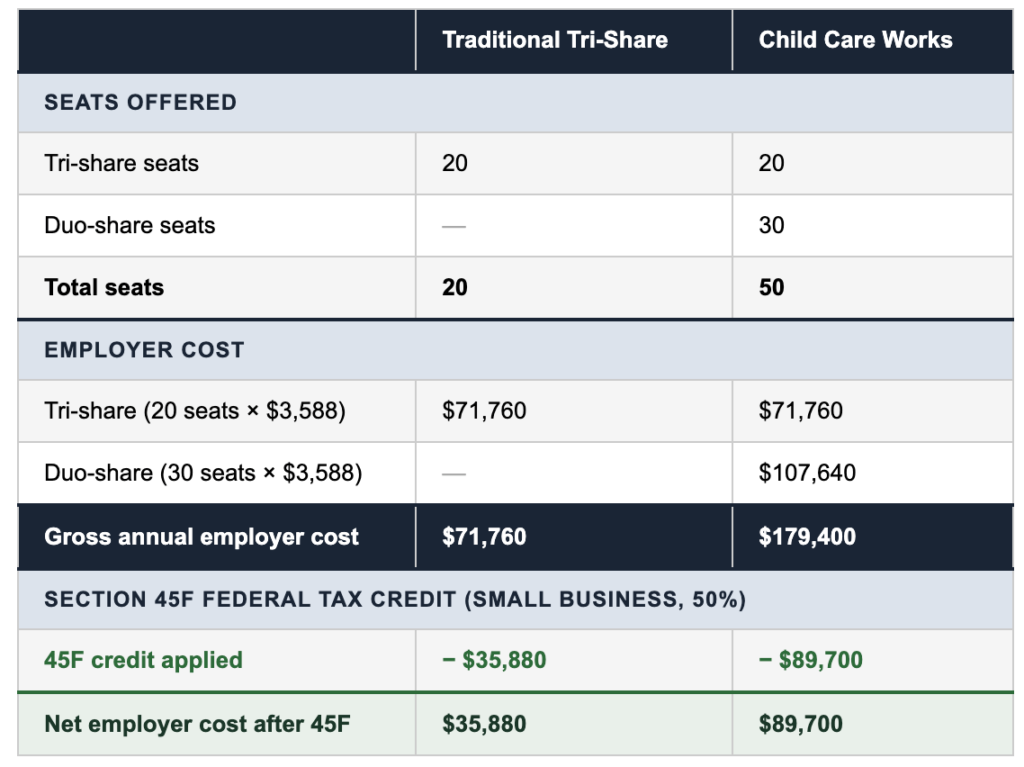
American families continue to struggle to afford child care. In fact, in a 2026 national poll conducted on behalf of First Five Years Fund, 80% of voters said working parents’ ability to find and afford child care is in a “state of crisis” or a “major problem.” Without sufficient federal funding to fill the gap, some states are implementing cost-sharing models to provide relief for families. Cost Sharing Models Cost-sharing models are a method of splitting child care costs among key stakeholders in order to make child care more affordable. Stakeholders often include families, employers, state and/or local funding sources, and philanthropic entities. Cost-Sharing In Missouri In Missouri, Child Care Aware of Missouri (CCAMO), in partnership with Kids Win Missouri, has implemented a unique cost-sharing initiative called Missouri Child Care Works (CCW). Executive Director of Kids Win Missouri, Brian Schmidt, recently detailed the program’s progress and key operational takeaways on his Substack . Missouri’s model is built around prioritizing local leadership, reducing administrative burden through supportive statewide infrastructure, and flexibility in funding structures. CCW recognized that local organizations are best positioned to know which employers are ready to engage, what local and philanthropic funding can be leveraged to support cost-sharing, and the needs of their communities. This meant creating a centralized platform to support these leaders in administering diverse funds to share the cost of care in ways that best suit their community. Additionally, Schmidt emphasized that the typical fixed three-way split between employer, employee, and a state funding source (known as tri-share) can be limiting, especially if not all employees meet the income eligibility requirements of that state funding source. As a result of this, CCW builds in alternative cost-sharing options, including duo-share, which allows the cost of care to be exclusively shared between employer and employee. To see other examples of Missouri’s flexible benefit structures click here . Progress in Missouri This focus on flexibility and local leadership has led to notable progress just five months after implementation. Currently: 34 employers are actively participating in Child Care Works, the majority of which are private businesses; In total, employers have committed more than 160 seats reserved for employees to fill as they enroll; 50 of these seats are already in active use. Cost-Sharing and 45F Cost-sharing models can be enhanced by taking advantage of the recent expansion of the child care tax credits (FFYF explains the expansion of these credits here ). The 45F tax credit is especially helpful, as it now allows larger businesses to deduct 40% of their qualified child care expenses (with a maximum credit of $500,000) and smaller businesses to deduct 50% of qualified child care expenses (with a maximum credit of $600,000). This means that businesses participating in cost-sharing would be able to receive up to 40% or 50% of those qualified expenses back as a credit that could be used to reduce their overall tax burden. CCW supports employers through the process of claiming the 45F credit in their continued effort to make participation in the cost-sharing model more affordable and attractive for businesses. Here is an example of how 45F could support cost-sharing in Missouri: Bottom Line Missouri has made progress in building its cost-sharing model by creating statewide infrastructure that empowers local leadership and increases funding flexibility. This approach allows businesses to participate in ways that are more predictable and better serve their workforce. Combined with the advantages of tax credits like 45F, this flexibility better supports families by making the Missouri model a more viable option for both businesses and local communities. The Missouri Child Care Works initiative reflects many of the strategies FFYF has championed to strengthen the child care system, including expanding access to affordable care, supporting working families, and fostering innovative public-private partnerships that engage employers in addressing child care challenges. The post Early Progress Found with Cost-Sharing in Missouri appeared first on First Five Years Fund .
10 Jun 2026

Lessons from the first state in the nation to offer universal child care
ALBUQUERQUE, N.M. — Like many families, Jessica and Adrian Garcia, who live in the mountain resort town of Ruidoso, had to cobble together different child care options for their son when they returned to work after his birth in 2023. Jessica, who works at the local branch of Eastern New Mexico University, and Adrian, a police officer, paid $300 a month for their son to attend daycare two days a week because they couldn’t afford full-time hours. Jessica’s mother also occasionally pitched in to care for the baby. At the time, Adrian had to bargain constantly with his boss to juggle graveyard shifts and child care, and if his schedule changed, his wife and mother-in-law both had to rearrange their own work on short notice to accommodate his. Before long, Jessica received an ultimatum from her job: If she couldn’t work full-time hours consistently, she would be demoted to a part-time position and lose the family’s health insurance benefits. Their luck turned last November when New Mexico became the first state in the country to launch free, universal child care for children from birth through age 13, regardless of household income. The expansion to a truly universal program “was just a big blessing to us,” said Jessica, who was able to enroll her son in full-time care. “It’s been a huge help.” New Mexico garnered a wave of attention when Gov. Michelle Lujan Grisham announced in September that all of the state’s families would be eligible for child care assistance. “Child care is essential to family stability, workforce participation, and New Mexico’s future prosperity,” she said at the time. In March 2026, requirements for the program shifted. Families earning up to 600 percent of the federal poverty line are now eligible for free child care without copays, the equivalent of a four-person family earning $198,000 annually. Copays beyond that threshold are also contingent on if the price of oil decreases. Participating families can choose from a wide range of options, including center-based care, home-based providers, before- and after-school care, and faith-based centers. On average, the universal program is expected to save participating families $12,000 a year. (Private providers still have the option to not serve families receiving child care assistance and continue to charge tuition.) What has received less attention outside New Mexico, however, is the state’s attempt to fairly compensate the long underappreciated and underpaid early childhood workforce. Because the state is now in charge of early education through the universal program, it has also stepped into the role of being responsible for child care wages. It has had to decide questions such as how to weigh experience against education in child care wages, how to financially incentivize centers to adopt rigorous measures of quality and a whole host of issues that have typically been left to the market. But the child care “market,” as it currently exists in other states, has primarily produced poverty wages for workers and exorbitant costs for families. There’s a hope that if New Mexico can iron out these issues, it can lead the way for other places that might want to implement a universal program, such as New York City. Mayor Zohran Mamdani announced earlier this year that the city will create 2,000 free child care slots for 2-year-olds in the city on its way to scaling up a universal and free program for all young children, but the city would need 30,000 new child care workers to make that work. New Mexico has currently set aside $60 million for increased wages for the state’s child care workforce. A working group is now refining a “wage scale and career lattice framework” intended to support experience, education and quality. “It’s so exciting to see New Mexico grapple with these questions,” said Lena Bilik, a senior program manager at the Roosevelt Institute, a left-leaning think tank that advocates for universal child care. “Other countries have realized this is a place where the government has to step in. If you’re going to expand your system, you can’t do it without increasing wages. That’s starting to be a bigger conversation.” Related: Young children have unique needs and providing the right care can be a challenge. Our free early childhood education newsletter tracks the issues. Child care providers and advocates in the state have different opinions about the efforts thus far. Barbara Luna Tedrow, a child care center owner in Farmington, first opened her business, A Gold Star Academy, over 25 years ago with 60 children and 10 staff members. Farmington is oil and gas country surrounded by badlands and grayish sands. It’s also just outside of Navajo Nation, making it a border town with a significant Native American population. Around 2012, Tedrow was approached by an oil field worker — New Mexico is the nation’s second-largest producer of oil — who offered to finance the construction of a second child care center. Over the next decade, grant funding and solid relationships with city officials helped her expand to five branches. Now, her team cares for 700 children, with 400 of those slots opened up in the past three years alone. Part of her success, she said, is because she worked to advocate for child care as a means of complementing oil and gas jobs. “If you want cities to flourish, they need high-quality child care,” she said. “All of these new employees want to go to work, but they can’t without it.” Tedrow’s employees receive medical, vision and dental insurance as well as a 401(k) retirement program, which together cost $15,000 per employee on top of their salary. Therefore, Tedrow said she worries about what might happen if state reimbursement rates decline in the future or if the state increases the minimum wage for employees without increasing the state reimbursement along with it. “We’re dependent on the state for wages, benefits and everything else to run a high-quality child care center,” she said. Mirna Polendo, the director of Imagination Station, a Christian preschool in the mountain resort town of Ruidoso, made some changes to her program when the state moved to a universal system. New Mexico pays enhanced rates to centers that are open at least 10 hours a day and that pay increased wages to teachers. Polendo extended her hours from 7:30 a.m. to 5:30 p.m. and bumped employee wages to $17 an hour to qualify for more state reimbursement. In return, Polendo receives $1,400 per month from the state to care for an 18-month-old infant, $1,075 for a toddler and $890 for kids ages 3 to 5. Across the board, the state reimburses more for care than private tuition ever did. If her center meets certain quality measures, the state reimbursements could be even higher. But one of those quality measures would require her to bump staff wages up to $18 an hour. That is right on the borderline of what Polendo can afford to pay staff while remaining in the black, she said — “I can’t do higher than that.” Olga Grays, a home daycare provider in Las Cruces, has worked as an early childhood educator for 20 years and is licensed to care for up to 12 kids at a time in her home. In her backyard and garden area, vibrant streams of papel picado — colored paper with intricate perforated designs — are taped up across the shaded patio. Colorful play structures and swings are a few steps away. The setup feels so personal, which Grays credits to the nature of the business. “Home daycares have this connection with parents that a lot of centers can’t,” she said. Some days, Grays opens up at 4 a.m. to accommodate a family, and closes as late as 11 p.m. Grays has to pay her employees $16 an hour to accept state subsidies and has chosen at this time not to make the changes to her business that would unlock larger reimbursement from the state. Olga Grays, owner of Mrs. Olga’s Daycare in Las Cruces, speaks during a “Day Without Child Care” event on May 12, 2025. Credit: Leah Romero/Source NM “I’d rather spend my time in daycare with children providing the services they need,” she said. “I don’t believe that taking the time out to do that paperwork will help them.” But that means that any of her employees could leave for another center that is paying more, she said. She supports linking wages to years of experience and educational attainments instead of focusing solely on a center’s quality metrics. While the work that remains is complex, that should not overshadow the years of effort and advocacy that it took for the state to reach this point, said Jacob Vigil, the chief legislative officer for New Mexico Voices for Children, a state advocacy group. “It took over a decade for us to get here,” Vigil said. “It was a campaign that was broad based and that had a diverse base of folks that really understood and coalesced around the messaging of why early childhood is important.” Contact editor Christina Samuels at 212-678-3635 or samuels@hechingerreport.org This story about universal child care was produced by The Hechinger Report , a nonprofit, independent news organization focused on inequality and innovation in education. Sign up for the Hechinger newsletter . The post Lessons from the first state in the nation to offer universal child care appeared first on The Hechinger Report .
10 Jun 2026
Statement: House Lawmakers Introduce Bipartisan Child Care Modernization Act to Strengthen Child Care Options for Working Families
WASHINGTON, D.C. — Representatives Ryan Mackenzie (R-PA), Susie Lee (D-NV), Ashley Hinson (R-IA), and Kristin McDonald Rivet (D-MI) today introduced the Child Care Modernization Act , bicameral, bipartisan legislation designed to strengthen the federal Child Care and Development Block Grant (CCDBG) program and better support the child care needs of working families across the country today. An identical bill was introduced last year in the Senate by Senators Deb Fischer (R-NE), Kirsten Gillibrand (D-NY), John Hickenlooper (D-CO), and Susan Collins (R-ME). The Child Care Modernization Act would help expand access to affordable, quality child care while giving states greater flexibility to address the unique needs of their communities. The legislation focuses on targeted efforts to increase child care supply and capacity, support child care providers, and improve access for working families struggling with the high cost of care. For the First Five Things to Know About the Child Care Modernization Act, click here : First Five Years Fund Executive Director Sarah Rittling praised the legislation and the bipartisan leadership behind it. “Child care continues to shape the daily decisions of working families, influencing when and where parents can work and how they plan for the future,” said Sarah Rittling, Executive Director of First Five Years Fund. “The Child Care Modernization Act provides an important opportunity to strengthen and sustain the child care sector while helping states better address child care needs in real time. Families can’t press pause on their child care needs, and this legislation helps expand child care options and respond to families’ needs today. We’re so grateful to Representatives Ryan Mackenzie, Susie Lee, Ashley Hinson, and Kristin McDonald Rivet for their bipartisan leadership and commitment to working together to expand child care options for families.” “Working families in the Lehigh Valley and the Poconos count on access to high-quality, affordable child care here in our community,” said Congressman Mackenzie. “After childcare costs skyrocketed by 29% from 2020-2024, it’s more important than ever that we deliver the relief and reform that working families need to thrive. By bringing federal childcare support in line with the modern needs of parents and providers, the bipartisan Child Care Modernization Act will help to improve access, affordability, and quality for everyone.” “Parents are doing everything right and still struggling to find and afford child care,” said Congresswoman McDonald Rivet (D-MI). “This bill helps by cutting red tape, supporting child care providers, and giving families more choices. It won’t solve the whole problem, but it’s a step in the right direction. We need to keep pushing for the investments and reforms that working families deserve.” “Childcare remains one of the biggest household expenses for families in Iowa and across the country. After more than a decade without reauthorization, the federal government’s primary childcare program simply isn’t equipped to meet the needs of our families. That’s why I helped introduce bipartisan legislation to expand access to affordable, quality childcare and ensure every working family can access quality, affordable childcare. This bill tackles barriers that make it harder to open and grow childcare facilities, creating more options for parents and strengthening our workforce. Family is at the heart of everything I do, and I’ll keep fighting to make it easier to raise one,” said Rep. Ashley Hinson (R-IA). “It’s no secret how ridiculously expensive child care is in Nevada. Three out of four kids in our state do not have access to a licensed child care provider — that’s unacceptable. Parents shouldn’t need to choose between having a full-time job or taking care of their kids,” said Congresswoman Susie Lee (D-NV). “This isn’t a red or blue issue. I’m proud to introduce the bipartisan Child Care Modernization Act to address this crisis by helping child care providers expand their reach and allowing more families in our community to access the high-quality child care they need.” About the Bill: The legislation would create child care supply and facilities grants to help providers expand and improve care options, including funding for the renovation, repair, and construction of child care facilities. The bill would also move the program towards using more accurate cost estimation models for provider reimbursement rates under CCDBG, helping states better align payments with the true cost of providing quality care. Additionally, the legislation maintains state flexibility through a mixed-delivery approach that supports a variety of child care settings, including licensed child care centers, home-based providers, and faith-based programs. It also includes additional technical assistance for in-home and rural child care providers and seeks to reduce regulatory barriers that can limit home-based care options in rural communities. Under the proposal, states would also have the flexibility to expand eligibility and serve more working families who may currently struggle with the cost of child care but do not qualify for assistance today. Endorsed by: Afterschool Alliance, Alliance of New York State YMCAs, Buffett Early Childhood Institute, Child Care Aware of America, Children First PA, Early Care and Education Consortium (ECEC), Executives Partnering to Invest in Children (EPIC), Fight Crime: Invest in Kids, First Five Nebraska, First Five Years Fund, Groundwork Ohio, Home Grown, Independent Restaurant Coalition, KinderCare Learning Companies, Learning Care Group, Local Initiatives Support Corporation (LISC), Low Income Investment Fund (LIIF), Moms First, Michigan’s Children, Mission Readiness, National Association for the Education of Young Children (NAEYC), National Association of Counties (NACo), National Head Start Association (NHSA), National Association of Women Business Owners (NAWBO), National Child Care Association, National Children’s Facilities Network, National Conference of State Legislatures, Ready Nation, Save the Children, SCAN Iowa Start Early, Tootris, U.S. Chamber of Commerce, YMCA of the USA, and Zero to Five Montana. The post Statement: House Lawmakers Introduce Bipartisan Child Care Modernization Act to Strengthen Child Care Options for Working Families appeared first on First Five Years Fund .
9 Jun 2026
First Five Things To Know About: The Child Care Modernization Act
Parents need child care options that meet their family’s unique needs and support their child’s healthy development. Yet today, far too many working families struggle to find and afford the care they need. On September 17, 2025, Senators Deb Fischer (R-NE), Kirsten Gillibrand (D-NY), John Hickenlooper (D-CO), and Susan Collins (R-ME) introduced the bipartisan Child Care Modernization Act in the Senate, legislation that would strengthen the federal Child Care and Development Block Grant (CCDBG) program in order to better address child care needs facing parents today and in the future. On June 9, 2026 Representatives Ryan Mackenzie (R-PA), Susie Lee (D-NV), Ashley Hinson (R-IA) , and Kristin McDonald Rivet (D-MI) today introduced the Child Care Modernization Act in the House of Representatives. Here are the First Five Things to Know about the Child Care Modernization Act : Working families with young children need affordable, quality child care. And they need it today. The average cost of child care today is more than $13,000 a year, by far the largest expense many families with young children face. Nine in ten Republicans (91%) think it’s a problem or crisis that Americans can’t afford child care, along with 91% of Independents, and 97% of Democrats. The Child Care Modernization Act helps parents have more options by creating new child care supply and facilities grants. These grants would help providers expand the supply, quality, and capacity of child care. They also would help to fund the renovation, repair, and construction of child care facilities. This helps improve both the supply and quality of care, especially in high-need communities. The Child Care Modernization Act would also help better support the dedicated child care professionals taking care of children. CCDBG reimbursement rates paid to providers currently do not cover the actual cost of providing quality care. Under this bill, states will design a “cost estimation model” to calculate provider payment rates, leading to more accurate and reliable estimates. (States would have five years to make updates, ensuring they have ample time to adapt.) And it would help states better meet the needs of their local communities. The legislation maintains state flexibility in choosing how to use their block grant across a variety of settings (also known as “mixed delivery,”) for maximum efficiency. It also provides additional technical assistance to in-home and rural child care providers so they have the support they need, as well as directing the Department of Agriculture to remove some regulatory burdens that can restrict home-based child care providers in rural areas. The legislation gives states the flexibility to support more working families. Under the Child Care Modernization Act, states could serve more working families by expanding eligibility to those who may be struggling with the cost of child care but aren’t currently eligible for CCDBG. And the bill also continues to ensure parents can choose the type of child care setting that works best for them, including licensed child care centers, home-based providers, and faith-based programs. The Bottom Line The Child Care Modernization Act enables states to better address the growing child care needs of working families, providers, and employers. This bipartisan legislation strengthens and sustains the Child Care and Development Block Grant (CCDBG), which helps states offer essential child care support to hundreds of thousands of working families with young children. By increasing the availability of quality child care in local communities, the bill ensures that parents have more options to meet their needs. It reinforces the existing CCDBG framework while laying the groundwork for future investments through the appropriations process, ensuring the program can continue to evolve and respond to the changing needs of families, children, and communities now and into the future. Our Take “Access to affordable, reliable child care is one of the biggest challenges facing working families. The Child Care and Development Block Grant (CCDBG) is a vital part of facing that challenge head on. We’re grateful to Senators Deb Fischer (R-NE), Kirsten Gillibrand (D-NY), John Hickenlooper (D-CO), and Susan Collins (R-ME) for their bipartisan leadership in introducing the Child Care Modernization Act. This legislation offers an important opportunity to strengthen and sustain CCDBG while also addressing child care needs in real time. This will help serve more families both now and in the future.” – Executive Director Sarah Rittling, First Five Years Fund Supporters Include First Five Years Fund Afterschool Alliance Bipartisan Policy Center Action Buffett Early Childhood Institute Child Care Aware of America ECEC Executives Partnering to Invest in Children (EPIC) Independent Restaurant Coalition KinderCare Learning Companies (KLC) Low Income Investment Fund Moms First National Association of Counties (NACo) National Association for the Education of Young Children (NAEYC) National Association of Women Business Owners (NAWBO) National Child Care Association National Children’s Facilities Network Save the Children Start Early Tootris YMCA Statements of support can be found here . Learn More FFYF’s CCDBG overview provides an in-depth look at how CCDBG helps meet the needs of children, parents, and child care providers in all 50 states. The FFYF CCDBG state fact sheets show the reach, eligibility, and impact of CCDBG in all 50 states. These FY2026 Dear Colleague letters highlight Members of Congress from both parties who support prioritizing funding for CCDBG. Official press statement from Senate Offices: Fischer, Colleagues Introduce Bipartisan Bill to Expand Working Families’ Access to Child Care . Statements of support from organizations can be found here. And for a deeper dive into policy, FFYF has a side-by-side comparison of the Child Care Modernization Act and the current law. Download First Five Things – Child Care Modernization Act 2025 (177.78 kB) The post First Five Things To Know About: The Child Care Modernization Act appeared first on First Five Years Fund .
9 Jun 2026
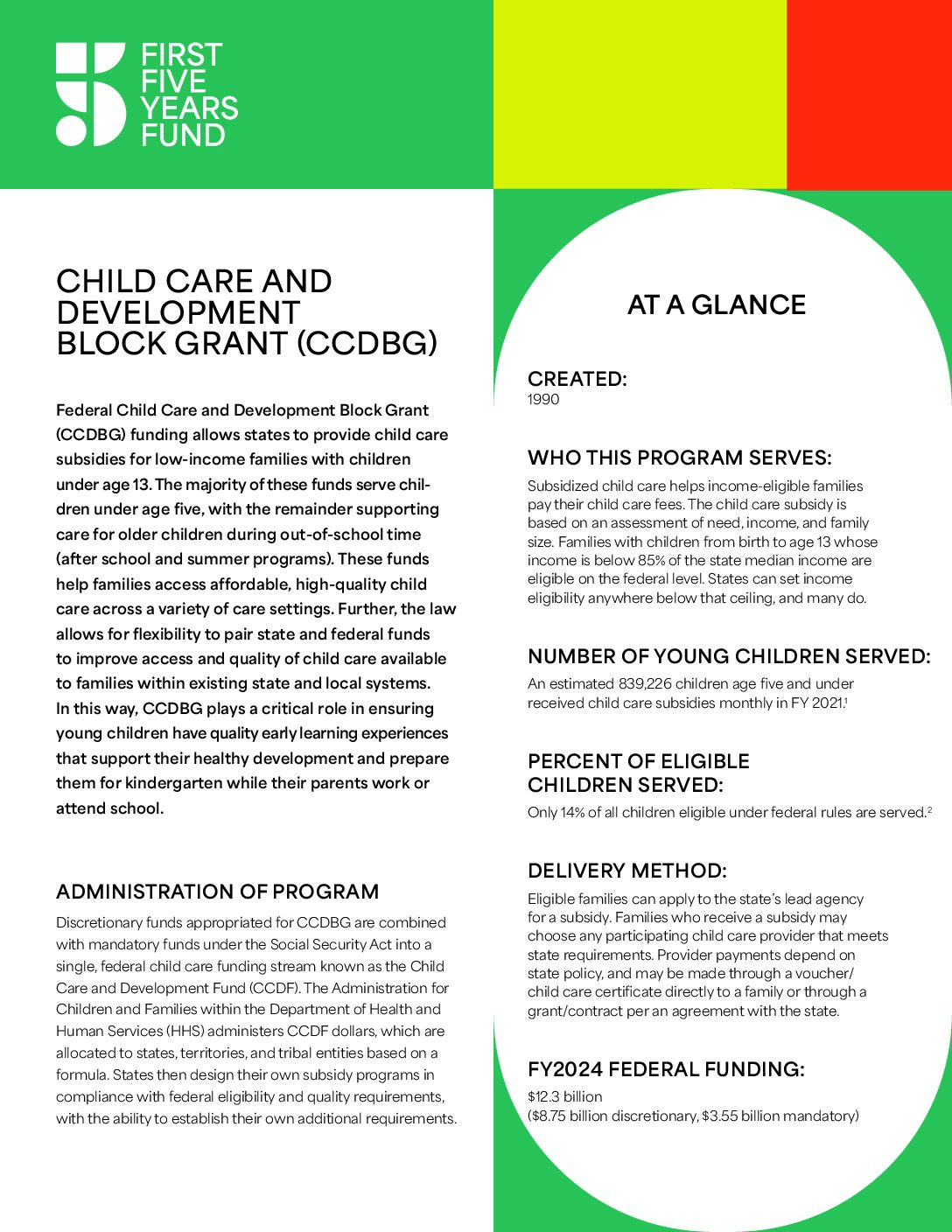
CCDBG: Overview
The Child Care and Development Block Grant (CCDBG) Act provides federal funding to states for child care subsidies for low-income families with children under age 13. Download (423.42 kB) The post CCDBG: Overview appeared first on First Five Years Fund .
8 Jun 2026
FFYF Capsule Collection: Fiscal Year 2027 Appropriations
Overview Each year, Congress determines funding levels for all federal defense and non-defense discretionary programs, including those that support the care and education of children from birth through age five. Over the past fifteen years, federal early learning programs have seen steady, significant increases through increased, bipartisan investments from both Congress and the White House. These funds provide the backbone of child care and early learning in our nation. Annually, nearly $31.30 billion in federal mandatory and discretionary funds support early care and education for children birth to five, compared to $15.36 billion in state match spending. Child Care and Development Block Grant (CCDBG): The largest source of federal funding for child care. Congress sets funding levels; states have flexibility in how funds support families and providers in their communities. Early Head Start/Head Start: Delivers comprehensive early learning, health, nutrition, and family support services for eligible children and their families. Preschool Development Grant Birth through Five (PDG B-5): Help states strengthen, align, and expand their early learning systems. Key Info Committees The initial spending bill for child care and early learning programs is overseen by the Labor-Health and Human Services-Education and Related Agencies subcommittee (or “Labor-H”). Senate Appropriators : Committee Chair Susan Collins (R-ME), Ranking Member Patty Murray (D-WA). Labor-H Subcommittee Chair Sen. Shelley Moore Capito (R-WV), Sen. Tammy Baldwin (D-WI) House Appropriations : Committee Chair Tom Cole (R-OK), Ranking Member Rosa DeLauro (D-CT). Labor-H Subcommittee Chair Rep. Robert Aderholt (R-AL), Ranking Member Rosa DeLauro (D-CT) 2026 Dates March 17: FFYF’s hosts “FFYF’s ABCs of Federal Early Learning” briefing on the Hill for Members and staff. March 25: The child care and early learning community sends Congressional appropriators a Community Letter calling for increased funding in FY27 March 27 : Deadline for House Dear Colleague letter s in support of FY27 child care and early learning funding. April 3: White House Budget Proposal released April 20: Democratic Senators submit a Dear Colleague letter in support of federal funding for child care and early learning programs. June/July: Potential markup from Appropriators (with initial decisions on funding levels) June 5: The House Appropriations Subcommittee on Labor, Health and Human Services, Education, and Related Agencies held a budget hearing regarding the Department of Health and Human Services. September 30: End of the Fiscal Year. Congress must either pass a spending package by midnight, a temporary “Continuing Resolution,” or face a government shutdown. The Letters FY27 Dear Colleage Letter Recap! : An overview of the FY27 Dear Colleague letters with statistics on number of signers. FY27 Dear Colleague Letters : Dear Colleague letters from Republicans and Democrats with funding asks for child care and early learning programs. Community letter : FFYF and a coalition of 89 child care and early learning organizations from 32 states have a new letter to Congressional appropriators calling for increased funding for federal early learning and care programs, including: CCDBG: Increase of at least $3.57 billion, for a total of at least $12.4 billion Early Head Start/Head Start: Increase of at least $1.91 billion for a total of at least $14.27 billion PDG B-5: At least $315 million Ask Please urge your Members of Congress to show support for the child care and early learning programs working families need. Share this Action Toolkit with information, emails, social posts, more Take direct action here! Resources From topline to in-depth, these resources can be used in meetings with staffers, with reporters, or simply to get up to speed on the importance of federal funding to child care and early learning. FY27 Key Early Learning Programs : A chart explaining the funding timeline of FY27 funding decisions from the White House and Congress. The First Five Things to Know: Appropriations FY27 : What you need to know about FY27 appropriations and it’s impact on child care and early learning. ABCs of Federal Early Learning Programs : Contains an overview of each of the federally funded early learning and care programs. Federal Funding is Foundational : The federal government provides the majority of public funding needed to undergird the child care in the United States. Polling – In this 2026 polling, nearly three out of four voters (74%) say federal funding for child care and early learning is a good use of tax dollars, including 53% of Republicans, 77% of Independents, and 93% of Democrats. Video – ABCs of Federal Early Learning Programs : This 2-minute video explains how federal funding helps families find and afford quality child care and early learning programs for their young children. Events FFYF’s ABCs of Federal Early Learning briefing Looking Back: FY26 FY26 Capsule Collection : Links to all of the updates and resources used during the FY26 Appropriations process. FY26 State of Play : Track what happened and when Key Early Learning Programs FY26 : Funding levels across key programs, including initial levels proposed by the community, White House, House, and Senate as well as what was included the final spending package. FY26 Early Learning and Child Care Appropriations Letters : Dear Colleague letters from Republicans and Democrats with funding asks for child care and early learning programs. The post FFYF Capsule Collection: Fiscal Year 2027 Appropriations appeared first on First Five Years Fund .
5 Jun 2026
STATEMENT: FFYF Executive Director Sarah Rittling on Proposed FY27 House Funding Levels for Child Care and Early Learning Programs
On June 4th, the House Labor, Health and Human Services, Education, and Related Agencies Appropriations Subcommittee released its FY2027 funding proposal , including federal investments in child care and early learning programs. The House proposal would provide a $10 million increase for the Child Care and Development Block Grant (CCDBG), and a $10 million increase for Early Head Start/Head Start. The proposal would also eliminate funding for the Preschool Development Grants Birth through Five (PDG B-5) program. Sarah Rittling , Executive Director of First Five Years Fund, released the following statement: “Families across the country are counting on Congress to prioritize child care and early learning and we are pleased to see lawmakers continue to do so. Increased funding proposed for both the Child Care and Development Block Grant (CCDBG) and Head Start in the House FY27 Labor-H Appropriations bill will help ensure these critical programs continue to support these families with access to care. These programs play a foundational role in helping working families afford child care, supporting children’s healthy development, and strengthening communities in every Congressional district. “At the same time, we are concerned by the proposal to eliminate Preschool Development Grants Birth through Five (PDG B-5). This program helps states build stronger, more coordinated early childhood systems and better connect families with the services they need. “Supporting programs that help parents find reliable, affordable care for their little ones is both pro-work and pro-family. When Congress invests in these resources, it makes it easier for parents to work, gives children the opportunity to learn and thrive, and helps build a stronger economy for everyone. “We are thankful to leaders from both parties on the House Appropriations Committee and Labor-H Subcommittee for their support of the child care and early learning programs that families rely on every day. We urge the Senate to build on these investments by prioritizing robust funding for CCDBG and Head Start while maintaining support for PDG B-5. Doing so would help more families access affordable child care, support providers, and give more children the opportunity to grow, learn, and thrive.” House Proposal The House Labor-HHS appropriations proposal includes: Child Care and Development Block Grant (CCDBG): $10 million increase at $8.8 billion; Early Head Start/Head Start: $10 million increase at $12.3 billion; Preschool Development Grants Birth through Five (PDG B-5): Eliminated. Learn More: FY27 Key Early Learning Programs : A chart explaining the funding timeline of FY27 funding decisions from the White House and Congress. Support from Members of Congress : This year, the annual Member led Dear Colleague letters supporting funding for child care and early learning programs saw record levels of support for CCDBG, Head Start, and PDG B-5. The First Five Things to Know: Appropriations FY27 : What you need to know about FY27 appropriations and it’s impact on child care and early learning. ABCs of Federal Early Learning Programs : Contains an overview of each of the federally funded early learning and care programs. Federal Funding is Foundational : The federal government provides the majority of public funding needed to support child care in the United States. Polling – In this 2026 polling, nearly three out of four voters (74%) say federal funding for child care and early learning is a good use of tax dollars, including 53% of Republicans, 77% of Independents, and 93% of Democrats. The post STATEMENT: FFYF Executive Director Sarah Rittling on Proposed FY27 House Funding Levels for Child Care and Early Learning Programs appeared first on First Five Years Fund .
4 Jun 2026
FFYF Statement on H.R.7726: Concerns and Recommendations around Accountability and Access
Federal support for child care through the Child Care and Development Fund (CCDF) is foundational to the health and well-being of children, families, and the broader economy. The program helps working families afford care and supports the healthy development of young children. Fraud or misuse of child care funds is unacceptable. It undermines public trust and diverts limited resources away from eligible families, many of whom remain on waiting lists and urgently need assistance. At the same time, efforts to address fraud should be carefully targeted to protect program integrity without disrupting access for the families and providers who participate in good faith and represent the overwhelming majority of participants. First Five Years Fund appreciates Congressional efforts to build upon the current oversight structures in CCDF to help ensure these funds are used as intended to support working families with young children. However, FFYF has significant concerns with H.R. 7726, the “Stop Child Care Scams Act of 2026.” This bill not only misses the opportunity to strengthen child care but could have sweeping negative consequences for states, providers and families. FFYF outlined detailed concerns in a comment letter submitted to the House Committee on Education and Workforce earlier this year. Particularly of concern are provisions that would: Automatically consider unintentional reporting errors from child care programs as fraud, punishing providers for accidental oversights. Fail to give states adequate time to demonstrate progress toward compliance. Create confusion among states and the federal government regarding who holds responsibility and authority for fraud prevention. Impose sanctions that are not proportional to the severity and persistence of the noncompliance. And ultimately make it harder for parents to find and afford the child care they need. We urge Congress to ensure that enforcement mechanisms are explicitly tied to intentional misconduct, sanctions are proportional to the severity and persistence of noncompliance, and that states demonstrating good-faith progress toward compliance have a meaningful opportunity to do so before facing consequences as severe as funding ineligibility. Accountability and access are not mutually exclusive. The families and providers who depend on child care deserve policies that reflect both priorities, and we encourage Congress to renew their focus on advancing constructive, bipartisan policies that support the care and early learning needs of our nation’s families with young children. Additional Details The detailed FFYF response to the proposed legislation is outlined in the comment letter FFYF submitted to the House Committee on Education and Workforce in March. Specifically: Withholding CCDF funding from an entire state would ultimately harm the children and providers who depend on these resources, not just the bad actors the policy intends to target. Permanent debarment provisions that do not explicitly limit enforcement to intentional misconduct risk penalizing providers operating in good faith , and would require significant new federal administrative capacity that the bill does not account for. Improper payments are not fraud. They often result from paperwork errors and administrative mistakes, not intentional misconduct . Treating them the same produces penalties that are far too severe for the underlying problem, and causes harm to the families these programs exist to serve. States operating complex child care systems in good faith deserve a clearly defined, reasonable path to compliance before facing consequences as severe as funding ineligibility. For states, the consequences include: Loss of federal funding that supports entire state child care systems , triggered by error rates that may reflect administrative complexity rather than systemic failure. Diversion of already-strained administrative resources away from serving families and toward compliance and corrective action. For the child care market and the families it serves the consequences include: Provider closures and funding disruptions in states that lose CCDF eligibility would reduce the overall supply of child care. This would drive up costs and wait times exponentially for families who remain in need of child care, in a market without subsidies. The Bottom Line The consequences of this law would fall hardest on the lowest-income working families and smallest providers, the precise populations federal child care funding exists to support, while doing little to deter the intentional bad actors the policy is designed to target. The post FFYF Statement on H.R.7726: Concerns and Recommendations around Accountability and Access appeared first on First Five Years Fund .
2 Jun 2026
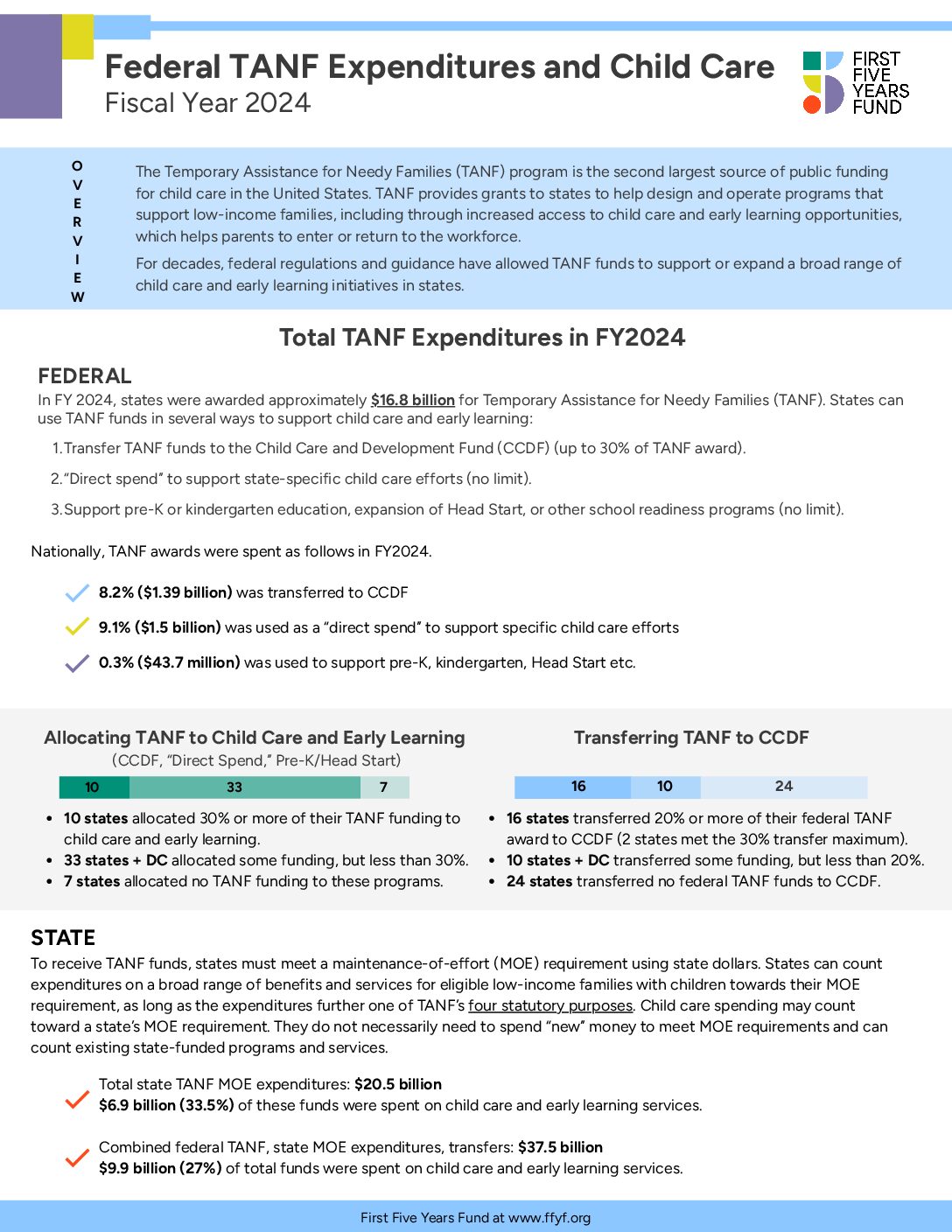
Federal TANF Expenditures in FY 2024
Overview The Temporary Assistance for Needy Families (TANF) program is the second largest source of public funding for child care in the United States. TANF provides grants to states to help design and operate programs that support low-income families, including through increased access to child care and early learning opportunities, which helps parents to enter or return to the workforce. For decades, federal regulations and guidance have allowed TANF funds to support or expand a broad range of child care and early learning initiatives in states. Downloadable version with chart Total Federal TANF Expenditures in FY 2024 In FY 2024, states were awarded approximately $16.8 billion for Temporary Assistance for Needy Families (TANF). See the chart below for details on how each state used these funds to support child care and early learning. States can use TANF funds in several ways to support child care and early learning: Transfer TANF funds to the Child Care and Development Fund (CCDF) (up to 30% of TANF award). “Direct spend” to support state- specific child care efforts (no limit). Support pre-K or kindergarten education, expansion of Head Start, or other school readiness programs (no limit). Nationally TANF awards were spent as follows in FY 2024: 8.2% ($1.39 billion) was transferred to CCDF 9.1% ($1.5 billion) was used as a “direct spend” to support specific child care efforts 0.3% ($43.7 million) was used to support pre-K, kindergarten, Head Start etc. CCDF Transfer 16 states transferred 20% or more of their federal TANF award to CCDF (2 states met the 30% transfer maximum). 10 states + DC transferred some funding, but less than 20%. 24 states transferred no federal TANF funds to CCDF. CCDF, “direct spend” child care, and pre-K/Head Start 10 states allocated 30% or more of their TANF funding to child care and early learning. 33 states + DC allocated some funding, but less than 30%. 7 states allocated no TANF funding to these programs. State MOE Expenditures To receive TANF funds, states must meet a maintenance-of-effort (MOE) requirement using state dollars. States can count expenditures on a broad range of benefits and services for eligible low-income families with children towards their MOE requirement, as long as the expenditures further one of TANF’s four statutory purposes . Child care spending may count toward a state’s MOE requirement. They do not necessarily need to spend “new” money to meet MOE requirements and can count existing state-funded programs and services. Total state TANF MOE expenditures: $20.5 billion $6.9 billion (33.5%) of these funds were spent on child care and early learning services. Combined federal TANF, state MOE expenditures, transfers: $37.5 billion $9.9 billion (27%) of total funds were spent on child care and early learning services. Download with chart Download TANF to Child Care Chart (432.47 kB) The post Federal TANF Expenditures in FY 2024 appeared first on First Five Years Fund .
1 Jun 2026
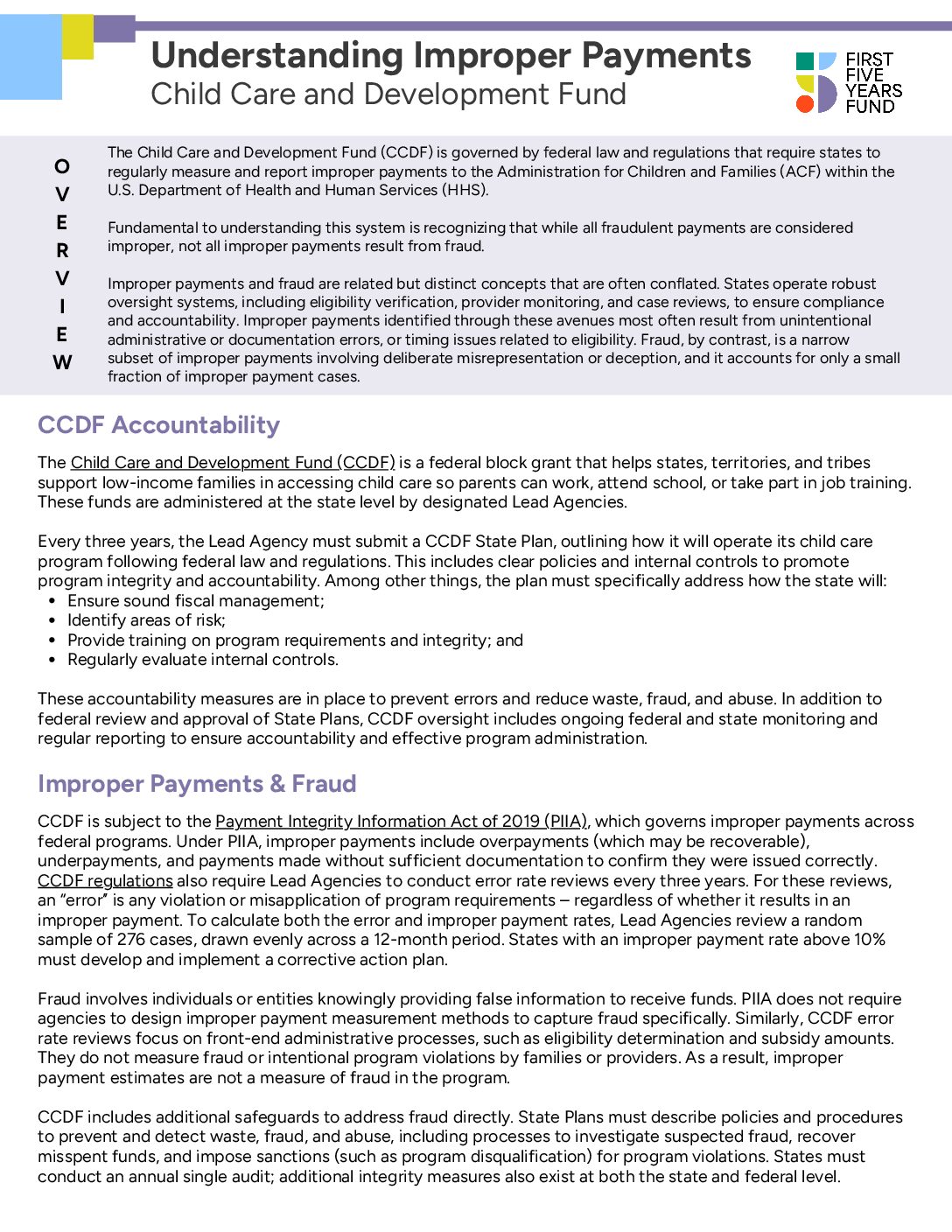
Understanding Improper Payments: Child Care and Development Fund
Overview The Child Care and Development Fund (CCDF) is governed by federal law and regulations that require states toregularly measure and report improper payments to the Administration for Children and Families (ACF) within the U.S. Department of Health and Human Services (HHS). Fundamental to understanding this system is recognizing that while all fraudulent payments are considered improper, not all improper payments result from fraud. Improper payments and fraud are related but distinct concepts that are often conflated. States operate robust oversight systems, including eligibility verification, provider monitoring, and case reviews, to ensure compliance and accountability. Improper payments identified through these avenues most often result from unintentional administrative or documentation errors, or timing issues related to eligibility. Fraud, by contrast, is a narrow subset of improper payments involving deliberate misrepresentation or deception, and it accounts for only a small fraction of improper payment cases. Downloadable Version Here CCDF Accountability The Child Care and Development Fund (CCDF) is a federal block grant that helps states, territories, and tribes support low-income families in accessing child care so parents can work, attend school, or take part in job training. These funds are administered at the state level by designated Lead Agencies. Every three years, the Lead Agency must submit a CCDF State Plan, outlining how it will operate its child care program following federal law and regulations. This includes clear policies and internal controls to promote program integrity and accountability. Among other things, the plan must specifically address how the state will: Ensure sound fiscal management; Identify areas of risk; Provide training on program requirements and integrity; and Regularly evaluate internal controls. These accountability measures are in place to prevent errors and reduce waste, fraud, and abuse. In addition to federal review and approval of State Plans, CCDF oversight includes ongoing federal and state monitoring and regular reporting to ensure accountability and effective program administration. Improper Payments & Fraud CCDF is subject to the Payment Integrity Information Act of 2019 (PIIA) , which governs improper payments across federal programs. Under PIIA, improper payments include overpayments (which may be recoverable), underpayments, and payments made without sufficient documentation to confirm they were issued correctly. CCDF regulations also require Lead Agencies to conduct error rate reviews every three years. For these reviews, an “error” is any violation or misapplication of program requirements – regardless of whether it results in an improper payment. To calculate both the error and improper payment rates, Lead Agencies review a random sample of 276 cases, drawn evenly across a 12-month period. States with an improper payment rate above 10% must develop and implement a corrective action plan. Fraud involves individuals or entities knowingly providing false information to receive funds. PIIA does not require agencies to design improper payment measurement methods to capture fraud specifically. Similarly, CCDF error rate reviews focus on front-end administrative processes, such as eligibility determination and subsidy amounts. They do not measure fraud or intentional program violations by families or providers. As a result, improper payment estimates are not a measure of fraud in the program. CCDF includes additional safeguards to address fraud directly. State Plans must describe policies and procedures to prevent and detect waste, fraud, and abuse, including processes to investigate suspected fraud, recover misspent funds, and impose sanctions (such as program disqualification) for program violations. States must conduct an annual single audit; additional integrity measures also exist at both the state and federal level. The Details: What the existing safeguards and oversights looks like State Oversight Internal Controls: States must maintain strong controls across eligibility verification, provider licensing, attendance tracking, and payment authorization to ensure accurate and proper payments. Risk Assessments: States identify and manage risks in eligibility and payment processes through tools such as data matching, real-time system alerts, and routine quality assurance and supervisory reviews. Provider Monitoring: States conduct annual, unannounced inspections of providers receiving CCDF funds to ensure compliance with health and safety requirements. Single Audits: States that expend $750,000 or more in federal funds annually are subject to organization-wide audits under the Uniform Guidance. Findings of unallowable CCDF costs result in disallowances, requiring repayment or offset of misspent funds. State Audits and Inspector General Reviews: State auditors and inspectors general regularly review CCDF expenditures and drawdown practices to ensure compliance and accountability. Fraud Detection and Investigations: States investigate complaints, conduct reviews of providers and families, and refer cases for enforcement action when warranted. Federal Oversight (ACF/HHS) CCDF State Plan Approval : ACF reviews and approves multi-year State Plans that detail eligibility policies, payment practices, provider requirements, and internal controls. Payment Management Review: States access CCDF funds through a federal payment system and must certify that expenditures are allowable, properly documented, and tied to eligible services. Program Reviews and Monitoring : ACF conducts ongoing monitoring, including onsite and desk reviews, to assess compliance with CCDF requirements, with a focus on fiscal controls, eligibility determinations, and payment accuracy. Audit Resolution : Federal audits, including Single Audits under the Uniform Guidance, identify questioned or disallowed costs and may require repayments, corrective action, or additional conditions on future funding. Targeted Conditions or Restrictions : When risks are identified, HHS may impose additional oversight, such as enhanced documentation requirements, restrictions on drawdowns, or prior approval for expenditures. Sanction Authority : Following due process, HHS may require repayment of improperly spent funds, reduce a state’s administrative allotment by up to the amount misspent, or apply additional sanctions as appropriate. Though fraud is identified from time to time, it represents a distinct and narrow category, involving deliberate misrepresentation, that makes up the minority of improper payments. As such, improper payment rates are best understood as program integrity measures used to identify areas for improvement, rather than direct indicators of wrongdoing. Strong state oversight remains central to safeguarding CCDF funds, while ensuring eligible families can access child care. Download Here Download Improper Payments 2026 Explainer (162.81 kB) The post Understanding Improper Payments: Child Care and Development Fund appeared first on First Five Years Fund .
1 Jun 2026
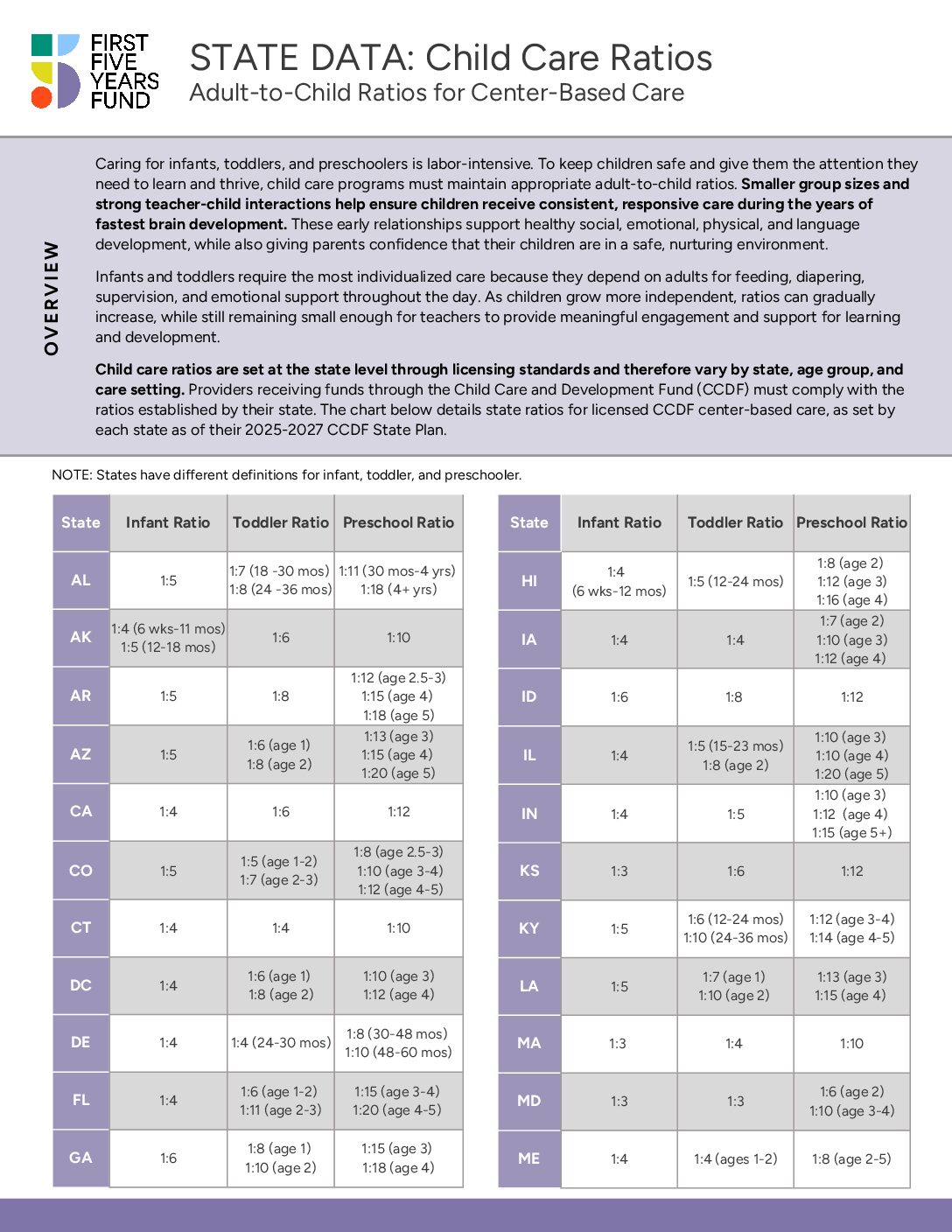
State Data: Child Care Ratios – Adult-to-Child Ratios for Center-Based Care
Caring for infants, toddlers, and preschoolers is labor-intensive. To keep children safe and give them the attention they need to learn and thrive, child care programs must maintain appropriate adult-to-child ratios. Smaller group sizes and strong teacher-child interactions help ensure children receive consistent, responsive care during the years of fastest brain development. These early relationships support healthy social, emotional, physical, and language development, while also giving parents confidence that their children are in a safe, nurturing environment. Infants and toddlers require the most individualized care because they depend on adults for feeding, diapering, supervision, and emotional support throughout the day. As children grow more independent, ratios can gradually increase, while still remaining small enough for teachers to provide meaningful engagement and support for learning and development. Child care ratios are set at the state level through licensing standards and therefore vary by state, age group, and care setting. Providers receiving funds through the Child Care and Development Fund (CCDF) must comply with the ratios established by their state. The chart below details state ratios for licensed CCDF center-based care, as set by each state as of their 2025-2027 CCDF State Plan. Download (371.91 kB) The post State Data: Child Care Ratios – Adult-to-Child Ratios for Center-Based Care appeared first on First Five Years Fund .
29 May 2026

Summer camp is child care, but many families miss out
When Glennys Torres was looking for summer child care for her kids, she envisioned a program full of outdoor play and time spent with friends. But Torres quickly realized she didn’t have many options because of the cost. Each summer, she ended up enrolling them in a free school-based summer camp, but she said her kids spent too much time on screens. “I feel like that was the only choice that I had,” said Torres, a child care provider who lives in New York City. “Getting one that I would like my kids to go to, playing outside, doing a lot of activities, was really expensive.” Each year, parents of 24.6 million children in the United States hunt for structured summer experiences, including summer camps, sports programs or summer enrichment programs. These programs are a key form of child care for elementary age children and children who attend school-based preschools that don’t operate during the summer. But nationwide, 51 percent of children are unable to enroll, mostly due to high costs and a lack of transportation, according to a new report by the nonprofit Afterschool Alliance . Low- and middle-income families are especially likely to miss out on summer opportunities; 13 percent of low-income children attend summer camp, compared to 45 percent of those in high–income families, according to the report. “Finding affordable summer programs for their children is one of the greatest challenges many working families face,” said Jodi Grant, the Afterschool Alliance’s executive director, in a statement. “Parents need to stay in their jobs to provide for their families, but they can’t find affordable summer programs. So instead of being active, engaging with peers and caring adults, and learning new skills over the summer, their children may be unsupervised, on screens, at risk, and in some cases without healthy food during the summer months.” Research shows summer camps can influence career interests , improve social skills and contribute to higher self-esteem . Although free and low-cost camps exist, experts say that in many communities the demand outpaces the supply. Some school districts have cut back on summer learning opportunities in recent years after Covid relief funds, which helped pay for those programs , ran out. Some nonprofits have tried to expand free camp offerings to families that would otherwise miss out. In New York City, the Fresh Air Fund runs six sleepaway camps north of the city, offering free camp experiences for low-income New York students starting at age 8. The camps also provide clothes, sleeping bags and other items to children when they attend. “All the kids of New York City deserve the exact same access to the outdoors, the exact same access to learning about who they are in a summer situation, the exact same access to creating community and new friendships,” said Lisa Gitelson, the chief executive officer of the Fresh Air Fund. For that to happen, more funding needs to be provided for camps, in recognition that they are a form of child care, she added. “For parents to be able to work, they need somewhere for their kids, always, whether that’s school year or summer.” Two years ago, Torres was given a flyer about the sleepaway camps. She applied for her son, Evander, who was 8 at the time. Evander said he missed his parents at first, but he was excited to meet new people and spend his days swimming and playing basketball, kickball and soccer. And he learned a lesson that he says other kids should learn too: “It’s not only fun to be on electronics when you can go outside and breathe the fresh air and play.” This story about summer camp was produced by The Hechinger Report, a nonprofit, independent news organization focused on inequality and innovation in education. Sign up for the Hechinger newsletter . The post Summer camp is child care, but many families miss out appeared first on The Hechinger Report .
28 May 2026

New Report Shows Nearly Half of All Young Children Live in Child Care Deserts
Access to child care plays a key role in supporting parent workforce participation and the healthy growth and development of children. Yet for far too many families, this essential support is out of reach. Families across the nation find themselves living in child care deserts—areas where there are three or more children, aged five and under, per licensed child care slot. Without enough slots, children are unable to receive the care they need, and parents are forced to make difficult decisions that may cause them to leave the workforce or settle for child care that does not align with their needs and preferences. The Center for American Progress (CAP) recently released a report updating their data on the current state of our nation’s child care supply, as well as a map that provides a visual representation of child care deserts across the country. The report reveals that while overall access is marginally improving, it has worsened in rural communities. Some key findings from the report are listed below. For CAP’s full analysis and policy recommendations, click here . Key Findings Nationally, in 2025, 46% of children ages five and under lived in a licensed child care desert, a slight improvement compared to 51% in 2018. In rural communities, this trend is moving backwards. In 2025, the number of children ages five and under living in child care deserts rose to over 70%, up from around 66% in 2018. The prevalence of licensed child care deserts varies significantly from state to state with the extremes being: Highest rates of child care deserts: Idaho (83%), Hawaii (95%), and Alaska (96%). Lowest rates of child care deserts: Washington D.C. (5%), Massachusetts (21%), and New Jersey and Nebraska (25%). In line with these findings, FFYF has found that at current funding levels, federal early learning programs serve only a small fraction of eligible families. FFYF polling underscores that voters recognize this gap in access and support meaningful solutions and investments. This support is nationwide, including amongst rural voters who feel the weight of this issue the heaviest. FFYF Polling on All Voters Four out of five rural Americans say the ability of working parents to find and afford quality child care is either in a state of crisis or a major problem. Over two-thirds (69%) of rural Americans say federal funding for child care and early learning programs is a good investment of taxpayer money, and a strong majority (55%) would like to see that funding increase. FFYF Polling on Rural Americans 80% of voters say the ability of working parents to find and afford child care is either in a state of crisis or a major problem. 75% of voters believe child care funding should be increased or kept at current levels. Bottom Line The current supply of child care is not sufficient to support the needs of families who deserve quality care. This is especially true in rural communities where one in five parents are struggling to find or keep a job or cutting back on basic necessities due to child care challenges. Robust federal investment for child care programs is necessary to support financial stability for families, healthy development for children, and to strengthen our economy overall. Questions? Contact Holly Evans at hevans@ffyf.org The post New Report Shows Nearly Half of All Young Children Live in Child Care Deserts appeared first on First Five Years Fund .
27 May 2026
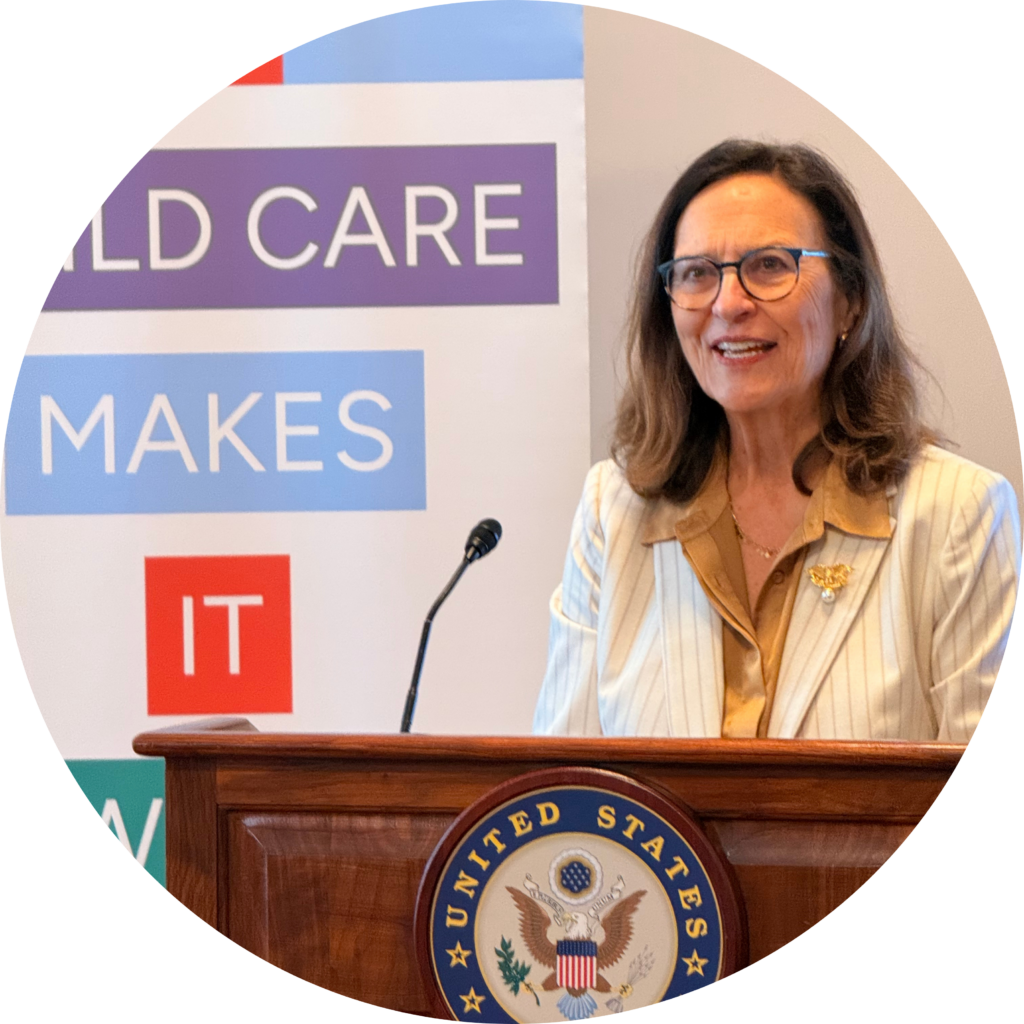
“Child Care Makes It Work!” Reception on Capitol Hill
What a wonderful evening on Capitol Hill! On May 20, First Five Years Fund hosted “Child Care Makes Things Work,” a bipartisan reception celebrating the essential role child care plays in supporting working families, businesses, and the economy. The event also marked the launch of FFYF’s inaugural Federal-State Partnership Program, bringing together child care advocates and providers from 15 states to meet directly with lawmakers and congressional staff about the importance of strengthening federal child care policy. The room was filled with Members of Congress, congressional staff, child care providers, advocates, and state partners from across the country who were all united around a shared goal: ensuring families can find and afford quality child care and that providers have the support they need to serve their communities. The evening highlighted the bipartisan Child Care Modernization Act , legislation designed to strengthen the federal Child Care and Development Block Grant (CCDBG) program and better address the child care challenges facing families today and in the future. Guests heard remarks from bipartisan champions of the legislation, including Senators Susan Collins, Deb Fischer, and John Hickenlooper , who spoke about the importance of child care to families, local economies, and the workforce. The evening was moderated by FFYF Executive Director Sarah Rittling, who thanked lawmakers and advocates for their continued leadership and emphasized the urgency of strengthening child care investments nationwide. “At First Five Years Fund, we believe every family should be able to find and afford child care that works for them,” Rittling said. “But right now, too many parents are struggling with costs, and too many providers are struggling just to keep their doors open. That’s why the Child Care Modernization Act is so important. It’s a practical, bipartisan effort to strengthen the Child Care and Development Block Grant program and help states better meet the needs of families, providers, and employers.” She also thanked the bipartisan sponsors of the legislation, Senators Fischer, Kirsten Gillibrand, Hickenlooper, and Collins, for their leadership and commitment to working families across the country. Most importantly, the reception celebrated the partnerships that make progress possible. Throughout the evening, advocates from 15 states connected with congressional offices to share firsthand stories about the challenges families and providers face and the importance of bipartisan federal solutions that help child care work better for everyone. The post “Child Care Makes It Work!” Reception on Capitol Hill appeared first on First Five Years Fund .
27 May 2026
VIDEO: The Child Care Modernization Act
Families need affordable child care options that meet their unique needs and support their children’s healthy development. The bipartisan Child Care Modernization Act would enable states to better meet the growing child care needs of working families, providers, and employers. In a nutshell, the bill would strengthen child care by working with states to design a more accurate way of determining provider reimbursement rates. It provides additional technical assistance to in-home and rural child care providers. And it would continue to ensure parents can choose the type of child care setting that works best for them, including licensed child care centers, home-based providers, and faith-based programs. The post VIDEO: The Child Care Modernization Act appeared first on First Five Years Fund .
26 May 2026

Want to boost early literacy skills? Try singing
Parents and educators intuitively know the many benefits of singing and music for young children. It’s why children learn the alphabet through song, PBS’ Daniel Tiger sings to teach emotional regulation, and lullabies are used to lull babies to sleep. But there is also a growing body of research backing a link between music and brain development — specifically, reading skills. Studies have found that singing helps children learn vocabulary and identify sounds in words , known as phonological awareness. Listening to music also reduces anxiety and supports bonding between caregivers and children, research shows. Playing instruments has been found to strengthen fine motor control and executive function . Experts say making more time for music in early childhood classrooms could be a way to improve child outcomes, especially at a time when reading scores have stalled post-pandemic. “Increasingly in early childhood education, if you look at the requirements, we’re urging literacy and mathematical competence,” said Dennie Palmer Wolf, a principal researcher at the research and consultancy group WolfBrown, and author of a recent report with Carnegie Hall’s Weill Music Institute on how music affects child development. “Visual arts, dance, music get pushed to the side.” When it comes to access to music, opportunities are uneven and limited for many children. In the earliest years, exposure to the arts is largely contingent on the capacity and resources of parents or caregivers. And although almost anyone can sing or chant, many caregivers lack confidence in their musical abilities, Palmer Wolf said. Children’s music classes can be costly, and access to free options, like those at public libraries, varies greatly by community. In some states, nonprofits are trying to close the gap by bringing music programs into places already frequented by families and young children. In Minnesota, the MacPhail Center for Music , a music school that serves thousands of students a year in the Twin Cities, has partnered with local health clinics to offer free parent-child music classes. In Houston, the Prelude Music Foundation offers free music classes in local early childhood programs, with an emphasis on underserved communities. And in New York City, the Weill Music Institute has launched music initiatives in child care programs, public hospitals and correctional facilities to encourage parents to sing and make music with their children. Another state-funded project in Minnesota provided $600,000 for an intervention called Tune Into Reading . From 2016-2021, children in 25 of the state’s elementary schools used karaoke-like software that encouraged more singing. “Singing is natural, it precedes talking,” said Ann C. Kay, co-founder and education coordinator of the project. By encouraging more singing, Kay said, teachers can “develop young brains for reading.” The program, run by a nonprofit called the Rock ‘n’ Read Project, was used for 14 hours over a span of 12 to 16 weeks. A report to the legislature after the program concluded said that children who participated made notable literacy gains . The program has shifted to bringing more music to early childhood classrooms by educating educators and parents on the literacy-related effects of music and singing. This year, the Rock ‘n’ Read Project is partnering with four Head Start pre-K classrooms in Minneapolis to train teachers and encourage daily singing and basic music skills, like beats, rhythm and pitch. By introducing music early, Kay says the program hopes to build early literacy skills and ultimately close reading achievement gaps. “Auditory processing is the key to language and literacy,” Kay said. “This is how it starts.” This story about early literacy was produced by The Hechinger Report, a nonprofit, independent news organization focused on inequality and innovation in education. Sign up for the Hechinger newsletter. The post Want to boost early literacy skills? Try singing appeared first on The Hechinger Report .
14 May 2026
State Of Play: NPRMs
On May 11, 2026, the Administration released two announcements specific to child care and early learning at the federal level through the “Notices of Proposed Rulemaking (NPRM)” process. Here’s what to know. Background Head Start NPRM Child care final rule Background Reauthorization vs. Regulation Reauthorization: A process through which Congress provides structural updates and policy reforms to improve a program through legislation. Federal programs including Head Start and the Child Care and Development Block Grant (CCDBG), are typically reauthorized every five years – though programs can, and often do, function with expired authorizations because they can continue through annual funding decisions made by Congress. Regulation: Rules written by administration officials to explain “how” to carry out the mandates established by laws. Regulations help fill technical gaps when interpreting statute, but relying solely on regulation to adapt policy can leave programs outdated and vulnerable to shifting administrative priorities across administrations. CCDBG was last reauthorized by Congress in 2014 (authorization expired in 2020). Head Start was last reauthorized by Congress in 2007 (authorization expired in 2012). https://www.regulations.gov/learn has more information. Overview: Notice of Proposed Rulemaking (NPRM) An NPRM (Notice of Proposed Rulemaking) is a formal announcement published in the Federal Register when a Federal Agency intends to add to, remove from, or otherwise change policy through a rule or regulation. Interested parties then have a set number of days (usually 30 or 60) to submit public comments, after which the agency is required to review and analyze all comments. After considering all comments the agency issues a Final Rule including a “preamble” explaining the rule’s purpose and responding to major public concerns. Published in the Federal Register today, May 11, 2026 Head Start Notice of Proposed Rulemaking (NPRM) “ Restoring Flexibility to Support Head Start Program Access ,” a proposed rule by the Department of Health And Human Services, Administration for Children and Families. What’s Included: The NPRM removes requirements that were effective October 1, 2024, related to wages (implemented by August 1, 2031) and benefits (implemented by August 1, 2028) in the Head Start program. The following requirements are now proposed for elimination: Rolling Back Wage Requirements, including: Developing or updating formal pay scales for all staff Paying education staff wages comparable to public preschool teachers Providing salaries sufficient to cover basic living costs Promoting wage comparability between Head Start Preschool and Early Head Start staff Rolling Back Benefits Requirements, including: Health insurance and paid leave benefits Behavioral health supports Access to child care subsidies and student loan forgiveness Periodic reassessment of benefits packages NOTE: The Following 2024 Requirements Are NOT Currently Proposed for Removal The 5/11/26 NPRM explicitly states that other portions of the 2024 Head Start rule are not currently being rescinded , although HHS invites comments on whether additional changes should be considered later. These include: Mental health and wellness supports outside compensation mandates. Staff breaks and workforce wellness provisions not tied directly to compensation. Various program quality and operational changes. Most education, family engagement, and health requirements. Next Steps: Interested parties have 30 days to provide comments and feedback to the Administration for Children and Families, with instructions provided in the Federal Register. Learn More The Core Elements of Head Start About Early Head Start/Head Start : An Overview Child Care and Development Fund (Final Rule) “ Restoring Flexibility in the Child Care and Development Fund ,” a Final Rule by the Department of Health And Human Services, Administration for Children and Families. Background: A NPRM was originally released in January 2026. During its 30-day comment period, “HHS received 1,244 comments from State human services and educational agencies; members of the U.S. Congress; national, State, and local early childhood and family-focused advocacy organizations.” What’s Included : The final rule repeals the following requirements in the Child Care and Development Fund Program: (Note: It remains allowable for States to implement these measures in their subsidy programs; it is no longer a requirement to do so.) Capping CCDF family co-payment at 7% of income. Paying child care providers prospectively (at the start of the service period). Pay providers based on a child’s enrollment rather than daily attendance. Providing some direct services through grants or contracts. Next Steps: The Final Rule will go into effect 60 days after it is published in the Federal Register. Learn More Reauthorizing CCDBG through the bipartisan Child Care Modernization Act Enrollment vs. Attendance : What it means for providers Please contact Amanda Guarino, Managing Director of Policy & National Partnerships, at aguarino@ffyf.org with any questions. The post State Of Play: NPRMs appeared first on First Five Years Fund .
11 May 2026

Data centers, air pollution, climate math: Lessons from a climate and education conference
PROVIDENCE, R.I. — Students who attend schools near data centers are more likely to see their math performance decline than those who don’t. Attending school near noisy airports is also associated with declines in math scores. After participating in a math lesson incorporating information on renewable energy, U.S. students were more likely to say they knew about climate change and felt some hope about combating it. Children in India who learned about air pollution in arts lessons were more likely to understand the environmental problem, but not necessarily to change their behavior in ways that might alleviate it. Those were among the research findings, many of them preliminary, discussed at a conference I attended last week on climate change and education organized by SustainableED , a Brown University program. It was started last year by Matthew Kraft, an education and economics professor, to support research on schools, learning and climate change — and get that work in front of policymakers. At the event, Kraft said it was important to expand the conversation around climate change by connecting it to other issues people care about — such as students’ health, their success in school, and their “sense of community and belonging.” “We can talk about it in terms of dollars and cents, and operational expenditures, and potential savings,” he added. “We can talk about it in terms of operational performance, keeping school buildings open and functioning.” Here are some research highlights and other takeaways from the conference: Universal schooling is climate policy , according to Harry Patrinos, a professor at the University of Arkansas, who presented research on whether schooling drives pro-environmental behavior. His review of existing studies, including on the effects of compulsory education laws in Europe, suggest that people who spent an additional year in school were more likely to be aware and concerned about climate change and to align themselves with green political parties. Math scores for students in schools within a mile of data centers declined more than for students in schools between one and two miles away, according to Samantha Kane, a postdoctoral research associate at Brown. Her preliminary findings suggest that there is a statistically significant drop in the math scores of third graders who attend schools near the centers, which emit harmful pollutants linked to asthma and other health problems. Children in schools near more than one data center saw even sharper declines. It’s not just air pollution — noise pollution was also associated with declines in math scores , according to research by Josh Aarons, a doctoral student at the University of California San Diego. He looked at schools in “noise corridors” near the Seattle-Tacoma International Airport, and found that the math scores of students there saw a significant decrease. That suggests schools need to invest in noise insulation in classrooms, he said. Even relatively small doses of instruction can increase students’ understanding and sense of hope around climate issues. The study in India, a randomized control trial, found that after just three, 60-minute lessons, students were more likely to understand air pollution issues, according to Ashutosh Bhuradia, a Ph.D. candidate at Harvard University’s Graduate School of Education. After participating in several roughly 60-minute climate-related lessons in one of four subject areas — art , algebra , English and science — students said they knew more about climate change and had a greater sense of purpose around climate action, according to research presented by Margaret Wang, a cofounder of SubjecttoClimate, which connects teachers with climate lessons. Prompting students to change their behavior is possible too, though it may be harder to achieve. Students in Bhuradia’s study were no less likely to take a climate-related action — in this case, to choose an environmentally friendly incense instead of a regular one, and to donate to a classroom “clean air fund” — after participating in the lessons. In the study from Wang, though, participating students did report a greater willingness to take actions like buying energy-saving lightbulbs, washing clothes at lower temperatures, and writing to elected officials. Sixty of the nation’s 200 largest school districts have adopted environmental and sustainability policies , compared with 51 in 2020, according to Carine Verschueren, a postdoctoral research associate at the University of Illinois-Urbana Champaign. A growing share of the policies discuss climate change and climate justice, often because of activism from students, whose role was mentioned in many of the documents, Verschueren said. School districts were motivated to adopt the policies for a variety of reasons — including conserving resources, promoting student and staff health, saving money and empowering students. Contact editor Caroline Preston at 212-870-8965, via Signal at CarolineP.83 or on email at preston@hechingerreport.org. This story about climate education in schools was produced by The Hechinger Report , a nonprofit, independent news organization focused on inequality and innovation in education. Sign up for Hechinger’s climate change newsletter . The post Data centers, air pollution, climate math: Lessons from a climate and education conference appeared first on The Hechinger Report .
10 May 2026

Home-based child care programs are struggling to survive
In the last half of 2025, Gertrudis Espinal watched as, one by one, children left the child care program she runs out of her home in the Bronx. The city had run out of voucher money that her families needed to pay for care, and by February, she only had seven children enrolled – half as many in the previous year. “We should be focusing on teaching the kids right now,” Espinal said, rather than having to fight for funding. “It’s their future.” In New York City, most of the low-income families who use a child care voucher enroll their children in home-based programs. But those small programs are uniquely vulnerable to economic shocks because they enroll fewer children than center-based programs and have less access to grants and resources than other child care settings. Some organizations are trying to help with various initiatives designed for home-based providers. Espinal is one of 50 Bronx-based child care providers who benefited from a guaranteed income pilot program called the Thriving Providers Project , a national program run in six states by the nonprofit Home Grown , which supports home-based child care. Beginning in June 2024, Espinal received $1,000 monthly, paid out every two weeks for 18 months, which she could use with no restrictions. She used the funds to buy supplies, like books, paint, and a sand and water sensory table for the children in her care, and paid electricity bills, which in the past she’d had to put on her credit card. “It gave me peace of mind,” said Espinal. “I have the money, so your mind is focusing on what you need to, [like] training and teaching these kids to develop their skills and the foundation,” she said. “You’re in peace of mind, so you are projecting a more peaceful and a better environment to the kids.” Educators and experts say this kind of support, in particular programs that help boost wages for employees, could be life-changing for providers and help stabilize the shaky industry. “Family child care is still waiting for compensation that is matching the true cost of care,” said Lara Kyriakou, senior director of policy at All Our Kin , a nonprofit that supports family child care providers and that partnered with Home Grown to run the Bronx pilot program. “Educators are really concerned about being able to take care of their own personal and family needs, and being able to meet the needs for their program and the children they care for.” Research that Stanford University’s Center on Early Childhood conducted on Thriving Providers shows that the predictable funds allow early educators to pay off debts and buy food; in some cases, it’s the difference between keeping their businesses open or closed. Child care income can fluctuate based on enrollment, attendance and state voucher policies, which makes reliable income more critical, experts say. With predictable funds, “you are able to just continue functioning without any concerns about funding,” said Kyriakou. That supports providers but also enables a “continuity of care and a stable, nurturing environment” for children. Elizabeth Olivo, a Bronx-based home-based provider who also participated in the Thriving Providers Project, said she used the stipends to purchase essential materials and supplies for her program. “Nearly every major operating expense for my family child care program has increased, making it more challenging to maintain stability while continuing to provide quality care for families,” Olivo said by email. (Recent research shows operating costs have increased for providers across the country, who in many cases are passing those costs on to families.) Olivo fears what will happen to the industry if the current status quo continues. “If these rising costs continue without additional support,” she said, “many family child care providers may struggle to remain open.” Research shows even modest cash bonuses and stipend programs for providers in states like California and Virginia improved chronically low early educator retention rates . In the District of Columbia, which offered a wage supplement of $10,000 to $14,000 per year to home and center-based providers beginning in 2022, research found child care employment increased by 7 percent within two years. New York child care advocates are also hoping that $500 million for child care that was included in a Senate budget proposal will make it into the state’s final budget. That money could provide additional compensation to child care providers to boost their chronically low wages. Nationwide, their median salary is around $13 an hour. Child care providers may have to continue looking to private initiatives such as Thriving Providers, and to cities and states for support, as opposed to the federal government. In early April, President Trump said “it’s not possible” for the federal government to pay for child care costs. “We’re fighting wars. We can’t take care of day care. You got to let a state take care of day care, and they should pay for it too,” Trump said. In recent months, however, many states have started slashing such funds , creating longer waitlists for families in need of payment assistance and forcing programs to close. The District of Columbia’s pay equity initiative is also at risk of elimination . For Espinal, her business is struggling again now that the payment program has ended. As children lost their vouchers and her enrollment dropped, she had to let her assistants go. Once again, she is worried about being able to pay her expenses. “We really need more of this funding, not just in a project, but consistently,” she said. “Early childhood needs to be funded so we can thrive, so we don’t have to be fighting to thrive.” This story about home child care was produced by The Hechinger Report, a nonprofit, independent news organization focused on inequality and innovation in education. Sign up for the Hechinger newsletter . The post Home-based child care programs are struggling to survive appeared first on The Hechinger Report .
7 May 2026
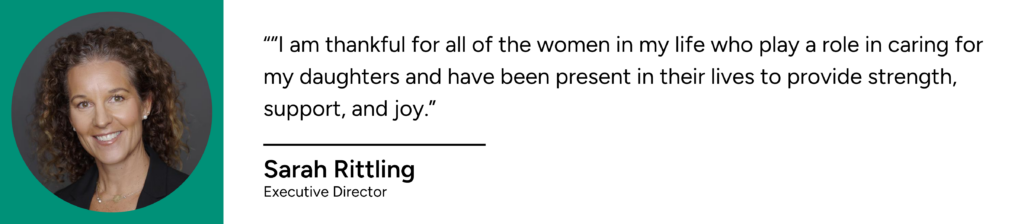
Celebrating Mother’s Day and Provider Appreciation Day with the FFYF Team
With Mother’s Day this Sunday and Provider Appreciation Day on May 8th, it’s important to recognize and appreciate the important partnerships between mothers, child care providers, and early educators. Child care and early learning programs allow mothers to stay in the workforce and support their families. Limited access to affordable, quality programs can force mothers to leave their jobs, limiting their lifetime earnings and economic contributions. This Mother’s Day, we’re amplifying the voices of working mothers on our own team and recognizing the integral work of mothers, providers, and educators everywhere. When mothers lack these necessary services, it impacts both their short-term financial security and their long-term retirement savings . To correct this, Congress needs to protect and prioritize support for working parents, child care providers, and early educators, ensuring that children across the nation get the care they deserve. Happy Mother’s Day from FFYF! The post Celebrating Mother’s Day and Provider Appreciation Day with the FFYF Team appeared first on First Five Years Fund .
7 May 2026
TOOLKIT: CCDBG Fact Sheets
MESSAGE: CCDBG helps working families with young children afford child care. FFYF’s new fact sheets have data and information on how CCDBG works in each state. Please help share these with Members of Congress, staffers, reporters, and advocates to continue to strengthen support for this important program. Families need affordable child care options that meet their unique needs and support their children’s healthy development. Many working families, however, struggle to find and afford the care they need. The Child Care and Development Block Grant (CCDBG) is a federal program with a long history of bipartisan support that helps more than a million children from lower-income families access child care. Funded by the federal government and administered by states, the program allows parents to choose child care that fits their family’s needs, including centers, home-based care, or faith-based programs. Since CCDBG offers states flexibility in how funding is used, the program looks a little different in each of the 50 states and D.C. These new state fact sheets from FFYF highlight the various ways this essential program works in every state. CCDBG is vital in strengthening working families, fostering child development, and fueling our economy. This is information our Members of Congress need! Please share these fact sheets and urge your Members to support this important program. hiGHLIGHTS sHARE pOST tAKE aCTION Highlights In 22 states, families can save more than $1,000/month (on average) using CCDBG subsidies. In 12 states, a family’s maximum CCDBG co-pay for child care is less than $100 a month. Due to limited federal funding, 39 states are serving less than 20% of the children who qualify for CCDBG subsidies. sHARE WITH YOUR NETWORK Below is a template message you can share with your network. We encourage you to customize this text to fit your organization’s messaging and calls to action. Child care is essential, but it can be difficult for families to find and afford. The Child Care and Development Block Grant (CCDBG) is an important part of the solution, helping more than a million lower-income families afford the child care they need. CCDBG is funded by the federal government and administered by states, which have flexibility in how the program operates. As a result, CCDBG specifics can vary significantly from state to state. First Five Years Fund has a new set of fact sheets with information on CCDBG in each state, including specifics on eligibility, co-pays, and implementation. These paint a picture of how this program supports hard-working families, fuels economic growth, and helps ensure children have safe, nurturing environments to learn and grow. Join me in taking action today: Share our fact sheets with Members of Congress [link], and urge them to continue to protect and prioritize CCDBG. Social MEDIA Content Below are some template posts and a graphic, you’re welcome to customize the social copy to fit your organizational needs. A family in [STATE] using subsidies from the federal child care program (CCDBG) saves an average of [$NUMBER] every month. ffyf.org/ccdbg-state-sheets Families in every state rely on the federal child care program (CCDBG) to afford the quality early learning and child care they rely on. #childcare ffyf.org/ccdbg-state-sheets Curious to see how your home state uses CCDBG to help families afford child care? Check it out: #childcare ffyf.org/ccdbg-state-sheets Congress: Support working families while providing opportunities for our nation’s youngest learners, in every state. See how your state uses CCDBG today! #childcare ffyf.org/ccdbg-state-sheets Ways to Take Action Below are the actions FFYF will be sharing for people to contact their Members of Congress. Please help us spread the word through the FFYFF Action Center or post your own actions! Send a Letter to the Editor: Tell Congress why CCDBG is important to your state Send an LTE Share important information on CCDBG with your Member of Congress Send a Message The post TOOLKIT: CCDBG Fact Sheets appeared first on First Five Years Fund .
6 May 2026
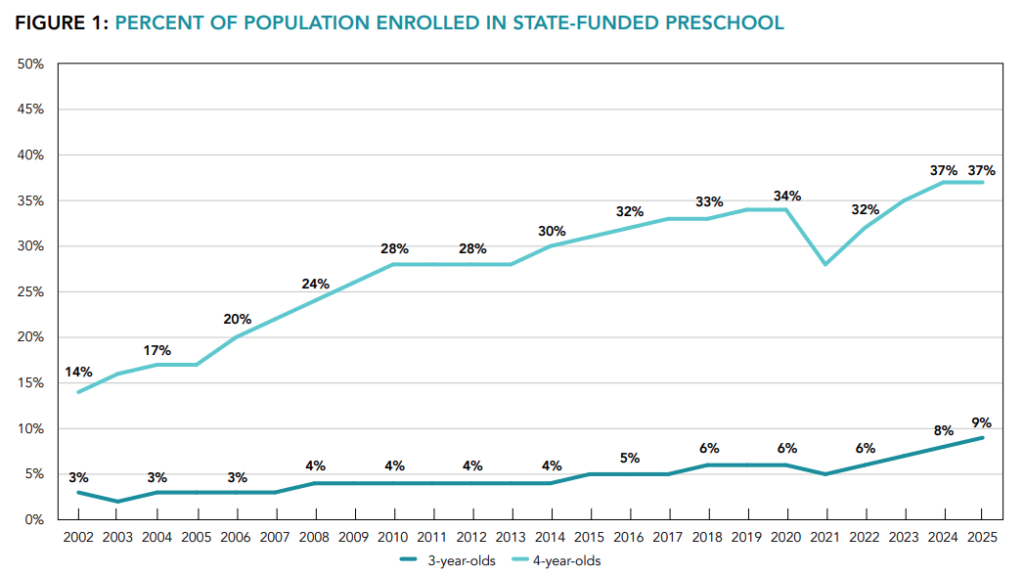
NIEER’s New State of Preschool Yearbook Highlights State Progress and Challenges
The National Institute for Early Education Research (NIEER) released their 2025 State of Preschool Yearbook , which offers a comprehensive analysis of state-funded preschool programs during the 2024-2025 school year. Currently in its 23rd edition, this report continues to serve as a crucial resource for policymakers, educators, and advocates, providing data-driven insights into enrollment trends, funding levels, and quality standards across the U.S. Overview The 2024-2025 school year represented another year of record highs in state support for preschool enrollment, quality, and funding. However, the pace of this growth significantly slowed from the 2023-2024 school year. The Yearbook provides key information that highlights the importance of federal early childhood funding in states, encourages policymakers to create policies that will preserve and increase investment, and highlights state progress and challenges. Key Takeaways Enrollment: Enrollment reached a new high of nearly 1.8 million children during the 2024-2025 school year. National enrollment for four-year-olds increased by 44,000 children in this school year, though the percentage remained the same as the previous year at 37%. National enrollment of three-year-olds increased by 8,000 children, bringing the percentage up to 9%. 12 states enrolled more than 50% of their four-year-olds in state-funded preschool. Funding: State preschool funding also reached a new high with states spending nearly $14.4 billion, an inflation-adjusted increase of $434 million (3%). All reported funding (state, local, and federal) in support of state preschool reached a high of nearly $17.7 billion, an inflation-adjusted increase of $2 billion (14%). State spending per child enrolled averaged $8,124, an inflation-adjusted increase of $45 per child. 28 states increased spending per child, adjusted for inflation. Quality: A record six states met all 10 of NIEER’s quality standards benchmarks: Alabama, Georgia, Hawaii, Michigan, Mississippi, and Rhode Island. Georgia became the newest state to enter this category by lowering their class sizes from 22 to 20 and improving their teacher-to-child ratios from 1:11 to 1:10, it is also the first state offering universal pre-K to meet this milestone. Another eight states met nine of NIEER’s quality standards benchmarks and 21% of children in state-funded preschool are enrolled in programs that meet nine or 10 benchmarks. 20 states still meet five or fewer of these quality standards benchmarks, these 20 programs serve 46% of children in state-funded preschool. FFYF Takeaway State-funded preschool programs are an important part of states’ early learning and care systems. State spending is steadily increasing, and non-state spending is increasing at a higher rate. While overall progress is important, the Yearbook found that this progress was not even among states. Some states made remarkable strides, while others remained stagnant or even slid backwards. Increased and sustained investment is necessary to improve quality and long-term outcomes nationwide. The post NIEER’s New State of Preschool Yearbook Highlights State Progress and Challenges appeared first on First Five Years Fund .
6 May 2026
Child Care Across America: 2026 CCDBG State Fact Sheets
The Child Care and Development Block Grant (CCDBG) is the federal government’s primary child care assistance program, helping more than a million children from lower-income families afford the care they need. Federally funded and administered by the states, CCDBG specifics, including eligibility, co-pays, and implementation, can vary significantly from state to state. FFYF has a new series of fact sheets which provide state-specific data on how CCDBG works, who it serves, and how it is funded. For example: In 22 states, families can save more than $1,000/month (on average) using CCDBG subsidies. In 12 states, a family’s maximum CCDBG co-pay for child care is less than $100 a month. Due to limited federal funding, 39 states are serving less than 20% of the children who qualify for CCDBG subsidies. And together, these state snapshots tell a larger national story: CCDBG is a proven, bipartisan program that supports hard-working families, fuels economic growth, and helps ensure children have safe, nurturing environments to learn and grow. The Report National Data In Your State Find your state! Alabama Alaska Arizona Arkansas California Colorado Connecticut Delaware District of Columbia Florida Georgia Hawaii Idaho Illinois Indiana Iowa Kansas Kentucky Louisiana Maine Maryland Massachusetts Michigan Minnesota Mississippi Missouri Montana Nebraska Nevada New Hampshire New Jersey New Mexico New York North Carolina North Dakota Ohio Oklahoma Oregon Pennsylvania Rhode Island South Carolin a South Dakota Tennessee Texas Utah Vermont Virginia Washington West Virginia Wisconsin Wyoming National Historical Data You can find a summary of and links to FFYF’s 2024 CCDBG state fact sheets here . The post Child Care Across America: 2026 CCDBG State Fact Sheets appeared first on First Five Years Fund .
30 Apr 2026

Screen time in the early grades: a parent and teacher weigh in
There’s a growing backlash to educational technology in the classroom, as I described in my story co-published with The New York Times in March. To dig deeper into the topic, I led a Hechinger Report webinar last week on screen time in the early grades . It featured Jill Anderson, a third-grade teacher in New York, and Miriam Kendall, a parent and head of the Illinois-based group Screen Sense Evanston. After initially embracing devices, Anderson has cut down on tech in her own classroom. Devices are “taking the social element out of learning, which I think is so important,” she said. “If we’re going to play a math game, why not play it with another child and learn to make eye contact and how to act when you win or lose?” She added: “I almost feel this responsibility to intentionally have less tech here to make sure that they don’t have an excessive amount in general.” Kendall said she worries about the “gamification” of learning — educational apps using reward systems to capture children’s attention. “I think we are training our kids’ brains that learning is like a video game,” she said. We got such a huge response from webinar participants — more than 700 of you signed up! — and didn’t have a chance to answer every question. So I wanted to tackle some of those questions here: After Anderson said that she noticed low-income students seem to have more screen time than more affluent students, a participant asked if there were any studies showing this to be true. Indeed, some studies have found this to be the case: One pre-pandemic study found lower-income children ages 0-8 spent more time on screens than middle- or higher-income children. A 2022 study found children whose families are higher income spend less time on screens, with the exception of video chats. Another participant asked if screen time has displaced play and learning life skills for young children. Studies have found that excess screen time is associated with lowered executive functioning . Other researchers have found that more screen time for toddlers was associated with less time playing with other children. One participant asked if literacy skills are dropping due to screen time because children are not reading as many books , and another asked if there is data connecting speech problems in young children to screen use. Literacy rates have been dropping for years, and while some researchers suspect screen time is a part of that trend, it’s not the sole cause. Poor reading instruction and lost learning time during the pandemic are among other potential reasons . As for speech, therapy referrals and speech delay diagnoses increased during and after the pandemic. A 2023 study found children who had more screen time at age one were more likely to have communication-related delays at ages 2 and 4. My recent story offers more detail on ed tech use in the early years, and we wrote a piece capturing reader response — pro and con — to the original story. I also filmed a short video of Anderson’s classroom and the full webinar can be viewed on YouTube. This story about screen time was produced by The Hechinger Report, a nonprofit, independent news organization focused on inequality and innovation in education. Sign up for the Hechinger newsletter . The post Screen time in the early grades: a parent and teacher weigh in appeared first on The Hechinger Report .
30 Apr 2026
House Passes SEED Act, Extending Educator Tax Deduction to Early Childhood Educators for the First Time
The Supporting Early-Childhood Educators’ Deductions (SEED) Act passed the U.S. House of Representatives. The bipartisan legislation would extend the existing federal educator expense tax deduction to early childhood educators, allowing them to deduct up to $350 in out-of-pocket classroom expenses for supplies, materials, and professional development. Statement from Sarah Rittling, Executive Director, First Five Years Fund: “The House’s passage of the bipartisan SEED Act marks an important victory for early childhood educators, working families, and America’s youngest learners. Passage of this bill demonstrates that child care remains a priority and that Congress understands the importance of taking every opportunity to support early childhood educators. “Every day, early educators help children learn, grow, and build the foundation they need for success in school and life, while also making it possible for parents to work and businesses to thrive. Despite earning modest wages, these educators often spend hundreds of dollars of their own money on books, classroom supplies, and learning materials. K-12 teachers are already able to deduct a portion of their out-of-pocket classroom expenses on their annual taxes. The SEED Act extends that same benefit to early childhood educators, recognizing the essential role they play and the personal financial sacrifices they make to support young children’s learning and development. “By easing a portion of the financial burden on early educators, the SEED Act helps retain the workforce that makes child care possible—supporting working families, strengthening businesses, and improving access to quality care. “We applaud Representatives Jimmy Panetta (D-CA), Brian Fitzpatrick (R-PA), Maggie Goodlander (D-NH), and David Valadao (R-CA) for their leadership and their commitment to the educators who care for our youngest children. The fact that the House has prioritized passing a stand-alone child care bill is a testament to the broad bipartisan recognition that supporting early educators and working families is both urgent and necessary. Their work on this legislation reflects exactly the kind of commonsense policymaking that child care providers and families need. “Now we urge the Senate to act swiftly and send this bill to the President’s desk. Senators Michael Bennet (D-CO) and Susan Collins (R-ME) have championed this effort from the start, and the case for passage is clear: when we support early educators, we support working families, strengthen businesses, and invest in the future of every child in America. The Senate should seize this moment.” Learn more: First Five Things to Know About the SEED Act , Letter in Support of SEED Act to House Ways and Means The post House Passes SEED Act, Extending Educator Tax Deduction to Early Childhood Educators for the First Time appeared first on First Five Years Fund .
27 Apr 2026
The Cost of Raising a Child Tops $300K, and Child Care Is a Major Driver
A new analysis from LendingTree finds the cost of raising a child in the U.S. now exceeds $300,000 over 18 years , highlighting the enormous financial pressure families face — particularly in the early years when child care costs are highest. Raising a child now costs $303,418 over 18 years , averaging $16,857 per year for a middle-income family. The first five years are by far the most expensive , costing families about $29,325 per year on average. Infant child care alone averages $17,264 annually , making it one of the single largest expenses families face. Even with a slight recent dip, child care costs have surged 46.9% since 2021 , far outpacing many other child-rearing costs. Families spend nearly 22% of their income on the basic costs of raising a young child. From FFYF’s Sarah Rittling: “Child care costs stretch household budgets to the breaking point. When the early years of raising a child are also the most expensive, it puts enormous pressure on parents who are trying to work and support their families. Congress has an opportunity to ease that burden by strengthening federal child care investments so more families can afford the care they need.” What’s Next: Congress can prioritize protecting and strengthening federal child care funding in the appropriations process so more families can afford care and providers can continue serving their communities. Learn more here. The post The Cost of Raising a Child Tops $300K, and Child Care Is a Major Driver appeared first on First Five Years Fund .
17 Apr 2026

The Friday Five: The Latest Child Care and Early Learning News
The child care and early learning news you don’t want to miss. Check here for updates every Friday for the latest information you need to know. April 17 This week’s Friday Five includes a quick roundup of the latest news and research on child care and early learning: The Washington Post dove into Congress, bipartisanship, and child care this week. Check out the full story. An annual survey from NAEYC found that the 2025 program year was especially challenging for providers and families. A recent report from NBC News shared how the updated child care tax credits make a big difference in the lives of families. A new analysis from LendingTree finds the cost of raising a child in the U.S. now exceeds $300K over 18 years, highlighting the enormous financial pressure families face, particularly in the early years when child care costs are highest. Last day: The Week of the Young Child ends today, check out our stat of the week to see the latest data on young learners in the U.S. and how we’re celebrating. April 10 Congress may be in recess but child care news never stops as appropriations season continues and tax season comes to a close. Read all the latest below FFYF released this statement in response to President Trump’s recommendations on discretionary funding levels for fiscal year 2027. The Week of the Young Child starts on April 11th, celebrating early learning, young children, their teachers, families, and communities. Need a funding refresher? Use this chart which explains the funding timeline of FY27 funding decisions from the White House and Congress. Hawaiʻi has received a one-year federal grant through the Preschool Development Grant Birth through Five (PDG B–5) Systems Building Grant program. More from Kaua’i Now . Last Chance: We are wrapping up tax season next week by highlighting how child care tax credits help make care more accessible and affordable for families nationwide. April 3 Child care continues to be a major issue for families, employers, and the economy. Check out the latest resources and stories on how tax policy, employer efforts, and public investments are helping support families and strengthen the economy. Join us this tax season in highlighting how child care tax credits help make care more accessible and affordable for families nationwide. Everyone relies on child care, even those without kids! This Denver Post story highlights how child care makes life run more smoothly for entire communities. Here are 3 real-world examples of companies leveraging the Employer-Provided Child Care Tax Credit (45F) to connect employees to child care while bringing increased stability to local providers. A recent report shared by 25 News Now in Illinois shows that child care challenges cost the state economy more than $6 billion annually. ICYMI: Check out Sarah Rittling’s ‘Executive Insights’ conversation at the Politico Economy Summit on how child care affordability plays a big role in making our economy stronger. March 27 Affordability is on everyone’s minds right now. Whether you’re a parent or a business owner or a Member of Congress! Lawmakers are hearing about the rising cost of both accessing and running child care from constituents everywhere they go. Read today’s Friday Five for more on the child care affordability conversation: FFYF joined policymakers, journalists, and economic leaders at POLITICO’s Economy Summit to share why child care is central to the affordability conversation, and to the economy. The bipartisan SEED Act , led by Reps. Jimmy Panetta (D-CA) and Brian Fitzpatrick (R-PA) would extend the existing federal tax deduction for out-of-pocket classroom expenses to include early childhood educators. FFYF and a coalition of 87 major early education advocacy organizations from 32 states have a new letter to Congressional appropriators calling for increased funding for federal early learning and care programs. Arizona is one of 23 states selected to receive funding through the federal Preschool Development Grant Birth Through Five (PDG B-5) Systems-Building Grant. Contact your Member of Congress today and urge them to show support for the child care and early learning programs working families need. March 20 Capitol Hill was busy this week as ‘Dear Colleague’ letter deadlines are fast approaching and key decisions are being made about child care and early learning funding priorities. Check out today’s Friday Five to hear what Members are talking about and more: FFYF, in conjunction with the Bipartisan Pre-K and Child Care Caucus, hosted our annual “ABCs of Federal Early Learning and Child Care” briefing focused on the importance of federal early learning and child care programs and the need for robust funding. The Senate HELP Committee held a Member Day Hearing during which Senators like Tim Kaine and Deb Fischer had the opportunity to advocate for their proposals to address child care challenges faced by families. States have the flexibility to pay child care providers participating in subsidy programs based on either enrollment or attendance. Our new resource explains which approach states use. Senators Maggie Hassan (D-NH) and Dan Sullivan (R-AK) recently introduced bipartisan legislation to help more businesses take advantage of federal child care tax incentives. In the states: Axios NW Arkansas recently reported on new data from the Women’s Foundation of Arkansas suggesting that child care costs are the most common obstacle to employment for mothers. Subscribe to our weekly newsletter FFYF Insider to stay up to date with the latest child care and early learning priorities! March 13 FY27 appropriations season is in full swing with lawmakers circulating ‘Dear Colleague’ letters to drum up support for child care and early learning funding. This week’s Friday Five has ways to take action, stay involved, and get informed. Contact your Member of Congress today using our action center and urge them to sign on and show support for the child care and early learning programs our community needs. You can read the various ‘Dear Colleague’ letters that are currently being circulated related to the federal early learning and care programs here . A recent op-ed in AL.com shows how Senator Katie Britt led the way in ensuring the child care tax credits were updated to better support families The Richland Source in Ohio also reported on how these updated child care tax credits will help working parents better afford child care. Child care costs are on the rise and outpacing inflation year after year. A New York Times article focuses on the issue of child care affordability and the challenges faced by families. Check out our social media platforms at the bottom of this page to keep up with all of the most up-to-date child care and early learning policy news and legislation. February 27 While lawmakers in Washington are preparing to head into FY27 appropriations season, Governors and advocates at the state level are sharing their concerns and solutions to the child care challenges facing families nationwide. FFYF’s annual review of governors who delivered State of the State addresses revealed a striking consensus: 72% used their remarks to address child care, early learning, or policies supporting new parents and infants. Child care is top of mind for constituents as lawmakers on both sides of the aisle put forth plans to address growing affordability issues. FFYF’s Sarah Rittling spoke with CNN about the need for action. Each year, millions of children from birth through age 5 benefit from an array of federal early learning and care programs. This resource highlights how this funding is used to support young learners, their families, and providers. The President and CEO of the Darke County Chamber of Commerce in Ohio shared why CCDBG is essential to local economies and helping parents afford the child care they need to get to work. More in The Daily Advocate . Take a moment to urge your Members of Congress to make life affordable for families with young children by supporting federal child care programs! Make it easy to stay up to date by bookmarking our homepage for easy access to the latest child care and early learning news. February 13 It was a busy week for child care with plenty of activity on the hill, new research, and more! Check out all of the latest resources and legislation below: Yesterday, the Senate HELP Committee convened a hearing focused on child care access and affordability in light of recent discussions concerning program oversight. Child care champions in both the House and Senate introduced the bipartisan After Hours Child Care Act to expand access to child care during nontraditional hours to better support working parents. ReadyNation released an updated report estimating that child care challenges cost the economy $172 billion each year. A former state senator and Oklahoma mom lays out how critical CCDBG is for working families. More in Tulsa Today. Ohio is set to receive an over $14 million Preschool Development Grant – Birth to Five (PDG B-5) to support access to early care and education services. Don’t forget to subscribe to our weekly newsletter, FFYF Insider to stay engaged and informed every week! February 6 Big news this week from Capitol Hill as Congress passed the FY26 funding package including funding for child care and early learning. Get the details and more on the child care challenges facing families in today’s Friday Five. The House of Representatives voted, 217–214, to approve five full-year spending bills, including funding for child care and early learning as part of Labor–Health and Human Services. The Washington Post reported on a new plan from the bipartisan Problems Solvers Caucus to tackle America’s affordability crisis – and addressing child care is high on their list! New data from the National Survey for Children’s Health shows major disparities in Kindergarten readiness. AP has the story . These are the First Five Things you need to know about what voters are saying about child care affordability and availability. New data, reported by CNBC , found that caregiving responsibilities, including the cost of child care, was the #1 driving factor that led women to leave the workforce voluntarily last year. Have a hard time keeping up with the latest news? Follow us on social media using the links at the bottom of this page to stay tuned in. January 23 Congress got one step closer to funding increases for child care and early learning this week as the funding deadline at the end of the month looms closer. We have additional information on appropriations progress and more in today’s Friday Five. The House of Representatives released a Labor, Health and Human Services, and Education appropriations package that includes funding increases for federal early learning and care programs. The RAPID Survey Project at the Stanford Center on Early Childhood found in a recent study that U.S. parents across all income levels have trouble finding, and affording, child care for their children. Reported by CBS News, recent analysis demonstrates the steep financial burden of child care in the U.S. for working parents. The House Education and Workforce Subcommittee on Early Childhood, Elementary, and Secondary Education held a hearing last week to highlight the role employers can play in supporting access to child care. Governor Ivey of Alabama announced the state received a $3.8 million federal Preschool Development Grant Birth through Five to support continued efforts to strengthen and align the early childhood education system. Subscribe to First Look and our weekly newsletter, FFYF Insider to stay in-the-know as things on Capitol Hill will progress quickly over the next week. January 16 This was another busy week for child care as we head closer to the Congressional funding deadline at the end of the month. The resources and stories below will give you the tools and information you need to stay informed on all things child care and early learning. For the next 6 days we are taking action by telling Congress to protect and prioritize child care investments during the Appropriations process. Join us using this toolkit ! New research reported in The Washington Post shows 1 in 5 families face child care hardships because of child care expenses, with single mothers most affected. First Five Years Fund and our partners recently hosted an advocacy webinar underscoring why now is the time to speak up for child care. In Vermont , the federal Preschool Development Grant Birth Through Five (PDG B-5) will help strengthen the state’s child care and pre-K programs, among other early childhood services. FFYF and 50 other national organizations issued a joint statement to emphasize the urgent need to ensure that federal child care resources continue to reach eligible families with young children, while maintaining active oversight and accountability. Be sure to follow us on social media using the links at the bottom of this page to stay tuned for more ways to get involved over the coming weeks. December 19 As we close out 2025, we are looking back on the incredible accomplishments made this year and looking forward to continuing this important work to make child care more affordable and accessible for families in 2026. Our last Friday Five of the year serves as a reminder of what we can get done when we work together and what challenges still need sustained solutions. Check them out below 2025 gave us plenty to celebrate for child care and early learning. These 10 bright spots lay a strong foundation for continued progress in supporting children and families across the country. Families continue to struggle to afford the child care they need. This EdSource piece highlights that child care costs are exceeding rent in metro areas across the country. Congresswomen Kristen McDonald Rivet and Jen Kiggans recently introduced the bipartisan Child Care Access and Affordability Act in an effort to prioritize child care for working families. Areas like Spokane County are experiencing serious child care challenges that impact families, providers, and employers alike. This week, Congress passed the National Defense Authorization Act , taking an important step toward addressing the critical child care needs of military families. Wishing you a happy holiday season and a wonderful new year! We’ll be back in your inbox with the first First Look of 2026 on January 5th. December 12 This week, stories from across the country highlighted the challenges faced by both parents and providers as rising costs are creating financial burdens for families. Congress has the opportunity to invest in child care and early learning by passing a full year spending package by January 30th. Check out this week’s Friday Five highlights below: NBC reports that working moms are leaving the workforce due to rising child care costs and shifting work policies. The Head Start program has supported young learners and their families for 60 years. K-12 Dive recently highlighted what makes this program work. Being a working parent means juggling a variety of responsibilities, a recent piece in Forbes shares how child care costs and lack of access adds to these burdens. A survey from the RAPID Survey Project found that 58% of providers surveyed experienced hunger in June 2025 demonstrating the instability experienced by many in the industry. Cost Estimation Models are one tool states can use to strengthen the workforce, enhance the quality of care children receive, and reinforce child care as a whole. You can make your voice heard on these important issues by contacting your Member of Congress through our Action Center . December 5 The countdown to the January 30th funding deadline has officially begun! Lawmakers have 56 days to fully fund the federal government. Without a full-year deal , families, children, and early learning programs could again face uncertainty, putting access to child care and early learning at risk. Here are the resources you need to stay involved and informed going into the weekend: Use our action center to tell Congress: Pass the FY26 Labor-HHS-Education bill to ensure full-year funding for the programs that support child care and early learning for families around the country. Many Head Start programs are just starting to open back up now after the recent shutdown like these programs in Toledo, OH . A recent report from the Center for American Progress shows that Head Start is a valuable model for addressing the needs of vulnerable young children through quality care and mental health services. In addition to sustained federal funding, tax credits like 45F help increase access to child care while making it even easier for businesses to support working parents like this example in Lincoln, NE . ICYMI The Build America Caucus , led by Representatives Kristen McDonald Rivet (MI-08), Jen Kiggans (VA-02), and Chair Josh Harder (CA-09), recently hosted a bipartisan child care roundtable. Stay tuned for more highlights by making sure you’re subscribed to this newsletter and our weekly FFYF Insider . November 21 Members of Congress now have until January 30th to pass full-year spending bills for FY26, including funding for child care and early learning programs including the Child Care and Development Block Grant (CCDBG) and Head Start. Check out the stories and resources below for more on Congress and the child care challenges facing families: Hot on the Hill: Congress must act quickly to provide increased stability for families, children, and programs by passing the Senate FY26 Labor-H appropriations bill that prioritizes funding for child care and early learning programs for a full year. Thousands of children in several states across the U.S. remain locked out of Head Start programming. Fox News is reporting on how families are impacted. CBS News is sharing new data which shows that families are struggling to afford child care, with costs competing with rent for the highest household expense Our friends at Child Care Aware of America demonstrate in their new report how an uncertain patchwork of child care funding and the reemergence of waitlists are shaping the futures of families. Need to catch up? Here’s a refresher on all things appropriations as Members of Congress make major funding decisions that will impact child care and early learning. Note: First Look will be taking a short break for the Thanksgiving holiday but we’ll be back in your inbox Monday, December 1st. See you then! November 1 4 This week saw the longest shutdown in U.S. history come to a close. The shutdown demonstrated the fragile state of funding for child care and early learning programs and the need to continue investing in programs that help make child care more affordable and accessible for families. Here’s what you can expect next from Capitol Hill and beyond: The Washington Post reported on the end of the shutdown confirming that the deal will fund the government through January 30th. FFYF released this statement urging Congress to act quickly to provide increased stability for families by passing a spending bill that funds child care and early learning programs through Fiscal Year 2026. According to Roll Call , the Senate is preparing to consider the Labor-HHS-Education funding bill as soon as next week. As a refresher, here is a timeline of where appropriations discussions stood before the government shutdown including the Senate proposal from July which includes robust funding for child care and early learning programs. Head Start programs that closed their doors and sent staff home this month could face obstacles to reopening, even now that federal funding has been restored. Some programs like in the Tampa Bay region will continue to pause services until they receive funding. You can tell your Members of Congress to protect and prioritize funding for child care and early learning by visiting our action center . November 7th Since the November 1st funding deadline for Head Start has come and gone, programs in states across the country have had to close their doors leaving more than 9,000 children and families without access to the care, early learning, nutrition, and stability Head Start provides. The stories and resources below give a closer look at child care and early learning challenges faced by families right now: FFYF is continuing to track local stories and data around the shutdown on our Impact page . Check back daily for updates. Local Head Start programs are doing everything they can to stay afloat. This Stateline story gives a birdseye view at how communities are handling it. Sarah Rubinfield recently joined Early Childhood Chats from the Institute for Childhood Preparedness to sound the alarm on what’s at stake for children, families, and communities nationwide as this shutdown continues. Head Start parents are scrambling to find child care as programs are forced to close their door during the shutdown. NPR’s Here & Now spoke with a mother in Ohio who relies on Head Start. CBS Sunday Morning profiled the bipartisan work of Senators Katie Britt (R-AL) and Tim Kaine (D-VA) in updating child care tax credits for the first time in a quarter-century. We will continue to monitor the shutdown as it develops and give you the latest updates on how it is affecting families with young children. October 31 As the federal shutdown continues with no end in sight, news coverage this week focused on what this means for Head Start programs at the federal, state, and local level. Over 100 programs are facing a big deadline tomorrow. Check out the stories and resources below for a quick refresher on where things stand: The Washington Post reports in today’s Early Brief that federal programs like Head Start will face massive impacts if the shut down continues. They spoke with FFYF Executive Director Sarah Rittling to learn more. First Five Years Fund and 129 other organizations issued a joint statement urging Congress to take action to protect Head Start by ending the federal shutdown now. More reporting from NOTUS shares how lawmakers are discussing the shutdown on Capitol Hill and why advocates are saying it has to end. The Associated Press has the big picture look at how the shutdown could affect tens of thousands of children. Politico highlighted what’s next for Head Start programs facing closure in the coming days if the shutdown continues. Note: FFYF is tracking news coverage of the impact the shutdown is having on Head Start programs across the country HERE . October 24 As the federal shutdown stretches into its fourth week, national coverage has zeroed in on its toll on Head Start — jeopardizing the early learning, nutrition, and stability that thousands of young children and families rely on across the country. First Five Years Fund summed up what’s at stake in a new statement from Executive Director Sarah Rittling: “If the shutdown continues past November 1st, Head Start grantees in 40+ states and Puerto Rico will not receive their funding, putting tens of thousands of children at risk of losing access to Head Start and the services their families depend on. Without action, the consequences will only get worse.” Education Week reports on how the prolonged federal shutdown is threatening Head Start programs nationwide, putting essential early education and support for thousands of children at risk. NBC News also warned that Head Start programs “flash red lights” ahead of the November 1st deadline. They spoke with Michelle LaJoie, the executive director for a Head Start program in Michigan, who says, ““For many kids, children in our community, this is where they get nutritious meals.” In Iowa, Our Quad City news spoke to Daniel Sheridan, CEO of Community Action of Eastern Iowa, a Head Start provider, about the importance of early education: “A child who receives early care and education and supports when they’re young end up being twice as likely to be kindergarten ready.” In Kansas City, KCUR highlights the other services Head Start provides. According to the director of a local Head Start program, Kasey Lawson, “Head Start is more than just education. We also provide children and families with support services for mental health disabilities, health and nutrition services.” Stay up to date HERE with the most up to date stats and stories related to Head Start and the shutdown. October 17 This week, both national and local press focused on the specific challenges that arise when working parents struggle to find and afford child care. 9News in Colorado reports that, due to a shortage of child care providers, some Colorado parents are leaving the workplace. The Mountain State Spotlight showcases parents in West Virginia who are feeling the child care strain. Public News Service highlights new polling from First Five Years Fund showing that families are about how hard it is to find and afford childcare, and they want Congress to take action. Military families tell San Diego’s NBC7 that, as they continue to work without a paycheck during the ongoing federal shutdown, they are increasingly stressed about how to pay for child care. And First Five Years Fund is tracking the impact the federal shutdown could have on child care and early learning programs in its frequently updated State Of Play . Want to stay in the loop on everything happening in child care and early learning? Get a quick roundup of the day’s top stories straight to your inbox every weekday morning. Subscribe HERE The post The Friday Five: The Latest Child Care and Early Learning News appeared first on First Five Years Fund .
17 Apr 2026
New Survey Emphasizes How Child Care Affordability Challenges Destabilize Both Providers and Families
Even as the demand for child care remains high, escalating operational costs and staffing challenges prevent providers from being able to maintain and increase program enrollment, making it harder for families to find and afford care. The annual early childhood education workforce survey from the National Association for the Education of Young Children (NAEYC) found that the 2025 program year was especially challenging for providers and families. The survey highlighted increased reports of persistent issues in the field, such as educator burnout and enrollment challenges, as well as an affordability crisis driven by rapidly rising costs for both providers and families. In addition to a national brief, NAEYC released state by state survey briefs with state-specific data and quotes from educators on rising costs, burnout, and closures. The survey found that the cost of operating a child care program rose drastically in 2025, further constraining providers who were already operating on razor-thin margins. While educators have reported increased costs fairly consistently in past years, this new survey observed sizable jumps in the percentage of respondents reporting increases in costs over several key categories. These increases are depicted below: As program costs continue to rise without sufficient public investment to fill the gap, providers face difficult decisions about how to offset those costs. Often, they must decide whether to shoulder the burden and risk business instability in an already strained market, or to pass the burden on to families in the form of higher tuition, which may jeopardize enrollment if families are unable to afford new rates. Across settings, the survey found that respondents from 65% of child care centers, 51% of public school-based programs, and 31% of home-based programs reported passing at least some of these costs on to families by raising tuition over the last year. This trend is especially concerning given that nearly half of respondents reported that their programs were not enrolled at the desired capacity, citing family affordability and staffing challenges as the primary causes. In particular, more than half of program leaders indicated an increase in the number of families who withdrew from their program because they lost their subsidy or could not afford tuition. Respondents also reported increased difficulty recruiting and retaining qualified staff, driven in part by challenges offering sufficient compensation and the need for remaining staff to take on heavier workloads. FFYF Takeaway: Overall, the results of this survey point to an affordability crisis impacting both the early childhood field and the families it serves, underscoring the need for sustainable public investments to ease these burdens. Without sufficient funding, program leaders are trapped in a difficult cycle: to stay afloat they must raise rates and/or cut costs, yet both actions undermine the stability of their operations and ability to provide affordable, quality care for families. The post New Survey Emphasizes How Child Care Affordability Challenges Destabilize Both Providers and Families appeared first on First Five Years Fund .
16 Apr 2026

Early intervention services for young children boost later test scores
A first-of-its-kind study has found that early intervention services — which can include occupational, physical and speech therapies, among others — improve children’s test scores, even years down the road. The study, conducted jointly by researchers at the Columbia University Mailman School of Public Health and the New York City Health Department, showed that children who received the services between birth and age 3 outperformed similar peers on third grade reading and math tests . Early intervention services are intended for children with disabilities, developmental delays or those who are at risk of them, such as children who are born severely premature. Federal law mandates such services, but states design their own programs and set their own funding levels. I was especially interested in these findings after reporting several stories on early intervention, including one on racial disparities in access to services and another on the broken pipeline from the neonatal intensive care unit to receiving the crucial therapies. Countless parents have described to me the pivotal role that early intervention played for their children. Jaclyn Vasquez, a Chicago mother, credits the timely start of more than a half-dozen therapies with her daughter’s thriving years later in elementary school. “I was told my child would need a wheelchair by kindergarten,” Vasquez told me. “She is running, dancing, chasing siblings, dancing on trampolines — all because of the amount of time we poured into therapies at a very young age.” Yet I have been surprised at how challenging it has been to find research on early intervention’s long-term effects, particularly when it comes to performance in school. “There is very little out there,” said Jeanette Stingone, an assistant professor of epidemiology at Mailman School of Public Health and one of the study’s authors. Several studies have shown crucial developmental gains in speech and other areas after children receive early intervention therapies. But what makes the new study unusual is that it tracked children for several years, and it included a comparison group that did not receive early intervention. Stingone said that researchers at the Health Department started building a data set two decades ago that would allow them to assess the effects of early intervention services in New York City. In the end, the researchers focused on babies who were born in the city between 1994 and 1998 — a group of more than 200,000 children. Of those, roughly 13,000 received early intervention services. Drawing from the full pool of more than 200,000, the team was able to compare the third grade test scores of the kids who received the services with those of similar children — based on more than 20 factors, including race, disability status, neighborhood, socioeconomic level, mother’s education level and insurance status — who did not. “The findings … suggest that EI services for children younger than 3 years with moderate to severe developmental delays or disabilities had tangible academic benefits later in childhood,” the authors wrote in the study, published in JAMA Network Open in February. The findings held across socioeconomic groups: Wealthier children who received early intervention, for instance, outperformed similar higher-income peers who did not. And they were particularly pronounced when it came to children who required special education services in school, suggesting that early intervention sets children with disabilities on a stronger path from day one. The team hopes that their model of linking health and education data over decades can be used by other cities and communities hoping to conduct similar analyses. This story about early intervention was produced by The Hechinger Report, a nonprofit, independent news organization focused on inequality and innovation in education. Sign up for the Hechinger newsletter . The post Early intervention services for young children boost later test scores appeared first on The Hechinger Report .
16 Apr 2026

PARENT VOICE: Children with special needs are too often failed by our education system
As a mom of a child with special needs, I often spend the majority of my day filing insurance forms for reimbursement. I can spend hours on the phone trying to find out why coverage was denied for my child’s therapy. Usually, it is due to an error, but there are other times when we are required to jump through hoops. I have been told that if my child is not demonstrating sufficient growth, coverage of her treatment will stop, even though there is research-based evidence that therapy is the only treatment for some of her conditions. She is six years old and in first grade, which makes it even harder to comprehend that someone so young could be denied services to improve the quality and trajectory of her life. My daughter has autism, ADHD and several speech disorders, including a neurological condition called apraxia of speech , which impacts the neural pathways that send the messages to produce sounds and recall words — severely impacting her intelligibility — as well as global dyspraxia, which impacts the general coordination of fine and gross motor movements. Apraxia is also associated with a strong likelihood of language-based learning differences that can impact reading, writing and math. When speaking to insurance companies, I have to be a strong advocate and not accept the delay-and-deny game that they play with families with complex needs. Related: A lot goes on in classrooms from kindergarten to high school. Keep up with our free weekly newsletter on K-12 education . In addition to fighting with the insurance company, I often have to end my paid workday several hours early to take my child from school to therapy appointments, sometimes four or five days a week. I have had well-intentioned friends and colleagues suggest that I could make up the hours at night. Any parent of a child with special needs knows that this is a joke. There is no energy left at the end of the day. As a result of the demands of navigating these systems and being a constant advocate, I only accept part-time and contract work. Conversations in pediatric therapists’ waiting rooms confirm that I am not alone. I have met numerous moms over the years who have left dream jobs and accepted the derailment of their careers in order to support the needs of their children. Our system for children with special needs is broken, and it is not serving our children well. The amount that a state spends to educate a child with special education needs varies widely and can average up to $24,443 per year depending on location . Districts pay significantly more for private placements for students with complex needs. We rarely hear about the costs imposed on families, however, because keeping these costs invisible prevents holding systems accountable to deliver for our children and families. And the costs for families are significant. Students with complex needs are often recommended to seek private speech therapy, physical therapy or occupational therapy to supplement the modest amount provided at school. There is also the cost of assessments, which provide critical information to guide the services and accommodations that help children access their school curriculums. Without an assessment to document clear needs, it is nearly impossible to advocate for the best interests of your child. Yet, getting an assessment is a major challenge. In the Washington, D.C., area, for example, the backlog for an educational assessment from District of Columbia Public Schools was over a year when we requested one for my daughter; going through one of the hospital systems that accepts insurance requires a one- to two-year wait. Some families have no option but to stay on the waiting lists, which means their children will wait years to receive appropriate services at school since the assessment results will then need to be translated into individualized education programs (IEPs). Other families opt to pursue private assessments because these can be scheduled within a few months. From my experience, private assessments cost around $5,000 each and are rarely covered by insurance, which means they are limited to families with considerable means. Just from these two examples — therapy and assessments — it is clear that families are navigating complicated systems and making tough decisions based on their financial means and the needs of their children. There is usually one person in the family, most often the mom, who does the heavy lifting of identifying specialists, scheduling appointments, coordinating appointments around school and other activities and battling insurance companies to cover their children’s care. This additional labor takes a heavy toll on one’s time and mental capacity. Related: TEACHER VOICE: I’m a new, male kindergarten teacher in rural Missouri. Extra support made a huge difference to my class To be clear, I have no regrets. I am fortunate to have a part-time position that I love, and I get to be involved in the tremendous growth my child has shown through the hard work she puts into her different therapies. At the same time, I cannot help but be enraged that, given the amount of resources available in this country, and in my city in particular, we cannot design systems to meet the educational and developmental needs of children without placing such a high financial, personal and professional cost on families — especially on mothers. We need to reduce wait times and increase our ability to provide more services in schools by creating pipelines to train more specialists in educational psychology, speech pathology and occupational and physical therapy. We also need to overhaul our health insurance system to eliminate the games companies play and the obstacles to accessing therapeutic treatment for children. We need to demand more and not accept that this work falls on families when systems do not deliver. For all the families out there doing this work, I see you, I feel you and you are valid in being angry and frustrated while advocating for your child. I also believe systems can do better. Elizabeth Davis is a postdoctoral fellow at EdPolicy Forward , George Mason University. Contact the opinion editor at opinion@hechingerreport.org . This story about educating children with special needs was produced by The Hechinger Report , a nonprofit, independent news organization focused on inequality and innovation in education. Sign up for Hechinger’s weekly newsletter . The post PARENT VOICE: Children with special needs are too often failed by our education system appeared first on The Hechinger Report .
6 Apr 2026
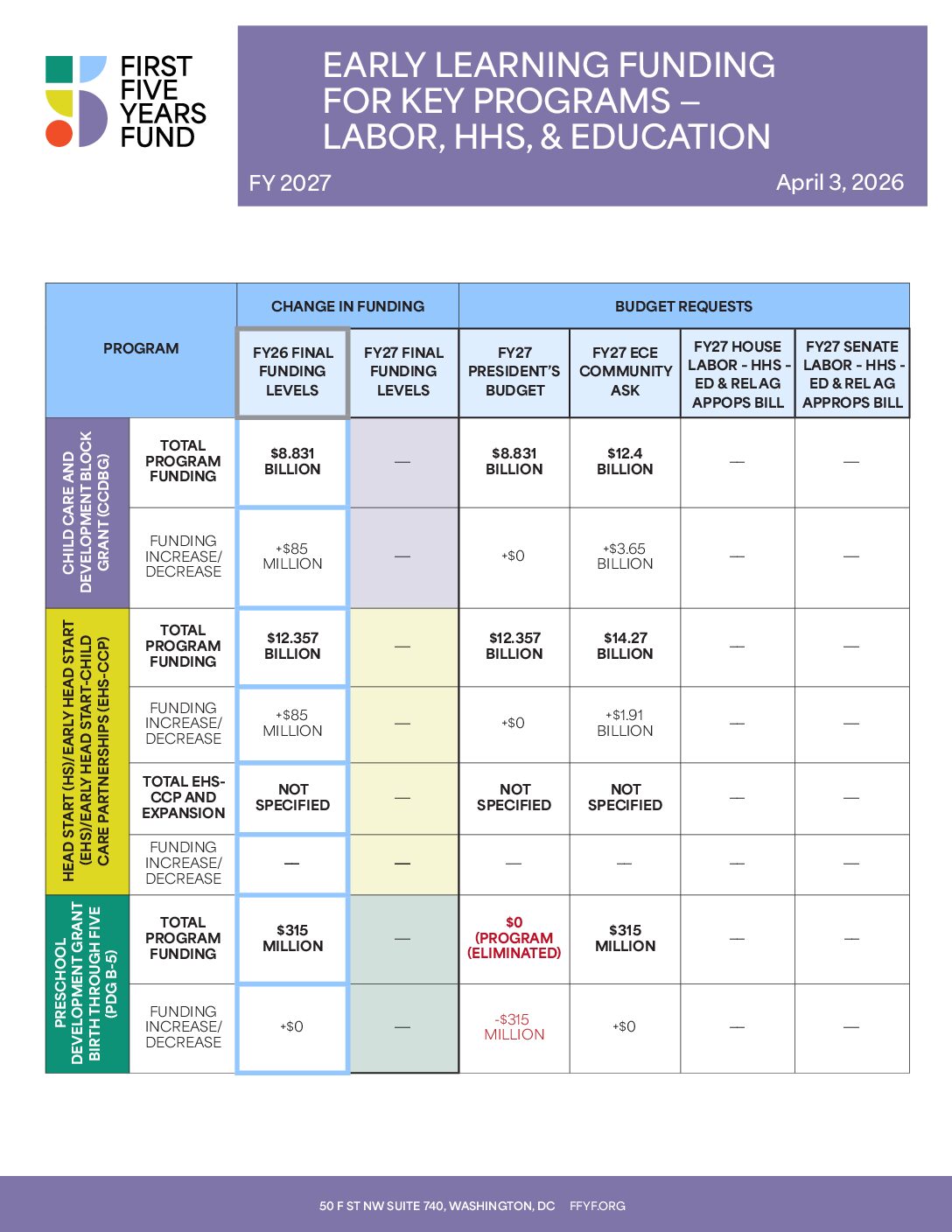
FFYF Statement on White House Budget Proposal, FY2027
This morning, the White House released President Trump’s recommendations on discretionary funding levels for fiscal year (FY) 2027. The budget includes level funding for Child Care and Development Block Grant ($8.8 billion) and Early Head Start/Head Start ($12.3 billion), and the elimination of the Preschool Development Block Grant Birth Through Five. Full funding numbers are below, and read more about funding here : The following is a statement from First Five Years Fund: “This morning, the Administration released its FY 2027 budget request outlining its priorities for federal discretionary spending which maintained funding for CCDBG and Head Start – the core federal child care and early learning programs. It also eliminated funding for Preschool Development Block Grants Birth through Five (PDG B-5). As Congress moves forward with the fiscal year 2027 appropriations process, we urge them to protect and prioritize funding for child care and early learning programs. “Investments in child care and early learning benefit both families and the workforce. Programs including CCDBG and Early Head Start/Head Start form the backbone of the nation’s child care system, while Preschool Development Grants help states strengthen and coordinate their child care systems. As families face rising costs, it will be especially important for Congress to maintain strong funding for child care programs and restore funding for PDG B-5. Together, these programs support children’s healthy development in their earliest years, strengthen family finances, and fuel our national economy. “We appreciate the longstanding bipartisan commitment lawmakers have demonstrated in funding for child care and early learning programs. As lawmakers begin drafting FY2027 appropriations bills, they have an important opportunity to demonstrate continued support for these critical programs by building on the bipartisan funding increases enacted last year. “Child care has also proven time and again to be an issue that is front and center for America’s working families and one with overwhelming support among voters across the political spectrum. In the months ahead, we urge Congress to protect and prioritize additional investments in these essential programs.” Support: This year, the annual Member led Dear Colleague letters supporting funding for child care and early learning programs saw record levels of support for CCDBG, Head Start, and PDG B-5. Community letter : FFYF and a coalition of 89 child care and early learning organizations from 32 states have a new letter to Congressional appropriators calling for increased funding for federal early learning and care programs. Learn More: FY27 Key Early Learning Programs : A chart explaining the funding timeline of FY27 funding decisions from the White House and Congress. The First Five Things to Know: Appropriations FY27 : What you need to know about FY27 appropriations and it’s impact on child care and early learning. ABCs of Federal Early Learning Programs : Contains an overview of each of the federally funded early learning and care programs. Federal Funding is Foundational : The federal government provides the majority of public funding needed to undergird the child care in the United States. Polling – In this 2026 polling, nearly three out of four voters (74%) say federal funding for child care and early learning is a good use of tax dollars, including 53% of Republicans, 77% of Independents, and 93% of Democrats. Download EarlyLearningFunding_FY2027_4.3.26 (228.46 kB) The post FFYF Statement on White House Budget Proposal, FY2027 appeared first on First Five Years Fund .
3 Apr 2026
Funding for Key Early Learning Programs, FY2027
Each year, Congress determines funding levels for all of the federal defense and non-defense discretionary programs, including those that support the care and education of children from birth through age five. Traditionally, subcommittees within the House and Senate Appropriations Committees develop their own legislation that sets funding levels for the programs within their jurisdiction, which is then taken up by the full Appropriations Committees, and later the full legislative body, before a negotiation process between the two chambers of Congress and ultimately the president’s signature. Over the past fifteen years, federal early learning programs have seen steady, significant progress through increased, bipartisan investments from both Congress and the White House. Below is a timeline of recent funding decisions by Congress for Fiscal Year 2027 : March 25: 89 National and State organizations submit a letter to Appropriators in support of federal funding for child care and early learning including: CCDBG: Increase of at least $3.57 billion, for a total of at least $12.4 billion Early Head Start/Head Start: Increase of at least $1.91 billion for a total of at least $14.27 billion PDG B-5: At least $315 million March 27: House Members submit Dear Colleague letters in support of federal funding for child care and early learning programs. The FY27 Dear Colleague letters showed record levels of support for federal child care and early learning programs. April 3, 2026: T he White House released President Trump’s recommendations on discretionary funding levels for FY 2027. The budget includes level funding for Child Care and Development Block Grant ($8.8 billion) and Early Head Start/Head Start ($12.3 billion), and the elimination of the Preschool Development Block Grant Birth Through Five. April 20: Democratic Senators submit a Dear Colleague letter in support of federal funding for child care and early learning programs. The chart below includes proposed FY2027 funding levels for the key early learning programs. Download EarlyLearningFunding_FY2027 (228.46 kB) HISTORIC RESOURCES Below you will find links to charts from previous fiscal years: FY26 FY25 FY24 FY23 FY22 FY21 FY20 The post Funding for Key Early Learning Programs, FY2027 appeared first on First Five Years Fund .
3 Apr 2026

Delaying kindergarten may have limited benefit
When my son was about to turn 5, I was faced with a decision that may be familiar to parents of children whose birthdays are close to kindergarten enrollment cutoff dates. In my local school district, children must be 5 years old on or ahead of Sept. 1 before they enroll in kindergarten. With a late September birthday, my son was only a few weeks too young to make that cutoff. A friend of mine whose child had a similarly timed birthday was trying for early enrollment. Should I, too? Ultimately, I decided against it, swallowing thousands of dollars for another year of preschool tuition. Instead of starting kindergarten just a few weeks short of 5, my son started when he was just a few weeks away from turning 6. And while I was not “redshirting” — intentionally holding my child back for a year when he would have otherwise been allowed to enroll — the supposed benefits of redshirting were part of my thinking. Of course, I thought, boys need more time to mature, and starting school on the older end of his cohort would be a clear win. But are those perceived benefits of redshirting — a term borrowed from athletics and sports eligibility rules — really true? A new study suggests whatever academic boost children may experience when they are the oldest in their kindergarten class fades by the time they reach third grade. “For the average kid, they’re not going to get that much of an advantage,” said Megan Kuhfeld, the director of growth modeling and data analytics at NWEA, an assessment and research organization behind the Measures of Academic Progress, or MAP, tests used by tens of thousands of schools across the country. For this analysis, NWEA studied the 3 million students who took the kindergarten through second grade MAP Growth assessment between 2017 and 2025. Researchers also followed a cohort of students who started kindergarten in the 2021-22 school year to see what their test results looked like when they were in third grade, compared to when they entered school. Students who started kindergarten a year later than their peers had measurable advantages in reading and math. Compared to the average academic growth of kindergartners, the academic advantage by “redshirted” children represented 20 percent to 30 percent of an academic year of learning. That advantage didn’t last long, however. By the time students entered third grade, children who had been held back a year were indistinguishable from their peers academically. The NWEA study didn’t dig into the factors behind these findings, but Kuhfeld has some theories. First, there might be some benefit to children to having older peers in the classroom to serve as academic and behavior role models. In other words, children like my son, who started school as an older 5-year-old, could be a positive influence on children who turned 5 shortly before the cutoff for kindergarten enrollment. Children who are already much older than their grade-level peers have no model to emulate. The benefits of starting school late may also disappear because children who enter school already knowing the kindergarten curriculum may get bored, Kuhfeld said. Classrooms aren’t necessarily set up to push along children who are already meeting academic standards; instead, the teacher is likely to be focused on children who need more help. Among the more surprising results of the study for me was that redshirting is relatively uncommon. For each of the years studied, about 5 percent of kindergartners started school a year after official eligibility. That peaked at 6.4 percent in fall 2021. The children most likely to be held back a year are white students and boys; redshirting was also more common in low-poverty and rural schools. Considering how rare the phenomenon is, it sure is talked about a lot. Kuhfeld said that may be because people are more aware of, and worried about, the higher academic demands of kindergarten. Also, Kuhfeld said, the idea of holding children back gained more attention after a prominent author, Richard Reeves, wrote a 2022 article recommending that all boys be redshirted to give them an extra year for their brains to mature. (Rise Together, a fund established by Reeves, is one of The Hechinger Report’s many donors.) Kuhfeld said that the study focused solely on academics, not behavioral outcomes or other factors, so parents should make decisions that work for their individual children. But there are social implications of being older than your grade-level peers, she noted. Parents of kindergartners might not be thinking about this when their children are young, but what does it mean to be the first of your friends to go through puberty, or one of the oldest high school seniors? “It’s worth considering there are trade-offs,” Kuhfeld said. “It’s often painted in conversation as, ‘Of course you would do this,’” she added. “There’s actually a lot of nuance here.” This story about kindergarten redshirting was produced by The Hechinger Report, a nonprofit, independent news organization focused on inequality and innovation in education. Sign up for the Hechinger newsletter . The post Delaying kindergarten may have limited benefit appeared first on The Hechinger Report .
2 Apr 2026
The First Five Things to Know: Appropriations FY27
Print-friendly Version Each year, Congress determines funding levels for all federal programs, including those that support the care and education of young children as part of the annual Appropriations process, including: Child Care and Development Block Grant (CCDBG): The largest source of federal funding for child care. Congress sets funding levels; states have flexibility in how funds support families and providers in their communities. Early Head Start/Head Start: Delivers comprehensive early learning, health, nutrition, and family support services for eligible children and their families. Preschool Development Grant Birth through Five (PDG B-5): Help states strengthen, align, and expand their early learning systems. This investment becomes the foundation of child care and early learning in our nation. Here are the first five things to know about Fiscal Year 2027 Appropriations: Millions of hard-working American families struggle to find and afford the quality child care they need. Two thirds of all children ages five and younger need some form of child care because all of their available parents are working. For these families, child care is one of their largest household expenses – the average annual cost of child care for one child exceeds $13,000 a year . Federal funding provides the foundation for early learning and child care programs. These programs support families in all 50 states and every Congressional district. Annually, nearly $31.30 billion in federal mandatory and discretionary funds support early care and education for children birth to five, compared to $15.36 billion in from states. Funding for these programs has strong bipartisan support in Congress. Each year, Members of Congress submit “Dear Colleague” letters to leaders of the House Appropriations Committee expressing support for program funding. For FY27, nearly every letter saw record levels of backing from both Democrats and Republicans. [The Senate letter , led by Mazie Hirono (D-HI) has a deadline of April 20, 2026.] Funding for these programs has strong bipartisan support among voters. In a January 2026 poll, nearly three out of four voters (74%) say federal funding for child care and early learning is a good use of tax dollars, including 53% of Republicans, 77% of Independents, and 93% of Democrats. Congress will be making funding decisions for FY27 over the next few months. The Spending bills for child care and early learning programs are overseen in the House and Senate by Appropriators on the Labor-Health and Human Services-Education and Related Agencies subcommittees (or “Labor-H”). A coalition of 89 child care and early learning community has submitted a letter to these Appropriators calling for funding levels including: PDG B-5: At least $315 million CCDBG: $3.57 billion, for a total of at least $12.4 billion Early Head Start/Head Start: Increase of at least $1.91 billion for a total of at least $14.27 billion Bottom Line Investing in federal child care programs is good policy. Making child care more affordable and accessible for families not only provides young children with vital opportunities to learn and grow, it also strengthens family finances, supports a thriving workforce, and fuels our national economy. Learn More FFYF Statement on the White House FY27 budget proposal: FFYF reacts to the White House FY27 budget proposal, which recommends level funding for CCDBG and Head Start, and the elimination of PDG B-13. FY27 Dear Colleage Letter Recap! : An overview of the FY27 Dear Colleague letters with statistics on number of signers. FY2027 Dear Colleague Letters : Links and details for the House and Senate Dear Colleague letters. ABCs of Federal Early Learning Programs : Contains an overview of each of the federally funded early learning and care programs. Federal Funding is Foundational : The federal government provides the majority of public funding needed to undergird the child care in the United States. FY27 Key Early Learning Programs : A chart explaining the funding timeline of FY27 funding decisions from the White House and Congress. Take Action Urge Congress to protect, prioritize, and expand federal funding for child care and early learning programs with these handy tools. Print Version Download (209.04 kB) The post The First Five Things to Know: Appropriations FY27 appeared first on First Five Years Fund .
1 Apr 2026
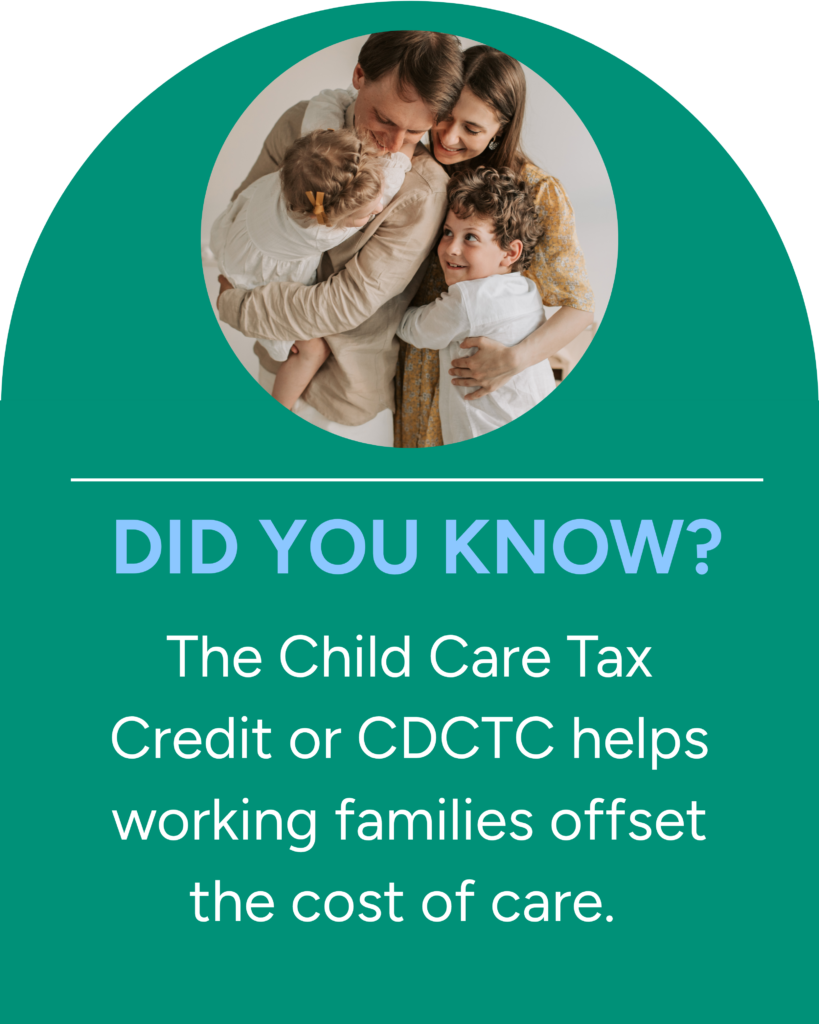
Toolkit: Child Care Tax Credits
The Goal This tax season, highlight how child care tax credits help make care more accessible and affordable for families nationwide. Step 1: Get The Facts Across the country, the rising cost of daily life is putting pressure on household budgets, and for parents of young children, child care stands out as one of the most significant and unavoidable expenses. The following tax credits can help make a big difference in making life more affordable for families: The Child and Dependent Care Tax Credit (CDCTC) is the only tax credit designed specifically to help parents offset the cost of child care. The Dependent Care Assistance Program (DCAP) allows some working parents to set aside a small amount of their pre-tax paycheck to pay for child care expenses (including employer-sponsored child care contributions). The Employer-Provided Child Care Credit (known as 45F) supports businesses who want to locate or provide child care for their workforce, while also increasing the number of child care slots available in their community. These provisions were expanded by Congress in July 2025 but this is just the start, more can be done to help working families find and afford the care they need. Step 2: Take Action Use the text options below to post on social media about why child care tax credits are so important to supporting working families. Millions of families are struggling to afford necessary household expenses like child care. The Child Care Tax Credit – or CDCTC – helps working families offset the cost of care. Learn more about the tax credits that help parents afford the care they need. https://www.ffyf.org/policy-priorities/cdctc/ On #TaxDay, remember: tax credits play a key role in helping families afford child care. Dive deeper into the tax provisions that make it easier for working parents to find and afford the child care they need. https://www.ffyf.org/policy-priorities/tax-policy-and-child-care/ Thanks to 45F, Hudl and Primrose in Nebraska joined forces to provide child care for employees, leading to reduced tuition, higher satisfaction among working parents, and improved retention for the company. Read 45F success stories and more here: https://www.ffyf.org/policy-priorities/45f/ Right click and save the images below to share on social: Step 3: Spread The Word Tax Day only comes around once a year so the window of opportunity to share this message is short. Now is the time to build support for policies that help working families offset the cost of care. Please ask partners, followers, network members and others and urge them to take action too! Reach out to your people through newsletters, webinars, and meetings. Right click and share the QR code below in your newsletters, meeting slides, or over email to spread the word! The post Toolkit: Child Care Tax Credits appeared first on First Five Years Fund .
31 Mar 2026
Lawmakers Show Record Support for Child Care and Early Learning Programs
Each year, Members of Congress submit letters to leaders of the House and Senate Appropriations Committee calling for robust funding for child care and early learning programs. This year, support for the programs reached new heights. The Child Care and Development Block Grant (CCDBG) saw the highest level of backing ever from both Democrats and Republicans, and nearly every letter garnered more signers than ever before. With child care costs exceeding $1,000 a month, these programs remain critical to keeping care affordable for working families. Highlights in the House Child Care and Development Block Grant (CCDBG) Republican CCDBG letter , led by Rep. Burgess Owens (R-UT): Had the highest number of signatories calling for robust funding ever (40). Democratic CCDBG letter , led by Rep. Suzanne Bonamici (D-OR): Had 156 signers—the highest level of Democratic support ever. Head Start Sees Unprecedented Level of Support Republican Head Start letter , led by Rep. Pete Stauber (R-MN): Had 43 total signers—more than in the last five years. Democratic Head Start letter , led by Rep. Jahana Hayes (D-CT) : Had 189 total signers—the highest level of support ever for a Democratic Head Start letter. Bipartisan PDG B-5 Letter Led by Reps. Joaquin Castro (D-TX) and Brian Fitzpatrick (R-PA): 96 total signers— the highest number of signers to date. Bipartisan CCAMPIS Letter Led by Rep. Bill Foster (D-IL) . received robust backing, with 76 total signers expressing their support for increased funding to meet the needs of student-parents enrolled in higher education Highlights in the Senate A child care and early learning le tter led by Sen. Mazie Hirono (D-HI) in support of funding for early learning and child care programs also reached a record level of support, with 42 signers (surpassing last year’s total of 41). Read all the letters here What This Means: In a Washington that feels more polarized than ever, these numbers show that child care is a rare issue that unites lawmakers across the aisle—and that support for these programs is growing stronger and broader than ever before. Why It Matters: Child care is one of the largest and most unavoidable expenses for families with young children. Rising costs directly affect whether parents can work, how many hours they can work, and even whether it makes financial sense to have another child. Federal early learning programs like CCDBG and Head Start not only make care more affordable, they strengthen families, support child development, and fuel the broader economy. In March, First Five Years Fund (FFYF) led a coalition of nearly 90 national early education advocacy organizations in calling for increased funding for federal early learning and care programs. Past Dear Colleague letters linked below: FY2026 FY2025 FY2024 FY2023 FY2022 FY2021 FY2020 The post Lawmakers Show Record Support for Child Care and Early Learning Programs appeared first on First Five Years Fund .
31 Mar 2026
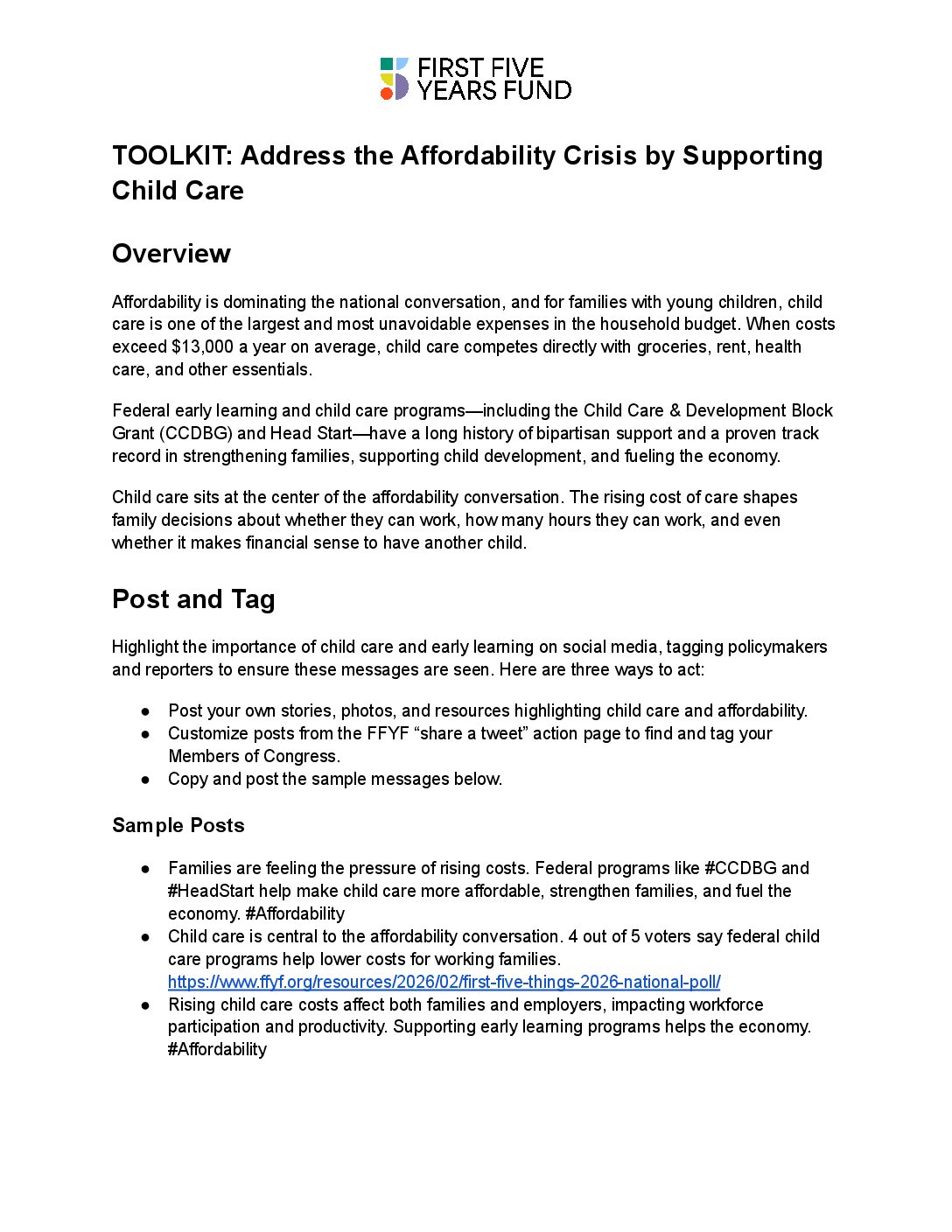
TOOLKIT: Address the Affordability Crisis by Supporting Child Care
Overview Affordability is dominating the national conversation, and for families with young children, child care is one of the largest and most unavoidable expenses in the household budget. When costs exceed $13,000 a year on average, child care competes directly with groceries, rent, health care, and other essentials. Federal early learning and child care programs—including the Child Care & Development Block Grant (CCDBG) and Early Head Start/Head Start —have a long history of bipartisan support and a proven track record in strengthening families, supporting child development, and fueling the economy. Child care sits at the center of the affordability conversation. The rising cost of care shapes family decisions about whether they can work, how many hours they can work, and even whether it makes financial sense to have another child. Post and Tag Highlight the importance of child care and early learning on social media, tagging policymakers and reporters to ensure these messages are seen. Here are three ways to act: Post your own stories, photos, and resources highlighting child care and affordability. Customize posts from the FFYF “share a tweet” action page to find and tag your Members of Congress. Copy and post the sample messages below. Sample Posts Rising child care costs affect both families and employers, impacting workforce participation and productivity. Supporting early learning programs helps the economy. #Affordability Families are feeling the pressure of rising costs. Federal programs like #CCDBG and #HeadStart help make child care more affordable, strengthen families, and fuel the economy. #Affordability Child care is central to the affordability conversation. 4 out of 5 voters say federal child care programs help lower costs for working families. https://www.ffyf.org/resources/2026/02/first-five-things-2026-national-poll/ Messages That Resonate For families across the country—especially those with young children—the cost of daily life is increasingly difficult to manage. Child care is consistently one of the most significant and unavoidable expenses. “Affordability anxiety” is particularly high for parents of young children, where child care costs directly affect whether families can work, pay bills, and remain economically stable. Federal early learning and child care programs—including the Child Care & Development Block Grant (CCDBG), Head Start, and child care tax credits—have earned decades of bipartisan support because they work. These programs help hundreds of thousands of families in every state and congressional district afford safe, quality care. Without these programs, many families would face greater financial strain, employment disruptions, and instability. With them, more parents remain in the workforce, more children have access to healthy development opportunities, and our economy is stronger. Sarah Rittling, FFYF, highlighted the economic stakes: “There’s a clear through line here—from the strain on families, to the strain on businesses, to the impact on the broader economy. Child care isn’t just a ‘me’ problem, it’s a ‘we’ problem—and it’s costing about $172 billion a year in lost wages and productivity.” Employers are increasingly treating child care as a workforce issue. When child care is unaffordable or unavailable, it affects employee retention, productivity, and overall economic stability. Strengthening federal child care programs addresses these challenges for families and businesses alike. By the Numbers Two-thirds of children ages 5 and under in the United States today may need a form of child care because their parents work. Child care prices rose 29% between 2020 and 2024 due to increased operational costs and competing wages from other service sectors, or +7% more than the rise overall prices for other goods and services. Average cost of child care is +$13,000 a year (+$1,000 a month) . View state averages. With CCDBG, the average child care copay drops to $3,400 a year ($284 a month) . View state copay averages. Polling Snapshot Affordability is the dominant issue for voters: In a January 2026 poll, voters ranked affordability as a top concern, ahead of jobs and the economy. Lowering the cost of living was identified as the top way President Trump and Congress could help families, including 68% of Republicans, 80% of Independents, and 77% of Democrats. Child care as an affordability issue: 80% of voters say the inability of working parents to find affordable child care is a “state of crisis” or a “major problem,” including 65% of Republicans, 81% of Independents, and 94% of Democrats. Federal child care funding seen as a solution: 82% of voters say federal funding for child care programs will help lower costs for working families, including 69% of Republicans, 84% of Independents, and 94% of Democrats. 70% also say federal investment in child care programs will improve the economy, including 54% of Republicans, 68% of Independents, and 87% of Democrats. Strong overall support for federal child care funding: Nearly three out of four voters (74%) view this funding as an important priority and a good use of tax dollars, including 53% of Republicans, 77% of Independents, and 93% of Democrats. More from the poll can be found here . Bottom Line Families are increasingly concerned about affordability. For families with young children, finding and affording child care can be an enormous financial strain. Federal programs like the Child Care & Development Block Grant and Head Start are foundational to the health and wellbeing of our nation, strengthening families, young children, and economy. Download TOOLKIT_ Address the Affordability Crisis by Supporting Child Care (123.38 kB) The post TOOLKIT: Address the Affordability Crisis by Supporting Child Care appeared first on First Five Years Fund .
30 Mar 2026
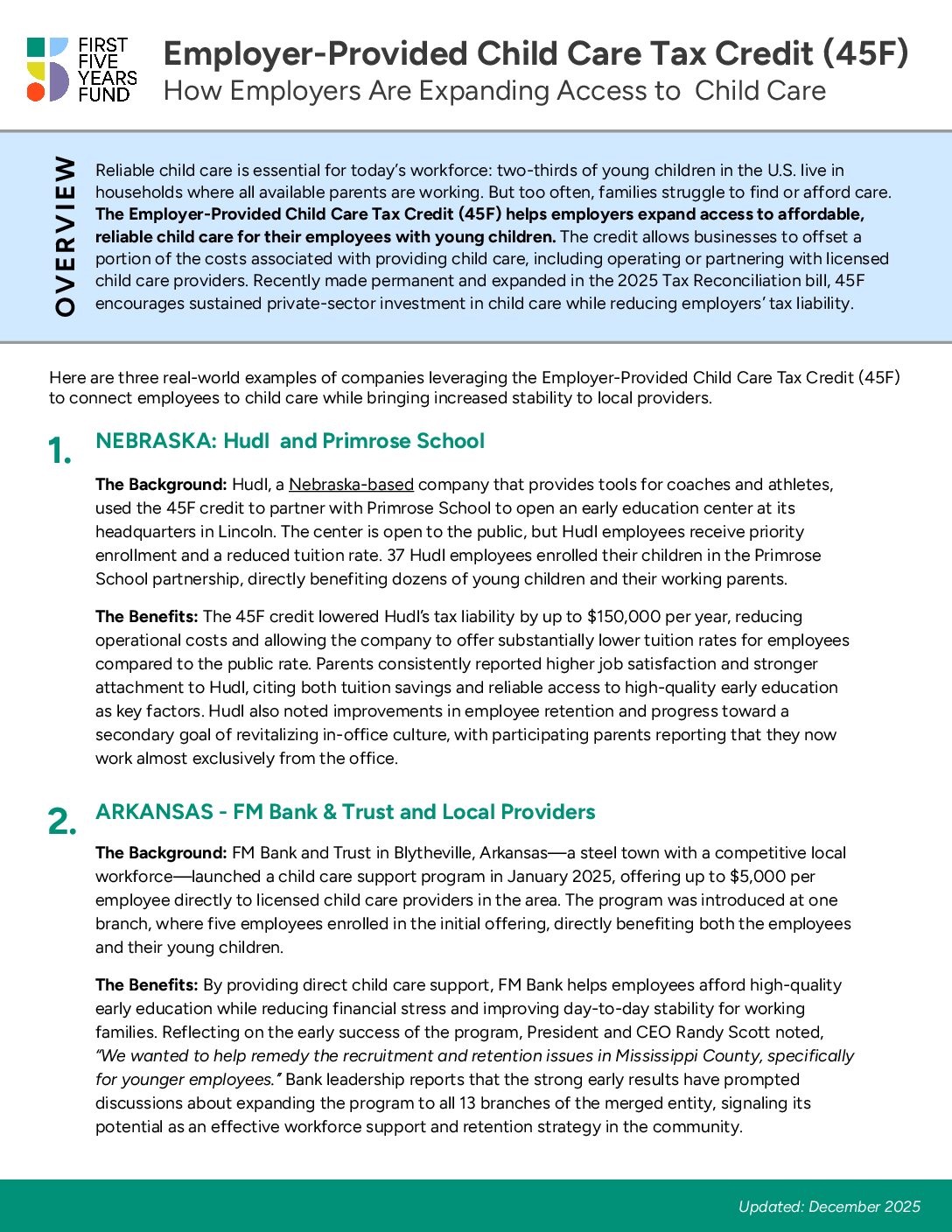
How 45F Helps Employers Strengthen Child Care Options
Reliable child care is essential for today’s workforce: two-thirds of young children in the U.S. live in households where all available parents are working. But too often, families struggle to find or afford care. The Employer-Provided Child Care Tax Credit (45F) helps employers expand access to affordable, reliable child care for their employees with young children. The credit allows businesses to offset a portion of the costs associated with providing child care, including operating or partnering with licensed child care providers. Recently made permanent and expanded in the 2025 Tax Reconciliation bill, 45F encourages sustained private-sector investment in child care while reducing employers’ tax liability. Print-Friendly Version Here are three real-world examples of companies leveraging the Employer-Provided Child Care Tax Credit (45F) to connect employees to child care while bringing increased stability to local providers. 1. NEBRASKA: Hudl and Primrose School The Background: Hudl, a Nebraska-based company that provides tools for coaches and athletes, used the 45F credit to partner with Primrose School to open an early education center at its headquarters in Lincoln. The center is open to the public, but Hudl employees receive priority enrollment and a reduced tuition rate. 37 Hudl employees enrolled their children in the Primrose School partnership, directly benefiting dozens of young children and their working parents. The Benefits: The 45F credit lowered Hudl’s tax liability by up to $150,000 per year, reducing operational costs and allowing the company to offer substantially lower tuition rates for employees compared to the public rate. Parents consistently reported higher job satisfaction and stronger attachment to Hudl, citing both tuition savings and reliable access to high-quality early education as key factors. Hudl also noted improvements in employee retention and progress toward a secondary goal of revitalizing in-office culture, with participating parents reporting that they now work almost exclusively from the office. 2. ARKANSAS – FM Bank & Trust and Local Providers The Background: FM Bank and Trust in Blytheville, Arkansas—a steel town with a competitive local workforce—launched a child care support program in January 2025, offering up to $5,000 per employee directly to licensed child care providers in the area. The program was introduced at one branch, where five employees enrolled in the initial offering, directly benefiting both the employees and their young children. The Benefits: By providing direct child care support, FM Bank helps employees afford high-quality early education while reducing financial stress and improving day-to-day stability for working families. Reflecting on the early success of the program, President and CEO Randy Scott noted, “We wanted to help remedy the recruitment and retention issues in Mississippi County, specifically for younger employees.” Bank leadership reports that the strong early results have prompted discussions about expanding the program to all 13 branches of the merged entity, signaling its potential as an effective workforce support and retention strategy in the community. 3. IOWA: Frontier Co-Op and On-Site Care The Background: Frontier Co-op, headquartered in Norway, Iowa, is a member-owned cooperative that manufactures and sells herbs and spices. In the 1980s, Frontier Co-op established an on-site child care center for employees’ children. Today, Frontier Co-op utilizes the 45F tax credit and subsidizes a portion of child care costs for employees, with families paying roughly $110–$115 per week per child for on-site care. The cooperative also offers a partial reimbursement option for employees who use licensed providers outside the center. The center operates from 7 a.m. to 6 p.m., allowing parents to bring their children to work with them and pick them up at the end of the day. The Benefits: With a workforce largely made up of manufacturing employees and farming families, access to reliable child care has long been a challenge in the community. Today, the center is licensed for up to 120 children and operates and nearly full capacity. With the recent expansion of 45F, the co-op is now thinking about expanding the center to serve even more working families. According to Frontier, “Many of Frontier Co-op’s early employees were farming families with parents out in the fields, leaving primary caregivers who needed to go to work with few child care options. Parents often had to bring their children to work, which led the company to create a child care center, and today the 45F tax credit helps make it possible to sustain and expand that kind of support for working families.” How Employers Use 45F Employers can use the 45F child tax credit in several ways, including: Contracting with a local provider to offer child care for employees’ children; Building or operating an on-site child care center for employees; Partnering with third-party intermediaries to contract with qualified child care providers. The Corporate Bottom Line 45F offers a direct reduction of a tax bill for businesses. A large business can reduce their tax bill by up to $500,000 (or 40% of eligible expenses up to the maximum claim.) A small business can reduce their tax bill by up to $600,000 (or 40% of eligible expenses up to the maximum claim.) Businesses large and small report improved employee recruitment and retention, increased productivity, and overall employee satisfaction when child care support is offered to employees. Learn More 45F Overview – A deep dive into how 45F works and how the newly expanded credit The First Five Things To Know About 45F : A topline look at 45F and the impact it has on employers, parents, and communities. How 45F Helps Employers Strengthen Child Care Options – A link to stories of employers leveraing 45F to connect employees to child care. Print friendly version Download (154.60 kB) The post How 45F Helps Employers Strengthen Child Care Options appeared first on First Five Years Fund .
28 Mar 2026

Child care centers tap retirees to fill staffing gaps
DENVER — It was nap time at Family Star Montessori, and Sue Alexander, a retired accountant, settled onto the floor beside a little girl named Ophelia. The child leaned against her and announced: “I love squishy things.” Alexander’s “squishy thing” — her arm — just earned her a new friend. Alexander is a member of the Early Childhood Service Corps , which trains adults ages 50 and older to work as substitute teachers in child care centers like this one in Denver and the surrounding suburbs. In addition to helping to staff an industry that chronically lacks workers, ECSC also offers personal fulfillment and community connection for its members in the years after retirement , participants say. “Training was a lot, but it was really well put together,” Alexander said of the program. “They’ve got good people.” The shortage of child care teachers is a well-known problem, but a lack of qualified substitute teachers doesn’t always get as much attention. Legally, centers are required to maintain a certain number of adults for the children they have in care. Without reliable substitutes, full-time teachers can barely step out of the room for a short break, much less make longer appointments for something like a trip to the doctor. The program also offers volunteer “business advisers” who provide back-office support to centers that need it. “The early care and education field is just full of clever people who are trying to find ways to shore up the system in any way possible,” said Elizabeth Pufall Jones, the director of preparation and work environment programs at the Center for the Study of Child Care Employment. Early childhood teachers are often perceived as babysitters whose roles can be easily filled, she said, but that’s not true. With ECSC members, “you know they’re a well-qualified individual to go into these classrooms.” Lisa Armao, who has worked in early childhood education for more than 30 years, founded ECSC in 2022, inspired by a documentary called “The Growing Season” that features a program in Seattle housing a senior center and a daycare center under one roof. She visited the Seattle program with the intention of trying to start a similar model in Denver. The pandemic upended her plan to create a stand-alone facility, but Armao has been able to raise over $440,000 in state and local funding for the ECSC model of placing older adults in child care centers both as substitute teachers and as office staff. Lisa Armao, founder and executive director, Early Childhood Services Corps. Credit: Sara Hertwig for The Hechinger Report Related: One city’s big bet on finding badly needed early educators — and getting them to stay Over the last three years, ECSC has placed about 150 volunteers in Montessori programs and other child care centers around the Denver area. Those who want to work as teachers attend three to four months of online classes offered by Red Rocks Community College. Those who want to work with children but don’t want the extra training take 19 hours of training modules offered by ECSC. Volunteer business advisers take seven hours of free training on early childhood regulations before being placed at a center. Some of the participants in the program are paid, while others provide support to child care centers for free. Family Star Montessori educates 230 children, ranging from 8 weeks to 6 years old, in its two schools and its home-based learning program. Alexander’s presence in a classroom means teachers can step out to take a phone call or go to the bathroom without worrying about whether there are enough adults in the classroom. “We don’t talk about bathroom breaks enough,” Armao said. “If you need to go to the bathroom, there has to be someone to come in to cover you in that space, and that can make for a very uncomfortable working environment. Meeting the needs of the adults helps with morale.” ECSC has attracted a steady stream of local media attention, which is how most older adults learn about the program, but finding corps members to meet the need remains a challenge. Armao said she has received inquiries about replication from people in California, Ohio, Oregon and Washington state. Just as Family Star executive director Lindsay McNicholas relies on Alexander to help care for kids, she depends on another ECSC member, Jean Townsend, for administrative support. Sunanda Babu received early childhood training through programs offered through the Early Childhood Service Corps. Credit: Sara Hertwig for The Hechinger Report Before she retired, Townsend owned a local economics consulting firm and, among other accomplishments, helped to start the Colfax Marathon, an annual race that brings out thousands of runners. She came to Family Star with extensive contacts among business and political leaders as well as a roll-up-your-sleeves attitude. “I’ve learned that if you’ve got a problem, you solve it,” Townsend said. She is working with the center as it plans to sell one site and buy another with more modern heating, closer to where most of the families live. Townsend’s business background has been invaluable, McNicholas said. “I’ve been able to meet officials and city planners in Jefferson County, which is a new county for us. That has given us a jump-start with this really incredible opportunity for our organization.” Related: Young children have unique needs and providing the right care can be a challenge. Our free early childhood education newsletter tracks the issues. Armao said the corps members come from a variety of professional backgrounds and have a range of different expectations for the experience. Along the way, they gain insight into a largely invisible profession. “They get a schooling in the state of early childhood and they come to understand it in a deeper way. Some grab onto the fact that it’s an economic driver. Others grab onto the simple fact that these children are going to be humans running our world.” Kit Karbler, 72, is a glass artist whose work is displayed at the Denver Art Museum. “If I hadn’t found this, I can’t imagine what I’d be doing,” he said about being a substitute child care worker at an early learning center based at Temple Emanuel in Denver. Karbler works 20 hours a week, more if they need him. “What would I be doing that would give me this emotional return?” Kamal Fakhouri, 68, worked in education and business all over the Middle East. At Monarch Montessori, a public school with 250 children ages 6 weeks through 5 years, Fakhouri fills in as a substitute teacher. Born in Lebanon, she lived in the United Arab Emirates, Kuwait, Saudi Arabia and Egypt before moving to Denver to be near her daughter and grandchildren. This was during the height of the Covid pandemic. Fakhouri said she especially prizes moments of connection. “I was reading with a child in a class that I haven’t been to in a while, when [a child] just came and hugged me from the back and started telling me about what work they’re doing,” she said. Chuck Sonderquist, 74, reads to a child at Thrive Preschool in Littleton, Colo. Credit: Sara Hertwig for The Hechinger Report Bethanne Rodriguez, executive director of the five-site Thrive Preschool network in the Denver area, which has welcomed corps members, said she appreciates their “older faces and older energy” — as well the example they set for the rest of the staff. “They have had a career and have that life experience to know and understand the investment that this work is,” she said. “They know what it means to show up for work and know what it means to not call out when you’re just having a bad day.” One of the corps members at Thrive’s Littleton location is Yvonne Wilder. After her first week in the baby room, her muscles ached in places she’d forgotten existed. The retired wetlands biologist, who’d spent decades cataloging ecosystems for the city of Tampa, was discovering that an eight-hour shift there demanded a different kind of stamina than fieldwork ever had. Yvonne Wilder, 57, works with children at Thrive Preschool in Littleton, Colo. Credit: Sara Hertwig for The Hechinger Report “It’s a very physically challenging job,” said Wilder, 57. “I change diapers all the time. I do everything. I admire all the people who do this full time because it is not easy.” During her first year, Wilder says, she got sick constantly, and her adult children asked her if she really wanted to continue. Soon, though, her immune system caught up, and she discovered that spending time with the children, germs and all, makes her happy. “I’ve had them ask me, ‘Are you my grandma?’” she said. “And I’ll say, ‘I can be your school grandma.’ It’s such a privilege to know them and to be known by them.” Support for this reporting came from the Better Life Lab at New America. This story about child care workers was produced by The Hechinger Report , a nonprofit, independent news organization focused on inequality and innovation in education. Sign up for the Hechinger newsletter . The post Child care centers tap retirees to fill staffing gaps appeared first on The Hechinger Report .
20 Mar 2026

How a Minneapolis child care center survived an ICE surge — and is moving forward
MINNEAPOLIS — On a frigid February afternoon at a Spanish-immersion child care center, toddlers grabbed puffy coats out of cubbies as parents helped them pull on mittens and hats before heading home. In an office down the hall, Michael, the husband of the center’s director, stared intently at a computer monitor streaming footage from the building’s security cameras. During dismissal, he watches for any vehicles that might be carrying agents from the U.S. Immigration and Customs Enforcement. Since January, when federal agents descended on the Twin Cities as part of Operation Metro Surge, he started leaving his own job early every afternoon to volunteer here. As the last children left, other volunteers arrived. Most of them are in their 70s, and they’re now here regularly, too. In fact they’ve become so familiar the staff has affectionately nicknamed them the “ abuelitas, ” even though their own grandchildren don’t attend the center. Their mission has been to drive 10 of the center’s staff members home and to serve as observers and translators should federal agents pull them over. The staffers are immigrants, and even though the center director says they are all authorized to be in the country and working, the aggressive enforcement left them too afraid to drive to the center on their own. “I’m just doing what I can do. And I obviously feel less vulnerable than she would be,” said Sarah, one volunteer driver. “I’m white, I’m 71. I think I would not be treated like she might be treated.” Those interviewed for this story agreed to talk only if the center wasn’t named and their full names were not included, for fear of attracting the attention of federal authorities. The effort has been both a feat of organization and a time-consuming daily grind: Some 60 volunteers, many of whom live in suburbs, have worked in shifts taking the center’s staff members to and from their homes in neighborhoods across the city. Related: America’s child care system relies on immigrants. Without them, it could collapse The volunteer drivers are just one example of the elaborate systems of mutual aid and support that child care centers have set up in the Twin Cities. The immigration surge in Minnesota was linked to debunked claims that many daycare programs in Minneapolis and in St. Paul were taking public money but not caring for children, putting the entire sector under a microscope. This one center had to cope not just with fearful employees, but with threatening anonymous phone calls and families withdrawing their children. Nationwide, 1 in 5 workers in the child care field are immigrants, so enforcement actions around the country have had an outsized impact on child care providers. The effort that has kept this center open offers lessons for child care facilities in other communities that may face similar actions. While Minneapolis and this center’s staff slowly get back to something like normal, other areas may have to develop volunteer networks of their own. “You literally have to have a good network to survive, because it’s not as though there is a government organization coming to help,” said Lily Crooks, the director of a child care center in St. Paul who is active in local networks to help providers. At her center, for instance, Crooks held a fundraiser that raised $5,000 for Lyft gift cards so that employees and parents could pay for a ride rather than stand at a bus stop where ICE agents have been known to operate. “It’s both really amazing to see the way that people are sticking up for their neighbors and supporting them, and then it also kind of feels bleak realizing that there isn’t going to be some saving entity coming,” Crooks said. But even as Bruce Springsteen, U2 and others rush out anthems celebrating the mass resistance efforts by folks in the Twin Cities to help their immigrant neighbors, some worry about what will come next as the surge recedes from public view, and if such volunteer efforts will be sustainable in the long run. “This is not over,” said Diana, the director of the child care center. “And maybe it’s going to take years.” Related: Young children have unique needs and providing the right care can be a challenge. Our free early childhood education newsletter tracks the issues. In November, employees at the Minneapolis daycare center started hearing murmurs that immigration agents were detaining people even if they had legal status. “They are not respecting the due process — like, what is happening?” said Diana, whose center serves about 50 children from 3 months to 5 years old. “Then some teachers started to say, ‘I’m not gonna go out.’” The employees started limiting how often they left their homes, only venturing out to work. All of her employees are authorized to work in the country, Diana said, but since English is not their first language, they worried about explaining their situations if stopped by ICE. “We had to cancel our holiday party because they were afraid to go out at night,” she said. Diana, who grew up in South America but is now a U.S. citizen, started carrying her passport in her purse, just in case. Credit: Illustration by Elena Lacey for The Hechinger Report Then the day after Christmas, Nick Shirley, a 23-year-old right-wing influencer, posted a video on YouTube alleging fraud in Somali-run daycares in Minneapolis. The video — which included many claims that were later shown to be false and misleading — went viral, quickly attracting millions of views and amplification on social media by Vice President JD Vance and Attorney General Pam Bondi. Suddenly the child care system in the Twin Cities became the focus, with Shirley visiting centers run by Somali immigrants that he claimed collected government handouts despite serving no kids. Reporters visited some of the same centers soon afterward and found them operating normally, but the Trump administration quickly announced that it would freeze federal child care payments for low-income families in Minnesota because of what it said was widespread fraud. Only a few of the families in Diana’s privately owned center are on public assistance, but she knew plenty of other centers in the area that would be plunged into a financial crisis without federal funding; an estimated 23,000 children in the state rely on it. (In February, a federal judge ordered the funds unfrozen while a legal challenge to Trump’s action plays out.) Shortly after the freeze announcement, on New Year’s Eve, Diana’s center received a threatening phone call. “He was saying, ‘You guys are not safe. You guys have to leave,’” Diana said. “And I was like, ‘Who is this?’” The line went dead. “I was thinking, ‘Do I have to go into lockdown? Is this someone who will come and shoot, you know, use guns?’” She called the police to report what she felt was a threatening call but said officers told her there wasn’t enough detail to investigate. Still, Diana notified families, wanting to be transparent about any risks. She heard from other child care center directors who’d received phone calls from people making more direct threats against staff members and about social media influencers knocking on their doors trying to record videos of children. On Jan. 5, the Trump administration cited the Nick Shirley video as justification for adding 2,000 ICE and Border Patrol agents to its Operation Metro Surge in Minnesota. That brought the total number to some 3,000 officers, about three times the number of police officers in St. Paul and Minneapolis. Then, two days later, ICE agent Jonathan Ross shot and killed Renee Macklin Good, one of the thousands of residents who’d taken on the role of volunteer observers during the enforcement surge. The shock of the event sent most of Diana’s employees into hiding. So many employees stayed home that she closed the center for six days as she tried to figure out how to move forward. Some families were spooked, too. Families withdrew 12 kids, forcing Diana to lay off one staff member. To persuade her remaining staff to return, she reached out to people and nonprofit groups she knew for help on how to keep her staff safe. A local immigrant rights group offered to coordinate the system of volunteer drivers to escort staff to and from their homes. The staff members all agreed to try it. Every morning, Diana checked to make sure no one was detained. “We say on the radio, ‘Everyone is here,’” said Diana, tearing up. “The kids don’t know what we mean. But every day it’s: Who is going to make it? Are we all going to make it?” The drivers said volunteering was an obvious decision, even though they also feel unsafe doing it. Most don’t consider themselves activists. “Oh, it’s risky,” said Sarah, who has been driving one of the child care employees home two or three times a week, often with her 76-year-old husband as backup. “I still need to find the strength and courage to do what I know is right.” The volunteers have been coached about what to do if they are stopped by ICE: Crack the window, don’t lie, see if the agents have a warrant signed by a judge and dated. If she were stopped, said Sarah, “I would do the best I can. I would follow the protocol. I would ask all those questions — and what would happen, would happen.” Sarah takes precautions to avoid being tracked. She always turns off her smartphone’s location services when giving rides. She wishes she had a second car so she could alternate vehicles. She is also careful when talking about her volunteering, since she knows that not everyone sees things the way she does. At a recent meeting of her neighborhood book club, “one of the women said, ‘The Somalis don’t belong here.’ Another one said, ‘They’re only rounding up criminals,’” she said. “It’s really disheartening to me that people can see things and interpret it so differently.” Sarah was a teenager during the Civil Rights Movement, she said, “and this feels like a similar moment for our generation to stand up and against oppression in various ways.” And she has formed a bond with the child care worker she drives home, P. “We’ve kind of adopted her — we really want to protect her,” she said. Sarah and her husband have brought her food and are reaching out to their network to try to get her husband a job. The language barrier makes the 30-minute car rides pretty quiet. P’s English is limited, and Sarah doesn’t speak Spanish. “She’s so shy,” Sarah said. “But she’s hard-working — a real asset to this community.” Related: Immigration enforcement is driving away early childhood educators P. said that she is thankful for the help and wouldn’t be able to work or eat without it. But, in an interview conducted partly in English and partly with the help of a Spanish interpreter, she said she’s frustrated that this kind of help is necessary at all. “It’s not OK that someone feels unsafe in a safe country,” she said, putting the word “safe” in air quotes. As a substitute teacher, she fills in when any of the other employees go on breaks, changing the diapers of the youngest kids and helping out with pre-K students as well. She’s able to forget about the situation when engaging with the kids. But she misses being able to move about without concern. “I’m free,” the staffer said, again with air quotes. “But I can’t do anything. It’s very hard.” Though Trump administration officials have announced that Operation Metro Surge is winding down, residents are gradually seeing a change: Crowdsourced sites like IceOut continued to record ICE actions. Local media said that agents were getting stealthier and targeting the suburbs rather than urban areas. Even so, leaders of the volunteer driving effort have started looking for signs that the situation is safe enough for them to wind down their efforts. In early March, all but two of the employees said they were comfortable enough to start driving to work on their own again. P is still being driven to work, but she expects that soon she will go back to driving herself. “I need a job. It’s not possible to stop for me,” she said. “We have to try and just do it. We have to survive. We have to ‘ resistir.’ ” Diana, the center director, explained that “in Spanish we use that word a lot — ‘ resistencia. ’” The meaning carries a blend of resistance and endurance. “It means that you don’t give up, you keep fighting,” she said. “We are going to get through it. This is going to pass.” Contact editor Christina A. Samuels at 212-678-3635 or samuels@hechingerreport.org. This story about ICE raids was produced by The Hechinger Report , a nonprofit, independent news organization focused on inequality and innovation in education. Sign up for the Hechinger newsletter. The post How a Minneapolis child care center survived an ICE surge — and is moving forward appeared first on The Hechinger Report .
19 Mar 2026

Readers weigh in on our story about screen time for kids in school
Last fall, I was contacted by a reader who was so concerned about the pervasive use of screens in their young child’s classroom, they had pulled their child out of their local school district. The parent wanted to know if, from my reporting, I had heard of districts that were either not using screens in grades K-2 or used them only sparingly. As I started researching, interviewing parents and watching school board meetings around the country, I found there are many districts and states grappling with how to best incorporate screen time in the early grades — or whether they should at all. Some have already taken steps to back away from screens. And in many more districts, I found parents growing especially concerned about the amount of excess — non-academic — entertainment their young children were accessing at school, especially during snack time, indoor recess and lunch. In some cases, children came home knowing commercial jingles and language from YouTubers because of the screen time they had at school. Last week, I wrote about this screen time battle in a story published in partnership with The New York Times . The response has been immense. Here’s a sampling of feedback I received via email and LinkedIn, or saw in comments and on social media. (Some have been edited lightly or shortened for clarity.) Parents and educators around the country say screen time in early elementary has been a concern for years “I was horrified that my son’s school gave each kindergartner a Chromebook (in 2023),” one New York mom wrote on LinkedIn. “I had worked so hard to limit screen time and then he was in school-based aftercare watching YouTube videos on the Chromebook. (The aftercare has since banned Chromebooks, thank goodness). And snack time! In kindergarten, they watched PBS Kids videos during snack time. And I love PBS Kids, but snack time should be for learning to converse with your classmates, not watching videos. I wanted to complain to the school, but didn’t want to be ‘that’ parent so I never said anything.” “My daughter was watching sexy K-Pop Demon Hunters videos within the first weeks of school,” wrote Lindsay Lieberman, a cyber abuse attorney in the District of Columbia, in an email. “Many of us are advocating for policy changes within the district as more evidence emerges about the cognitive and developmental harms associated with excessive screen use in young children.” Andrea, a substitute teacher in her local Massachusetts preschool, said on Facebook, “They have smart boards in every ‘classroom.’ For toddlers! No cute little songs sung by teachers who don’t care if they have a great voice. Just animated, cluttered, attention-destroying ‘songs’ for toddlers.” Kayla, who works in a school in North Dakota, said on Facebook that at her school, “There are movies or YouTube videos being played for students on the smart board during snack time. … Readalouds are done by someone who made a video of the book on the internet, so there aren’t natural stopping points to stop and talk about what’s happening in the book.” Betsy Tao, the technology committee chair of the Montgomery County Council of PTAs in Maryland, said in an email that the group recently surveyed district families about technology use. More than 1,000 families responded , and the majority of elementary parents said there was “too much” Chromebook use in schools. Based on the results, Tao said, it was clear parents were also concerned about “the ways in which these devices were being used to access inappropriate and sometimes harmful content, and the impact they were seeing on their own kids.” Teachers turn to screens for many reasons “I’ve learned from many early educators that screen time isn’t always replacing social-emotional learning,” wrote Tanya, the president of a private elementary school in California, on LinkedIn. “Often it’s replacing 15 minutes of escalating chaos that prevents learning from happening. Or filling gaps exhausted teachers don’t have the bandwidth to manage differently. An iPad designed for solo engagement creates a very different experience than media designed with compliance guardrails, developmental appropriateness, and clear use cases.” A lack of school funding for staff positions has led to increased screen use in some cases “In our schools they cut teacher assistant $$ and thus sometimes the iPad takes the place of what should be in-person instruction,” wrote EmmyEm, on Bluesky . “I used to volunteer in my kids’ classrooms as the iPad person who’d take a group out to the hallway for iPad time while the teacher did small-group sessions.” State testing needs to change in order for device usage to change A teacher named Allie posted on X that students in her district have to complete state tests on computers, one of the reasons they need familiarity with devices. “For a long time we assumed kids would be able to translate the skills from tablets to computers. Then we learned they could not.” But she also criticized some of the nonacademic uses of screen time that I wrote about. “I am mad at the teachers putting their kids on YouTube in class because yes, that’s dumb, and it makes the rest of us look bad.” District leaders and administrators set the tone for classrooms “Teachers that are required to do student-led learning are left with little choice but to use tech,” wrote Heather Ann, on Facebook . “We need the ‘people in power’ at the schools to allow teachers to go back to teaching without tech without fear of being penalized in yearly evaluations.” “Parents need to push back!” wrote Terrie Jordan on Facebook. “The pressure to use devices comes from the higher-ups not the teachers (in most cases!).” Within classrooms, children may have varying experiences Two parents from Croton-Harmon Schools, one of the districts mentioned in the article, told me their experiences have been different from parents quoted in the story. “I have two children who attend Croton schools … and I have been extremely happy with the District’s purposeful approach to the use of technology,” one parent wrote. Her children have explored coding and are learning digital fluency, she added. “Like it or not, those skills are necessary to thrive in the world we live in.” Screen time at home is a big concern for educators, and parents need to cut down there as well “We get the kids in the classroom that are very addicted to screens. Some of them cannot sustain any amount of focus off the screen. Parents can’t allow hours of screen time at home and then expect miracles at school!” Billie Hall, a third-grade teacher, said on Facebook . “This isn’t all on teachers and schools! Stop giving your kids devices all the time so we don’t have to reteach them how to focus!” Paige Elizabeth, on Facebook . “Perhaps because I am older, I don’t use tech with children,” wrote Christina Carico, on Facebook. “I don’t have devices in my room, and I don’t know the passwords for the school-issued devices the school provides (older children). My room has chess, Spot-It, Apples to Apples, Monopoly Deal, Word Uno. They *love* game time. I am heartbroken, though, when I see devices at dinner tables, at church, in theaters. They are everywhere.” More on screen time in schools The ed tech industry is trying to fight bills in 16 states related to technology use in classrooms, writes Tyler Kingkade for NBC News. A proposed bill in Minnesota aims to ban screen time for pre-K and kindergarten students, according to Richard Reeve with KSTP. Each year, we ask readers to share with us their connection to early childhood education and what they would like to see us write more about. Your responses help guide our coverage and provide valuable insight into our audience. Please take time to fill out this brief audience survey, and thank you! Yes, I will take the survey! This story about screen time for kids was produced by The Hechinger Report , a nonprofit, independent news organization focused on inequality and innovation in education. Sign up for the Hechinger newsletter. The post Readers weigh in on our story about screen time for kids in school appeared first on The Hechinger Report .
18 Mar 2026

IPads in kindergarten, YouTube videos at snack time: Parents are pushing back on screens in the early grades
CROTON-ON-HUDSON, N.Y. — A few months before her daughter started kindergarten, Claire Benoist saw a Facebook post that stunned her. Another family with an incoming kindergartner was wondering if it was true that children in the Croton-Harmon School District, 45 miles north of New York City, receive an iPad when they start school. Other parents confirmed this: Kindergartners are often on their own iPads during school, playing games and watching television shows and YouTube videos. “It had never occurred to me that screens would be used in such a way,” Benoist said. A few weeks before school started, Benoist told school administrators in the 1,500-student district that she couldn’t believe schools would give devices to kids as young as 4 and 5. Benoist and her husband had followed pediatric guidelines recommending no screen time before age 2. After that, they only allowed occasional episodes of kids’ shows like “Bluey” or “Daniel Tiger’s Neighborhood.” School administrators assured Benoist that iPad time would be limited to 15 minutes a day, she said. But once school started, Benoist’s daughter suddenly knew jingles from diaper and car commercials, which Benoist and her husband determined were playing before YouTube videos at school. “It feels like too much,” said Benoist, whose daughter has watched videos during snack time, transition time and dismissal. “I am just horrified by this,” she added. “I don’t understand how we’ve created a system that fosters this kind of screen time in school.” Related: PROOF POINTS: 10,000-student study points to kindergartners who may become heavy screen users There’s mounting evidence that excessive screen time can harm young children — contributing to anxiety and depression, delaying social and emotional skills, increasing the likelihood of obesity , straining eyes and decreasing attention spans . In response, many parents are reassessing device use and cutting back at home. But some are encountering an unexpected challenge as they try to rein in screen time — their kids’ schools. Elementary schools and districts that ramped up their use of technology during the pandemic have largely maintained those practices. Eighty-one percent of elementary teachers across the country surveyed by The New York Times in October said that at their school, students receive devices in class by kindergarten. And now too many schools have become reliant on screens to teach, entertain and, in some cases, just keep kids quiet, parents and experts say. “Screen time, when it’s purposeful, can augment the work of the teacher and it can be wonderfully complementary,” said Dr. Michael Glazier, chief medical officer of Bluebird Kids Health, which runs a half-dozen pediatric offices across Florida. “The problem is, in many schools, it’s becoming less of a complementary activity and more of a default.” The Croton-Harmon School District declined to answer specific questions for this story. In a statement, Superintendent Stephen Walker said the district’s schools “are committed to ensuring that technology use is active, intentional, and used to create learning experiences that wouldn’t have been possible without technology.” Late last month, the district announced it would reduce spending on ed tech and end the practice of sending devices home with students in elementary school. In other parts of the country, parents are pushing school districts to set limits with varying success. In Evanston, Illinois, a parent-run group, Screen Sense Evanston, organized a petition last year requesting that the district remove non-educational apps and create daily maximum screen time limits for each grade. More than 1,000 parents have signed on. Last year, parent advocacy successfully pushed the district to limit YouTube in classrooms. Students read silently from books in Jill Anderson’s classroom library. Credit: Jackie Mader/The Hechinger Report Miriam Kendall, a parent of three and the head of Screen Sense Evanston, said one of the group’s main goals is to remove “pure entertainment” activities, like videos and online games at school, and to get districts to set limits for device use. Kendall, who monitors her daughter’s iPad usage online, said she noticed that the first grader was watching Taylor Swift videos in the middle of a school day. “It’s unreasonable to assume that somehow students aren’t going to be distracted and only supposed to use these devices for education,” she said. “Literally millions of hours of very, very smart people’s time has gone into making these things absolutely irresistible on purpose.” Similar demands to cut screen time have cropped up among parents and teachers across the country, including in California, North Carolina , Maryland , Texas and elsewhere in Illinois . Related: Young children have unique needs and providing the right care can be a challenge. Our free early childhood education newsletter tracks the issues. Many complaints from parents across the country are about screen time that is not directly related to academics and is nearly impossible to track. That includes children playing board games virtually or watching someone on YouTube read a book to the class, instead of their teacher. In some classrooms, “brain breaks” consist of loud, flashy dance or movement videos that are marketed exactly for that purpose to teachers. Parents say their children are watching movies and television shows during indoor recess, lunch and snack time. For the youngest children, experts say, there are additional concerns. In addition to learning academic skills, school is a place to absorb social skills, said Glazier, the pediatrician. “That doesn’t happen if they’re just in front of a screen and they’re not interacting.” The American Academy of Pediatrics doesn’t have a set time limit for screen use in schools, but it says screen time should be active and involve critical thinking activities such as coding or media and video production, not passive, like watching content for entertainment. Some parents and experts say that even some of these active programs are problematic. They worry that apps that are “gamified,” for example, could encourage early addictions to screens by getting kids hooked on the dopamine rush that comes from mastering new levels and earning digital rewards. Students pass a beach ball during a “brain break” activity, meant to give students more screen-free time at school. Credit: Jackie Mader/The Hechinger Report Richard Culatta, the CEO of the technology nonprofit ISTE+ASCD, agrees that some apps are better than others and that schools should do a better job of vetting them. But, there are benefits to engaging, research-based games, he said. “When kids hate learning because it’s boring, it will have far more damaging consequences than if they are playing a game that is helping them find learning more interesting,” Culatta said. And rather than a wholesale removal of tech devices, he said schools need to “rebalance.” “We do have to be really careful that we don’t actually end up harming kids by taking away tools that are really helpful for them for their future,” Culatta said. Samantha Harvey, whose daughter attends school in the Croton-Harmon district, didn’t realize how much screen time her daughter was getting at school until the kindergartner began talking about “apps” soon after starting school. “I wouldn’t mind if it were once a day after school, or a special thing,” Harvey said. “It just seems like it’s ubiquitous. It’s every day, and it seems to pop up in every room.” Then one day, Harvey was taking a video of her daughter dancing to send to her grandparents. When the song ended, her daughter finished her dance, looked at the camera and said, “If you like what you saw, click below to subscribe.” Related: Glued to the screen: A third grade class where kids spend 75% of the day on iPads In part because of concerns from parents and educators, districts have already begun rolling back technology use. In 2022 in Missouri, Springfield Public Schools cut back on classroom technology for its youngest students. That same year, Santa Barbara Unified School District in California removed 1:1 devices from kindergarten and stopped sending devices home with first, second and third graders. In 2023, Glastonbury Public Schools in Connecticut reduced technology use. A year later, several Kansas districts scaled back, including Wichita Public Schools, which eliminated screen time from pre-K and kindergarten classrooms. Lawmakers in several states — including Utah , Massachusetts , Vermont and Missouri — have introduced legislation to limit screen time or review ed tech products more closely. Countries like Sweden and Denmark have also transitioned away from digital learning. In addition to state and district efforts, individual teachers are making changes within their own classrooms to move away from screens. Jill Anderson, a third grade teacher, has experienced the screen time debate on both sides. Her children attend Croton-Harmon schools, but she teaches just south in the Ossining Union Free School District, which takes a more gradual approach to introducing kids to screens. Kids in Ossining schools don’t take home a device until fifth grade, and, unlike some districts that require students to complete a certain number of lessons on educational apps, Ossining does not mandate screen time. Third grade students in Jill Anderson’s class complete math problems on individual white boards. Credit: Jackie Mader/The Hechinger Report In Anderson’s classroom, school-issued devices are tucked away in a cart that is often hidden by a large paper easel and barely touched by students. The shelves in the back of her room are overflowing with books, board games and Legos. Break time features games like hopscotch, and students who are not working with Anderson during small-group time play chess or with math cards. Anderson embraced ed tech when it started rolling out in schools pre-pandemic. But then she started to notice more focus and attention challenges among her students, and she worried that it was the result of their overall use of screens at home and at school. She started researching screen time and educational technology use and was dismayed by reports showing that few digital learning programs have met federal standards for demonstrating effectiveness. She was surprised to see schools were regularly using digital books, despite evidence that kids read better on paper than on screens . “I used all these interactive math games thinking they were so great,” she said. “Then I realized, ‘I don’t actually think they’re learning any math from asteroid blasting multiples of five.’” Anderson has since replaced screens with more hands-on activities and writing. Instead of a smart board, Anderson now works through math problems on her paper easel while students follow along on individual dry erase boards. For class rewards, students play board games, get an extra outdoor recess or have a dance party instead of Chromebook time. Plans left for substitute teachers no longer include any technology. “I feel like I see students detoxing under my eyes,” Anderson said. Related: Technology overuse may be the new digital divide Michael Hanna, director of technology in Ossining, said while students have more access to technology than before the pandemic, the district is mindful of how it is used. “I’m not a proponent of using technology with our littlest,” Hanna said. “When they are in school, they should be learning how to make friends. They should be learning how to have empathy. They should be learning how to share. They should be learning how to do all of those things. And by putting them on a device, I think it’s taking away so many opportunities for them to engage with their friends and with their peers.” Last year, Anderson formed a community group , now with more than 250 members, aimed at educating and helping families cut down on tech. She also founded Mindful Tech Lessons, a national organization that educates caregivers and educators and provides consulting to parents, teachers and districts on technology usage. In early February, she testified on behalf of a bill in Vermont seeking more oversight over ed tech used in school. Students play math card games during small group time in Jill Anderson’s class. Credit: Jackie Mader/The Hechinger Report She starts every workshop by telling attendees why she advocates for change. “When I first started teaching 20 years ago, kids wanted to be veterinarians because they loved animals, teachers because they loved helping kids or athletes because they love playing sports,” Anderson said. “Then it changed. Now, the most common answer is, ‘I want to be a YouTuber or influencer,’ and they no longer tell me why.” Benoist, the Croton-Harmon parent, joined Anderson’s collective and has also advocated for less screen time in front of the district school board. She said she has heard less about her daughter watching TV shows and ads at school since January. Benoist welcomed the shift away from screens for elementary students, but said she still feels defeated when she thinks about how much screen time her daughter has already been exposed to in school. “I’ve done everything I can to shepherd her through this world that’s already so technology-driven, to shield her childhood, to have her have a normal, analog childhood,” she said. “And I just handed her off to a school district and they destroyed that within three months.” Contact staff writer Jackie Mader at 212-678-3562 or mader@hechingerreport.org . This story about screen time was produced by The Hechinger Report , a nonprofit, independent news organization focused on inequality and innovation in education. Sign up for the Hechinger newsletter . The post IPads in kindergarten, YouTube videos at snack time: Parents are pushing back on screens in the early grades appeared first on The Hechinger Report .
10 Mar 2026

As business costs rise, child care programs are increasing tuition to survive
It’s becoming markedly more expensive to run a child care business. And as public funding fails to keep up with inflation, those costs are getting passed on to families that in many cases can’t afford to pay more. Those are some of the main findings of a new report by the National Association for the Education of Young Children, which earlier this year surveyed more than 7,000 early childhood educators from a variety of early learning programs across the country. The cost for food and supplies has increased the most, providers say, followed by maintenance for facilities and liability insurance. Child care programs have long reported challenges obtaining and affording liability insurance, which is required for child care centers in many states. In an attempt to stabilize their businesses, 65 percent of the center-based providers and 31 percent of the home-based providers reported increasing tuition over the past year. Many families cannot afford to pay more, however. A study released in January by LendingTree found the average annual cost of child care for an infant and a 4-year-old is more than $28,000 a year, meaning a family with two children would need to earn more than $400,000 to have child care account for 7 percent of less of their household income, a federal metric for affordability. “There is a significant gap between what parents can afford and what early childhood educators need to live,” NAEYC CEO Michelle Kang said in a statement. “As public funding stagnates and costs keep rising, more early childhood educators will leave the field, and more programs will close—with lasting consequences for children, communities, and our economy.” These findings add to growing concerns around the stability of the child care industry post-pandemic. In anticipation of federal funding cuts to programs such as Medicaid and the Supplemental Nutrition Assistance Program, also known as food stamps, some states are making up for a budget shortfall by slashing state funding for child care. More than half of program leaders who were surveyed by NAEYC said they have seen consequences from raising tuition, including an increase in families leaving their programs. Sixty-one percent of respondents said their programs are underenrolled because so few families can afford to pay. In Philadelphia, Mary Graham, executive director of the early learning program Children’s Village, said liability insurance has skyrocketed over the past few years, from $45,000 in 2024 to $62,000 this year. “I almost had a heart attack,” Graham said. Costs for food, health insurance and worker’s compensation have also increased for the program, which opened in 1976, leading to a deficit of $200,000 this year. It’s the first time the program has had a deficit in more than three decades. Graham prides herself on offering a living wage and benefits to her 76 full-time staff members, who care for children from infancy through school age. This year, however, she had to cut back on substitutes as well as the amount of money she was planning to put toward raising salaries. Despite an increase in children identified with disabilities in her program, she is unable to put an extra teacher in those classrooms to provide support. “Kids need it, but we can’t,” Graham said. “It means we have to be more creative,” she added. “We do what we can.” This story about the cost of child care programs was produced by The Hechinger Report , a nonprofit, independent news organization focused on inequality and innovation in education. Sign up for the Hechinger newsletter . The post As business costs rise, child care programs are increasing tuition to survive appeared first on The Hechinger Report .
4 Mar 2026

What’s behind explosive student behavior?
Last summer, I was visiting a Head Start center in rural Ohio when a teacher offhandedly mentioned to me that student behavior has become markedly worse since the pandemic. The teacher was confident she knew why: too much time on iPads at home. The comment stuck with me as another in a long stream of anecdotes I had been hearing about worsening behavior. I wrote about the trend that teachers are talking about — and potential solutions — in a story that ran this week in partnership with the Los Angeles Times. Educators and experts had a host of reasons they believe explains this trend. Like the Ohio preschool teacher, other teachers told me that excessive screen time is affecting children’s attention and social and emotional development. Children are also experiencing more poverty, which can affect brain development, health, well-being and behavior. Between 2021 and 2023, the child poverty rate nearly tripled to 14 percent, from a historic low of 5.2 percent, after pandemic-era aid to families ended, for example. Last year, nearly half of families with young children reported difficulties meeting their basic needs, according to a report by Stanford’s Rapid Survey Project. Some experts blame parenting practices to a degree. Scott Ervin, a former teacher and superintendent who now provides consultations and training to schools and teachers on behavior management, says there seems to be more of an emphasis on parents talking about behavior with children — sometimes to an extreme degree — and fewer consequences. That overload of “attention and control” when children are misbehaving at home is “just absolutely catastrophic,” Ervin said. “Teachers are having to deal with the aftereffects.” (These children are also entering schools where even the youngest must focus on more challenging academic tasks while getting less time for recess — even though recess is proven to improve behavior and learning .) Likely, it’s a confluence of many factors. And as I found from my recent reporting, it’s forcing educators, districts and states to reexamine their approach to behavior and figure out how to address it. For some, like a Northern California teacher I visited, that means taking a more holistic approach to understanding what children are dealing with outside of school, and throwing out punitive or potentially embarrassing behavior management techniques, like public “clip charts” where student names are moved up or down to reflect “good” or “bad” behavior. Other states, however, are doubling down on giving teachers more power to punish students — something President Trump supports as well. READ MORE This story about student behavior was produced by The Hechinger Report, a nonprofit, independent news organization focused on inequality and innovation in education. Sign up for the Hechinger newsletter . The post What’s behind explosive student behavior? appeared first on The Hechinger Report .
18 Feb 2026

Biting, kicking, wandering the classroom: Teachers say there’s a rise in misbehavior even among the littlest kids
SAN MATEO, Calif. — School had been in session at Lead Elementary for less than an hour, but already Andrea Quinn had paused teaching her first graders nearly 20 times. First, there was the child who had zipped his entire face inside the hood of his green sweatshirt. “Is that a good choice?” Quinn asked. “Yeah?” responded a muffled voice. Then, there was the girl in pink leggings who stood up from her seat, wandered over to Quinn as she was teaching and stood next to her at the front of the room. “Can you go sit in your spot?” Quinn whispered. The girl stayed put. A few minutes later, there was the boy spinning around uncontrollably from his corner of the carpet in the front of the room, kicking students near him with his black and white sneakers. “Your feet are not safe,” Quinn told him. He stopped and sat on his knees, bouncing up and down as Quinn continued her lesson. Teaching first grade has always involved dealing with wiggly and talkative kids. But it hasn’t always been quite like this. Over the past 10 years, Quinn has seen an increase in challenging behavior and more emotions among her 6- and 7-year-olds, with a particular ramp-up since the pandemic. Elementary teachers nationwide say they’re seeing the same trend: worsening — and increasingly severe — behavior problems in young children. Students are more disruptive. They sometimes lash out physically at classmates and teachers. They’re more defiant. It’s pushing many teachers and schools to try new methods to bring classrooms under control, with districts and states sharply divided over the right approach. Related: Young children have unique needs, and providing the right care can be a challenge. Our free early childhood education newsletter tracks the issues. Andrea Quinn gets the attention of her classroom at the beginning of a lesson. Quinn, who has been teaching for more than 20 years, has noticed an uptick in student misbehavior and needs over the past decade. Credit: Jackie Mader/The Hechinger Report While policymakers have been focused on stalled academic progress and math and reading interventions, far less attention has been paid to understanding why students are displaying more challenging behavior and supporting and training teachers as they try to manage it. Federal data shows educators want help: The percentage of elementary schools where educators say they need more training on classroom management increased from 51 percent in May 2022 to 65 percent last year. Even though these children were toddlers, infants or not even born when the pandemic began, experts say that the disruption has had long-lasting repercussions. In 2021, researchers at Brown University found that toddlers who were born during the pandemic had significantly lower verbal, motor and overall cognitive performance compared to toddlers born in the previous decade. Those “pandemic babies” would now be around 6 years old and in first grade. In a 2025 survey, 76 percent of elementary school leaders said they “agree” or “strongly agree” that the pandemic has continued to negatively affect the behavioral development of students. Many young children missed out on preschool and other social experiences during the pandemic that could have helped prepare them for school. A study published last year showed that children whose early childhood education was highly disrupted by the pandemic suffered from more emotional problems and lower reading skills compared to students who were in more stable programs. These children are also entering into challenging environments. Over the past two decades, schools have started requiring even the youngest children to focus on more challenging academic tasks. At the same time, children are getting less time for recess even though recess is proven to improve behavior and learning . Children are also on screens now more than ever, which is believed to contribute to more anxiety, depression, aggression and hyperactivity . “A lot of things have changed since the pandemic,” said Wendy Reinke, co-director of the Missouri Prevention Science Institute, a research group, and a professor of school psychology at the University of Missouri. Those years “really disrupted a lot of children’s social-emotional development and routines, and the profession of teaching is not as sought after as it used to be. There are a lot of staffing shortages and there’s a lot of mental health indicators going on,” she added. “I think teachers are seeing that and feel undertrained to deal with some of those things.” Dealing with disruptive kids makes it harder to teach and harder for kids to learn, whether they are the ones with the behavioral challenges or the ones watching it all unfold in their classroom. “There has been — in research for decades — very clear, established connections between kids’ academic skills and kids’ behavioral skills,” said Brandi Simonsen, a professor of special education at the University of Connecticut and co-director of the university’s Center for Behavioral Education and Research. A child may act up in class to avoid lessons that are too hard for them or get kicked out of class because of their behavior and then miss academic time. “Then you get into this vicious cycle where both skills are struggling,” Simonsen added. Related: Preventing suspensions: Tackle discipline problems with empathy first Quinn, who has taught at the same Northern California school for 21 years, says child misbehavior was relatively minimal during the first decade of her career: kids who couldn’t sit still or who would blurt things out when she was speaking. In the years leading up to 2020, she started to notice students weren’t as independent and struggled more to manage their emotions, get started on assignments and ask for help when they didn’t know what to do. Then the pandemic hit, and as kids navigated tough situations at home, isolation, more screen time and school closures, misbehavior got worse. “They’re just so much more physical,” she said. “We’re struggling with kids being able to talk to each other and talk to adults in a respectful manner, and say, ‘I need a new pencil. That’s why I’m angry,’” she added. “It’s a lack of understanding how to interact with others.” Educators are overhauling their classroom management approach to cut down on the chaos. In New Jersey, kindergarten teacher Tahnaira Clark said she has seen more challenging behaviors with her current class of “Covid babies” than previous student cohorts. Her students have more trouble controlling their bodies and expressing their feelings. They also spend more time on phones and tablets outside of school, which she believes has contributed to noticeably shorter attention spans. “Getting them to sit on the carpet for a long book can be challenging,” she said. A student in Andrea Quinn’s class works on a morning activity. Quinn makes sure to always greet students in the morning, something proven to increase on-task behavior, and allows students to talk as they settle into their groups each morning and start their morning activity. Credit: Jackie Mader/The Hechinger Report Clark spent six weeks at the beginning of this school year setting up and practicing classroom routines and procedures with her students. She was as explicit as possible about her expectations. “I’m explaining everything from how you throw your trash in the trash can to how you hold your pencil,” Clark said. She rewards good behavior in her young students with a sticker. Kindergarten teacher Cristina Lignore, who teaches in New York City, said, “There’s a lot of interruptions. And a lot of times when I have to pause and address behaviors over and over again, that can interfere with students who are 100 percent ready to learn.” From 2022 until 2025, Lignore says she benefited from a behavior coach sent from the Child Mind Institute, a nonprofit focused on child mental health. Her coach observed her frequently and gave feedback on classroom management, something she felt she didn’t learn much about even after getting her master’s degree in education. The coach also pulled small groups of challenging students out of Lignore’s class to teach them social and emotional skills and helped Lignore make and consistently use behavior charts with her students. She still uses many of the strategies she learned, though she tweaks them based on the needs of students in her class. “It’s hard teaching a class, especially by yourself when you don’t have an aide or assistant, trying to balance behaviors and trying to teach,” Lignore said. “You have to find what works for you and make it your own.” Related: Five tips to help manage behavior in young children Across the country, schools are divided in how to handle these problems. Some are backing away from exclusionary discipline like suspensions and expulsions and have embraced schoolwide approaches that reward positive behavior and provide social skills practice through games and role-playing. Others are opting for restorative practices , which emphasize group conversations where students share feelings and perspectives to build community and resolve conflict. In Texas, the International Leadership of Texas charter school network hired more behavior coaches and specialists to support teachers after seeing an increase in “pretty severe behavior issues” post-pandemic, said Laura Carrasco, assistant superintendent of the network. Each K-8 school in the network now has three counselors, each of whom focus on specific grade levels. “They help remove some of the barriers that prohibit kids from learning, or in some cases, their peers,” Carrasco said. The team also offers more support for teachers: If they are struggling with a student, they can call their school’s administrative team and a counselor will be in their classroom within 90 seconds. Research has found restorative practices can improve student behavior and academic performance. Still, these schoolwide systems are not always rolled out correctly or get all teachers to buy in, which can affect their success. Some states are taking a different approach to student misbehavior, saying that the answer is to bring in more consequences and give teachers more power to punish disruptive students. For example, a West Virginia law passed in early 2025 gives teachers more power to exclude disruptive students from their classrooms. The law also creates a discipline process for preschool and elementary students where there was none before. Young children who are violent must go through a behavioral intervention program and can be removed from the classroom if they don’t make adequate progress. A “calm corner” in a classroom at Lead Elementary provides a quiet area for students to sit when feeling sad or angry. Credit: Jackie Mader/The Hechinger Report Signs in an elementary school classroom remind students of behavioral expectations. Some teacher preparation programs have ramped up teaching classroom management strategies like these to better prepare aspiring teachers for classroom behavior. Credit: Jackie Mader/The Hechinger Report President Donald Trump has also called for a return to what he called “common sense discipline policies” in an April executive order . The directive repealed federal guidance that schools work to avoid racial disparities in school punishments. Related: Teachers offer their wisdom on how to stay sane dealing with your kids’ crazy behavior As behavior challenges persist, educators say teacher preparation programs could better prepare new teachers. Only 27 percent of teacher preparation programs surveyed by the National Council on Teacher Quality in 2020 mandate that aspiring teachers practice the effective management skill of reinforcing positive behavior before they graduate. Only 53 percent of programs require aspiring teachers to practice addressing serious misbehavior. Difficulty managing student behavior is frequently cited as one of the main reasons why teachers quit . Some teacher preparation programs are trying to evolve to meet the need. At Relay Graduate School of Education, a nonprofit, independent institution of higher education that offers teacher and administrator preparation programs and professional development, Challa Flemming, the assistant dean of clinical experience, said the program has added a focus on trauma-informed teaching practices and restorative practices over the past few years. They now teach aspiring educators strategies like having a “calm down corner,” where students can go when they are having big emotions, and a system to check in with each student daily to see how they’re doing. “Behavior has meaning,” said Flemming. “If we can reposition ourselves to be curious about why students are doing what they’re doing, and help them move through that, then we can end up in a much stronger place in terms of classroom culture.” Quinn has cycled through various management techniques over the past two decades. She no longer relies on popular strategies like offering treasure chest prizes for good behavior or a “clip chart,” where clothespins with student names are moved up and down a chart based on how good or bad their behavior is. Not only were they ineffective, Quinn said, the public shaming made behavior worse. Now, she focuses on affirming positive behavior, hoping students will want to then emulate it. She tries to assume there’s a reason behind students acting out. It’s an immensely challenging, exhausting job that on some days feels impossible to do alone. “I’m just one person,” Quinn said. “My real purpose is to teach them content. … I’m not trained in psychology. I’m not trained in social work,” she added. Simonsen, from the University of Connecticut, said there’s a need to provide more education on research-backed strategies that can support teachers and improve behavior at school, like teaching social skills and improving school environments, so they’re not going it alone. “We know a lot about the science of behavior,” she said. “It’s never talked about as much as it should be. To me, it all starts with this.” Contact staff writer Jackie Mader at 212-678-3562or mader@hechingerreport.org . This story about disruptive students was produced by The Hechinger Report , a nonprofit, independent news organization focused on inequality and innovation in education. Sign up for the Hechinger newsletter . The post Biting, kicking, wandering the classroom: Teachers say there’s a rise in misbehavior even among the littlest kids appeared first on The Hechinger Report .
17 Feb 2026

President’s Fiscal Year 2025 Budget Is a Win for Babies
Contact: Joe Weedon (202)277-9410 jweedon@zerotothree.org WASHINGTON, DC – ZERO TO THREE , the country’s leading early childhood development nonprofit dedicated to ensuring all infants and toddlers have a strong start in life, is encouraged that President Biden’s proposed fiscal year 2025 budget includes essential and much-needed funding for programs that build a strong foundation for young children and families. “If implemented, President Biden’s budget released today will make our nation a better and fairer nation to have and raise a baby. ZERO TO THREE has urged Congress and the Administration to prioritize the needs of babies and their families in five key areas : maternal health, infant and early childhood mental health, child care, housing and economic security,” said Miriam Calderón , Chief Policy Officer at ZERO TO THREE. “ And, in last week’s State of the Union address, the President laid out a path toward a future where families are empowered and have choices about their baby’s future. This proposed budget expands on this vision with proposals that address all facets of young children’s development.” The President’s budget proposes investments to support babies and strengthen families including: Funding affordable, high-quality child care for all young children birth to 5 for working families with incomes up to $200,000 per year. Reinstating the enhanced, fully refundable Child Tax Credit as enacted under the 2021 American Rescue Plan Act. Providing up to 12 weeks of paid leave for qualifying workers through a national, comprehensive paid family and medical leave program. Allowing state Medicaid programs to cover young children continuously from birth to age 6. Increasing investments in maternal health, including treatment for maternal mental health and substance use disorders. Fully funding the Special Supplemental Nutrition Program for Women, Infants, and Children (WIC). “Now, Congress must work with the Administration to deliver for families and babies,” Calderon continued. “We look forward to working with Congressional appropriators and our baby champions on the Hill to make these bold proposals a reality.” The post President’s Fiscal Year 2025 Budget Is a Win for Babies appeared first on ZERO TO THREE .
11 Mar 2024

New Report Reveals Economic and Care Disparities, Continued Mental and Emotional Distress Among Nation’s Babies and Families
ZERO TO THREE report shows 41% of low-income families saw earnings decline in 2021, and that access to childcare remains a challenge The mental and physical health of our nation’s infants and toddlers continues to be jeopardized by the devastating impacts of the COVID-19 pandemic. The fourth annual State of Babies Yearbook: 2022 , released today by leading early childhood nonprofit ZERO TO THREE , affirms that many parents and primary caregivers today still do not have what they need to ensure a strong foundation for their children. Longstanding disparities before the pandemic in health and early learning, economic stability, and access to child care have left many families to fend for themselves. Data included in the report show that the 40 percent of babies in families with low income before the pandemic were more likely to experience more economic insecurity during the pandemic. More than four in 10 low-income families with young children saw their income decrease in 2021, compared to roughly two in 10 of higher-income families. The numbers were reversed for families seeing their incomes rise in 2021: 38 percent of higher-income families reported an income increase, compared to just 25 percent of lower-income families. The data reveal that even in a growing economy, structural disparities continue to hurt babies and young children. These inequities are also apparent in access to child care. The use of non-parental child care increased substantially over the course of the year, from 53.3 percent of surveyed families in January 2021 to 66 percent in December. However, the return to non-parental care was lower among families with low income, reflecting continued job losses among these families and decreased availability of care providers. In addition, public programs meant to support access to early development and care opportunities are not reaching all families who could benefit. Only 11 percent of eligible infants and toddlers have access to Early Head Start, and under 5 percent of federally eligible families receive help paying for child care. The constraints on public programs and limits to private access leave many young children and families scrambling for proper care. Also of critical concern, children and caregivers’ overall mental health has shown some improvement since the first year of the pandemic, but families are still reporting lower levels of emotional support and higher levels of loneliness and emotional distress than before the pandemic began, when one in five mothers were already reporting less than optimal mental health. “The pandemic has exposed and exacerbated our nation’s longstanding failure to invest in the health and well-being of every baby, particularly those from families of color and those with low-incomes,” said Miriam Calderón , chief policy officer at ZERO TO THREE. “The mental and physical well-being of our babies and toddlers are powerful indicators of our nation’s overall health. But the State of Babies Yearbook: 2022 shows that all is not alright for the littlest among us. Families with young children are not receiving the resources they need to provide their infants and toddlers with the basic necessities required to thrive, which can have lifelong repercussions.” The State of Babies Yearbook , an initiative of ZERO TO THREE’s Think Babies , provides a snapshot of how babies are faring nationally, in all 50 states, the District of Columbia, and Puerto Rico across more than 60 indicators and policy areas essential for a good start in life. The report synthesizes a wide range of data, from census data, the National Survey of Children’s Health, the Rapid Assessment of Pandemic Impact on Development Early Childhood Household Survey , and other sources. In doing so, the Yearbook provides policymakers and local leaders with an extremely comprehensive source of data on the well-being of children and families. The report is structured around three areas necessary for babies to thrive: Good Health, Strong Families, and Positive Early Learning Experiences. States are tiered based on how well they support children and families in each of those areas. The tiers, from least supportive to most supportive, are: G etting Started, R eaching Forward, Improving O utcomes, and W orking Effectively (GROW). This year, 12 states or localities, primarily in the Northeast and Northwest, achieved the highest tier (W): Colorado, Connecticut, District of Columbia, Maine, Maryland, Massachusetts, Minnesota, New Jersey, Oregon, Rhode Island, Vermont, Washington. 13 states, primarily in the South and Plains or Mountain West, achieved the lowest tier (G): Alabama, Arizona, Arkansas, Florida, Georgia, Idaho, Kentucky, Louisiana, Mississippi, Nevada, South Carolina, Texas, Wyoming. “For race, income, and geography to no longer determine whether a child has the opportunity to reach their full potential, we need every state to do more for their babies and their families,” said Calderón. “And we cannot expect states to do it alone. We need a strong national agenda that addresses disparities and creates equitable opportunities for every young child in every zip code across America.” In the report, ZERO TO THREE makes the following policy recommendations: Reinstate and make permanent the expanded Child Tax Credit. Mandate Medicaid coverage for 12 months postpartum. Enact a national paid family and medical leave policy that promotes bonding between parents and babies and enables workers to care for their own and family members’ health needs. Sustain child care and build the world-class system families deserve by enacting a comprehensive child care program that places quality child care within reach of all working families, particularly those with low and moderate income. Transform pediatric care by adding child development specialists to pediatric teams. Fully fund Early Head Start so that all eligible infants and toddlers can enroll in the program. Expand early intervention services to meet the developmental needs of infants and toddlers, including developmental screening and follow-up and incorporating more infant and early childhood mental health expertise and services. Following the release of the State of Babies Yearbook , ZERO TO THREE will virtually connect babies and families from all 50 states and the District of Columbia to their Members of Congress for their annual Strolling Thunder event on May 17 as part of the organization’s Think Babies initiative. This event gives Congressional leaders the chance to hear the stories behind the numbers as families and caregivers share their experiences raising children and what they need to support their baby’s healthy development. The post New Report Reveals Economic and Care Disparities, Continued Mental and Emotional Distress Among Nation’s Babies and Families appeared first on ZERO TO THREE .
3 May 2022
Hello world!
Welcome to WordPress. This is your first post. Edit or delete it, then start writing! The post Hello world! appeared first on ZERO TO THREE .
14 Jul 2020

Helping Young Children Channel Their Aggression
Parenting strategies for managing aggression in young children. Ask any parent whether she wants her child to be an aggressive person and you are likely to get more than one answer. After all, aggression is associated with both approved and disapproved behavior in our minds and in our society—both with the energy and purpose that help us to actively master the challenges of life and with hurtful actions and destructive forces. Most of us want our children to be able to take a stand for themselves when others treat them roughly. We hope that they will not start fights but if attacked will be able to cope with the attacker and not be overwhelmed. A child’s learning to find a healthy balance between too much and too little aggressive behavior is probably the most difficult task of growing up. According to developmental theory, aggressive impulses or drives are born in the human child and are a crucial aspect of the psychological life-force and of survival. In the course of healthy development, these drives are normally expressed in various behaviors at different ages and, with assistance from parents and others, are gradually brought under the control of the individual—moderated, channeled, and regulated, but by no means stamped out. Aggression Is Part of Healthy Development During the first year, infants are not often thought of as behaving aggressively, and yet encounters in which an infant pushes, pulls, or exerts force against another are signs of the outwardly directed energy and assertiveness that reflect the healthy maturation of aggression. But the 9-month old who pulls your hair does not know that it might hurt—it is done in the same exuberant, playful spirit that is seen in other activities. It is only in the second year, when the child develops a better awareness of his separateness as a person—of “me” and “you”—that he can begin to understand that he is angry at someone and behave with intentional force. We do not usually talk about a child’s being cruel or hostile toward others until some time during the second year. Even then, he does not know enough about cause and effect to understand the consequences of his action or how to regulate this behavior toward others. When your 15-month-old smashes a fragile object, he is caught up in the pleasure of assertiveness, not anticipating its result. Parents sometimes tell me about their toddler who “knows better” than to hit or bite. They believe this is so because when he is scolded, he looks ashamed. What the toddler understands is not that he has hurt someone or destroyed something but that he has earned the disapproval of his parents. Conversely, when praised for being gentle with another, he knows and is pleased that he is approved of for that behavior at that moment. It will take time and many reminders before he can understand that not hitting or biting applies to many situations. Young children, particularly those under 3½, scarcely know their own strength. The differences between a kiss and a bite, between patting and hitting, between nudging and pushing someone down are not automatically understood and children need many reminders: such as, “Let me show you how to pat the baby (or the family dog or Daddy’s cheek)”; “Patting feels nice. Hitting can hurt”; or “Do it softly (or gently), like this.” Learning “What to Expect” at Different Ages and Stages As is true of the young child’s development in other areas, there are steps and phases in the socialization of aggression, and it is worth your while to learn something about what kind of behavior to expect at various ages. If you understand what an infant or toddler or a 4-year-old is capable of, you can adjust your own actions and teaching to realistic expectations and save yourself worry and frustration. You don’t need the anxiety of imagining that your toddler who gets very angry and has very little control over his aggression when frustrated or upset is destined to become an angry, destructive, uncontrolled 4- or 10- or 20-year-old. On the other hand, if your 4-year-old has frequent aggressive outbursts and seems not to be concerned about the effect of his aggression, or even seems to enjoy hurting others, you are correct in being worried and in seeking ways to help him toward healthier behavior. Parenting Strategies for Managing Aggression in Very Young Children How then do parents moderate and channel their child’s aggression without stamping it out by being too severe? While there is no exact recipe, here are 12 suggestions that may help you to provide your child with the guidance he needs. Limits are part of loving. Keep in mind that your child’s feeling loved and affectionately cared for builds the foundation for his acceptance of the guidance you will provide as he grows. Children who feel loved want to please their parents most of the time and will respond to their guidance. Putting reasonable restrictions on your child’s behavior is part of loving him, just as are feeding, comforting, playing, and responding to his wishes. Try to figure out what triggered your child’s aggressive behavior. Ask yourself what might have happened that set him off—your behavior or that of another person, or something else in the situation; perhaps he is overtired or not feeling well physically. Being rushed, abruptly handled, being denied something he wants, even being unable to do something he has tried to do with a toy or physical activity often produces feelings of frustration and anger that result in aggressive behavior. Use what you know. Make use of what you know about your child’s temperament, rhythms, preferences, and sensitivities. For example, if you know that he is irritable or ill-humored for the first hour of the day or gets very out of sorts when tired or hungry, you won’t pick that time to ask a great deal in the way of control. Be clear. Tell your child what you want him to do or not do in a specific situation (but try not to give a long lecture). Your child will be aware of your displeasure from your tone of voice as well as from what you say. It is important that you try to be clear about your disapproval. However, long lectures and dire predictions are usually counterproductive. Telling a 3-year-old child that she can’t have any television for 2 weeks if she hits her baby brother may upset her, but it is unlikely to help her understand and develop her own controls. A better reason is that you don’t want her to hit him because it hurts. That you don’t like the behavior is your most effective message. It helps any young child who has earned the disapproval of a parent to be reminded that she is loved even when you don’t like the behavior. Be a careful observer. When your young child is playing with other children, keep an eye on the situation but try not to hover. What begins as playful scuffling or run and chase or sharing toys can quickly move into a battle between children, and they may need a referee. However, there are times when you can let young children work things out among themselves. Age makes a difference, of course. Use redirection. When your child is being aggressive in ways you don’t like, stop the behavior and give him something else to do. You may either suggest and help start a new activity or perhaps guide him to a place where he can discharge aggressive feelings without doing harm to himself, to anyone else, to toys, or to the family pet. For example, a corner in which there is something to punch or bang or throw at can be utilized. You can say, for example, “If you feel like hitting, go and hit your pillow (or punching bag), but you can’t hit the dog (or bang the table with a hammer).” Such an opportunity not only helps the child discharge some aggressive feelings but also helps him understand that there can be a time and place provided for such actions. Be a coach. When time permits, demonstrate how to handle a situation in which there is conflict between children. For instance, if your child is old enough, you can teach him a few words to use in order to avoid or settle a conflict. A 2-year-old can be helped to hold on to a toy and say “no” or “mine” instead of always pushing or crying when another child tries to take a toy. Children need specific suggestions and demonstrations from adults in order to learn that there are effective ways to handle disagreements that are more acceptable than physical attack and retaliation. Use language. If your child has language skills, help him explain what he is angry about. If you are able to guess and he cannot say, do it for him, such as, “I guess you’re mad because you can’t go to play with Johnny. I know how you feel, but it’s too late to go today” (or whatever the reason is). Ask yourself if you are sending “mixed messages” to your child about his aggressiveness. If you say “Don’t hit” or “Be nice” while you are not so secretly enjoying your child’s aggressive behavior toward someone else, he will be confused, and such confusions tend to make it more difficult to develop self-control. Be a role model. Keep in mind that parents are the most important models for behavior and how to use aggression in a healthy way. If social exchanges in your family include much arguing or physical fighting in the presence or hearing of your children, you can count on their picking it up. Home environments like these can be unsafe and unhealthy for everyone in the family. If you are coping with a violent partner, call the National Domestic Violence Hotline at 1-800-799-7233 or 1-800-787-3244 (TTY) for support, shelter, or services, or visit Stop Family Violence for more information on getting the support and help you need. Avoid spanking. Think about the very real disadvantages of physical punishment for your child. Children often arouse anger in adults when they provoke, tease, behave stubbornly, or attack others. If your practice is to hit or physically punish your child in some other way for such behavior, you need to think very carefully about what he learns from that. Be patient; learning takes time. Your child’s learning to love and live in reasonable harmony with others comes about only gradually and over many years. For you as parents there will always be ups and downs, periods when you despair of “civilizing” your child or when you will worry that he will be too timid for the rigors of the world. While living from day to day with the pleasures and frustrations of being a parent, it is also important to keep the long view in mind: there is a positive momentum to development. This forward thrust of your child’s growth and development actually works in favor of his acquiring the ability to channel and productively use those aggressive energies that are a vital part of our makeup. This article was edited from the ZERO TO THREE journal, April 1985. The post Helping Young Children Channel Their Aggression appeared first on ZERO TO THREE .
6 Jul 2016

Toddlers and Challenging Behavior: Why They Do It and How to Respond
This article explores the meaning behind challenging behaviors and how parents and caregivers can set age-appropriate limits for their toddlers. The year between age 2 and age 3 is an exciting one. Toddlers are realizing that they are separate individuals from their parents and caregivers. This means that they are driven to assert themselves, to communicate their likes and dislikes, and to act independently (as much as they can!). Toddlers are also developing the language skills that help them express their ideas, wants, and needs. At the same time, toddlers do not understand logic and still have a hard time with waiting and self-control. In a nutshell: Two-year-olds want what they want when they want it. This is why you may be hearing things like “no” and “me do it” and “no diaper change!” more than ever before. Learning to Handle Strong Feelings As a parent, your job is to help your young toddler navigate the tide of strong emotions she is experiencing this year. This is no small task, because the emotional lives of 2-year-olds are complex. This year they are beginning to experience feelings like pride, shame, guilt, and embarrassment for the first time. Older toddlers are a lot like teenagers. Their feelings may swing wildly from moment to moment. They may be joyful when getting a popsicle and then despair when it drips on their hands. So toddlers really need your loving guidance to figure out how to cope with their emotions. Your child is struggling with this when: He has a meltdown when you can’t understand his words She says no when she means yes (you are offering her a favorite treat) He gets so angry that he might throw a toy She cannot settle for a substitute—if the purple pajamas are in the wash, she is inconsolable (even though you have offered the pink ones, the polka dot ones, the ones with the cupcake patch on the front, etc.) He acts out when frustrated—will give up or get angry when he can’t figure out how to make the jack-in-the-box work Your child is learning to manage strong feelings when he: Uses words or actions to get your attention or ask for help Talks to himself in a reassuring way when he is frustrated or frightened. For example, he might say to himself, Daddy will come back, after you drop him off at child care. Or, I can build this again after his block tower collapses Re-enacts a stressful event, like a doctor’s visit Uses words like I’m mad rather than throwing or hitting Tells you the rules or shows that she feels badly about breaking rules. For example, your child might say no to herself as she does something off-limits, like opening the fridge. Or he might tell you at the park, Don’t walk in front of the swings. Practicing Self-Control When you see challenging behavior, it usually means that your child can’t figure out how to express her feelings in an acceptable way or doesn’t know how to get a need met. What helps your child learn is when your response shows her a different, more constructive way to handle these feelings. Learning to cope with strong feelings usually happens naturally as children develop better language skills in their third year and have more experience with peers, handling disappointment, and following rules. Although children won’t completely master self-control until they are school-age (and practice it all their lives!), here are some ideas for helping your toddler begin to learn this important skill: TALK ABOUT FEELINGS AND HOW TO COPE. Read books and notice aloud how the characters are feeling: The dog is really happy that he got a bone. And share your own feelings: I just spilled the baby’s milk. I feel really frustrated! Will you help me wipe it up? Wow, it feels so good to have your help. When your child can label how he is feeling, it helps him gain control over his emotions and communicate them to others. Once your child has named his feelings, you can suggest what he might do to feel better or solve the problem. This helps him learn what to do in the future when he faces a similar challenge. For example, if he is sad because his grandparents just left after a 2-week visit, you can suggest looking at photos of them or drawing them a picture. OFFER YOUR CHILD IDEAS FOR HOW TO MANAGE STRONG EMOTIONS. Young children need guidance when it comes to figuring out how to deal with big feelings like anger, sadness, and frustration. So when your child is really angry, validate what he is experiencing: You are really angry right now because I said no more television. Then suggest that he jump up and down, hit the sofa cushions, rip paper, cuddle up in a cozy area for alone time, paint an angry picture or some other strategy that you feel is appropriate. What’s important is to teach your child that there are many options for expressing his feelings in healthy, non-hurtful ways. EMPATHIZE WITH YOUR CHILD. It’s okay to let her know that you understand the choices she is being offered are not the ones she wants: We have to leave now to go to Ms. Kelly’s house. I know you want to stay home with Daddy. You miss me and I miss you during the day. But staying home is not a choice today. Daddy has to go to work. But when we get home, we will finish the puzzle we started and have a yummy dinner. Do you want to get into the car seat yourself or do you want me to put you in? GIVE YOUR CHILD A VISUAL AID TO MAKE WAITING EASIER. If your child has to wait until his oatmeal has cooled down, show him the steam rising from the bowl. Tell him that when the steam goes away, you can test the oatmeal on a spoon to see if it is cool enough. If you need to help your child brush her teeth for 2 minutes each day, use an egg timer so she can watch the countdown. Need 10 minutes to fold some clothes? Set a kitchen timer so that your child can keep track. Timers are also great tools for helping children learn to share. Give them each a few minutes—using the timer—to play with a toy they both want, like the shiny new tricycle parked out back. It’s also helpful to state the obvious: It’s hard to wait sometimes, isn’t it? LET YOUR CHILD MAKE CHOICES APPROPRIATE TO HER AGE. Some examples include: what to wear (perhaps offer 2 choices) and what to eat (within reason), what to play, who to play with. This gives her a feeling of control and supports her growing confidence and sense of competency (the belief that “I can do it”). Offering choices also helps head off the “Not That One” game where you keep offering your child different things and he keeps saying “Not that one, the other one!” Instead, try giving your child 3 choices and let him pick: You can have an apple, a string cheese, or a bagel for snack. What sounds good to you? LOOK FOR WAYS TO HELP YOUR CHILD “PRACTICE” SELF-CONTROL. There are many daily moments when you can teach your child this skill. For example, games that require turn-taking are great for practicing how to wait and share. Rolling a ball back and forth is an example. This game gives children the chance to wait and control their impulse to grab the ball. You can also take turns hitting a soft foam ball off a tee. Or try acting out a story. Pretend play offers many chances to wait, take turns, and negotiate as children decide how the story will unfold. Another idea is playing “sharing music” where each of you chooses an instrument to play and set an egg-timer for 1 minute. When the timer goes off, switch instruments and set the timer again. The post Toddlers and Challenging Behavior: Why They Do It and How to Respond appeared first on ZERO TO THREE .
6 May 2016
Caring Conversations Café Model Facilitator Guide
Facilitator’s guide includes seven parent-provider café agendas which emphasize the importance of culture as woven through ZERO TO THREE’s Parents and Providers: Sharing the Care handouts. Purchase Access This easy-to-use facilitator’s guide includes seven parent-provider café agendas which emphasize the importance of culture as woven through ZERO TO THREE’s Parents and Providers: Sharing the Care handouts. The cafes build on parent engagement and promote the protective and promotive factors identified by the Center for the Study of Social Policy. Available as a downloadable product. Pages: 226 The post Caring Conversations Café Model Facilitator Guide appeared first on ZERO TO THREE .
16 Mar 2016

Tips on Learning to Talk
This article gives a brief introduction to language development and includes age-appropriate activities for language-building for children birth to 3 years old. Learning to talk is a process that starts at birth, when your baby experiences how voices can sound. By 2 years old, most babies have a large vocabulary and can put words together to express their needs and ideas. Let’s see how this process unfolds and what you can do to encourage your baby’s ability to communicate. From Birth to 3 Months Your baby listens to your voice. He coos and gurgles and tries to make the same sounds you make. You can help your baby learn how nice voices can be when you: Sing to your baby. You can do this even before he is born! Your baby will hear you. Talk to your baby. Talk to others when she is near. She won’t understand the words, but will like your voice and your smile. She will enjoy hearing and seeing other people, too. Plan for quiet time. Babies need time to babble and play quietly without TV or radio or other noises. From 3 to 6 Months Your baby is learning how people talk to each other. You help him become a “talker” when you: Hold your baby close so he will look in your eyes. Talk to him and smile. When your baby babbles, imitate the sounds. If he tries to make the same sound you do, say the word again. From 6 to 9 Months Your baby will play with sounds. Some of these sound like words, such as “baba or “dada.” Baby smiles on hearing a happy voice, and cries or looks unhappy on hearing an angry voice. You can help your baby understand words (even if she can’t say them yet) when you: Play games like Peek-a-Boo or Pat-a-Cake. Help her move her hands along with the rhyme. Give her a toy and say something about it, like “Feel how fuzzy Teddy Bear is.” Let her see herself in a mirror and ask, “Who’s that?” If she doesn’t respond, say her name. Ask your baby questions, like “Where’s doggie?” If she doesn’t answer, show her where. From 9 to 12 Months Your baby will begin to understand simple words. She stops to look at you if you say “no-no.” If someone asks “Where’s Mommy?” she will look for you. She will point, make sounds, and use her body to “tell” you what she wants. For example she may look up at you and lift her arms up to show you she “wants up.” She may hand you a toy to let you know she wants to play. You can help your baby “talk” when you: Show her how to wave “bye-bye.” From 12 to 15 Months Babies begin to use words. This includes using the same sounds consistently to identify an object, such as “baba” for bottle or “juju” for juice. Many babies have one or two words and understand 25 or more. He will give you a toy if you ask for it. Even without words, he can ask you for something—by pointing, reaching for it, or looking at it and babbling. You can help your child say the words he knows when you: Talk about the things you use, like “cup,” “juice,” “doll.” Give your child time to name them. Ask your child questions about the pictures in books. Give your child time to name things in the picture. Smile or clap your hands when your child names the things that he sees. Say something about it. “You see the doggie. He’s sooo big! Look at his tail wag.” Talk about what your child wants most to talk about. Give him time to tell you all about it. Ask about things you do each day—“Which shirt will you pick today?” “Do you want milk or juice?” Build on what your child says. If he says “ball,” you can say, “That’s your big, red ball.” Introduce pretend play with your child’s favorite doll or toy animal. Include it in your conversations and your play. “Rover wants to play too. Can he roll the ball with us?” From 15 to 18 Months Your child will use more complex gestures to communicate with you and will continue to build her vocabulary. She may take your hand, walk you to the bookshelf, point to a book and say “buk” to say, “I want to read a book with you.” You can help your child talk with you when you: Tell her “Show me your nose.” Then point to your nose. She will soon point to her nose. Do this with toes, fingers, ears, eyes, knees and so on. Hide a toy while she is watching. Help her find it and share in her delight. When he points at or gives you something, talk about the object with her. “You gave me the book. Thank you! Look at the picture of the baby rolling the ball.” From 18 Months to 2 Years Your baby will be able to follow directions and begin to put words together, such as “car go” or “want juice.” He will also begin to do pretend play which fosters language development. You can spur your child’s communication skills when you: Ask your child to help you. For example, ask him to put his cup on the table or to bring you his shoe. Teach your child simple songs and nursery rhymes. Read to your child. Ask him to point to and tell you what he sees. Encourage your child to talk to friends and family. He can tell them about a new toy. Engage your child in pretend play. You can talk on a play phone, feed the dolls, or have a party with the toy animals. From 2 to 3 Years Your child’s language skills will grow by leaps and bounds. He will string more words together to create simple sentences, such as “Mommy go bye-bye.” He will be able to answer simple questions, such as “Where is your bear?” By 36 months he will be able to answer more complicated questions such as, “What do you do when you are hungry?” He will do more and more pretend play, acting out imaginary scenes such as going to work, fixing the toy car, taking care of his “family” (of dolls, animals). You can help your child put all his new words together and teach him things that are important to know when you: Teach your child to say his or first and last name. Ask about the number, size, and shape of the things your child shows you. Ask open-ended questions that don’t have a “yes” or “no” answer. This helps them develop their own ideas and learn to express them. If it’s worms, you could say: “What fat, wiggly worms! How many are there?…Where are they going? Wait, watch and listen to the answer. You can suggest an answer if needed: “I see five. Are they going to the park or the store?” Ask your child to tell you the story that goes with a favorite book. “What happened to those three pigs?” Reading spurs language development. Take him to storytime at your local library. Your toddler will enjoy sharing books with you as well as peers. Do lots of pretend play. Acting out stories and role-playing create rich opportunities for using, and learning, language. Don’t forget what worked earlier. For example, your child still needs quiet time. This is not just for naps. Turn off the TV and radio and let your child enjoy quiet play, singing, and talking with you. (Note: This information was adapted, with permission, from Learning Link: Helping Your Baby Learn to Talk, by C.E. Morrisset Huebner and P. Lines, 1994, Washington, DC: U.S. Department of Education, Office of Educational Research and Improvement.) The post Tips on Learning to Talk appeared first on ZERO TO THREE .
25 Feb 2016