Career and Technical Education Takes Its Next Big Step
Join this free virtual event to hear creative approaches to modernize CTE programs and navigate the shift away from a near-exclusive focus on "college preparedness."
23 Jul 2026
Getting Professional Development to Stick
Join this free virtual event to explore best practices, funding, format, and timing for teacher and principal PD.
18 Jun 2026

Hong Kong graduates prefer careers in finance, survey finds
Hong Kong graduates believe the city’s finance industry is its most attractive and stable sector, making them more optimistic about career opportunities than their global peers, according to a study by the CFA Institute, which trains investment managers. The New York-based institute’s “2026 Graduate Outlook Survey”, released on Wednesday, found that 71 per cent of Hong Kong graduates rated their career prospects between eight and 10 out of 10. The global average for that level of optimism was 59...
18 Jun 2026
Fending off summer melt
The Community College of Rhode Island (CCRI) has a warm-blooded approach to help stave off summer melt. Meet CeCe, an emotional support dog who is cared for by a campus police officer and visits all the college’s four campuses and attends special events – but also has become a recruitment tool. The loveable gold retriever is among the tools used to encourage students to enroll and attend classes this fall, helping to resolve a problem that likely causes a quarter of prospective community college students to simply not show up. The challenge is summer melt – that nettlesome problem of students who’ve shown interest or even enrolled but, for a variety of reasons, have decided not to attend as the first day of classes approaches. As one part of a campaign targeting those students who might “melt,” CeCe helps “to foster a welcoming campus environment, increasing engagement and broadening the college’s reach across platforms,” said Amy Kacerik, associate vice president for student affairs at CCRI. “ Our students are managing work schedules, caregiver responsibilities and other commitments, making it challenging to stay on top of enrollment tasks,” she said. “While CeCe was not initially brought to CCRI to drive recruitment or enrollment, she has quickly become an effective tool for student engagement and enrollment outreach. She serves as another touchpoint that helps students feel connected to CCRI before classes begin.” CCRI and other community colleges are making a connection between students and the campus with an array of supports and nudges, hoping to combat summer melt, which is gaining attention as pressure on higher education enrollment – and some of the reasons for students to have second thoughts – both increase. The summer melt problem Katherine Meyer, a fellow at Brookings who researches key higher education issues like summer melt and efforts by colleges to keep students on track, says recent data show that while the numbers are hard to track, colleges overall lose about 10% to 20% of their prospective students prior to the start of the year, and community colleges may lose 27% and in some cases as high as 40% percent . “Navigating the complexity of college admissions and enrollment can be a challenge for any prospective student, but it’s even harder for those planning to attend community college,” she says, noting that community college students are more likely to have less knowledge about the enrollment process and less time and support to navigate it. “The community college staff may not be able to offer as much outreach or orientation either, and the students don’t have a trusted adviser to turn to for specific help with paperwork or to offer encouragement,” Meyer says. Lisa Matye Edwards, vice president for student affairs for Arapahoe Community College (Colorado), says prospective students may have family or employment commitments that conflict with college office hours, juggle overlapping course schedules or simply don’t have time to manage the process. Other hurdles include overall cost, noncredit developmental programs (which can discourage students) and concerns in some cases about immigration enforcement activities, according to officials. “If classes conflict with work schedule or childcare becomes an issue, a person who perhaps doesn’t have a connection to a college is more likely to not enroll or stay enrolled – and community colleges in the past have not had mechanisms to monitor those issues like our four-year friends,” Matye Edwards says. She adds that open-access community colleges are typically very supportive once students enroll, but sometimes “almost allow too much freedom versus structured and clearly communicated pathways.” She believes that is changing. A variety of challenges Tara Zirkel, director of strategic research at EAB , has studied the issue from multiple perspectives and surveyed community college students about their enrollment experiences. She points out that at a time when college value is being questioned and the demographic cliff is looming, the issue becomes even more concerning. “For community colleges, summer is a critical window to keep new students engaged and ensure they complete their enrollment steps before fall,” she says. “Many students, especially first-generation or those juggling work and family commitments, struggle to navigate deadlines, financial aid requirements and course registration.” Her team’s survey of 1,000 community college students about enrollment concerns showed that: More than half of students seriously considered not attending. About a quarter said they were frustrated by the enrollment process and also by choosing a major. 73% said a personal interaction was extremely important and a similar number expected it to take place within 24 hours. However, only 21% received a response in that time frame, and 27% of respondents said it took more than a week. Seven percent never received a reply at all. Figuring out how to pay for college was significantly discouraging for another 19%. Family obligations were a serious concern for about a quarter of the students. About 18% doubted whether they even belonged in college. Her research concluded that students want a faster, more personalized interaction and that many are “one obstacle away from opting out entirely.” “If community college doesn’t have a solid communication plan, the student and their family may re-think the decision and feel like they are not college-ready,” Matye Edwards says. “They may not know what to do, so they miss out on critical activities like registering for class or filing the FAFSA.” What works Like staff at many community colleges, Kacerik and her team at CCRI try to keep prospective students engaged in a number of ways – beyond the use of CeCe. They have recently enlisted a customer relationship management platform that provides proactive, personalized, 24/7 support. “AI virtual agents respond to student questions at any time, helping students navigate enrollment, financial aid, registration and campus services at times that work for them,” she says. “Messaging is dynamically tailored to each student’s profile, needs and progress, enabling targeted outreach that enhances engagement, persistence and successful outcomes.” Meyer has written about the value of “nudges” and stresses that messages to students should be “timely, relevant and actionable.” Automated systems provide students accurate information faster and reduce the load on the college staff, while potentially gathering data about where prospects find gaps in the information the college is offering, according to Zirkel, who also has written about key ways AI can be used to reduce summer melt. “The student gets the information and can spend time with the college staff having a deeper conversation or covering other concerns,” she says. Matye Edwards says her team contacts prospects at specific points to ask if they need assistance and how best it can be delivered. For instance, if an admitted student has not done an orientation, registered for classes or handled school financing, they might get a reminder and be offered a virtual counseling session. CCRI also is proactive in contacting students with paid messages in a variety of platforms. Also, AI can make creating a two-year plan or class schedule easier by quickly generating several options for students and advisors to consider. “By combining 24/7 access to information, personalized communication, course planning assistance and structured enrollment guidance, AI can help students navigate the transition into college more smoothly,” Zirkel says . Closer ties with high schools College officials can also reduce that burden, Zirkel says, by partnering with school counselors so that high schools have good information for their students and are prompted to encourage them to attend, even despite the counselor’s large caseloads and traditional 10-month schedule. She says some community colleges hold special informational sessions for high school counselors that often feed into their college, ensuring they can both address some concerns and have a stronger connection to the college. In addition, Zirkel notes that community colleges, like CCRI with CeCe, are increasingly trying to create a stronger brand and attachment to their campus with students and high school counselors, which is typically more prevalent in four-year schools. The post Fending off summer melt first appeared on Community College Daily .
17 Jun 2026

Over 100,000 Kids Have Died Due to Greenpeace Blocking Genetically Enhanced Rice, New Calculation Shows
Greenpeace and its activists allies have blocked for more than two decades the adoption of Golden Rice, which is genetically enhanced to produce the vitamin A precursor beta-carotene. The result, according to new calculations by DC Abundance founder and research director at the Golden Gate Institute for AI Abi Olvera , is that "delay has killed about 106,000 children and left another 210,000 to 425,000 blind." Her conservative calculations of the deaths and disabilities caused by Greenpeace's scientifically ridiculous opposition to Golden Rice are focused on 11 countries in which the consumption of rice makes up a significant proportion of their people's diets. As Olvera reports, the World Health Organization (WHO) has estimated that "250 000–500 000 children who are vitamin A-deficient become blind every year, and half of them die within 12 months of losing their sight." Vitamin A deficiency contributes to increased morbidity and mortality from common childhood infections. As the WHO notes, "Even mild, subclinical deficiency can be a problem, because it may increase children's risk for respiratory and diarrhoeal infections, decrease growth rates, slow bone development and decrease the likelihood of survival from serious illness." And it is the world's leading preventable cause of childhood blindness. I have been debunking Greenpeace's unscientific opposition to Golden Rice since 2000 when the activist group claimed : "Greenpeace opposes golden rice because it has all the risks of any [genetically modified] crop." In my 2013 article, "Scientists Call Out Greenpeace for Killing and Blinding Kids," I hailed the blistering editorial in Science that asserted , "If ever there was a clear-cut cause for outrage, it is the concerted campaign by Greenpeace and other nongovernmental organizations, as well as by individuals, against Golden Rice." In 2016, I reported the open letter by 100 Nobel Prize laureates calling on "Greenpeace to cease and desist in its campaign against Golden Rice specifically, and crops and foods improved through biotechnology in general." The laureates suggested that Greenpeace was committing a "crime against humanity." And as recently as 2024, I warned that Greenpeace's crusade against Golden Rice will continue to blind and kill children when reporting that the anti-technology activist group had persuaded a Philippine court to block local farmers from planting the grain. For over 25 years, Greenpeace and its anti-technology allies have blocked this lifesaving crop. Although it is way past time, Greenpeace's blockade may be coming to an end. As it has become more normal for poorer countries to engineer their own genetically enhanced crops, Olvera optimistically concludes, "the harder it gets to keep blocking the one that should have come first." The post Over 100,000 Kids Have Died Due to Greenpeace Blocking Genetically Enhanced Rice, New Calculation Shows appeared first on Reason.com .
17 Jun 2026

Barry Daly murder trial hears evidence of ‘serious trauma’ to right side of jaw
Barry Daly (44) died of cardio-respiratory arrest due to severe facial and head trauma complicated by aspiration and blood, trial hears
17 Jun 2026

PAA extends airspace ban on Indian aircraft until July 24
ISLAMABAD: Pakistan has extended its airspace ban on Indian civilian and military aircraft for another month, until July 24, 2026, according to a Notice to Airmen (Notam) issued by the Pakistan Airports Authority (PAA) on Wednesday. The previous extension of the airspace ban was set to expire on June 24. “Pakistan has extended the air ban on Indian-registered aircraft till the morning of July 24,” the PAA Notam said. “The ban on Indian aircraft (both civil and military) will remain in effect from 5:50pm on June 16 to 4:59am on July 24,” the Notam added. The country’s airspace is divided into two flight information regions (FIRs) — Karachi and Lahore, according to a Pakistan Civil Aviation Authority (PCAA) document from 2022. The Notam applies to both the Karachi (OPKR) and Lahore (OPLR) FIRs. India and Pakistan closed their airspaces to each other’s airlines since late April 2025, when tensions between them escalated in the wake of a deadly attack in Indian-occupied Kashmir’s Pahalgam. On April 24, Pakistan’s top brass had announced a series of measures , including the closure of its airspace to all India-owned or Indian-operated airlines with immediate effect, as it retaliated against New Delhi’s slew of aggressive measures against the country. Since then, Pakistan has extended the ban several times. New Delhi, without evidence, had alleged that Islamabad backed the attack; however, Pakistan had strongly denied any involvement and offered a neutral probe . The nuclear powers had the fiercest air battle in May, in which Pakistan said it downed seven Indian fighter jets.
17 Jun 2026
Info-Tech Resource Available to Students and Faculty to Support Teaching, Learning, and IT Strategy
Info-Tech Resource Available to Students and Faculty to Support Teaching, Learning, and IT Strategy Superadmin Wed, 06/17/2026 - 12:26 On June 17, the Office of Information Technology will add Info-Tech to its catalog of IT learning and development resources offered to the Georgia Tech community. The Info-Tech learning portal provides a comprehensive library of downloadable IT research reports, tools, templates, and playbooks to assist faculty and students in the preparation of project, program and action plans as well as strategic frameworks rooted in more than 450 industry research reports and methodologies. The platform also includes software evaluation resources, industry trend analysis, and an online training library with certification opportunities. The platform is owned by Info-Tech Research Group, an international information technology research and advisory company, “This is an exciting step forward in expanding access to high-quality resources that support both teaching, learning, research and decision-making,” said Leo Howell, vice president for information technology and chief information officer. “Info-Tech will equip faculty and students with research and reporting grounded in technology insights to ultimately help guide the work they do.” The service’s introduction supports Georgia Tech’s commitment to innovation and experiential learning by connecting academic coursework with real-world IT practices. Faculty can integrate Info-Tech material into their courses, using industry-developed frameworks, case studies, and tools to enhance instruction. Students gain exposure to professional-grade resources commonly used across the technology sector, helping bridge the gap between theory and practice. The platform also offers value beyond the classroom: IT professionals and administrative staff can utilize Info-Tech to inform strategic planning, evaluate technology solutions, and strengthen governance practices. Access to benchmarking data and peer insights allows campus units to make more informed decisions and align with best practices across higher education. Info-Tech is available through Georgia Tech Single Sign-On, giving users seamless access its full range of resources. Once logged in, users can search for topics, explore research areas, and navigate curated tools based on their specific needs. For more information and to access Info-Tech, visit infotech.com/sso/gatech . Summary sentence The Office of Information Technology has added Info-Tech to its catalog of IT learning and development services for Georgia Tech students and faculty. Summary The Office of Information Technology has added Info-Tech to its catalog of IT learning and development services for Georgia Tech students and faculty. The addition supports the Institute's commitment to innovation and experiential learning. Dateline Tue, 06/16/2026 - 12:00 Email courtney.hill@gatech.edu Related links Info-Tech (Georgia Tech users) Additional information Georgia Tech users can learn more about Info-Tech by visiting knowledge article Info-Tech Campus Resource Access . Users can contact Info-Tech for assistance by visiting its Contact Us link (located at the bottom Info-Tech webpages). For Georgia Tech-specific support, submit a ServiceNow Technology Request . Associated importer 1 Keywords InfoTech Research oit News room topics Campus and Community Mercury ID 690799 Source updated Wed, 06/17/2026 - 12:26
17 Jun 2026

Court issues arrest warrants for ex-Shincheonji officials over suspected ties to PPP
A Seoul court on Wednesday issued arrest warrants for three former senior officials of the Shincheonji Church of Jesus, a nonmainstream religious sect, over suspicions they forced followers to join the main opposition People Power Party (PPP) between 2021 and 2024. The hearings for Goh Dong-ahn, former No. 2 leader of Shincheonji, and two other former officials took place at the Seoul Central District Court earlier in the day after a joint prosecution and police team filed for their arrest warrants Friday. The court granted the warrants following the hearing, citing concerns that the suspects could destroy evidence and flee. The three are accused of violating the Political Parties Act that bans forcing people to join or quit political parties. The former officials are suspected of forcing Shincheonji members to join the PPP to influence the results of the party's primaries held between 2021 and 2024 ahead of presidential and parliamentary elections at the time. South Korea held a presidential election in 2022 and parliamentary elections in 2024. The joint investigation team believes that
17 Jun 2026

Child psychotherapist warns of the rise of loneliness among young adults
Dr Colman Noctor said the overall findings from 20 years of research from the Growing Up in Ireland study show the importance of connection and community for children – two things he said are increasingly eroding in Ireland.
17 Jun 2026

Does screen time mean children are missing out on play?
banhan chueatong/Shutterstock In Toy Story 5, Woody, Buzz, Jessie and the gang are up against a new challenge: Bonnie’s tablet. Even Rex the toy dinosaur is worried about going extinct again. The storyline reflects a broader shift in childhood. Traditional toys increasingly share space with digital devices as part of children’s everyday play experiences. There is substantial evidence showing a decline in traditional free play and an increase in digital play among children around Bonnie’s age (eight to ten years). Research has suggested that children in this age group spend an average of four hours per day on screens. This has approximately doubled compared to previous studies from 2009 to 2010, which mainly focused on traditional TV and video viewing for children of similar ages. Play is essential in early childhood. It promotes cognitive, emotional and physical growth . Through play, children have opportunities to develop language and self-regulation skills. It is important to recognise that digital play is still a form of play. While defining play can be challenging, it is often described in terms of how and why someone engages in an activity to have fun rather than solely by the activity itself. Some experts argue that play is defined more by a child’s motivation and mental attitude than by the specific activity taking place. This means that using a tablet or smartphone can still be considered play, depending on how children interact with it. Different – but still play In 2002, play theorist Bob Hughes developed a framework categorising 16 distinct forms of play. These ranged from imaginative and socio-dramatic play, where children create stories and act out roles, to creative play, exploratory play and rough-and-tumble play. More recently , other scholars have examined the place of digital play within this framework. The findings suggest that all forms of play, except two previously defined types – “recapitulative play” (play that involves re-enacting aspects of human history, such as building dens or making camps) and “rough and tumble” – can be adapted to the digital context. The authors contend that it is not necessarily the type of play that changes when screens are introduced, but rather the nature of the play experience itself. Another study compared tablet play with traditional toy play by observing 98 different activities, both digital and non-digital. The authors concluded that tablet play was more likely to involve exploration, problem solving and skill acquisition. Traditional play involved more imagination and fantasy-based activities. Both forms of play may be important for development. Play focused on exploration and problem solving ( epistemic play ) can support learning and skill acquisition. Imaginative (ludic) play can help children develop flexibility in their thinking, understanding of symbols and emotional processing. Rather than one form of play being better than the other, research suggests that different play experiences may provide different developmental opportunities. A recent study randomly assigned children to play with either dolls or a tablet featuring open-ended creative games. The results indicated that children who played with dolls exhibited greater social understanding compared to those who interacted with tablets. This suggests that traditional imaginative play may provide opportunities for children to practise empathy and perspective taking. Read more: Dolls beat screens for building children’s social skills, study finds Research has also raised questions about whether digital play may displace other forms of play. A large study found that greater screen time in young children was associated with less playtime with peers. This, in turn, was linked to developmental outcomes, including motor, communication, social and cognitive skills. At the same time, research suggests that some forms of interactive digital play may support aspects of language development, executive function, memory and problem solving. Educational games and apps can provide opportunities for exploration and learning, particularly when children are actively engaged and supported by adults. The benefits of digital technologies often depend on factors such as the content being used, the child’s age and whether parents are involved in the activity. Not all screen time is equal These findings highlight why, in our research , we are moving beyond simple measures of screen time. A child passively watching videos for long periods is having a very different experience from a child creating digital artwork, solving puzzles, exploring an educational app or video-calling family members. Understanding how children engage with screens may be just as important as assessing how long they spend using them. Setting time limits and designating screen-free periods can provide children with a better balance between free play and digital play. However, it is important to note that the decline in play is not solely due to children’s choices. For instance, fewer opportunities for free play – child-led play that is unstructured and directed by children’s own interests and imagination – may contribute to this shift. Limits on children’s free play are often linked to concerns about neighbourhood safety . It is important to recognise that children have not lost their ability to engage in free play and, if given the opportunity, will do so. Read more: How to give children the freedom to play all across the city – not just in playgrounds While Toy Story 5 may treat the tablet as the antagonist, the truth is more complicated. The use of electronic devices is a regular part of growing up now, and some forms of digital play can actually build useful skills. At the same time, traditional imaginative play continues to provide significant opportunities for social and emotional development. The challenge may not be about choosing between toys and tablets. Instead, it may be about ensuring children have opportunities to experience a wide range of play experiences. Amy Hughes receives funding from the National Institute for Health and Care Research (NIHR) grant number 159040. The views expressed are those of the author(s) and not necessarily those of the NIHR or the Department of Health and Social Care. Liane Beretta de Azevedo receives funding from the National Institute for Health and Care Research (NIHR) grant number 159040. The views expressed are those of the author(s) and not necessarily those of the NIHR or the Department of Health and Social Care.
17 Jun 2026
Current DWP research being undertaken by external organisations
Check a list of live research being conducted by research organisations for the Department of Work and Pensions (DWP).
17 Jun 2026

Why so many whales are in Vancouver waters—and how to (legally) spot them
If you’ve noticed more whales visiting local waters, you’re not imagining it: Vancouver’s gargantuan guests are here thanks to the season, great grub and conservation successes, researchers say. A new study has confirmed transient killer whales are now seen in the Salish Sea for more than two-thirds of the year on average. And they are not alone. Humpback whales have rediscovered an ancestral feeding ground while grey whales are stopping by on their migration north. Dr. Andrew Trites ( AT ), professor in UBC’s Institute for the Oceans and Fisheries (IOF), Taryn Scarff ( TS ), who conducted the study as part of her Zoology Master’s degree and Julia Adelsheim ( JA ), IOF alumna and whale biologist, discuss why we’re seeing this increase and how to keep our vast visiting whales safe. What whales are people likely to see? TS: We’re seeing more and more reports of transient killer whales travelling along the Vancouver shoreline. Based on sightings from 2016-2023, our study found orcas regularly visit the Strait of Georgia, North Island Waters and harbours in Vancouver and Victoria to hunt. AT: We’ve also seen humpback whales. Historically, humpbacks were common in B.C. waters, but three years of commercial whaling from 1907 to 1910 eliminated all of them from this region. There were no whales left to pass on knowledge of feeding grounds to the next generation, so it has taken roughly a century for humpbacks to rediscover parts of their former range. And lastly, we’re seeing grey whales visit, which is unusual — they’re usually seen along the outer coast of Vancouver Island. Why are we seeing more whales than we used to? JA: A lot of it is seasonal: this is when whales return to B.C. waters to feed after fasting in their winter breeding grounds and during migration. Baleen whales such as humpback and grey whales arrive in the Salish Sea focused on rebuilding their energy stores, feeding on the Pacific Northwest’s cold-water prey, which are rich in fats. TS: For transient killer whales, the recovery of seal and sea lion populations has created what amounts to a year-round buffet. Seals and sea lions were heavily culled until the 1970s, but protections allowed their numbers to recover—and the killer whales followed. Today, transients are seen in the inside waters around Vancouver Island on roughly 250 days of the year, and about 70 per cent of the West Coast population regularly uses these waters. AT: Humpback whales are another conservation success story. Their populations rebounded after most commercial humpback whaling ended in the North Pacific in the mid-1960s. Large numbers now return to B.C. waters each summer to feed on krill, herring and other prey. In winter, they migrate to breeding grounds in Hawaii and Mexico. Recovery has been driven mainly by protections from whaling, but conservation measures such as improved fisheries management and efforts to reduce entanglements, underwater noise and ship strikes have also supported their return. Grey whales tell a different story. They feed near Alaska during the summer and fall on amphipods—tiny seafloor crustaceans that depend on nutrients from algae growing on and beneath Arctic sea ice. All gray whales must eat enough to fuel their 20,000 kilometre round-trip migration to Mexico, but pregnant females need even more energy—to support their pregnancy, nurse calves born in warm tropical waters and bring them back to the Arctic. In a recent study , we found pregnant females need 1,600 to 1,900 kg of prey per day to support fetal growth and store sufficient energy to produce milk while traveling after calving. Upon returning to their Arctic feeding grounds, lactating females require 1,300 to 1,600 kg of prey per day for another three to four months. However, climate change is reducing sea ice, which in turn decreases the algae that sustain the amphipods grey whales depend on. As a result, some grey whales are stopping off in places like Vancouver in a desperate attempt to refuel their emaciated bodies. Several grey whales have washed up dead along the coast, likely from starvation, and unfortunately, we’re likely to see more deaths in the years ahead. What can people do to keep whales safe? JA: The biggest thing is simple: give whales space and stay alert. If you’re on the water—whether it’s a boat, kayak or paddleboard—assume a whale could surface nearby. Slowing down and paying attention can make a huge difference in preventing collisions. It’s also really important to follow the viewing-distance rules. Around southern B.C., vessels now need to stay at least 200 metres away from most killer whales and 1,000 metres from endangered southern resident killer whales, and at least 100 metres from other whales, 200 if they’re resting or with a calf. If you’re unsure, it’s always best to be conservative and keep your distance. A good rule of thumb is: if you see a blow, go slow. Whales can change direction and surface unexpectedly, so giving them extra space helps keep everyone safe. This work was supported by the Natural Sciences and Engineering Research Council of Canada. Featured Researcher Julia Adelsheim Alum, Institute for the Oceans and Fisheries, Marine Mammal Research Unit Featured Researcher Taryn Scarff Alum, Institute for the Oceans and Fisheries, Marine Mammal Research Unit Featured Researcher Dr. Andrew Trites Professor, Dept. of Zoology, Institute for the Oceans and Fisheries, Marine Mammal Research Unit
17 Jun 2026
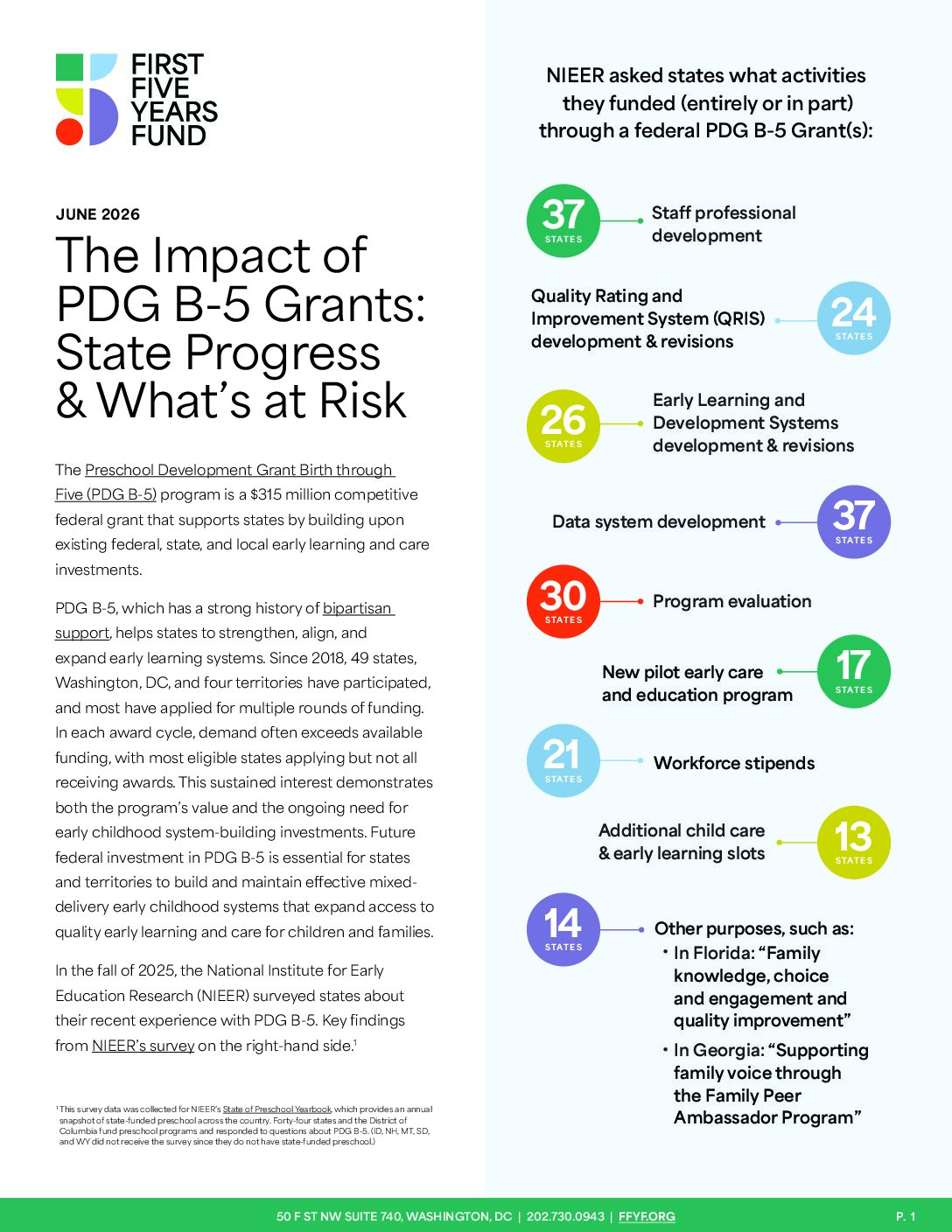
The Impact of PDG B-5 Grants: State Progress and What’s at Risk
The Preschool Development Grant Birth through Five (PDG B-5) program is a $315 million competitive federal grant that supports states by building upon existing federal, state, and local early learning and care investments. PDG B-5, which has a strong history of bipartisan support , helps states to strengthen, align, and expand early learning systems. Since 2018, 49 states, Washington, DC, and four territories have participated, and most have applied for multiple rounds of funding. In each award cycle, demand often exceeds available funding, with most eligible states applying but not all receiving awards. This sustained interest demonstrates both the program’s value and the ongoing need for early childhood system-building investments. Future federal investment in PDG B-5 is essential for states and territories to build and maintain effective mixed-delivery early childhood systems that expand access to quality early learning and care for children and families. In the fall of 2025, the National Institute for Early Education Research (NIEER) surveyed states about their recent experience with PDG B-5. Our full report and findings from NIEER’s survey are below . Download (1.92 MB) The post The Impact of PDG B-5 Grants: State Progress and What’s at Risk appeared first on First Five Years Fund .
17 Jun 2026

Africa’s anti-corruption research centre launched in Nairobi
The centre is both a vote of confidence in the country as 43 states back new graft war front.
17 Jun 2026

Lymphatic Dysfunction Drives Heart Valve Disease
Dysfunction in the lymphatic system has been identified as a hidden driver of life‑threatening heart valve disease in patients with Marfan syndrome, according to a new Northwestern Medicine study published in The Journal of Clinical Investigation. The post Lymphatic Dysfunction Drives Heart Valve Disease appeared first on News Center .
17 Jun 2026

Breathing life into a 6,000-year-old instrument: the Chogha Mish harp project
TEHRAN - For more than two decades, Iranian musician, instrument maker, and researcher Abdolali Bagherinejad has pursued an ambitious goal: reviving the sound of a harp that fell silent over 6,000 years ago. The celebrated curved harp has been reconstructed through meticulous study of ancient visual evidence from the archaeological site of Chogha Mish, near Dezful in southwestern Iran's Khuzestan province.
17 Jun 2026
2025 Annual report: defining our new direction
Looking back over my first year at the Nuffield Foundation – set out within the pages of this report – I’m very proud of what we’ve achieved so far. Having published an ambitious new strategy in 2025, we’re now firmly engaged in putting it into practice. We are doing this through collaboration – it has been thought provoking and inspiring to work with, and learn from, such a diverse range of organisations, experts and practitioners. Responding to a changing landscape If ever a reminder was needed of the importance of our work, 2025 provided it. Political and economic disruption, at home and globally, has created further instability for policymakers and the public. The need for authoritative evidence, and for bringing that evidence to decision-makers in a timely way, has never been more crucial. Equally vital is taking the longer view – building insight and expertise where it is needed while scanning the horizon for emerging issues. And the value of investing in newer priority areas from our Strategic Review – including trusted and effective institutions, demographic change, and the societal impacts of climate change and the transition to net zero – has only become clearer. Focus on young people’s futures Among many competing needs, we placed particular importance on our concerns for young people’s futures – a perennial Nuffield theme – especially post-16 transitions , SEND provision , and the risk of disengagement from education, employment, or training and how this can be addressed. Investing in long-term research and impact Landmark work supported by our Strategic Fund – such as The skills imperative 2035 and The Pissarides review , both completed in 2025 – demonstrates how ambitious long term research investment can contribute to national debate. Our new strategy makes this an ideal moment to reopen the Strategic Fund and support transformative, multidisciplinary research capable of shaping policy and practice. The first grants from the Racial Diversity UK Fund were awarded, seeding the development of a much needed portfolio of work providing timely insight on how to move towards a racially just and inclusive future. Alongside this, our in-house programmes Grown up? Journeys to adulthood , Public right to justice , and AI and education , produced a flow of insights on issues that have featured highly on news and policy agendas. Strengthening insight through our expert centres Nuffield’s expert centres – The Ada Lovelace Institute , the Nuffield Council on Bioethics , and the Nuffield Family Justice Observatory – have all played key roles over the last year in advancing our purpose. Whether addressing new issues in bioethics, family justice or AI and emerging technologies, their work is a vital part of the Foundation’s commitment to tackle inequalities, promote inclusiveness and fairness, and ensure science and technology work for people and society. In 2025, we began implementing our first annual action plan for equity, diversity, and inclusion , aiming to ensure that our work, partnerships and organisational culture reflect the values underpinning our mission. This is an ongoing priority, with a year-two plan now underway. Looking ahead with purpose As we look ahead, and our exploration of newer thematic areas gathers pace, I’d like to thank everyone who has contributed to our work this year – all our grant-holders, stakeholders, Trustees, and colleagues. Together, we will continue to champion evidence that shapes a more prosperous, fairer, and inclusive society and helps people lead better, more secure lives. Read the annual report The post 2025 Annual report: defining our new direction appeared first on Nuffield Foundation .
17 Jun 2026
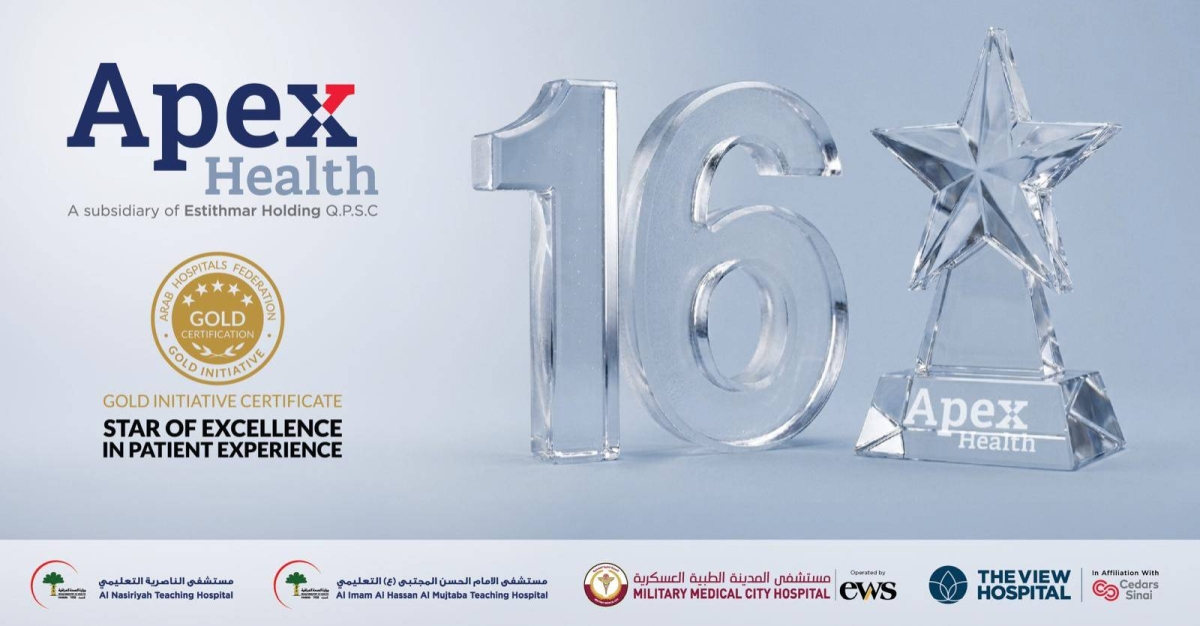
Apex Health wins 16 awards and earns highest recognition
Four platinum and twelve gold awards across five institutions, the highest designation the Federation confers. Apex Health, a subsidiary of Estithmar Holding and the fastest-growing healthcare company in the MENA region, has been named a Holistic Role Model by the Arab Hospitals Federation, the highest designation the Federation confers, after securing 16 recognitions across the group's network, including Apex Health at the group level, The View Hospital and The Military Medical City Hospital, managed by EWS, in Qatar, Al Imam Al Hassan Al Mujtaba Teaching Hospital and Nasriyah Teaching Hospital in Iraq. The achievement includes four Platinum and twelve Gold awards at the Federation’s seventh Gold Initiative Certificate, placing Apex Health ahead of 45 institutions recognised from 323 applications submitted across ten countries. Notably, every Apex Health institution submitted for consideration received an award. The Holistic Role Model status is reserved for organisations that demonstrate sustained, measurable performance across the full spectrum of healthcare delivery, rather than excellence in any single area. The framework evaluates performance across eight dimensions of healthcare excellence, ensuring a comprehensive view of organisational quality and impact. Commenting on this milestone, Joseph Hazel, Group CEO of Apex Health, said: “This is one of the proudest moments in Apex Health’s history. This recognition from the Arab Hospitals Federation across every institution in multiple countries proves our strategy works: quality at Apex Health is our baseline and we continue to provide trusted quality care with measured clinical outcomes across all the communities we serve.” Apex Health’s 16 recognitions were distributed across five institutions, covering eight dimensions of healthcare excellence including leadership and governance, workforce development, quality and patient safety, operational excellence, digital health, patient-centred care, and sustainability. The group’s model rests on three principles: investing in people, building systems that hold institutions accountable, and treating patient experience as the baseline against which everything else is measured rather than a separate function. The Federation’s evaluation was independently validated by HIMSS, The Beryl Institute, and the World Council for Medical Tourism. Holistic Role Model status is not a destination. For Apex Health, it is a confirmation of where the group stands today and a commitment to where it intends to go. The healthcare landscape is changing faster than at any point in recent history. Patient expectations are higher, regulatory scrutiny is sharper, and the competition for clinical talent is intensifying. Alice Yammine Boueiz, CEO, Arab Hospitals Federation, congratulated Apex Health, saying: “Apex Health was assessed across every level of the Gold Initiative Certificate: Silver, Gold, Platinum, and our highest honour, Holistic Role Model. The results speak for themselves. The message to Arab healthcare is clear. Real excellence cannot be hidden or faked. The assessment tested Apex Health across multiple dimensions and institutions, and the evidence held at every level. The Arab Hospitals Federation is proud of this achievement, both for Apex Health and for what it means for Arab healthcare. This is the standard we set. This is the standard they met.” Apex Health - Group Level: Platinum in Leadership, Governance & Continuous ImprovementGold in Workforce Development & Wellbeing The View Hospital, Qatar: Platinum in Leadership, Governance & Continuous ImprovementPlatinum in Patient Centred Care & ExperienceGold in Quality Management & Patient SafetyGold in Operational Excellence & Resource OptimizationGold in Digital Health & Technology Innovation The Military Medical City Hospital, managed by EWS, Qatar: Platinum in Quality Management & Patient SafetyGold in Patient Centred Care & ExperienceGold in Digital Health & Technology Innovation Al Imam Al Hassan Al Mujtaba Teaching Hospital, Iraq: Gold in Leadership, Governance & Continuous ImprovementGold in Patient Centred Care & ExperienceGold in Sustainability, Hospital Design & Resilience Nasriyah Teaching Hospital, Iraq: Gold in Quality Management & Patient SafetyGold in Patient Centred Care & ExperienceGold in Sustainability, Hospital Design & Resilience In that environment, the groups that will lead are those able to demonstrate consistency across institutions, countries, and healthcare settings. Apex Health has achieved exactly that, showing that its standards can be sustained across its network. The focus now is to build on this achievement and extend its impact to every institution the group operates and every patient it serves. Apex Health is the fastest-growing healthcare company in the MENA region, with eight hospitals across four countries. Managing over 2,800 beds, its hospitals serve more than 2.8 million patient visits annually.
17 Jun 2026
Apex Health wins 16 awards and earns highest recognition
Four platinum and twelve gold awards across five institutions, the highest designation the Federation confers. Apex Health, a subsidiary of Estithmar Holding and the fastest-growing healthcare company in the MENA region, has been named a Holistic Role Model by the Arab Hospitals Federation, the highest designation the Federation confers, after securing 16 recognitions across the group's network, including Apex Health at the group level, The View Hospital and The Military Medical City Hospital, managed by EWS, in Qatar, Al Imam Al Hassan Al Mujtaba Teaching Hospital and Nasriyah Teaching Hospital in Iraq. The achievement includes four Platinum and twelve Gold awards at the Federation’s seventh Gold Initiative Certificate, placing Apex Health ahead of 45 institutions recognised from 323 applications submitted across ten countries. Notably, every Apex Health institution submitted for consideration received an award. The Holistic Role Model status is reserved for organisations that demonstrate sustained, measurable performance across the full spectrum of healthcare delivery, rather than excellence in any single area. The framework evaluates performance across eight dimensions of healthcare excellence, ensuring a comprehensive view of organisational quality and impact. Commenting on this milestone, Joseph Hazel, Group CEO of Apex Health, said: “This is one of the proudest moments in Apex Health’s history. This recognition from the Arab Hospitals Federation across every institution in multiple countries proves our strategy works: quality at Apex Health is our baseline and we continue to provide trusted quality care with measured clinical outcomes across all the communities we serve.” Apex Health’s 16 recognitions were distributed across five institutions, covering eight dimensions of healthcare excellence including leadership and governance, workforce development, quality and patient safety, operational excellence, digital health, patient-centred care, and sustainability. The group’s model rests on three principles: investing in people, building systems that hold institutions accountable, and treating patient experience as the baseline against which everything else is measured rather than a separate function. The Federation’s evaluation was independently validated by HIMSS, The Beryl Institute, and the World Council for Medical Tourism. Holistic Role Model status is not a destination. For Apex Health, it is a confirmation of where the group stands today and a commitment to where it intends to go. The healthcare landscape is changing faster than at any point in recent history. Patient expectations are higher, regulatory scrutiny is sharper, and the competition for clinical talent is intensifying. Alice Yammine Boueiz, CEO, Arab Hospitals Federation, congratulated Apex Health, saying: “Apex Health was assessed across every level of the Gold Initiative Certificate: Silver, Gold, Platinum, and our highest honour, Holistic Role Model. The results speak for themselves. The message to Arab healthcare is clear. Real excellence cannot be hidden or faked. The assessment tested Apex Health across multiple dimensions and institutions, and the evidence held at every level. The Arab Hospitals Federation is proud of this achievement, both for Apex Health and for what it means for Arab healthcare. This is the standard we set. This is the standard they met.” Apex Health - Group Level: Platinum in Leadership, Governance & Continuous ImprovementGold in Workforce Development & Wellbeing The View Hospital, Qatar: Platinum in Leadership, Governance & Continuous ImprovementPlatinum in Patient Centred Care & ExperienceGold in Quality Management & Patient SafetyGold in Operational Excellence & Resource OptimizationGold in Digital Health & Technology Innovation The Military Medical City Hospital, managed by EWS, Qatar: Platinum in Quality Management & Patient SafetyGold in Patient Centred Care & ExperienceGold in Digital Health & Technology Innovation Al Imam Al Hassan Al Mujtaba Teaching Hospital, Iraq: Gold in Leadership, Governance & Continuous ImprovementGold in Patient Centred Care & ExperienceGold in Sustainability, Hospital Design & Resilience Nasriyah Teaching Hospital, Iraq: Gold in Quality Management & Patient SafetyGold in Patient Centred Care & ExperienceGold in Sustainability, Hospital Design & Resilience In that environment, the groups that will lead are those able to demonstrate consistency across institutions, countries, and healthcare settings. Apex Health has achieved exactly that, showing that its standards can be sustained across its network. The focus now is to build on this achievement and extend its impact to every institution the group operates and every patient it serves. Apex Health is the fastest-growing healthcare company in the MENA region, with eight hospitals across four countries. Managing over 2,800 beds, its hospitals serve more than 2.8 million patient visits annually.
17 Jun 2026
Current DWP research being undertaken by external organisations
Check a list of live research being conducted by research organisations for the Department of Work and Pensions (DWP).
17 Jun 2026

„Wir befinden uns in einer Art Teufelskreis“: Dürre bringt Hunger nach Afrika
Dürre und Wüstenbildung gefährden Millionen Menschen im Sahel und am Horn von Afrika. Viele verlassen ihre Heimat, aber einige versuchen, mit neuen Konzepten weiterzumachen.
17 Jun 2026

Raumfahrt: Europäische Ariane-6-Rakete mit stärkeren Boostern ins All
Die europäische Rakete Ariane 6 wird noch leistungsstärker: Ein neuer Booster verleiht der Rakete mehr Schub. Erstmals geht es damit ins All.
17 Jun 2026

Konflikt um Antisemitismusbeauftragten für Berlins Unis: Experten und jüdische Studierende stellen sich hinter Mehmet Can
Berlin streitet um den Antisemitismusbeauftragten für die Hochschulen. Wegen des Vorwurfs, die Verwaltung habe die Auswahl politisch beeinflusst, steht die Erstplatzierung von Mehmet Can infrage. Jetzt mehren sich Stimmen, die den Lehrer und Schulberater Can verteidigen.
17 Jun 2026

Lebensbewältigung: 20 Prozent der Deutschen fühlen sich stark gestresst
Arbeiten, Familie, Geldsorgen: Besonders Frauen und Berufstätige geben an, besonders gestresst zu sein. Männer und Frauen nutzen verschiedene Strategien dagegen.
17 Jun 2026

EU schwächt Regeln ab: Mit Gentechnik veränderte Lebensmittel dürfen leichter verkauft werden
Mit modernen Gentechnikverfahren veränderte Lebensmittel dürfen in der EU künftig ohne spezielle Kennzeichnung im Supermarkt verkauft werden.
17 Jun 2026
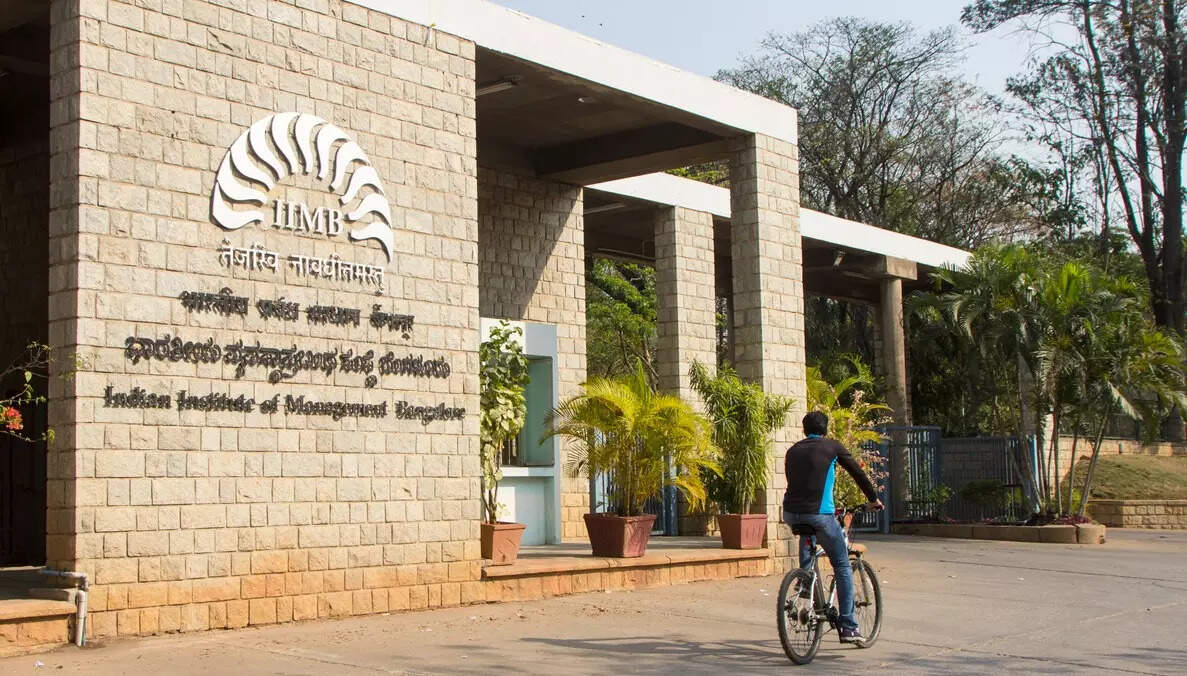
IIM Bangalore receives Tata Trusts support for new undergraduate school, first batch to begin classes in August
IIM Bangalore has received philanthropic support from Tata Trusts for its newly established School of Undergraduate Studies, marking the institute’s entry into residential undergraduate education. The initiative will begin with programmes in Economics and Data Science, while the funding will support infrastructure, faculty recruitment and research areas as IIMB expands its academic footprint.
17 Jun 2026

Erfolgreich im Alltagstest: ALS-Patient steuert Sprache per Hirnimplantat
Der Erfolg wurde nicht im Labor erzielt: 19 Monate lang konnte ein ALS-Patient zu Hause per Hirn-Computer-Schnittstelle kommunizieren. Ein Meilenstein – erreicht mit beträchtlichem Aufwand.
17 Jun 2026
Study links physical and mental capacity to disability before death
The study showed early evidence that monitoring things like walking speed and memory as part of routine care could be useful for developing early interventions to help older adults preserve their independence and quality of life.
17 Jun 2026
Study links physical and mental capacity to disability before death
The study showed early evidence that monitoring things like walking speed and memory as part of routine care could be useful for developing early interventions to help older adults preserve their independence and quality of life.
17 Jun 2026

Artist reflects on search for a ‘lost paradise’
For Salman al-Malek, every painting begins with a memory. A glimpse of brightly coloured fabrics beneath black abayas. The familiar faces of mothers and sisters in a close-knit neighbourhood. The birds that fascinated him as a child. Decades later, these images continue to appear in his work. In the latest episode of Artists’ Voices, a video series produced by Qatar Museums (QM), the veteran Qatari artist and caricaturist reflects on a life devoted to art and the memories that continue to shape his work. “When I paint, I search for myself,” al-Malek says in the documentary. “My inner self. I try to move away from the physical world to step back from my surroundings. What brings me to this gentle ‘trance’ is painting.” He notes that the story began long before galleries and exhibitions. It started in the fareej, the traditional neighbourhood where he grew up. “I’ve always felt I carried a visual archive inside me,” he said. “A visual archive of a child who grew up in a fareej. A child would grow up in a neighbourhood that felt like one big family.” “My visual memory is tied to so many things that helped me rediscover that memory and turn it into themes I paint today,” the artist added. The fareej left such a lasting impression that al-Malek said he would gladly return to that period of his life. “I’d return to it even for brief moments, just to live it again,” he stated. Years before his work was exhibited in galleries, al-Malek was known simply as “The Painter” among neighbours and classmates. Encouragement from his teachers helped strengthen his confidence in his talent. “It was the constant praise from my teachers, the art teachers in my early school years,” he recalled. “I’d always see a glimmer in their eyes, a kind of satisfaction,” al-Malek said. “That approval was a special moment for me. It fed my pride, but at the same time, it reassured me that I was moving in the right direction.” Equally important was his father’s support. Although he initially viewed drawing as a hobby that brought joy to his son, he found his own way of encouraging him. Working in an engineering office for an oil company, he would bring home black ink and drawing pens. “He saw the joy in my eyes whenever he did, and that became his way of supporting me,” al-Malek said. He stressed that pursuing art was never in doubt. “My determination to pursue art was genuine,” the artist said. “There was never even a one-in-a-million chance that I would study another field.” Not everyone shared his confidence. When he decided to travel to Cairo to study art, many questioned his choice. “They would ask, ‘You’re going to study art? What will you do afterwards? What will art give you after graduation?’ Those questions always shocked me and sometimes weakened my morale,” he recalled. Among the memories al-Malek recalled, one stands out above all others: the opening of his first solo exhibition in 1985. By then, his father was in the final years of his life. After arriving at the exhibition and seeing visitors gathered around the artworks, he turned to his son and asked: “Are all these people here to see your pictures?” Al-Malek smiled and told him that they were. “He was so happy,” the artist recalled. “It was one of the most moving moments of my life. I felt that I had given my father a sense of pride and happiness.” Throughout his career, al-Malek has worked both as a visual artist and as a caricaturist. While caricature allowed him to engage with society and reflect people’s concerns, painting remained his personal refuge. “Through caricature, I learned to stand beside ordinary people and their concerns,” he said. “Yet my final refuge is painting, because painting is what allows me to fulfil my inner self.” That personal connection to painting shaped the direction of his work. “When I decided what subjects to paint, I had two choices, he explained. “Either I could become a mere copy of the European artistic experience, or I could portray my own society using a universal artistic language.” Many of the women who appear in his paintings are drawn from childhood memories. “The women I paint are women I actually knew,” al-Malek said. “They were mothers, sisters and members of the community. I have always wanted them to remain part of the visual vocabulary of my paintings because they give the work its local identity.” He said that painting remains at the centre of his life: “I live with painting twenty-four hours a day. It dominates my sensory perception and my everyday awareness.” For al-Malek, art is more than a profession: it is a way for him to understand himself and the world around him. “Painting allows me to move away from the visible, material world into a world of transparency and subtlety,” he said. “I am always searching for a kind of paradise, a lost paradise. That is what I am constantly trying to find.” The Artists’ Voices series highlights the lives, creative processes and artistic perspectives of prominent Qatari and resident artists. It forms part of the QM’s broader “Evolution Nation” campaign, marking the institution’s 20th anniversary and celebrating Qatar’s growing presence on the global contemporary art stage.
17 Jun 2026
Artist reflects on search for a ‘lost paradise’
For Salman al-Malek, every painting begins with a memory. A glimpse of brightly coloured fabrics beneath black abayas. The familiar faces of mothers and sisters in a close-knit neighbourhood. The birds that fascinated him as a child. Decades later, these images continue to appear in his work. In the latest episode of Artists’ Voices, a video series produced by Qatar Museums (QM), the veteran Qatari artist and caricaturist reflects on a life devoted to art and the memories that continue to shape his work. “When I paint, I search for myself,” al-Malek says in the documentary. “My inner self. I try to move away from the physical world to step back from my surroundings. What brings me to this gentle ‘trance’ is painting.” He notes that the story began long before galleries and exhibitions. It started in the fareej, the traditional neighbourhood where he grew up. “I’ve always felt I carried a visual archive inside me,” he said. “A visual archive of a child who grew up in a fareej. A child would grow up in a neighbourhood that felt like one big family.” “My visual memory is tied to so many things that helped me rediscover that memory and turn it into themes I paint today,” the artist added. The fareej left such a lasting impression that al-Malek said he would gladly return to that period of his life. “I’d return to it even for brief moments, just to live it again,” he stated. Years before his work was exhibited in galleries, al-Malek was known simply as “The Painter” among neighbours and classmates. Encouragement from his teachers helped strengthen his confidence in his talent. “It was the constant praise from my teachers, the art teachers in my early school years,” he recalled. “I’d always see a glimmer in their eyes, a kind of satisfaction,” al-Malek said. “That approval was a special moment for me. It fed my pride, but at the same time, it reassured me that I was moving in the right direction.” Equally important was his father’s support. Although he initially viewed drawing as a hobby that brought joy to his son, he found his own way of encouraging him. Working in an engineering office for an oil company, he would bring home black ink and drawing pens. “He saw the joy in my eyes whenever he did, and that became his way of supporting me,” al-Malek said. He stressed that pursuing art was never in doubt. “My determination to pursue art was genuine,” the artist said. “There was never even a one-in-a-million chance that I would study another field.” Not everyone shared his confidence. When he decided to travel to Cairo to study art, many questioned his choice. “They would ask, ‘You’re going to study art? What will you do afterwards? What will art give you after graduation?’ Those questions always shocked me and sometimes weakened my morale,” he recalled. Among the memories al-Malek recalled, one stands out above all others: the opening of his first solo exhibition in 1985. By then, his father was in the final years of his life. After arriving at the exhibition and seeing visitors gathered around the artworks, he turned to his son and asked: “Are all these people here to see your pictures?” Al-Malek smiled and told him that they were. “He was so happy,” the artist recalled. “It was one of the most moving moments of my life. I felt that I had given my father a sense of pride and happiness.” Throughout his career, al-Malek has worked both as a visual artist and as a caricaturist. While caricature allowed him to engage with society and reflect people’s concerns, painting remained his personal refuge. “Through caricature, I learned to stand beside ordinary people and their concerns,” he said. “Yet my final refuge is painting, because painting is what allows me to fulfil my inner self.” That personal connection to painting shaped the direction of his work. “When I decided what subjects to paint, I had two choices, he explained. “Either I could become a mere copy of the European artistic experience, or I could portray my own society using a universal artistic language.” Many of the women who appear in his paintings are drawn from childhood memories. “The women I paint are women I actually knew,” al-Malek said. “They were mothers, sisters and members of the community. I have always wanted them to remain part of the visual vocabulary of my paintings because they give the work its local identity.” He said that painting remains at the centre of his life: “I live with painting twenty-four hours a day. It dominates my sensory perception and my everyday awareness.” For al-Malek, art is more than a profession: it is a way for him to understand himself and the world around him. “Painting allows me to move away from the visible, material world into a world of transparency and subtlety,” he said. “I am always searching for a kind of paradise, a lost paradise. That is what I am constantly trying to find.” The Artists’ Voices series highlights the lives, creative processes and artistic perspectives of prominent Qatari and resident artists. It forms part of the QM’s broader “Evolution Nation” campaign, marking the institution’s 20th anniversary and celebrating Qatar’s growing presence on the global contemporary art stage.
17 Jun 2026
Rejection in academia is structural not personal
From student assessments, peer review reports to funding and job applications, rejection is an increasingly common feature of academic life. Tara-Lyn Camilleri and Ed Ivimey-Cook argue that unlike other high-profile … Continued The post Rejection in academia is structural not personal first appeared on LSE Impact .
17 Jun 2026

UK police officer suspended for allegedly using AI to fabricate evidence
A British police officer has been suspended from frontline duties after allegedly using artificial intelligence to generate fake evidence in criminal cases.
17 Jun 2026

Unheilbare Krankheit: Lungenfibrose – manchmal hilft nur eine Transplantation
Lungenfibrose lässt das Gewebe vernarben und erschwert die Atmung. Medikamente können das Fortschreiten bremsen – doch oft bleibt nur eine Transplantation als Ausweg. Wie das Leben danach weitergeht.
17 Jun 2026

Uruguay enjoys 'positive discrimination' but must lift investment and productivity, BBVA says
Uruguay enjoys a "positive discrimination" relative to other economies for its institutional solidity, respect for agreements and political maturity, but its economic growth has been low over the past decade and its potential GDP —now at 2.1%— is declining. That was the assessment of economists from BBVA Research, one of Europe's largest banks, at the "Situación Uruguay" webinar, where they said the country's main challenge is to boost investment and raise productivity.
17 Jun 2026

AHRC forward look: summer 2026
This blog outlines the broad range of funding opportunities AHRC will publish over the coming months, and the wider portfolio they are part of. AHRC
17 Jun 2026

‘I killed two people’: Iceland murder trial hears evidence from first policeman on scene
Ming Ting Mancel in court in Reykjavik. Photograph: RÚV/Ragnar Visage
17 Jun 2026

Agentic systems seen reshaping Islamic banking, says expert
Agentic systems are reshaping the future of Islamic banking, with experts warning that their growing role in finance and business makes it imperative to define how the sector adapts to this new paradigm. This was emphasised by Dr Khalid bin Ibrahim al-Sulaiti, chairman of the organising committee and vice chairman of Bait Al Mashura Finance Consultations, during the 12th Doha Islamic Finance Conference held yesterday in Doha. Under the theme ‘Islamic Finance in the Age of Agentic Systems’, the event also marked the launch of the Doha Islamic Finance Conference Award, a global initiative aimed at recognising outstanding achievements in Islamic economics and finance. Al-Sulaiti said the expansion of agentic AI systems into roles long reserved for humans requires Islamic finance to examine its position within this emerging landscape. “The growing expansion of agentic AI systems in finance and business, as they increasingly assume roles long reserved for humans, makes it a scientific and strategic imperative to examine the position of Islamic finance within this emerging paradigm,” he said. He also said, “The responsibility of Islamic finance is not limited to benefiting from or adapting to these transformations, but also includes contributing to the development of a financial model that combines technological efficiency with value based governance.” Sheikh Abdullah bin Fahad al-Thani, chairman of Dukhan Bank, said agentic systems present opportunities to reimagine financial services in ways that enhance efficiency and responsiveness. He noted that digital innovation has become a cornerstone of Dukhan Bank’s strategy, reflecting its conviction that technology will play a defining role in shaping the future of Islamic finance. Engineer Hassan al-Marzouqi, director general of the General Directorate of Endowments, said the emergence of agentic systems opens broad opportunities to enhance asset management and strengthen governance and transparency. He cautioned that while these technologies offer promise, they also raise Shariah, legal, and regulatory questions that warrant careful study. Al-Marzouqi added that the directorate’s support for the conference reflects its mission to promote innovative scientific research and enrich knowledge. He expressed hope that the award launched at the event will become a platform for recognising creativity and excellence in Islamic finance. “We hope the award will become a leading platform for recognising creativity and excellence and a catalyst for advancing knowledge and professional practices across the various fields of Islamic finance.”
17 Jun 2026
Agentic systems seen reshaping Islamic banking, says expert
Agentic systems are reshaping the future of Islamic banking, with experts warning that their growing role in finance and business makes it imperative to define how the sector adapts to this new paradigm. This was emphasised by Dr Khalid bin Ibrahim al-Sulaiti, chairman of the organising committee and vice chairman of Bait Al Mashura Finance Consultations, during the 12th Doha Islamic Finance Conference held yesterday in Doha. Under the theme ‘Islamic Finance in the Age of Agentic Systems’, the event also marked the launch of the Doha Islamic Finance Conference Award, a global initiative aimed at recognising outstanding achievements in Islamic economics and finance. Al-Sulaiti said the expansion of agentic AI systems into roles long reserved for humans requires Islamic finance to examine its position within this emerging landscape. “The growing expansion of agentic AI systems in finance and business, as they increasingly assume roles long reserved for humans, makes it a scientific and strategic imperative to examine the position of Islamic finance within this emerging paradigm,” he said. He also said, “The responsibility of Islamic finance is not limited to benefiting from or adapting to these transformations, but also includes contributing to the development of a financial model that combines technological efficiency with value based governance.” Sheikh Abdullah bin Fahad al-Thani, chairman of Dukhan Bank, said agentic systems present opportunities to reimagine financial services in ways that enhance efficiency and responsiveness. He noted that digital innovation has become a cornerstone of Dukhan Bank’s strategy, reflecting its conviction that technology will play a defining role in shaping the future of Islamic finance. Engineer Hassan al-Marzouqi, director general of the General Directorate of Endowments, said the emergence of agentic systems opens broad opportunities to enhance asset management and strengthen governance and transparency. He cautioned that while these technologies offer promise, they also raise Shariah, legal, and regulatory questions that warrant careful study. Al-Marzouqi added that the directorate’s support for the conference reflects its mission to promote innovative scientific research and enrich knowledge. He expressed hope that the award launched at the event will become a platform for recognising creativity and excellence in Islamic finance. “We hope the award will become a leading platform for recognising creativity and excellence and a catalyst for advancing knowledge and professional practices across the various fields of Islamic finance.”
17 Jun 2026
Africa: Conflict Hits Schooling Hardest Where Children Are the Target - Study
[The Conversation Africa] According to Unesco, around 250 million children (16%) globally are out of school although they are of an age to be at school in their countries. Available evidence suggests that out-of-school numbers are extremely high in conflict-affected countries, though the exact number is hard to quantify. For example, in the Central African Republic, South Sudan and Eritrea, more than 50% of primary school-age children are not going to school.
17 Jun 2026

Farmer who claimed to be ‘squeaky clean’ when questioned about cannabis haul jailed for 10 years
The judge acknowledged that the accused accepted there was evidence on which a jury could convict him. File Photograph: Collins
17 Jun 2026

Shipping firms await proof of safety before returning to Hormuz
Shipping firms await proof of safety before returning to Hormuz Shipping companies are waiting for evidence that the agreement between the United States and Iran will hold before resuming operations through the Strait of Hormuz, Al Jazeera Arabic reported. The Financial Times quoted the chief executive of CMB Tech, one of the world's largest publicly listed shipping companies, as saying that the company would not send vessels through the waterway until it was "100% convinced" that conditions were safe. Insurance broker James Reason told the Financial Times that war risk insurance rates had not yet responded to the US-Iran agreement, adding that uncertainty persisted over its implementation. He said market participants remained concerned and were still assessing the seriousness and durability of the accord before adjusting their risk calculations. Iranians swim at Suru Beach in Bandar Abbas along the Strait of Hormuz, 1 June 2026 (Amirhossein Khorgooei/ISNA/AFP)
17 Jun 2026

Korean researchers develop blood and urine test for early colorectal cancer detection
A research team at the Korea Institute of Materials Science (KIMS) has developed a plasmonics-based liquid biopsy platform capable of detecting cancer-related gene mutations in the blood and urine of patients with early-stage colorectal cancer, paving the way for less invasive cancer diagnosis, KIMS said Wednesday. The research team, led by Lee Min-young, senior researcher at the Advanced Bio and Healthcare Materials Research Division, and Park Sung-kyu, director of the Global Top Research Consortium, developed a new testing platform capable of detecting KRAS mutations, a key genetic driver of colorectal cancer, with very high sensitivity. To test the technology, the researchers analyzed tumor tissue as well as matching blood and urine samples from patients with stage 0 and stage 1 colorectal cancer. The results showed more than 90 percent agreement across the different sample types, suggesting that the method could serve as a reliable alternative to conventional tissue biopsies. The study builds on KIMS' earlier work detecting lung cancer-related gene mutations in blood samples. This t
17 Jun 2026

The 'time-travel' flaw that prompted India to block Telegram ahead of NEET-UG retest
A Telegram editing feature is a vulnerability that the NTA said scammers exploit to fabricate evidence of paper leaks.
17 Jun 2026

SpaceX buys Cursor for $60bn
SAN FRANCISCO: SpaceX said on Tuesday it will acquire artificial intelligence coding startup Cursor for $60 billion as shares of Elon Musk’s rocket company soared for a third straight session after a record-breaking IPO. Near 1130am (1530 GMT), shares of SpaceX, formally Space Exploration Technologies Corp., stood at $214.29, up 11.2 per cent, and lifting its market value above Amazon to become the fifth largest enterprise in terms of market valuation. Cursor, founded in 2022 and based in San Francisco, specialises in AI for creating software code, particularly for business uses. An acquisition had looked possible after the two companies had announced a partnership in April that included a clause for Cursor to be potentially bought by SpaceX for $60 billion. In a filing with the Securities and Exchange Commission, SpaceX said the all-stock deal was expected to close in the third quarter of this year and that Cursor would become a wholly owned subsidiary. Combining Cursor’s software and product expertise with SpaceX’s “Colossus” AI training supercomputer will enable the company “to build the world’s most useful models,” the companies said in April when announcing their partnership. Cursor had initially emerged as a platform where developers could interface with other AI models, such as Anthropic’s Claude or Google’s Gemini programme. In late October, Cursor’s parent company Anysphere launched its own model, Composer, which has since been updated at a competitively priced level. Cursor’s emergence has coincided with the growth of “vibe coding,” whereby online users ditch written codes and build applications by commands executed by AI. The company has also been boosted by the growing capacity of AI “agents,” which are able to undertake tasks of increasing sophistication well beyond responding to research queries. Cursor described the latest version, Composer 2.5, as a “substantial improvement” over Composer 2. “It is better at sustained work on long-running tasks, follows complex instructions more reliably, and is more pleasant to collaborate with,” according to a May 18 blog post. Growth at Cursor has been accelerated by increased business with the private sector, where there is a greater volume of work and profit margins are more robust compared with individual clients. At its last funding round in November, Cursor was valued at $29 billion. Published in Dawn, June 17th, 2026
17 Jun 2026

Your soundproof car windows could trap you, new study finds
Automakers have increasingly turned to laminated acoustic glass to drown out highway noise and keep modern cabins whisper-quiet. While excellent for a peaceful commute, a new study by Korea's National Institute of Fire Service reveals that this luxury upgrade poses a hidden danger during an underwater emergency. The very material designed to protect you from exterior noise could trap you inside a sinking vehicle. The classic automotive survival playbook — grabbing the seat headrest and smashing the side window with its metal prongs — is dangerously outdated. The institute's survival simulations showed that on standard tempered glass, using a headrest prong is incredibly difficult because the car's rubber molding and window frame absorb the brunt of the impact. However, if you use a dedicated emergency tool like a rescue hammer or a spring-loaded punch, tempered glass shatters relatively easily, provided you avoid the center and aim repeatedly for the corners. If your vehicle is equipped with laminated acoustic glass, you are facing a literal brick wall. Because of a tough, plastic s
17 Jun 2026

‘Mediation for sake of regional stability, not narrow interests’
ISLAMABAD: The motives behind recent mediation efforts by Pakistan’s civilian and military leadership were aimed at securing regional stability and peace among Muslim countries, rather than pursing narrower interests, a senior security official said. The remarks came at a background briefing for selected journalists, held on Tuesday. There, the official addressed a wide range of issues, including Pakistan’s role in securing peace between the US and Iran and issues arising out of India’s tampering with the Indus basin. The security official said that through consultation with key stakeholders, Pakistan — and Field Marshal Asim Munir in particular — had helped avert a major war that he said had been planned with serious consequences for the region. FM Munir’s “sincerity, competence, brilliance and Allah’s blessings” was credited for what the official called a war “won… without actually being fought”, and described this as “the pinnacle of strategy”. The official said the diplomatic process required “utmost confidentiality, responsibility and caution,” and that Pakistan, as a “responsible mediator,” would not discuss the substance of any talks or next steps in order to avoid speculation. He also credited Muslim-majority countries, particularly Saudi Arabia, with showing what he called “masterly leadership, restraint and strategic patience” in helping avert a war he said could otherwise have pitted Muslim countries against one another. On the Indus Waters Treaty , the official said that Pakistan had also pursued what he called a highly successful legal and diplomatic response to Indian violations of the treaty. He added that whatever needs to be done, will be done to protect Pakistan’s interests whenever it needs to be. He alleged that India, in order to conceal its failures in held Kashmir, was attempting to incite unrest in AJK. The official said twelve reserved seats — an apparent reference to the seats set aside for Kashmiri refugees in the AJK Legislative Assembly — are tied to the Constitution and to Kashmiris’ right to self-determination, and that no group or armed faction could impose its will through force. Published in Dawn, June 17th, 2026
17 Jun 2026

Gesundheitsrisiko Hitze: „Stiller Killer“ – Was Hitze für Menschen gefährlich macht
Der Sommer bricht sich Bahn. Doch die kommenden heißen Tage bringen auch Gefahren mit sich – besonders für bestimmte Gruppen.
17 Jun 2026

Mbappe’s heroics prove too much as Senegal go down 3-1 to France
EAST RUTHERFORD: Kylian Mbappe scored twice as France shook themselves awake after a sleepy first half on Tuesday to beat Senegal 3-1 in New Jersey Stadium, for a perfect start to their World Cup campaign. While the Africans had looked the stronger team in the first half of the Group I match, the second period was a different matter as French class ultimately proved the difference. Inevitably, it was France captain Kylian Mbappe who broke the deadlock, unlocking the Senegalese defence in the 66th minute for a record-equalling 57th goal for his country. He made a brilliant run to get on the end of a through ball by Michael Olise and he didn’t even look up as he swept it past Edouard Mendy. Substitute Bradley Barcola added a second, and the skipper then broke Olivier Giroud’s record with his 58th goal for France, thanks to a scorching strike from outside the box deep into added time, just seconds after Ibrahim Mbaye’s consolation strike for Senegal. His second goal of the game also moved Mbappe into an elite group of footballers with 15 World Cup goals. He joins the likes of Brazil’s Ronaldo and West Germany’s Gerd Mueller. Only German wunderkind Miroslav Klose has more tournament goals, with 16. “France have been brilliant in the second half. That is what we hoped for and expected. Some of the passing, some of the movement has been outstanding. Senegal have just not been able to live with them. They will regret missing that big opportunity at the end of the first half with Sarr,” England striker Alan Shearer said on BBC Sport. Published in Dawn, June 17th, 2026
17 Jun 2026
New research centre to turn trash on Singapore’s sole landfill Semakau to treasure
Semakau Landfill is projected to hit full capacity by about 2035.
17 Jun 2026
Vast areas of climate-resistant coral reefs found: study
17 Jun 2026
Blurring the Lines: What Sweden’s Smoke-free Success Teaches
Molly Ogbodum Globally, the global conversation around tobacco control is undergoing a major shift, with discussions moving away from treating all nicotine use as a single, uniform risk. Sweden is leading the way globally with a clear real-world example of this shift by successfully lowering its smoking prevalence to 5.4 per cent and getting closer to the internationally recognized 5 per cent smoke-free threshold. Between 2012 and 2024, the country’s smoking rate declined by more than 54 per cent, much faster than its other EU contemporaries. This milestone by Sweden demonstrates that an approach centered on recognizing and distinguishing between different nicotine delivery systems yield rapid results. Sweden’s success was not a matter of product availability, but rather the result of a willingness to recognize risk differences, speak plainly about scientific evidence, and prioritize realistic public health outcomes. Central to understanding Tobacco Harm Reduction (THR) is debunking the myth that all nicotine products carry the exact same dangers. The scientific reality relies heavily on risk differentiation. The primary health hazard in tobacco uses stems from the toxic substances produced by burning tobacco. Nicotine is not the primary cause of smoking-related illnesses; the real danger is the smoke generated by burning. A landmark report by the Royal College of Physicians, titled ‘Nicotine Without Smoke’, concluded that the health hazards associated with long-term e-cigarette use are unlikely to exceed 5 per cent of those smoking traditional tobacco. Independent reviews by Public Health England have corroborated these findings, establishing that while non-combustible, reduced-risk alternatives are not entirely risk-free, they are less risky and safer than smoking traditional cigarettes. Yet, a significant misconception persists where public discussions treat all nicotine delivery systems as an identical threat tobacco product. When public awareness campaigns refuse to distinguish between traditional tobacco products and reduced-risk alternatives, they inadvertently deny adult smokers a realistic exit from combustible tobacco. This information gap is particularly evident in Nigeria, where smoking prevalence remains a significant challenge. While alternative products like nicotine pouches and vaping devices are increasingly accessible in the marketplace, they circulate without standardized public health guidance or accurate information for the consumer due to the complete absence of formal public education. This creates an environment where adult smokers looking to quit traditional cigarettes and tobacco products are left to rely on unsafe information or myths just to understand their choices. Public health outcomes are fundamentally shaped by how evidence is interpreted and communicated to the public. The potential risk for Nigeria is failing to engage with the changing nature of this global scientific debate altogether. In over a decade, success seen in advanced smoke-free nations occurred because alternative nicotine products were made accessible, affordable, and socially acceptable based on clearly communicated evidence with Sweden as a core case study. Moving Paving the way forward will requiredemands a strong focus on education and the dissemination of accurate information. The middle ground of tobacco control – where evidence-based harm reduction occurs – is where the most significant gains in population health are achieved. By prioritizing THR awareness, we can dismantle long-standing myths and ensure that adult smokers are provided with the clear, accurate and correct information necessary to transition away from the most harmful forms of tobacco use Ogbodum is a Public Health Advocate
16 Jun 2026

The People Behind the Programs: 2025–26 Techniques Year in Review
From September 2025 through May 2026, Techniques followed educators, program leaders and advocates as they worked through some of CTE’s most enduring questions: What does it take to build pathways that reach every learner? How do learning spaces and experiences shape what students believe is possible? As ACTE marks 100 years of service, these questions feel more relevant than ever. Techniques: Our CTE Year in Review The best CTE stories are never only about programs. They’re about the people inside them — what they built, what they believed, and what they refused to give up on. These eight articles are a record of that. Want to see your work in the next Year in Review? Learn more about writing for Techniques . Skills Over Stigma High-quality CTE is a promise. For justice-impacted learners, the stakes of that promise are especially high and the barriers especially real. The author of this article in Techniques writes from experience: As someone who has been justice-impacted and now focuses on education and reentry, they know firsthand what is at stake. It’s a compelling case for building pathways that recognize skills over stigma. READ MORE Leading the Change The narrative around CTE is changing, and the NextLevel Postsecondary CTE Fellowship alumni are leading that transformation. They come from all over the country and from institutions of all sizes. And their students, they say, have been their greatest teachers. This annual feature in Techniques celebrates the education leaders who are challenging outdated perceptions and building dynamic pathways. READ MORE Student-Centered Work Work-based learning is most effective when it encourages learners to explore their interests. Meaningful career exploration often depends on the freedom to question, refine and redirect — and that may look different for different students. This article in Techniques looks at what it takes to design experiences that meet students where they are and help them move toward what’s possible. READ MORE High-Quality CTE By Design Wraparound supports are often treated as supplemental. The truth is, they are central to keeping students engaged and on the path to program completion. When those supports are embedded into program design from the start, something changes. For students, for programs and for the communities counting on both. This article in Techniques looks at what it takes to make that shift and why it matters. READ MORE Meaningful Student Experiences The strongest CTE programs begin with a curricular vision, and the spaces that house them should reflect it. This article in Techniques offers a practical roadmap for facilities design that rarely requires new construction, starting instead with a fresh look at what’s already available. The goal, as the author writes, is to help students see themselves in future careers. The right environment can make that possible from the moment they walk in. READ MORE A Century of Storytelling Data helps make the case for CTE. Stories help people remember why it matters. As ACTE marks its 100th anniversary, this article in Techniques explores how the Association is harnessing storytelling as advocacy through the human touch of documentary film. The result is a portrait of CTE that makes its impact visible, relatable and personal, connecting a century of educational leadership to the students, educators and communities still writing the story. READ MORE Challenges & Opportunities Rural CTE programs face serious headwinds. As workforce numbers dwindle and services grow even more limited, communities have learned to brace for closure. This article in Techniques offers a practical framework for turning program impact into data administrators can use. The result is a story that goes far beyond graduation day — one that connects student success to workforce development and long-term community investment. READ MORE No More Revolving Door She left her career in insurance to become a CTE teacher. Two days into the school year, she resigned. This article in Techniques uses that story as a window into a pattern that is far more common than it should be. Drawing on original research, the author offers CTE leaders a blueprint for keeping industry experts in the classroom, built on the finding that when induction is treated as an experience rather than a checklist, they stay. And when they stay, students and programs thrive. READ MORE Lia Milgram is managing editor for ACTE. Read more in Techniques. Test text The post The People Behind the Programs: 2025–26 Techniques Year in Review appeared first on ACTE Online .
16 Jun 2026
More States Require Personal Finance. But Does It Actually Work?
Personal finance education can influence behavior positively with specific strategies.
16 Jun 2026

Improving STEM career readiness: Lessons from Denmark
After a year in Copenhagen, Denmark, as a Fulbright Scholar, Saint Paul College (SPC) biology professor Kristyn VanderWaal Mills returned with a clearer picture of how different education systems prepare students for careers in science and technology. Kristyn VanderWaal Mills By comparing Københavns Professionshøjskole (KP) with the Minnesota college, she explored a simple yet important question: how do we best prepare students for real-world STEM jobs? What she found is encouraging. Students in both places are learning many of the same essential skills, but SPC could also consider practical changes to make the learning experience more connected, clear and career-focused. “Meaningful international exchange thrives not through completion of a research project, but through creating space to examine familiar practices and collaborate,” VanderWaal Mills said. Building global lab skills At the center of this work were two projects. The first, called the LabBridge Virtual Exchange, brought students from Denmark and SPC together online. They discussed lab techniques, shared how their programs worked and practiced communicating about science professionally. What started as structured conversations quickly turned into something more natural. Students stayed engaged, continued discussions outside scheduled meetings and became more confident speaking about their work. For many, it was their first time working with peers from another country, and it made their learning feel more relevant and real. Comparing workforce skills The second project, the Technological Literacy Project, looked more broadly at the skills students need for modern laboratory careers. Faculty, researchers and industry professionals contributed insights about what matters most on the job and how those skills are taught. What stood out was that there weren’t significant differences between Denmark and the United States in expectations. In both places, employers value strong lab skills, clear communication, teamwork and critical thinking. In other words, the core goals are well aligned. The difference lies more in how students get there. Building a pathway forward from coursework to career Denmark’s structured model makes the connection between classes and careers clear from the start, helping students understand exactly what they are working toward and how each part of their program supports that goal. While SPC offers valuable flexibility, aligning courses more intentionally and emphasizing communication skills and industry perspectives could create a more connected, career-focused experience. These adjustments would make learning more relevant and help students better translate their education into real-world success. Looking ahead, the opportunity for SPC is not to become more rigid, but to combine flexibility with clearer pathways and stronger connections to careers. Programs like the LabBridge Virtual Exchange demonstrate that simple, affordable approaches, such as global collaboration, can boost confidence, engagement and communication skills. By strengthening course alignment, expanding hands-on learning, building industry partnerships and continuing to offer global opportunities, SPC can create a more intentional and supportive experience that prepares students for today’s workforce. The post Improving STEM career readiness: Lessons from Denmark first appeared on Community College Daily .
16 Jun 2026

4 steps you can take to avoid ‘perceived scarcity’ and prevent food waste
The grocery store is a busy place, full of signs and signals that we may or may not always notice. Picture yourself in your usual store: do your eyes get drawn to a “limited quantities” sign or a “buy now before it’s gone” promotion? Do you ever toss an extra item into your cart because of it? The reality is, you probably didn’t need that extra item, and a week later, half of it has ended up in the garbage. This isn’t just poor planning; it reflects a psychological trigger that most of us don’t realize is shaping our behaviour — and retailers use it widely. Food waste continues to be a massive global problem. A 2021 United Nations report found that about 60 per cent of global food waste comes from households . Public campaigns appropriately encourage people to plan better, shop more carefully, and use and freeze leftovers. These are effective strategies, but they don’t tell the whole story. Our research highlights an additional layer: psychological forces in the marketplace can quietly shape how much we buy in the first place, which can ultimately lead to more waste. Intuitively, we might expect that feeling short on resources would make people more careful, conserve what they have and waste less. And in some cases, that’s true: people with fewer financial resources do tend to waste less food. But our research explores what happens when people feel they don’t have enough, or perceived scarcity, regardless of what is in their fridge or bank account. And that’s where the pattern shifts. Perceived scarcity When people experience perceived scarcity, this activates an acquisition goal — a mental drive to secure more resources. When food is readily available, such as when stores are well stocked and people have purchasing power, perceived scarcity can push people to acquire more than they actually need. Think of the COVID-19 toilet paper rush , but with everyday groceries. This mismatch between what people buy and what they actually consume leads to increased food waste. Although scarcity can drive us to buy more, our physiological needs (how much we need to eat) stay the same. This surplus often becomes food waste. When we encounter scarcity cues, they don’t just nudge us to buy more; they can push us to over-acquire, taking more than we need. We conducted experiments and surveys to examine how this works. At a breakfast buffet, we placed a poster advertising “limited spaces available!” for an unrelated activity. We found that this led people to waste more food compared to the previous morning. We also conducted a study in our lab. Participants prompted to feel they had fewer resources than others took more snacks and left more uneaten than those who felt relatively better off. And we conducted two large-scale surveys, which showed the same pattern in real households: perceived scarcity predicted greater food waste. Many things can trigger a sense of not having enough. Retail messaging, such as “while supplies last,” is one obvious example. However, it doesn’t stop there. News reports about rising costs or product shortages, the pressure of limited time while shopping and even social media — where we see others enjoying experiences we feel we lack — can all activate a scarcity mindset. These cues create a subtle but powerful feeling of “not enough,” which drives us to acquire more, often without realizing it. In short, the environments we live in nudge us to feel perceived scarcity, leading us to over-purchase and, ultimately, waste more. Perceived scarcity isn’t the only psychological factor driving food waste. People have a natural tendency to seek variety, which causes us to overestimate how many options we might want. We might buy more variety, but not consume it because we fall back on routines. We show optimism bias, buying perishables (like ingredients for that healthy salad) with good intentions, but fail to use them. And we engage in temporal discounting — a tendency to prioritize the present over the future. In practice, this means we tell ourselves “I’ll use this before it goes bad,” but later on, other, more immediate options (like takeout or making an easier meal) win out. As a result, food we fully intended to use gets pushed aside until it spoils. Steps you can take Signs suggesting we have limited time to buy something can create a subtle but powerful feeling of ‘not enough,’ which drives us to over-buy. (Unsplash/Artem Beliaikin) Taken together, all this suggests food waste isn’t simply a planning problem — it’s a behavioural one shaped by multiple psychological forces. Given this, what can people do to make better decisions and prevent food waste ? Recognize scarcity cues. Simply being aware of the effects of “limited time” or “while supplies last” messaging can reduce its influence. Pause before purchase. Ask yourself: Do I have a specific plan for this item? When will I realistically use it? Start small. Purchasing smaller quantities of groceries more frequently can reduce over-buying. If you’re at a buffet, keep in mind that you can always go back for seconds, rather than overloading your plate. Think ahead. Mentally (or even in writing) assign foods to specific meals ahead of time. While these small shifts can help households counteract the pull of scarcity-driven buying, they are only part of the solution. The broader context also matters. Scarcity cues are embedded in retail and media environments, shaping how we feel and the decisions we make. Given that households are responsible for the majority of food waste, reducing it requires retailers and food businesses to do better planning. It requires designing environments and shaping habits that work with our psychology rather than against it. Bonnie Simpson has received funding from the Social Sciences and Humanities Research Council of Canada. Katherine White receives funding from the Social Sciences and Humanities Council of Canada. Rhiannon M. Mesler receives funding from the Social Sciences and Humanities Research Council of Canada. This article, originally published Jun 15, 2026 by The Conversation , is republished under a Creative Commons 4.0 license. UBC faculty members are encouraged to learn more about writing for The Conversation .
16 Jun 2026
Canadians would be paying additional $1000 a year if it weren’t for Alberta’s contribution: report
A study released Monday by the think tank says Alberta's relatively high employment rates, higher average incomes, and younger population mean the province makes an outsized contribution, paying more to federal revenues and national programs than it receives in transfers and federal spending. Read More
16 Jun 2026

Opinion | The Creative Economy: Moving Beyond Cultural Enlightenment to Shape the Future
The creative economy has become one of today’s most resonant terms in both cultural and economic discourse. It has evolved into a major economic enterprise and a top political priority for any nation seeking to strengthen its global standing. The world has come to realize—albeit somewhat belatedly—that art and culture are far more than tools of soft power or expressions of national identity. They are powerful economic engines and instruments of political influence. At its core, the creative economy is about transforming imagination into industry. Any creative idea can become an economic asset. A film, a song, a short series, a video game, a fashion design, digital content, a translation, an animated series, or even a simple traditional craft—all can be turned into globally resonant creative products worth billions of dollars, provided the state manages the sector wisely and creates a genuinely supportive environment. What is truly striking is that the concept of the creative economy is not new to Egypt. In fact, Egypt was among the first countries in the Global South to put this idea into practice long before the term itself was coined. For decades, Cairo was not merely a political capital but the beating heart of Arab art. Egyptian cinema, theatre, music, radio, and drama were never just forms of entertainment; they were vital sources of Egyptian influence across the Arab world and important economic lifelines for the state. In Egypt, art has never been a detached luxury. In the most difficult moments of its history, creativity served as a pillar of resilience and social cohesion. During times of war, the work of artistic giants—foremost among them the immortal Umm Kulthum—provided crucial support for the Egyptian army. In the January 2011 revolution, songs, dramas, and visual arts played a central role in expressing the spirit and identity of Egyptian society, carrying its voice to the world. The revolution was even described as “the White Revolution,” reflecting a civilized people who chose artistic expression over chaos and violence. Even during the COVID-19 pandemic, when entire economic sectors ground to a halt, artistic and digital content remained one of the few engines keeping economic and social life moving—not only in Egypt but across the globe. This reveals the sector’s true value: it is not marginal, but one of the few capable of persisting and producing even in the harshest crises. Perhaps the most significant shift in recent years has been the radical transformation in how we understand culture itself. In the past, cultural institutions saw their role as limited to enlightenment and the dissemination of knowledge. Today, the question has fundamentally changed: How can culture be converted into economic value? How can creators earn a living from their creativity without needing a second job? And how can the state project its identity to the world through technology and digital platforms? It is from this perspective that we can best understand the recent moves within Egypt’s Ministry of Culture, especially since Dr. Jehan Zaki assumed leadership. With her strong academic, cultural, and diplomatic background, she brings a sharp awareness of soft power and its connection to Egypt’s international image. What stands out in the ministry’s current discourse is the gradual shift from merely “managing cultural activities” to viewing culture as an integral part of the nation’s broader development and economic project. In this context, the ministry has already launched several policies and initiatives that genuinely reflect this transformation—not mere slogans. These include developing online platforms for showcasing books and short films, strengthening partnerships with the private sector to create funding mechanisms for cultural industries, and launching programmes to support translation and dubbing to help Egyptian cultural products reach international markets. These efforts signal a clear evolution: from simply patronizing culture to actively building it into a real industry. Over recent years, there has been a serious attempt to reposition culture as a driver of sustainable development rather than a service sector or seasonal activity. The ministry has expanded its activities, rolled out digital initiatives, opened genuine discussions on cultural and creative industries, developed new cultural sites, and linked cultural discourse to the broader goal of building the Egyptian citizen within Egypt’s Vision 2030. Yet the most critical question remains: Are we still thinking in terms of “cultural activities,” or have we truly begun thinking in terms of “cultural industries”? The difference is vast. Organizing seminars, festivals, or theatre performances is undoubtedly valuable, but it is not enough to build a real creative economy. That requires a fundamentally different mindset—one that sees the artist, writer, and content creator as genuine economic producers, not merely bearers of a noble cultural message. Prof. Inas Abd El-Khalek The world has changed at breathtaking speed, which is why certain international experiences deserve close study—not for blind imitation, but for understanding and adaptation. China, for example, did not wait for Western platforms to validate it, nor did it cling to the traditional format of long-form dramas. It recognized that audience behaviour had shifted and that people now consume content rapidly on smartphones. Thus emerged “micro-dramas”—extremely short episodes lasting just one or two minutes, built on fast pacing and relentless engagement. The result was a multi-billion-dollar industry in which millions of young people create content from their phones and generate real income. China succeeded in building a complete economic model rooted in a deep understanding of the new audience. South Korea offers the clearest example of turning culture into a national project. Once known for heavy industry and electronics, it invested heavily in the “Korean Wave” (Hallyu) by supporting music, drama, video games, and star-making systems. Today, groups like BTS and series like Squid Game have become powerful global economic and political assets. Korean culture has transformed into a premium brand that markets tourism, cosmetics, language, and lifestyle. In Africa, Nigeria stands out as a smart, pragmatic model. “Nollywood” did not begin with massive budgets or Hollywood resources. It started by developing a deep understanding of its local audience, then gradually expanded to become one of the world’s largest film industries by volume of production. Crucially, it did not wait for external validation; it built its own audience first, then successfully exported its model across the continent and beyond. So where does Egypt stand? Egypt possesses most—if not more—of the ingredients these countries had. It boasts a rich cinematic heritage, an immense musical and literary legacy, a widely understood dialect across the Arab world, exceptional talent, and a vast domestic and regional audience. The real challenge is not a lack of creativity, but the slow pace of adapting to rapidly changing global realities. The new generation is no longer waiting for cultural institutions to grant it a platform. It is creating its own culture on TikTok, YouTube, and Instagram. If cultural institutions do not move swiftly into this new world, they risk becoming increasingly detached from reality, no matter how glorious their history. The next phase therefore requires cultural and intellectual courage more than slogans. It demands the establishment of business incubators for creative industries, active partnerships between the Ministry of Culture and economic and educational ministries, funding programmes for digital content, investment funds for young creators, and stronger links between arts academies and modern digital platforms. Serious investment is needed in animation, video games, translation, and dubbing, along with the creation of accelerators for creative projects targeting global markets. Most importantly, Egypt must prepare a new generation that understands platform algorithms as thoroughly as it masters the rules of theatre and cinema, while offering real incentives for innovative content that carries Egyptian identity to the world. Even cultural palaces can be transformed into centres for digital content production rather than venues for traditional seminars and events. Culture today is no longer consumed in the old ways, and any state that fails to grasp the digital transformation will gradually lose its ability to exert influence in an intensely competitive world. This is precisely why the recent discourse from the Ministry of Culture—linking culture to development and human development—is so significant. The mission is no longer merely preserving heritage as a historical trust, but transforming it into contemporary economic and intellectual energy capable of global competition. The world has already entered the “attention economy.” Whoever can capture people’s attention holds both influence and wealth. Therefore, the battle for the creative economy is not merely a ministerial or institutional one. It belongs to every Egyptian creator who dreams of living from their art without having to emigrate or take up a second job, and to every young person creating content on their phone and aspiring to turn their small project into a global brand that carries Egyptian identity. Egypt lacks neither imagination, history, nor talent. What it sometimes lacks is the speed of movement and the ability to shift from the concept of “patronizing culture” to “managing culture as an industry.” If Egypt can move with China’s speed, invest in its soft power as South Korea did, and leverage the popularity of local content as Nigeria has, it will not merely participate in the era of the creative economy—it will be positioned to lead it across the Arab world and Africa. Ultimately, the real question is not whether Egypt has the capacity to enter the age of the creative economy—for that capacity has existed for decades. The deeper, more urgent question is: Do we have the will and wisdom to rediscover our cultural strength in the language of this new era? This is the challenge I urge all cultural sectors to embrace. Ministerial efforts must be supported by diligent collective work and genuine collaboration among all stakeholders to turn these initiatives into a tangible and lasting reality. Prof. Inas Abd El-Khalek, Academy of Arts The post Opinion | The Creative Economy: Moving Beyond Cultural Enlightenment to Shape the Future first appeared on Dailynewsegypt .
16 Jun 2026
Data-Driven and District-Ready: What EdWeek Research Tells Us About the CTE Market
Discover how to sharpen your positioning in a fast-moving market of CTE with actionable strategies grounded in EdWeek Research Center data.
16 Jun 2026