India’s university rise broadens beyond IITs, but internationalisation lags
More than half of India’s ranked universities improved their position in the QS World University Rankings 2027 , with 18 institutions achieving their highest-ever positions as gains increasingly spread beyond the country’s elite Indian Institutes of Technology (IITs). The rankings feature 52 Indian universities, up from just 14 a decade ago, making India the world’s fifth most represented higher education system behind the US, UK, mainland China and Germany. Over the past decade, India’s presence in the rankings has grown by 271% – the fastest proportional increase of any G20 nation. Some 26 Indian universities improved their position this year, nine remained stable, 15 declined and two entered the rankings for the first time. At the top of the table, IIT Delhi climbed to 118th globally, matching the highest position ever achieved by an Indian institution, a record previously set by IIT Bombay in 2025. IIT Bombay ranked 134th, followed by IIT Madras at 170th, IIT Kharagpur at 205th, and IIT Kanpur and IISc Bangalore, which were jointly ranked 221st. University of Delhi remained India’s highest-ranked non-STEM institution at 322nd globally. However, the most significant trend this year was the widening distribution of rankings success beyond the IIT sector. Among the strongest performers were Vellore Institute of Technology, which rose 94 places to 597th globally, Birla Institute of Technology and Science Pilani, which climbed 93 places to 575th, and Shoolini University, which entered India’s top 10 after rising 51 places to 452nd. Chandigarh University climbed 49 places to 526th, while Jamia Millia Islamia advanced more than 75 places to 686th. According to QS, 13 of the 18 institutions reaching all-time high positions this year were non-IIT universities. The number of ranked non-IIT institutions has increased from seven in 2017 to 43 today, while ranked institutions now span 19 states and union territories compared with just nine a decade ago. Education minister Dharmendra Pradhan said the results reflected the impact of reforms introduced under National Education Policy 2020. “India’s strong performance in the latest global university rankings reflects the transformative impact of NEP 2020, with 52 universities across 19 states and union territories now represented and more than half improving their positions,” said Pradhan. “As institutions such as Indian Institute of Technology Delhi achieve record-high rankings, India is emerging as a leading global knowledge hub, driven by research, innovation and the talent of its youth.” The rankings also highlighted areas where Indian universities are increasingly competitive internationally. India now has 11 universities among the world’s top 100 for citations per faculty, a measure of research impact, while six institutions rank among the global top 100 for employer reputation. Bharathiar University, one of two Indian debutants this year, entered directly into the global top 100 for citations per faculty, ranking 75th worldwide on the indicator. Graduate employability emerged as another area of strength. The University of Mumbai climbed 70 places to 25th globally for employment outcomes, one of the most significant single-year improvements recorded in this edition of the rankings, while the University of Delhi ranked 35th globally on the indicator. More than a third of Indian universities improved their employer reputation score, giving India the second-highest net improvement in Asia on the indicator, behind only Taiwan. India’s performance also stood out against a challenging year for several established higher education systems. While 52% of Indian universities improved their ranking, only 35% of UK institutions and 16% of German universities recorded gains. In the United States, just 13% of ranked institutions improved while 66% declined. Mainland China remained the strongest-performing major system, with 72% of ranked institutions improving and 13 universities entering the rankings. Globally, the Massachusetts Institute of Technology retained the top position for a 15th consecutive year, while Stanford University and Imperial College London shared second place. Oxford and Harvard completed the top five. Elsewhere, Australia saw 58% of institutions improve, with UNSW Sydney becoming the country’s highest-ranked university for the first time, while Canada endured a difficult year with 66% of universities declining despite McGill University retaining its position as the country’s top institution. We are seeing improvement across a much broader cross-section of the sector, suggesting that long-term investments and reforms are beginning to translate into measurable outcomes Ashwin Fernandes, QS India Despite the positive results, the rankings also underscored persistent challenges facing Indian higher education. QS identified internationalisation as one of the sector’s weakest areas, with 90% of institutions recording no improvement in international student numbers and only one Indian university ranking among the world’s top 500 for international faculty representation. Academic reputation also remained a challenge. Just 8% of Indian universities improved on the indicator, compared with 28% that declined, suggesting that gains in research output and graduate outcomes are not yet translating into equivalent levels of international recognition. The rankings noted that India continues to host relatively small numbers of international students compared with major destinations such as Australia, Canada and the UK, despite government efforts to expand inbound mobility through initiatives such as Study in India. The challenge was also highlighted in a NITI Aayog report published earlier this year, which estimated India could host 1.1 million international students by 2047 if barriers including limited scholarships, infrastructure constraints and concerns around global perceptions of Indian higher education are addressed. Commenting on the results, Ashwin Fernandes, chair of QS India and vice president for strategic and international engagement at QS, said the breadth of progress was particularly significant. “What makes this edition of the rankings compelling is its breadth. Progress is no longer concentrated among a handful of elite institutions. We are seeing improvement across a much broader cross-section of the sector, suggesting that long-term investments and reforms are beginning to translate into measurable outcomes,” he said. “For years, the story of Indian higher education was one of potential. Increasingly, it is becoming a story of delivery.” The post India’s university rise broadens beyond IITs, but internationalisation lags appeared first on The PIE News .
18 Jun 2026
Acumen acquires EduCorePro to boost AI-driven enrolment transformation
The deal brings EduCorePro’s technology platform, products, and specialist AI team into Acumen’s global admissions and enrolment services division, strengthening the company’s ability to deliver faster, more accurate and more scalable enrolment outcomes for higher education institutions worldwide. As part of the transaction, EduCorePro founder and CEO Bhushan Samant will join Acumen as chief technology officer of its admissions and enrolment services division, where he will lead the integration of AI capabilities into the company’s global operations. Acumen said the combined organisation will integrate EduCorePro’s automation and AI tools with its own human-led admissions expertise to build a next-generation enrolment platform. Acumen said the acquisition comes as institutions are under pressure to improve “compliance, application quality, fraud detection, visa credibility, operational efficiency and conversion performance,” while also managing increasing demand for faster decision-making and improved applicant experience. EduCorePro’s existing platform focuses on AI-powered tools designed to streamline admissions workflows, including document handling, applicant engagement, operational reporting and enrolment intelligence. Acumen said these capabilities will help universities improve application turnaround times, engagement and conversion efficiency. The company also highlighted broader sector challenges driving the need for automation, noting that universities are operating under “growing application volumes and heightened student expectations around speed, responsiveness and user experience.”. “International student recruitment and admissions is entering a period of profound operational change,” said Adrian Mutton, executive chairman, Acumen. Universities are increasingly being challenged to improve compliance oversight, identify and prioritise high-quality applicants more effectively, strengthen fraud detection processes, improve applicant response times and deliver a significantly better student experience — all while operating within tighter financial and operational constraints Adrian Mutton, Acumen “Universities are increasingly being challenged to improve compliance oversight, identify and prioritise high-quality applicants more effectively, strengthen fraud detection processes, improve applicant response times and deliver a significantly better student experience — all while operating within tighter financial and operational constraints.” The combined business will focus on AI-enabled tools including application triaging, fraud detection support, workflow automation, predictive enrolment intelligence and scalable admissions management systems. Commenting on the deal, Samant described Acumen as the “ideal organisation” for EduCorePro to partner with. “Together, we have an opportunity to fundamentally improve how institutions manage recruitment, admissions and enrolment operations through the intelligent and responsible application of AI technologies,” Samant added. The post Acumen acquires EduCorePro to boost AI-driven enrolment transformation appeared first on The PIE News .
17 Jun 2026

Why Employees Hate Mandatory Training (And How To Fix It)
Mandatory training is essential in many organizations, but employees often see it as repetitive, time-consuming, and disengaging. This article explores why mandatory training creates frustration and shares practical strategies to improve engagement, participation, and learning outcomes. This post was first published on eLearning Industry .
17 Jun 2026
“More of the right people”: diplomats walk a tightrope on UK-India student migration
Ben Moller, Britain’s Deputy High Commissioner to India, opened with a positive case for the bilateral relationship at the Cambridge India Business Dialogue late last month. Pointing to UK campus expansions across India and noting that British-educated Indians were statistically more likely to invest in the UK, he framed student mobility as a long-term economic pipeline, a theme echoed by fellow speakers Lord Karan Bilimoria and ICICI Bank CEO Raghav Singhal. But that warmth existed alongside an insistence on separating “legal” from “illegal” migration. The UK processes “a huge number of visas” from India, he said, and while “legal migration is fantastic and promotes growth,” both governments were working closely together on irregular arrivals. He drew an explicit line: “More of the right people and less of the wrong people.” It’s a framing that sits uneasily alongside a 30% fall in UK study visa applications in Q1 2026 and a sector asking which signals to believe. When I questioned him on whether that framing was producing unintended consequences for international students, specifically the political discourse around the Graduate Route visa, his response was measured. “We are trying to find the right balance,” he said, acknowledging a brief dip in visa numbers following the change in government, but arguing the UK was still successfully attracting students. Migration, he added, “is a very important part of the political discourse and rightly so”. It was a careful answer. Whether it was a sufficient one is harder to say. The numbers tell a more turbulent story Figures reported by The PIE News showed Indian students falling from nearly 140,000 in 2022/23 to 111,329 in 2023/24, a decline of over 20%. A partial recovery followed, with a 31% increase in Indian student visa grants in Q1 2025 year-on-year, but a Q4 2025 grant rate of 85% complicate any claim of stability. Germany, Australia, and New Zealand have all recorded rising Indian student interest in the same period. The Graduate Route sits at the centre of this volatility. Its reintroduction in 2021 drove the surge in Indian enrolments that saw Indian students overtake Chinese nationals as the UK’s largest international cohort. The 2025 immigration white paper proposed cutting its duration from two years to 18 months, a change confirmed in March 2026 and effective from January 2027. HEPI has flagged this as a primary concern, noting that post-study work rights are a significant driver of where students choose to study. Indian nationals still received 95,231 sponsored study visas in the year ending December 2025, 23% of the total, and led Graduate Route extensions with 90,153 granted. The pipeline is real. The question is whether policy is working with or against it. India’s High Commissioner to the UK, Periasamy Kumaran, added that overt activism in the field of student immigration advocacy risked producing further backlash, and that the balance would sort itself out as part of a natural cycle, the UK’s need for innovation would inevitably pull Indian students back in. The logic has some basis, but it sets aside the burden students carry in the meantime. A prospective master’s student from Chennai weighing a September 2026 application cannot wait for market equilibrium. She is already factoring in a shorter Graduate Route, higher maintenance fund requirements, rising tuition fees, and a securitised political climate. Diplomacy and the binary problem Moller’s distinction between legal and illegal migration is reasonable as far as it goes. Irregular migration routes, small boat crossings, fraudulent documentation, visa overstays – all of them represent a genuine policy challenge, and governments have a legitimate interest in addressing them. But the language of “right” and “wrong” people carries implications that often leads to conflation in public discourse. The language of “right” and “wrong” people carries implications that often leads to conflation in public discourse Asylum seekers, refugees, and those arriving via refugee family reunion routes made up around 16% of total UK immigration in 2025. Of the 100,625 people who claimed asylum that year, approximately 39% had arrived legally before making a claim. The top nationalities claiming asylum via small boat crossings are predominantly people fleeing documented conflict, whose claims sit squarely within the Refugee Convention. An Eritrean escaping conscription into an authoritarian military who crosses the Channel in a dinghy is, under this framing, a “wrong” kind of arrival. The binary does not accommodate these cases cleanly and immigration systems, by their nature, are full of them. The problem is not that the legal-illegal distinction is wrong. It is that once “right” and “wrong” enter the political discourse, they don’t stay calibrated. They travel into tabloid coverage, into the perceptions of parents and agents in Mumbai and Chennai, and into the enrolment decisions of students who register tone as readily as policy. The 2023 dependant ban illustrates this: aimed at misuse of the student route, it collapsed the dependant-to-student ratio from six per 20 to one per 20 by September 2025, with documented collateral effects on legitimate student enrolment. The wider picture for UK higher education is not comfortable. Postgraduate enrolments are falling; English universities face a proposed £925-per-student levy ; and a sector positioned as both economic export and soft-power instrument of the UK-India relationship is asking which set of signals represents the real policy direction. The UK-India CETA, signed in July 2025 and projected to add £25.5 billion annually to bilateral trade, represents a genuine commitment. So does the expanding network of UK campuses opening across India. The relationship has rarely looked stronger on paper, and there is an appetite on both sides to keep building it. Whether the balance Moller described can be found and what it costs in the meantime for students remains unanswered. The post “More of the right people”: diplomats walk a tightrope on UK-India student migration appeared first on The PIE News .
17 Jun 2026

Gender-neutral pronouns in French exams: how language classrooms respond to linguistic change
PeopleImages/Shutterstock When an exam board for England, Wales and Northern Ireland recently clarified that students are now permitted to use gender-inclusive or gender-neutral forms in French, Spanish and German exams, it marked more than a technical adjustment to assessment criteria. These updates highlight an important fact about the nature of languages. They are not fixed systems but evolving, social practices. The exam board guidance has not been universally embraced . Allowing references to diverse gender identities is perceived by some opponents to be ideologically driven. It has also been criticised that these novel forms, such as the French gender-neutral pronoun “iel”, are not widely used or endorsed by authorities (yet). These arguments surface some common misunderstandings of how languages work and what language education is for. Two fundamental insights of sociolinguistics – the academic discipline that studies language in its social contexts – are that languages are as diverse as the people who use them, and they are constantly changing and shifting. The ‘rizz’ of languages Languages are not neatly defined, unambiguous systems, but rather complex and dynamic. How we express ourselves is influenced by a range of factors including geographical regions, social aspects and identity, formality, medium and context – as well as individual preferences. Consider the differences between varieties of English spoken around the world, or the way you speak in a formal work meeting compared with how you talk to your friends in a café or pub. In addition, languages are constantly evolving and adapting. Youth language and slang are well-known and frequently discussed examples of language change. In 2025, I took part in a radio debate about the decision to include Gen-Z slang words like “skibidi”, “delulu” and “rizz” in the latest edition of the Cambridge Dictionary, a dictionary for learners of English. The discussion asked a central question about the purpose of dictionaries: do they tell us how languages should work, or how they actually do work? And which is it that language learners need? At the core of this question lies an important distinction that linguists make: prescriptive versus descriptive approaches to discussing language. Prescribe or describe? Prescriptivism is an approach that focuses on standardised rules and norms, telling us (that is, prescribing) how to express ourselves in a way that is considered “correct”. Descriptivism, on the other hand, observes and describes how a language is really used and acknowledges its variable, constantly evolving nature. In dictionaries, both approaches have their place, but we need to be clear what the purpose of any given dictionary is. Language classrooms may, for good reasons, lean towards a prescriptive approach . Exams need clear marking criteria. Learners need stability, especially at the beginning. There are also very practical considerations: you can’t teach everything, especially with limited contact time and set curricula to be covered – so how do you choose? As a teacher, how do you stay on top of all these new developments? These are all valid points and the answers are not always straightforward. On the flip side, you could argue that language teaching should represent languages the way they really are, and learners should be introduced to their nuances . Languages are not just transactional tools for ordering food or asking directions (although they are that too, of course!). Importantly, they are a means through which people describe their lives, relationships and identities. If teaching and assessment materials only reflected a narrow slice of this, they would fail to represent cultures, societies and communication authentically. Be it in films, social media or interactions with other users of the language, learners encounter not just textbook-standard language, but a wide range of forms and styles. The annual German youth word of the year competition, for example, is a great resource for students to learn slang words that are popular among young German speakers. In 2025, shortlisted words included “checkst du”, meaning “get it?” or “do you relate?” ‘Checkst du?’ Dragon Images/Shutterstock It’s easy to see why it’s important to equip learners with the means to express themselves flexibly and appropriately in a range of different contexts and situations. Ultimately, it’s about finding the right balance between prescriptivism and descriptivism in language education. This, as is often the case, is easier said than done. In my view, though, the exam board guidance did not deserve the criticism it received. After all, the guidelines afford students the freedom to express themselves flexibly using gender-neutral forms, without mandating it. This approach empowers learners to express themselves in a way that reflects their own identities if they wish to do so. Relatable classrooms Allowing and modelling inclusive language is a way to ensure that all learners see themselves reflected and respected. It helps create environments where students are able to engage fully and relate to the content, which is a core part of responsible curriculum design. Language both reflects and shapes social reality. Therefore, excluding diversity from language teaching risks perpetuating invisibility and bias. It may also create an unrealistic, unrelatable and potentially rather bland curriculum. And this is where some of the real potential lies. Creative, culturally rich and linguistically diverse content, which reflects current shifts in societies and empowers learners to connect them to their own experiences and realities, may be just the recipe to make learning a language even more exciting . Sascha Stollhans does not work for, consult, own shares in or receive funding from any company or organisation that would benefit from this article, and has disclosed no relevant affiliations beyond their academic appointment.
17 Jun 2026

Does screen time mean children are missing out on play?
banhan chueatong/Shutterstock In Toy Story 5, Woody, Buzz, Jessie and the gang are up against a new challenge: Bonnie’s tablet. Even Rex the toy dinosaur is worried about going extinct again. The storyline reflects a broader shift in childhood. Traditional toys increasingly share space with digital devices as part of children’s everyday play experiences. There is substantial evidence showing a decline in traditional free play and an increase in digital play among children around Bonnie’s age (eight to ten years). Research has suggested that children in this age group spend an average of four hours per day on screens. This has approximately doubled compared to previous studies from 2009 to 2010, which mainly focused on traditional TV and video viewing for children of similar ages. Play is essential in early childhood. It promotes cognitive, emotional and physical growth . Through play, children have opportunities to develop language and self-regulation skills. It is important to recognise that digital play is still a form of play. While defining play can be challenging, it is often described in terms of how and why someone engages in an activity to have fun rather than solely by the activity itself. Some experts argue that play is defined more by a child’s motivation and mental attitude than by the specific activity taking place. This means that using a tablet or smartphone can still be considered play, depending on how children interact with it. Different – but still play In 2002, play theorist Bob Hughes developed a framework categorising 16 distinct forms of play. These ranged from imaginative and socio-dramatic play, where children create stories and act out roles, to creative play, exploratory play and rough-and-tumble play. More recently , other scholars have examined the place of digital play within this framework. The findings suggest that all forms of play, except two previously defined types – “recapitulative play” (play that involves re-enacting aspects of human history, such as building dens or making camps) and “rough and tumble” – can be adapted to the digital context. The authors contend that it is not necessarily the type of play that changes when screens are introduced, but rather the nature of the play experience itself. Another study compared tablet play with traditional toy play by observing 98 different activities, both digital and non-digital. The authors concluded that tablet play was more likely to involve exploration, problem solving and skill acquisition. Traditional play involved more imagination and fantasy-based activities. Both forms of play may be important for development. Play focused on exploration and problem solving ( epistemic play ) can support learning and skill acquisition. Imaginative (ludic) play can help children develop flexibility in their thinking, understanding of symbols and emotional processing. Rather than one form of play being better than the other, research suggests that different play experiences may provide different developmental opportunities. A recent study randomly assigned children to play with either dolls or a tablet featuring open-ended creative games. The results indicated that children who played with dolls exhibited greater social understanding compared to those who interacted with tablets. This suggests that traditional imaginative play may provide opportunities for children to practise empathy and perspective taking. Read more: Dolls beat screens for building children’s social skills, study finds Research has also raised questions about whether digital play may displace other forms of play. A large study found that greater screen time in young children was associated with less playtime with peers. This, in turn, was linked to developmental outcomes, including motor, communication, social and cognitive skills. At the same time, research suggests that some forms of interactive digital play may support aspects of language development, executive function, memory and problem solving. Educational games and apps can provide opportunities for exploration and learning, particularly when children are actively engaged and supported by adults. The benefits of digital technologies often depend on factors such as the content being used, the child’s age and whether parents are involved in the activity. Not all screen time is equal These findings highlight why, in our research , we are moving beyond simple measures of screen time. A child passively watching videos for long periods is having a very different experience from a child creating digital artwork, solving puzzles, exploring an educational app or video-calling family members. Understanding how children engage with screens may be just as important as assessing how long they spend using them. Setting time limits and designating screen-free periods can provide children with a better balance between free play and digital play. However, it is important to note that the decline in play is not solely due to children’s choices. For instance, fewer opportunities for free play – child-led play that is unstructured and directed by children’s own interests and imagination – may contribute to this shift. Limits on children’s free play are often linked to concerns about neighbourhood safety . It is important to recognise that children have not lost their ability to engage in free play and, if given the opportunity, will do so. Read more: How to give children the freedom to play all across the city – not just in playgrounds While Toy Story 5 may treat the tablet as the antagonist, the truth is more complicated. The use of electronic devices is a regular part of growing up now, and some forms of digital play can actually build useful skills. At the same time, traditional imaginative play continues to provide significant opportunities for social and emotional development. The challenge may not be about choosing between toys and tablets. Instead, it may be about ensuring children have opportunities to experience a wide range of play experiences. Amy Hughes receives funding from the National Institute for Health and Care Research (NIHR) grant number 159040. The views expressed are those of the author(s) and not necessarily those of the NIHR or the Department of Health and Social Care. Liane Beretta de Azevedo receives funding from the National Institute for Health and Care Research (NIHR) grant number 159040. The views expressed are those of the author(s) and not necessarily those of the NIHR or the Department of Health and Social Care.
17 Jun 2026

Why L&D Teams Are Building Their Own Training Workflows—Without A Single Developer
Most L&D improvement efforts focus on content and design. But the real drag on L&D performance is operational: the manual workflows, spreadsheet trackers, and email chains that consume professional time and create execution gaps. Here's how to fix the layer most teams ignore. This post was first published on eLearning Industry .
17 Jun 2026
Malawi’s education choices in the wake of aid cuts
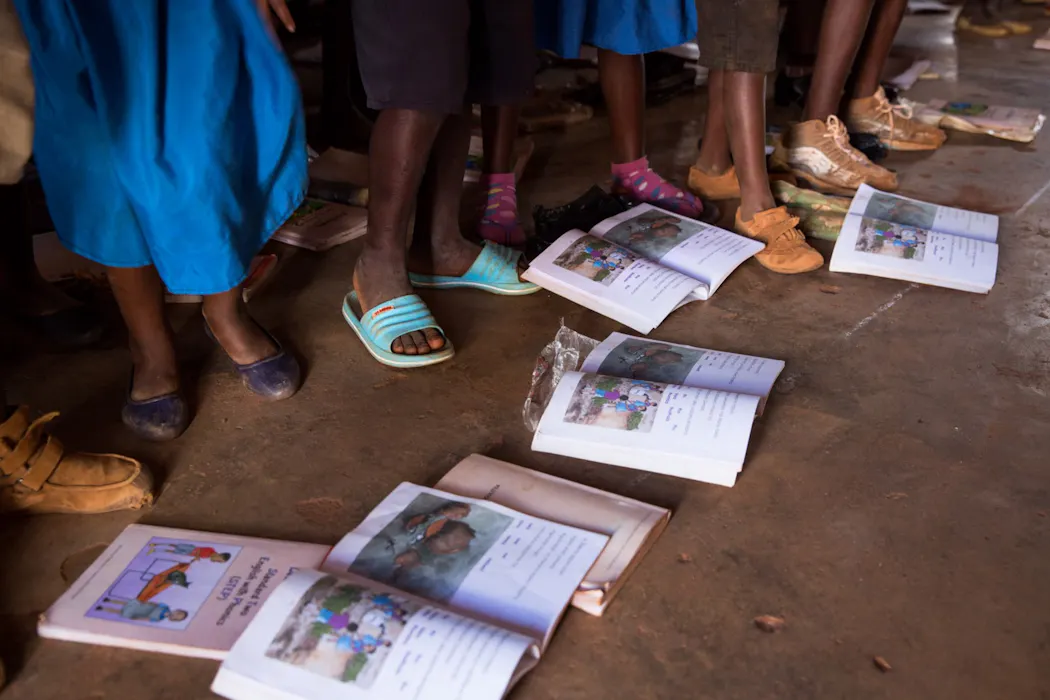
Students’ textbooks, provided by USAID, at a school in Malawi, 2016. By Lawrence Jackson, Wikimedia Commons Over a year has passed since the Donald Trump administration dismantled USAID , cutting more than 5,000 programmes and slashing US$40 billion in funding worldwide. The cuts have reduced access to HIV treatment , driven up severe malnutrition among children , and resulted in an estimated 700,000 lives lost . Medication and infrastructure to treat diseases like malaria, tuberculosis and pneumonia were withdrawn. In education, USAID’s closure has created an “ unprecedented crisis ”, according to a report by the European Training Foundation, an EU agency. Aid austerity is not limited to the US. In 2025, overall official development assistance dropped by 23%, marking what the OECD described as a “ historic decline in foreign aid ”. Cuts came from the US, Germany, the UK, France, Canada and Japan. As a transnational team of education scholars, we take a critical approach to development aid. While we recognise that aid can improve and even save lives, it is not an inherent good. It can reproduce inequities. We have spent decades studying educational interventions in Malawi and have documented how, even while aid has delivered benefits to individuals, its structures sideline local organisations , serve the interests of donor countries, and mimic colonial relations. For these reasons, we’ve been thinking about whether USAID’s closure, while painful and damaging, might give rise to a new arrangement beyond aid . Malawi is an ideal setting to explore this moment of change. The US alone contributed 13% of the country’s overall budget and provided one-quarter of education development spending. Interested in how Malawians make sense of aid austerity and imagine alternatives, we are launching a three-year (2026-2029) qualitative study of post-USAID possibilities in Malawi’s education sector. We are asking civil servants, NGO workers and aid workers how they see the future of education amid aid austerity. To prepare for the project, we conducted a pilot study of the immediate aftermath of USAID’s closure, from January to June 2025, with first-round follow-up interviews in May 2026. The 20 education experts we spoke to held very mixed opinions on the post-USAID landscape. Some saw potential to redress power imbalances; others emphasised the obstacles to self-resourcing. We pause now to reflect on these themes. Malawi’s relationship with aid Prior to the cuts, Malawi was saturated with international development – one informant called it “ a development playground ”. From 2019 to 2023, foreign governments contributed 80% of funding to Malawi’s education capital projects (school and classroom construction projects), according to Unicef . In 2024, USAID allocated US$34 million to education projects that promoted early-grade literacy and higher education. In turn, USAID’s portfolio buttressed US soft power while garnering opportunities for US businesses and contractors. In our research, we’ve purposefully included individuals with diverse perspectives on development and aid. Some participants have been employed directly by USAID, while others hold experience with local NGOs, government, and universities. For some, the closure of USAID was a welcome change. One former development worker called the previous status quo “more immoral than the cruel reality” of aid cuts themselves, as it was appearing as if the right things were happening, when in actual sense, the wrong things were happening. Comparing aid relations to “ coating a bitter thing with sweet on top ”, she was relieved by what felt like a break from the conditionalities and hidden agendas of US aid. She explained that, despite the rhetoric of improving Malawian education, USAID tended to funnel money to US consultants and international (rather than Malawian) NGOs. The projects ended up misaligning with Malawi’s needs. Recently, political scientist Dan Banik urged Malawi to “ say ‘no thank you’ to donors ” when funding doesn’t support national priorities. Given the fickle nature of donor funding, some study participants shared stories of how their organisations had already moved towards self-resourcing models prior to USAID cuts. While one Malawian NGO had incorporated a business division with facility and vehicle rentals, another introduced a farming scheme whose profits supported the NGO’s operational expenses. Both NGOs focused on community-driven, holistic and multi-generational education. Innovations like these, together with diversified funding sources, were imagined to help local organisations survive in a rapidly changing financial landscape that includes shocks of austerity. Read more: Africa relies too heavily on foreign aid for health – 4 ways to fix this Still, others worried that Malawi’s economic realities make alternative funding arrangements and aid refusal impossible. One faculty member at the University of Malawi explained that the country’s economic growth has stagnated for years. Speaking in early 2025, this scholar warned that idealistic visions of post-aid Malawi were naive at best. Malawi’s economy is in crisis , facing mounting debt borrowed from the World Bank, IMF and African Development Bank . After the 2025 aid cuts, the Malawian government increased its debt to compensate for lost funding flows. Debt payments have reached 90% of Malawi’s GDP. At the same time, respondents pointed to recent global developments that have only worsened the country’s financial situation. Wars in Iran and Russia/Ukraine have led to bottlenecks in key supply chains. Fuel costs in Malawi are among the highest in the world and fertiliser shortages foreshadow food insecurity for Malawi’s subsistence farming population. Opportunities for steady salaried employment in the development sector have vanished, as have the financial ripples these salaries create for the broader economy. International staff and projects, now reduced in numbers, are infusing less foreign exchange into the economy. In the absence of cash flows, self-resourcing efforts become increasingly untenable. Instead, new forms of more nakedly transactional aid have begun to appear, for example in US-led MOUs that are “ turning health aid into leverage .” No matter what comes next for education in Malawi, it is clear that we are in a transitional space where the terms of development are being rewritten. Emerging funding mechanisms — such as self-resourcing, debt-financed investments, and transactional aid — could amplify power imbalances instead of ameliorating them. This landscape demands continued intellectual and ethical scrutiny. Dr Steve Sharra, director of academic affairs at Malawi School of Government , contributed to this research and article. Alyssa Morley has received funding from the Spencer Foundation, MSU African Studies Center, and MSU Center for Gender in Global Context (GenCen). Alyssa has previous experience contributing to a USAID project led by Michigan State University (2021-2023). Rachel Silver receives funding from the Social Science and Humanities Research Council of Canada (SSHRC), the Spencer Foundation, and York University's Dadaleh Institute. Nelson Masanche Nkhoma does not work for, consult, own shares in or receive funding from any company or organisation that would benefit from this article, and has disclosed no relevant affiliations beyond their academic appointment.
17 Jun 2026

A safe AI strategy for Canadian youth should include age-associated risks
The federal government recently announced two policies that will shape the future of Canadian youth’s interactions with artificial intelligence: the AI for All strategy and the Safe Social Media Act . The government says the AI for All strategy will give “access to AI training and education for all Canadians” to address Canada’s “AI adoption gap,” arguing that “adoption will drive AI’s benefits for Canadians.” The Safe Social Media Act proposes establishing a regulator to protect youth from egregious harms posed by AI chatbots, such as “reinforcing harmful behaviours and providing unsafe responses.” It aims to maximize the safe adoption of AI by Canadian youth. However, research on generative AI (genAI) use among youth pinpoints design features that pose age-specific risks, which must be addressed before we adopt genAI in our schools and homes. The AI for All Strategy includes free AI literacy training via online courses, K-12 educator training, making AI chatbots available to all post-secondary students, job opportunities via funded internships and safety-focused governance of these systems. The Safe Social Media Act introduces a framework to improve online safety. It proposes regulating AI chatbots by requiring companies to protect privacy and not promote harmful content (cyberbullying, violent, sexual or hateful content) or harmful behaviours (impersonation/deepfakes, manipulative engagement techniques or encouraging self-harm). Risky design features of genAI I recently contributed as a scientific adviser to two research reports that identify risky design features of genAI. The first is a mapping of genAI’s impact on child development that was presented by a coalition of research groups as part of the G7 summit in France. In the report, collaborators and I argue that AI must: Be regulated through a developmental lens, ensuring it is age-appropriate; Support rather than replace young people’s skills; Be evaluated through youth-centred standards, evidence and safeguards. Importantly, youth must not be treated as a single entity or user category, as is done in the current regulations. AI will affect children, adolescents and young adults differently, including cognitive, emotional, social and educational elements of their lives. Given this, our research team identified the opportunities and associated risks of genAI for children and youth from birth to age 18, with policy recommendations. From birth to age 3: GenAI should strengthen caregiver responsiveness and not replace it, helping caregivers notice and respond to infants and young children . Risks arise when genAI is designed to be a source of responsiveness or stimulation for infants. Policy must recognize that genAI systems designed to mediate infant-caregiver interactions must be treated with more caution than ones designed as caregiver-support tools. Ages 3-6: GenAI must remain a tool within adult-guided interaction and not a stand-alone source of explanation, entertainment or social interaction. The features that drive generative AI engagement — fluent, personalized and emotionally resonant language — risk making these interactions feel authoritative and relationally authentic to children. Read more: AI products for kids promising friendship and learning? 3 things to consider Ages 6-12: GenAI must support learning and social development and not offload learning and outsource friendship-building. The design features of personalized learning, automatic feedback and social mediation risk reducing cognitive effort, weakening self-regulation and displacing human interaction . Policy must ensure the design features of AI strengthen and don’t weaken the skills that underpin children’s educational and social foundations. Ages 12-18: GenAI must support the building of autonomy, identity and judgment so adolescents become self-directed individuals. Policy must ensure design choices and default features of AI do not weaken independent judgment, intensify reliance and set improper expectations for healthy social relationships. Children & Screens research institute The second report is a review of research on AI in education published by Children & Screens , an independent research institute that conducts and shares interdisciplinary studies on the impact of digital media on children. The report covers how AI is used in education, the risks posed for each use and how educators and families can evaluate AI for learning. It concludes that genAI must be carefully integrated into learning by evaluating the opportunities and risks posed by each use, as well as risks arising from genAI being a tech company product. GenAI as a tool should help students complete specific learning tasks efficiently, such as organizing notes, formatting materials and making learning products (for example, editing a video report to remove transitions between sections) so students can focus on understanding and thinking about the learning content. Risks arise when the tool is designed to do the thinking for the student (such as editing, paraphrasing or brainstorming). Policies must ensure GenAI tools deployed in schools build skills and do not replace them. GenAI as a tutor should provide feedback, guided practice and explanations to help students move through a process of productive struggle. However, serious risks arise due to genAI hallucinations and the burden they place on students to correctly prompt the systems for guidance. Students are ill-positioned to judge if an AI tutor is correct or hallucinating. Students also do not know how to structure a lesson; they’re not teachers. Policies must ensure AI tutors are designed to address hallucinations and do not force students to become their own teachers. Author Adam Dubé of the Technology, Learning, & Cognition Lab at McGill University in conversation about AI in education on the Screen Deep podcast. GenAI as a resource should expand students’ access to explanations, examples and translations of learning content and practice materials while ensuring this content is both accurate and reflective of the students’ cultural context. Here, the risks arise in how the genAI is trained, on what information (internet versus trusted sources) and how it is designed to present information to students (linking to verifiable sources versus not). Policies must ensure that genAI systems be accurate and legally and ethically trained on Canadian content (for example: partnering with Indigenous communities to include Indigenous history and language) and present verifiable information. They must also ensure AI literacy training includes awareness of AI hallucinations and bias. GenAI as a tech company product should give students access to effective and safe genAI that is independently tested and proven to aid learning. Risks from tech companies include the “ deploy now, test later ” approach that puts unproven genAI into students’ hands; business practices that turn private student data (for example, related to age, backgrounds, grades, assignments, preferences, what they think, how they learn) into corporate assets to be monetized; and design features that maximize engagement (using friendly, human-like language to foster para-social relationships with genAI) instead of learning. Developmentally responsible ‘AI for All’ Policies should go beyond getting youth AI-ready. They must regulate genAI systems and interactions to make them youth-ready. This will require following evidence, developing critical AI literacy initiatives and drafting regulations that ensure AI is designed to maximize academic and social skills, not tech company profits. Adam Kenneth Dubé receives funding from the Social Science and Humanities Research Council, the Canadian Foundation for Innovation, and Mitacs.
17 Jun 2026

Data-Driven Growth: How To Leverage Analytics, SEO, And GEO To Spot Market Opportunities
Explore how data-driven growth transforms decision-making in business, leveraging analytics for better market insights. This post was first published on eLearning Industry .
17 Jun 2026
The Netherlands records first-ever international student drop
During the 2025/26 academic year, there were 129,764 international students enrolled across degree levels at Dutch universities and higher professional education (HBO) – a 0.1% decline of just 133 students on the year before. “Although it is a slight decrease, it certainly indicates a break in the trend,” said Jonatan Weenik, researcher at Nuffic, the Dutch body for internationalisation. The figures, released in Nuffic’s annual report, show a 3.8% decline in new international undergraduate enrolments, while new master’s students were up by 2.9% at universities and 8.4% at HBOs. According to Weenink, the increase in master’s students can partly be attributed to international students already in the country transferring from undergraduate degrees. “If you disregard those transfer students, there is also a decline in the university master’s.” “The fact that enrolment in bachelor’s programs continues to decline likely indicates that the drop in total numbers will continue for some time,” he said. While 2025/26 marks the third consecutive year of declines at the undergraduate level, it is the first time that total students across universities and higher professional education have fallen. Notably, Weenink highlighted a “striking” 28% decrease in new Chinese students, with China falling out of The Netherlands’ top five source countries for the first time since 2006. “A possible explanation for this is the rising position of Chinese universities in international rankings, making students more inclined to study in their own country,” he suggested, noting that Chinese enrolments in other European and Western countries are showing similar trends. Despite remaining the top sending country, the data showed new enrolments from Germany decline by 9% last year, in continuation of a trend seen since 2020. Elsewhere, there was a modest rebound of European students following a three-year decline, as Italy, Romania, Spain and Poland follow Germany to make up The Netherlands’ top five source markets. The fact that enrolment in bachelor’s programs continues to decline likely indicates that the drop in total numbers will continue for some time Jonatan Weenik, Nuffic While overall non-European students decreased by 3.5%, Indian student totals rose by the same amount, with new master’s students from India rising by 16.5%. What’s more, Türkiye overtook India as the second-largest sending country outside the European Economic Area , with both standing closely behind a rapidly shrinking China. Within The Netherlands, the number of international students in the capital decreased for the first time this year by 1.7%. “Amsterdam is, after all, the city with the most international students and has the image of a very international city,” said Weenink. “The decline fits the national picture, but is still striking in that light.” Meanwhile, Eindhoven saw a significant 13.4% increase, largely fuelled by more international students pursuing engineering degrees, something Eindhoven University of Technology is well known for. The 11% rise in international students studying engineering has made it the second-largest field after economics, reflecting universities’ agreement to actively recruit international students only in disciplines facing labour shortages, such as engineering. The data follows several years of federal restrictions on international students in The Netherlands, under the government’s internationalisation in balance bill (WIB) which sought to bring down international enrolments and strengthen the Dutch language in education. Whilst several of the bill’s most controversial measures have been rolled back – including the requirement to formally prove the right of English-taught courses to exist – universities have taken their own measures to reduce international enrolments to sustainable levels. The post The Netherlands records first-ever international student drop appeared first on The PIE News .
17 Jun 2026

Many college students already have well-formed cheating habits – that, not AI, is the real problem
Students are using AI to cheat, but the problem isn't limited to that. VectorMine/iStock/Getty Images Plus My colleagues and I recently spoke with a group of talented, interesting students who just completed their first year of college about using artificial intelligence as a research tool. I asked what must have seemed like an unrelated question: “How many of you cheated in high school?” Most of the students raised their hands. Perhaps comforted by the realization that they had plenty of company, they seemed neither embarrassed nor ashamed. This is not the first time I’ve asked my students that question. On each occasion, the results have been pretty much the same. By the time students end up in college classrooms, many have encountered cheating and think it makes sense in some cases to do so , because of factors like pressure to succeed. Let’s be clear: AI has not created the problem of intellectual dishonesty among this generation of students. Alas, the problem long predates AI and runs much deeper. The cheating pipeline Many college students are honest and hardworking. But by the time some students get to college, they have become accustomed to academic misconduct in American high schools . As Eric Anderman, a scholar of educational psychology, wrote in 2018 : “Academic cheating is prevalent throughout all types of American high schools. Data from one large national study indicated that 51% of high school students admit that they have cheated during a test.” Other research on high school cheating found in 2020 that 64% of 70,000 high school students across the country admitted to cheating on a test, and 58% admitted to plagiarism. Approximately 95% of high school students, meanwhile, said they “participated in some form of cheating, whether it was on a test, plagiarism or copying homework.” And in one Pennsylvania high school, 90 of the 100 respondents to a 2018 school survey “admitted to cheating on some form of schoolwork at least once.” One of the respondents put it simply: “Everybody cheats.” Students can cheat for different reasons. They might feel unprepared for an exam or paper, but they still want to get good grades and gain admission into a competitive college . They might recognize that cheating is wrong , but they justify it by saying everyone else is doing the same thing, or that they have teachers who don’t do their jobs well. Other students might not fully understand what cheating means in different contexts or think that what they are doing counts as cheating. This kind of thinking can allow students who sometimes cheat to not think of themselves as cheaters. Sociologists Gresham Sykes and David Matza call this tendency “ techniques of neutralization .” This means people use their internalized ways of seeing the world to justify acting in a way they know is wrong. Looking the other way A 2020 study of 840 undergraduate college students found that 32% of them had cheated in some way on an exam. College professors like me may be tempted to look the other way if we suspect a student is cheating, or try to solve the cheating problem by changing the ways we evaluate students . The Wall Street Journal, for example, reported in 2025 that faculty across the country are giving up on writing assignments, which students can produce with AI, and returning to in-class tests and examinations. Every college and university has rules against plagiarism and other forms of intellectual dishonesty. To offer one example, Harvard’s policy says that “Cheating on exams or problem sets, plagiarizing or misrepresenting the ideas or language of someone else as one’s own, falsifying data, or any other instance of academic dishonesty violates the standards of our community, as well as the standards of the wider world of learning and affairs.” Students who violate the cheating rules at Harvard and elsewhere might face consequences ranging from failing a class to being expelled. But many instructors don’t report incidents of cheating to administrators responsible for enforcing those rules and meting out punishments. Few colleges have developed an intellectual integrity curriculum that treats cheating as a habit and works to counter it over the four years of a student’s college education . I think that, like any bad habit, students can only be weaned from cheating slowly, with a support program and clear, severe consequences when they are caught. Cheating in college Getting a sense of the dimension of the cheating problem on college campuses is not hard . In February 2026, for example, a Harvard undergraduate student named Matthew Tobin published an opinion piece in the Harvard Crimson entitled “Plagiarize or Perish.” He cited a 2024 Harvard Crimson study that showed 47% of 850 surveyed senior students said they had cheated. Tobin wrote that while some people say cheating is the result of “modern students’ scholastic disengagement or use of artificial intelligence,” other issues are at play. Plagiarism and academic misconduct “have been happening all too often at Harvard for far longer than the advent of these issues,” he wrote. Reported academic misconduct cases increased at Ohio State University by 57% between 2014 and 2018. This is likely a low estimate, since most academic misconduct cases are not reported or investigated. Charlie McLaughlin, an Oberlin student, published an op-ed in the student newspaper in May 2026 criticizing the college’s decision to change its honor code charter to allow professors to proctor tests, meaning supervise students while they take the exam. “Changing this policy is a clear sign that this school doesn’t trust us to learn to be adults with integrity,” McLaughlin wrote. “That’s sad. Maybe, it’s also reasonable. Maybe, we don’t deserve that trust. That’s even sadder.” Princeton also recently abandoned its 133-year-old prohibition against proctoring exams “to address increasing concerns over academic integrity violations, including the proliferation of AI usage.” A 2020 study found that 32% of undergraduate college students had cheated in some way on an exam. SDI Productions/Stock Productions A teacher’s dilemma I don’t think of my students as cheaters, and I don’t want to regard them with the kind of suspicion that turns teaching into a policing activity. But it is my job and that of the college where I teach to recognize that our students need a lot of help to develop good academic habits. Unless colleges acknowledge these facts, I believe they have little chance to curb the pervasiveness of cheating. Faculty can start by weaving discussions of intellectual integrity throughout their courses and enlisting students to think about who they want to be – and whether they want to live their lives cutting corners and gaming the system. Only then can colleges hope to build what Tobin calls “a commitment to academic integrity in (our) students.” Austin Sarat does not work for, consult, own shares in or receive funding from any company or organization that would benefit from this article, and has disclosed no relevant affiliations beyond their academic appointment.
17 Jun 2026

Who gets to feel transformed by study abroad?
Study abroad is frequently framed as life-changing. The narratives are familiar: expanded horizons, newfound confidence, personal growth. But for many students, particularly those historically underrepresented in international education, the reality can feel more complicated. Will this be an affirming experience, or an isolating one? Will it create opportunity and connection, or place students in unfamiliar environments without meaningful support? These are the questions that have stayed with me throughout my career in international education and ultimately became the foundation of my doctoral research. These are not new questions. In 1944, Elsa Goveia left her home country of Guyana to study at University College London on scholarship, the beginning a stellar academic career. Similarly, Merze Tate, an early 20th century maverick, undertook her first foreign sojourn to France as a 26-year-old schoolteacher. She went on to become the first African American to earn a graduate degree at Oxford. She was a committed advocate for travel in its earliest academic iterations. Yet, she and Professor Goveia remain largely overlooked figures. Over the past few years, I’ve spent time speaking in depth with Black women from US universities who studied abroad in London. Via a series of interviews, I sought to understand not only what they did while abroad, but how they made sense of those experiences, and were perhaps shaped by them during and after their experiences abroad. What emerged wasn’t a single story, but a unique variety of shifts. Many described a growing sense of confidence. Others spoke about changes in how they navigated relationships, set boundaries, or imagined their futures. For some, study abroad was a gateway to academic clarity; for others, it offered a degree of freedom to think differently about their career paths and personal ambitions. One recurrent theme was the importance of stepping outside familiar contexts and seeing themselves in new ways. That does not diminish very real experiences of microaggressions or exclusion. Those moments existed too, but alongside them were experiences of recognition, possibility, and expansion that felt meaningful and, in some cases, deeply lasting. For prospective students, especially those who don’t always see their experiences reflected in study abroad narratives, these stories matter. They offer a more complete image of the study abroad landscape. This work is also shaped by my own experience as a nomadic student who has lived and learned on three continents. When I studied in London during my undergraduate degree, I didn’t yet have the vocabulary for what I was navigating. Nonetheless, I remember a sense of expansion, altered vision, and returning indelibly changed. That perspective continues to inform how I approach and make sense of this research. At its core, my aim has been simple: to listen carefully and center the voices of the students who generously opted into my study. If study abroad is going to deliver on its promise, it must work for a broader range of students, in practice as well as in theory If study abroad is going to deliver on its promise, it must work for a broader range of students, in practice as well as in theory. This means more emphasis on belonging, examining what support genuinely entails, and how programs are experienced, not just designed. There is a resurgence in interest in these questions across the sector, and I’ve had the chance to share elements of this work in assorted spaces along the way. I am invested in the hope that these insights do not remain static, that they transcend the research to drive valuable programmatic innovation. As I enter the final stages of writing my thesis, that focus abides. These are not niche stories. They lie at the heart of our understanding of what international education is, and what it can become. About the author : Kimberley Aparisio (she/her) is a final-year PhD candidate at the UCL Institute of Education and PASS Director at CEA CAPA London, where she supports the development and delivery of global education programs. She has 20 years of experience in international education, with a career spanning leadership roles at Minerva University, NU London, and IES Abroad London. Kimberley earned her BA in Psychology and Sociology from the University of Pennsylvania and an MA in Education and International Development from the UCL Institute of Education. Her doctoral research examines how study abroad from the US to the UK impacts the identities of Black women in higher education. The post Who gets to feel transformed by study abroad? appeared first on The PIE News .
17 Jun 2026
Beyond equations: The real value of advanced mathematical and physical sciences
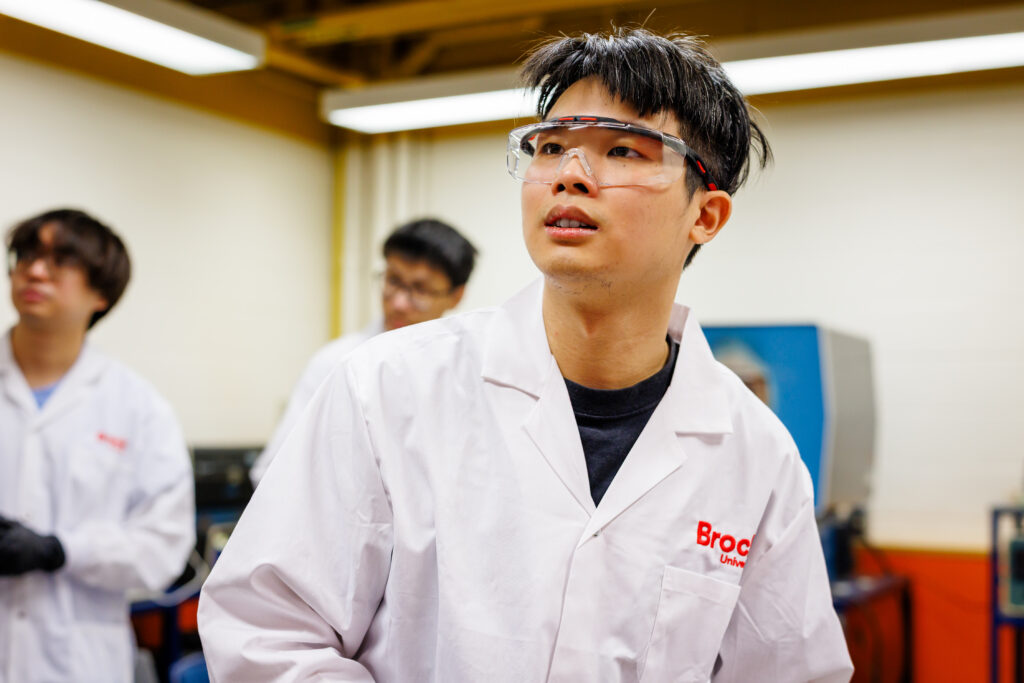
In 2025, the United Nations celebrated the International Year of Quantum Science and Technology , marking the next 100 years of progress in quantum mechanics – but the field is already transforming industries today . Quantum technologies are emerging as powerful tools in an unpredictable world, offering new ways to improve manufacturing and make supply chains more resilient. Across the world, governments have long recognised this shift. They are investing in the infrastructure and talent to drive the next phase of quantum computing, from the lab into real-world use. For those looking to be part of that momentum — and to help shape a faster, more efficient future — these are three universities offering some of the most focused graduate programmes in the field today. Brock University Brock University’s graduate programme focuses on students getting involved with research, scholarship, and professional development. Source: Brock University When studying mathematics or physics at Brock University, you’ll gain advanced skills that translate beyond academia into fields like technology, finance, policy, and research. Professors renowned worldwide for their contributions to science at the Faculty of Mathematics and Science will guide you into becoming a published research expert in the world’s most prestigious journals. You can play a leading role in projects where you’re advancing quantum materials by studying the strange behaviour of ultra-cold lithium or developing new materials that could increase the efficiency of batteries and hybrid energy storage devices. For international students seeking hands-on training in advanced experimental, theoretical, and computational techniques of modern materials science, the Master of Science in Material Physics (MSMP) is a great option. Set in one of the beautiful UNESCO Biosphere Regions of Canada, just a 20-minute drive to the iconic Niagara Falls, the MSMP lets you complete the degree in either 16 months or two years, the latter including a major research project within the curriculum. For those whose first language isn’t English, you can complete the Graduate Science Preparation Seminar prior to starting the programme to improve your technical language skills often required of professionals . With this strong foundation, you’ll then be set to make the most of the programme’s advanced industry-standard instrumentation . These include a scanning electron microscope and physical property measurement systems, part of a wide range of industry-grade equipment geared to help you hit the ground running in your future role. Indeed, MSMP graduates have gone on to become materials technologists, data scientists, laboratory technicians, and more at companies like Accenture, Temenos, and L3Harris. “I can confidently say that the diverse and challenging courses of the MSMP programme at Brock University played a pivotal role in preparing me for my current position as a quantitative finance researcher at BCA Research,” graduate Pratik Bhanuse says. “[Specialised physics courses] allowed me to approach problems with a purely quantitative perspective and utilise programming to find innovative solutions.” If you’re freshly entering university, you can build your foundation from the ground up through programmes like the BSc in Physics or the BSc in Mathematics . You have the option to tailor these interdisciplinary degrees to your specific interests through pursuing a concentration, from Quantum Materials to Theoretical Physics to Applied Mathematics. This is where you’ll discover your potential as a researcher. Guiding students as advisors are award-winning faculty, such as Physics Professor Dr. Kirill Samokhin and Mathematics Professor Dr. Stephen Anco, both listed in Stanford University’s 2025 ranking of the 2% of international scientists in physics and mathematics. The University of Texas at Dallas was founded in 1961. Source: The University of Texas at Dallas/Facebook The University of Texas at Dallas Set in one of the fastest-growing metropolitan regions in the US, the School of Natural Sciences and Mathematics (NSM) at the University of Texas Dallas seeks to foster lifelong curiosity and innovation by responding to emerging global challenges. With 33 undergraduate and graduate programmes, as well as 40 research labs within the school, the NSM is where you can bring theory to practice as a doctor, scientist, or mathematician. Graduate programmes at the Department of Physics offer a strong, professional-level foundation in classical mechanics, electrodynamics, quantum mechanics, and statistical mechanics. Students conduct cutting-edge research that gains them international respect, leading them to diverse careers in industry and academia. For those looking to get involved in research in quantum technologies, NSM also hosts the UTD Centre for Quantum Integrated Systems , which seeks to use quantum mechanics in advancing computation, communication, and sensing. If you seek a programme to master the fundamentals and current applications of physics, the Master of Science in Physics will be right up your alley. With courses led by widely cited experts in their fields, the programme spans a minimum of 30 credit hours. Students will pursue four core courses, and later customise their curriculum based on their interests. They have the option to specialise in a specific field, with four unique tracks offered, from condensed matter physics/materials science to atmospheric and space physics. Those entering university as freshman students can pursue either a Bachelor of Science or Bachelor of Arts in Physics to build their fundamental knowledge. Even at this early stage, you can start exploring research opportunities within the Natural Science and Engineering Research Laboratory, a high-tech 192,000-square-foot facility built in partnership with Texas Instruments scientists and engineers. The Department of Physics and Astronomy at the University of California, Davis offers two master’s degree routes to choose from. The Department of Source: University of California, Davis/Facebook University of California, Davis Part of the University of California (UC), Davis – ranked #2 among public universities for graduate financial success – the Department of Physics and Astronomy raises graduates who do not hesitate to make a profound impact in the industry. They’ve built new medical devices in the healthcare industry, managed large scientific projects at national laboratories, invested in new small businesses, and more. If you’re seeking that kind of career advancement in the field of quantum science, then you should sign up for the department’s master’s programmes , which spans between four to six quarters. The route you take depends on your specific goals: you can either choose to pursue Plan I, which comprises 32 quarter hours of graduate coursework and a thesis, or Plan II, which requires 36 quarter hours of coursework and an oral comprehensive exam. Courses will cover topics like classical mechanics, electrodynamics, quantum mechanics, and statistical mechanics. They’re led by distinguished experts in their respective fields, giving students the opportunity to work in various multidisciplinary centres and labs, as well as international collaborations. If you’re a soon-to-be undergraduate, the Bachelor of Arts or Bachelor of Science in Physics programmes will prepare you to tackle more advanced-level courses within the master’s programmes. Physics majors take on a mixture of classical and modern physics courses, alongside six quarters of calculus and other mathematics. This foundation will prepare you for more high-level areas like quantum mechanics and condensed matter physics.
17 Jun 2026

University of Chester: Build a career in cardiac rehab and heart health in 12 months
Henry Nwankwo graduated top of his medical school class in Nigeria – valedictorian with an MBBS and the first student in his university’s history to earn a distinction in internal medicine. He spent years in clinical practice managing patients with cardiometabolic conditions. And still, he felt there was more to understand about cardiovascular health than all he’s seen and done at the bedside. So he made a deliberate decision. He signed up for the MSc Cardiovascular Health and Rehabilitation at the University of Chester – a programme built for healthcare professionals and graduates who want to specialise in cardiac rehabilitation, prevention, and heart health at both an individual and population level. “The programme’s rigour and clinical grounding made it stand out,” Nwankwo says. “And being awarded a Commonwealth Shared Scholarship to pursue it here felt like both a privilege and a responsibility.” Designed for healthcare professionals and graduates, this MSc programme prepares you for multidisciplinary roles in cardiac rehabilitation and prevention. Source: University of Chester A programme built around where the field is heading Cardiovascular disease is the leading cause of death globally , and the demand for specialists who understand treatment, rehabilitation, prevention, and population-level outcomes is growing fast. This MSc was developed in direct response to that gap. The 12-month programme is aligned with the British Association for Cardiovascular Prevention and Rehabilitation (BACPR) standards and core components, the benchmark for cardiac rehabilitation practice in the UK and a framework recognised internationally. That alignment means when you graduate, you’re entering the field grounded in the same clinical standards employers and health systems worldwide are working to – whether you plan to work in the NHS or take your qualification back home. The curriculum is built around the competencies the field is actively hiring for. You’ll develop deep expertise in cardiac rehabilitation and secondary prevention, sharpen your approach to exercise prescription for cardiovascular conditions, and develop a strong grounding in behaviour change and patient adherence. Each area builds toward the kind of multidisciplinary practice that defines modern cardiac care. That multidisciplinary perspective extends to the people who teach you. The programme is delivered by specialists drawn from across cardiology, physiotherapy, nursing, exercise science, and public health – among others – ensuring the knowledge you graduate with reflects current clinical practice rather than any single specialism. “Studying at Chester has exceeded my expectations,” Nwankwo says. “The teaching is intellectually stimulating, blending exercise science, nutrition, and research methods across disciplines. What truly made the experience exceptional was the consistently supportive and student-focused guidance from my programme leader, lecturers, and tutors.” The MSc programme includes many opportunities for practical laboratory sessions. Source: University of Chester What studying here actually looks like Modules run in intensive three-day teaching blocks combined with supported independent study, giving you the structure of a full postgraduate degree without requiring you to step away from work. For international students, the model also allows for travel home between blocks without disrupting your progress. That flexibility is by design – and it’s part of why the cohort draws such a wide range of professionals, from early-career graduates making their first move into specialisation to practitioners like Nwankwo seeking expertise mid-career. The MSc includes the option to complete a placement in a cardiac rehabilitation unit. This is where you can see how multidisciplinary teams actually put patients first and how the evidence you’ve studied translates into direct patient outcomes. And you’ll get to do this with a diverse cohort of doctors, nurses, physiotherapists, cardiac sonographers, perfusionists, and technicians from across the world. “That mix of professional backgrounds and global perspectives has fundamentally shaped how I think about cardiac health and rehabilitation, revealing dimensions of the field I would never have encountered in a purely medical environment,” he says. That depth carries through to academic work as well. Nwankwo’s dissertation – a systematic review on psychosocial outcomes of cardiac rehabilitation in working-age adults – has sharpened his appreciation for evidence-based practice. A qualification with global reach Studying in the UK means getting exposure to one of the world’s most established healthcare systems. The NHS sets clinical standards for cardiac rehabilitation that are referenced internationally, and the experience you gain here is directly relevant to your future career. A UK postgraduate qualification in this field is recognised worldwide, with clear pathways to employment in hospitals, rehabilitation services, community healthcare, and public health after graduation. Nwankwo is proof of what that combination of academic rigour, clinical grounding, and global perspective can produce. His future plans centre on a career in cardiology – bridging clinical practice with academic work around underserved populations and cardiovascular equity. His advice to any healthcare professional considering the programme at the University of Chester is straightforward. “Come, the investment is worth it,” he says. Learn more about MSc Cardiovascular Health and Rehabilitation. Follow University of Chester on Facebook , Instagram , LinkedIn , YouTube , and TikTok
17 Jun 2026
Ofqual fines Cambridge English £875k over IELTS marking errors
The penalty follows revelations last year that a technical issue in IELTS’s automated marking system resulted in score corrections for thousands of test takers, prompting concerns about the impact on international students, migrants and institutions relying on the high-stakes English language test. In response, IELTS apologised to those affected and accepted responsibility for the errors. According to Ofqual, automated marking failures in the listening and reading components of IELTS went undetected from August 24, 2023, until September 2025, affecting candidates taking computer-delivered tests globally. The regulator said the errors stemmed from weaknesses in Cambridge English’s monitoring and error-detection processes. Ofqual found that 93,865 responses were incorrectly marked among approximately 7.7 million IELTS test instances processed during the affected period. While many of those errors did not alter final outcomes, 62,794 individual learners ultimately received incorrect component or qualification results that later had to be corrected. Of the 21,717 qualification-level corrections made, 20,602 were upward adjustments and 1,115 were downward revisions. Most changes involved a 0.5 band score adjustment, although two candidates received increases of a full band. Ofqual said some of the affected tests were Secure English Language Tests (SELTs), which are used in UK visa and immigration applications. According to IELTS, of the 1,108 affected UK visa-related tests, 279 involved a change in Common European Framework of Reference (CEFR) level. The organisation said that four cases ultimately affected visa eligibility, and that all four candidates subsequently met the required standard after resitting the test. Announcing the sanction on June 11, Ofqual executive director for delivery Amanda Swann said candidates had been “let down by systemic failures over a long period”. “Tens of thousands of people took these tests with the expectation of accurate results which influence important decisions,” she said. “We apologise to those affected, and we take responsibility for the error that resulted in some people receiving incorrect results,” an IELTS spokesperson said. We apologise to those affected, and we take responsibility for the error that resulted in some people receiving incorrect results IELTS spokesperson “Once this issue was identified, we acted to rectify it, correcting results and supporting people. We offered refunds or resits to everyone affected. We addressed additional support requests, including for 19 individuals who contacted us regarding potentially missed opportunities. We worked directly with recognising organisations and relevant authorities to help mitigate any harm.” IELTS added that it had conducted “a thorough review” and implemented additional safeguards to prevent a recurrence. “Our focus remains on delivering accurate, trusted and fair assessments for every test taker,” the spokesperson said. The organisation also highlighted the scale of its remediation efforts. According to figures provided by IELTS, 26,246 affected test takers requested and received refunds, while 1,145 candidates opted for a resit. A total of 270 complaints were received, of which 24 were upheld. Nineteen of those complaints related to alleged missed opportunities resulting from the incorrect scores. Ofqual noted that Cambridge English had cooperated with the investigation, accepted responsibility and entered into a voluntary settlement agreement. The regulator said these actions were considered mitigating factors when determining the size of the penalty. The regulator also acknowledged that Cambridge English had spent more than £6m on corrective measures, compensation, customer support and system improvements after discovering the problem in September 2025. The post Ofqual fines Cambridge English £875k over IELTS marking errors appeared first on The PIE News .
17 Jun 2026

Childcare workers have been guaranteed a pay bump. What’s the fine print?
Pavel Danilyuk/Pexels The federal government has announced another A$3.6 billion to boost childcare workers’ pay. The government says combined with other changes to the minimum wage, this will mean about $255 more per week for a typical full-time educator, compared to December 2024. The $3.6 billion continues a 15% pay rise for early childhood educators, introduced in late 2024 but due to run out at the end of 2026. The government’s renewed commitment will see educators’ pay continue at the new, increased level over the next two years. These new funds were not part of the May budget. But the childcare union has been pushing for a renewed commitment around pay and was planning to strike over the matter. So this is a significant announcement for educators and the sector. But is anything missing? What happened two years ago? In 2024, the Albanese government announced it would fund a 15% pay rise for childcare workers over the next two years, with the condition their employers limited fee increases. This was to prevent the cost of educator pay rises being passed on to families through higher fees. At the time, it was described as an “ interim retention payment ” and followed the Productivity Commission noting better wages and conditions were a key way to address staff shortages in the sector. The commission also noted government support for wage increases could help reduce closures and enable services to redirect funds to other measures that also support quality. It also came as the Fair Work Commission investigated the historic undervaluation of work in female-dominated industries, including early childhood education. In December 2025, the commission made changes to the children’s services award, including a boost to the minimum pay rates. This has taken longer than initially expected and will now be done in stages between May 2026 and June 2029. It is understood this will eventually mean services take on responsibility for paying educators at increased rates, rather than the government. What is happening now? As with the last payment, this funding boost is contingent on centres not raising their fees above a certain level. But there are also some changes. Services will now also have to meet national childcare safety standards as a condition of the payment. The payment will also apply to educators in family daycare and in-home care situations, as well as long daycare centres. What does this mean? This is a significant development for early childhood education and follows months of uncertainty around educator pay and how it would be funded. It’s a strong signal the federal government recognises the workforce is undervalued and underpaid. It is also positive this will minimise educators’ needs being pitted against family budgets — which is always a risk when educator wages are only funded via parent fee increases. And it’s important the government is now linking this funding to the national quality ratings for early education services. This acknowledges the community’s serious concerns about safety in childcare. And is another way to try and boost the quality of care and education during this crucial period of children’s development. This is on top of measures such as staff safety training and bans on educator-use of personal devices at work. At a broader level, this funded wage increase will also help make services safer for children, and promote quality more generally. This is because it helps to keep qualified educators in the sector, can reduce educator stress and help services attract and retain educators. All of this helps with staff-to-child ratios and continuity of educator-child relationships. Research shows these are fundamental to children’s safety and quality of education. But what is missing? Of course, it’s welcome the payment is being extended. But is it still kicking the can down the road? On Wednesday, in a press conference with Prime Minister Anthony Albanese, a journalist asked: “will this be the last round of this particular payment?” Education Minister Jason Clare responded: “We’ll look at that question as we build the early education system over the next few years”. This means we don’t have clarity over the future. There is a legitimate assumption services could end up footing the bill, as pay increases under new minimum wage provisions for early childhood educators roll out. But if services are forced to limit their fee increases for the time being, this means they won’t be able to incrementally increase fees, to ease into the changes the Fair Work Commission has set out by mid-2029. So it could become a really tricky situation. At the moment preschools (also known as kinders) are also not covered by this funding. This is a significant gap, as we know these services are crucial in preparing children for school. They are also more likely to provide higher quality care and education than long daycares. We also know pay is of course crucial, but is not the only thing that matters to early educators. Or the only factor that keeps them in their jobs. Research – including my own – shows workloads , community respect , and the way educators are treated by managers are continuing concerns across the sector. They are also key factors that could support long-term workforce quality and stability in early education and care. Erin Harper does not work for, consult, own shares in or receive funding from any company or organisation that would benefit from this article, and has disclosed no relevant affiliations beyond their academic appointment.
17 Jun 2026
How Echidna Approaches Scaling Impact
Perhaps because of recent cuts in foreign aid, perhaps because decades of project-based funding have struggled to move systems, the importance of scaling through government is getting significant attention in the development world. It was the subject of numerous panels at and around Skoll in April, the focus of Kevin Starr’s latest musings for SSIR , and fodder for Spring Impact’s case studies on scaling with government . It’s also long been the ultimate goal of the Scaling Community of Practice , which recently put together a series of case studies on how funders approach scaling impact. Echidna wrote a case study on our work, which we also shared during a recent webinar . Here we offer a (hopefully) digestible synthesis of how we are thinking about funding lasting impact at scale. At Echidna Giving, we realize that delivering the promise of girls’ education requires more and better use of resources by many actors, principally by governments themselves, which are the largest funders of public education. Low-income countries spend about $270 billion a year on education. In contrast, the top private funders of education in low-income countries fund perhaps $2 billion annually at best (less than 1%). Even collectively, top donors can only achieve significant impact if we influence the flow of major funding sources — governments. For that reason, Echidna Giving focuses on government systems. Below, we reflect on the practices we think are critical to success, the new efforts we’ve been experimenting with, and the tensions we face in this work. What We Know Matters 1. Making a long-term commitment Influencing systems does not happen on a 3-year project cycle. Echidna commits to our strategy areas and, often, individual grantees, over 8 to 10 years or more. Private funders are fortunate to take a long-term view, as they do not face election cycles. If foundations do not stick to their strategic priorities over the long haul, they are squandering a critical comparative advantage. 2. Taking a portfolio approach No single organization is likely to have all the capabilities needed to advance system change. Echidna sees the value of building a diverse portfolio of organizations: some doing deep work with communities to understand issues of marginalized populations; others emphasizing system strengthening, etc. This balance allows organizations to do what they do best, learn from and build on each other’s work, and explore multiple pathways to impact. It also allows us to take advantage of opportunities for systems change work, while simultaneously doing field-building work that can help generate windows of opportunity for system change and sustain political will for these efforts. We see field building and systems change work as two tools working on different time scales towards the same objective of scaling impact. ( Here is another simple framework that articulates how these two tools relate to one another.) 3. Funding organizations primed to enable lasting impact at scale When scoping potential grantee partners, we look for organizations that align with our ambitions to influence government systems. We prioritize funding organizations based in and led by leaders from the contexts in which they work, because actors who are proximate to government have the deepest understanding of the system, the most credibility to influence it, and a greater stake in it. A core component of scaling is learning: organizations need to figure out not only what models work, but what can work within government systems at scale, how to incentivize adoption, and so on. Because we want to incentivize scaling, we look for organizations with a learning culture and also incentivize learning through our funding and internal ways of working. For example, we reiterate to grantees and staff that what matters is learning from failure, not avoiding failure altogether. 4. Providing flexible support and building trusting relationships A big part of enabling lasting impact at scale is ensuring deep, sustained ownership and motivation among the folks actually leading the work. Since Echidna Giving is a funder, not a doer, the best way to support ownership and motivation is by funding what doers themselves define as the most important strategies. Trust-based practices enhance our ability to achieve outcomes by giving organizations the flexibility they need to adapt to realities and ownership over results. They are foundational to scaling impact. They also model the type of relationship organizations need when interacting with governments. For this reason, human relationships are as important as the technical pieces of what we fund. We work to create the cultures and mindsets that enable ownership and motivation for sustained change. 5. Hiring a team expert in theme and context, empowered to make decisions We have hired Program Leads who bring expertise in both the education themes they work on and the geographies where our grantees work. This technical and contextual expertise facilitates an understanding of opportunities for scaling. We work to build a culture that empowers Program Leads to be decision-makers, maximizing the expertise they bring. What We Are Experimenting With The five practices above are fairly well institutionalized within Echidna Giving and its principles . There are several other approaches we’ve been experimenting with to see whether and how they help advance our ambition towards lasting impact at scale. First, we have been funding several collaborative efforts that deliberately bring organizations together to work on areas such as measuring life skills and values, advancing supportive childcare policies and regulations, and promoting critical thinking about gender and power among adolescents in schools. These collaboratives have helped organizations tackle big issues collectively, drawing on the unique strengths each brings to the table. They have also taken a lot of time, effort, and intentional resourcing. We’re working to learn where these efforts are bearing fruit and what conditions are required for success. Second, in limited instances, we have directly funded semi-autonomous government agencies. These organizations already operate at scale but often lack the resources to innovate and adapt. We are learning about the unique opportunities and constraints of working directly with these entities. Tensions We Face As we work towards the worthy but difficult goal of lasting impact at scale, three tensions stand out. First is the tension between scale and equity. Echidna’s mission is to support education, particularly for marginalized girls. It is easy for these populations to miss out as programs scale through systems that are not designed to work for marginalized populations. We have productive debates about where we lean in with our grantmaking, given these tensions. Second is the question of how much to take the lead as a funder who seeks to elevate grantees. We default to supporting and amplifying existing efforts and momentum in the space, but given our positionality, sometimes identify gaps no one is filling and/or are asked to fill these gaps ourselves. Third is the challenge that success sometimes does not come in the form of major advances, but in maintaining ground and preventing backsliding in the face of opposing forces. In the full case study , we provide more color on how we have tried to institutionalize these practices within Echidna Giving and on the results of this work in our grantmaking. We remain committed to our principle of iterating and learning around our approach and look forward to further engaging with others in the field on these important issues.
16 Jun 2026

‘Every day I think about money’: how can we support uni students who struggle financially?
LinkedIn Sales Navigator/Pexels A university place is often described as a “ pathway to opportunity ”. But for many students, getting in is only part of the challenge. The other challenge is affording to stay. This is becoming more difficult as uni fees and costs-of-living increase. In a new report , we look at the financial pressures facing Australian university students and what can be done to better support them. We found one in three students surveyed reported they were struggling or severely struggling with their financial situation. This was more common among international students, Aboriginal and Torres Strait Islander students, students living with disability, and students living alone. Our research To understand what supports are available and what challenges today’s students face, we analysed 41 Australian universities’ policies on financial support for students. We then surveyed nearly 900 students and interviewed around 50 students and university staff. Students were recruited through university networks, student unions and social media. Students reported growing pressure across core living costs. For example, 51% experienced food insecurity and 64% struggled with housing affordability. Almost 45% said financial stress had negatively affected their studies. This mirrors other surveys showing students have been skipping meals to cope with costs of living. Other recent surveys suggest financial pressure is shaping study decisions before students even arrive at university. Some young people are delaying study, planning to study part-time, or expecting to live at home to reduce costs. What are students doing to cope? The most common strategy among those we surveyed is paid work. In our survey, 74% of students said they relied on paid employment to cover living expenses. About 36% worked more than 20 hours per week. While paid work can support independence and employability, working long hours can compete with study time, class attendance, assessments, placements and rest. One student described needing to “skip lectures or skip tutorials” because of work. Students also reported borrowing money from family and friends, taking out loans, delaying medical or dental care, reducing their study load, dropping classes or delaying graduation. One student told us: Every day I think about money […] I find it hard to sleep. What help is available? Government payments such as Youth Allowance, Austudy and ABSTUDY provide important support for eligible students. But these do not cover all costs of living and study or all students. For example, Youth Allowance for students is about A$339 a week, if you are over 18 and do not live with your parents. In 2025, the poverty line for a single adult was about $584 a week . This leaves a gap of about $245 a week even before extra study costs such as textbooks or placements. In 2026, Anglicare also found there were no affordable rental listings in Australia for a person receiving Youth Allowance. Welfare advocates also argue too many potential recipients are excluded. International students are generally ineligible and many domestic students are also ineligible due to age, if they live with their parents, or due to parental income. HELP loans – including recent debt-reduction measures – address tuition costs for many students. But they do not assist with day‑to‑day living expenses. What do unis provide? Our analysis found most universities offer some form of financial or cost-of-living support. This includes scholarships, bursaries, emergency grants, hardship loans, financial counselling, food programs (such as food pantries , grocery vouchers and subsidised meals ), textbook support and referrals to external services such as community legal centres, housing services, food relief providers and financial counselling services. But the main issue is not simply whether support exists. It is whether students know about it and can receive it before the pressure becomes a crisis. Only 22% of surveyed students were aware of financial support available at their university. Of those who were aware, almost half said the application process was difficult or unclear. Some schemes also require students to pay for costs up-front, and then apply for reimbursement, which they cannot afford. Students and staff described hard-to-navigate webpages, complex eligibility rules, extensive documentation, delays, uncertainty about who qualified, and stigma around asking for help. How can the system support students better? Financial literacy programs can help in some cases. But many students are not struggling because they cannot budget. The issue is their income does not meet the cost of studying and living. Government payments need to better reflect the real cost of studying and living. If students are expected to study full time and complete placements, income support needs to be assessed against actual costs such as rent, food, transport, health care and course requirements. While the government has introduced some payments for pracs , placement support needs to be equitable across disciplines and not limited to students who already receive government support . Additional support such as travel and parking subsidies are needed. More flexible placements, including part-time schedules could allow students to keep some paid work while meeting course requirements. Universities also need clearer ways to support students to find, understand and use the available supports. Support should be easy to find, written in plain language, and available through a central pathway. There needs to be simpler application processes for students and the staff supporting them. If Australia wants a skilled, diverse university-qualified workforce, we need to do a better job supporting students through their studies. It should not be a private problem for students to manage alone. Katherine Kent receives funding from The Australian Centre for Student Equity and Success. She is a member of the Nutrition Society of Australia and committee member for the Australian Academy of Science National Committee for Nutrition. Kelly Lambert receives funding from Australian Centre for Student Equity and Success.
16 Jun 2026

What Is A Learning Organization? Characteristics, Benefits, And Real-World Examples
Discover what a learning organization is, its core characteristics, benefits, examples, and strategies for building a culture of continuous learning that improves adaptability, upskilling, innovation, and business performance. This post was first published on eLearning Industry .
16 Jun 2026

The Great L&D Reckoning: Why The Future Of Learning And Development Belongs To Capability Architects
Artificial Intelligence is forcing Learning and Development to confront a difficult reality: creating learning content is no longer enough. As AI automates many traditional L&D activities, organizations are shifting their focus from learning delivery to workforce capability and business performance. This post was first published on eLearning Industry .
16 Jun 2026

Subject Matter Expert Does Not Mean Trainer
Being an expert in a job does not automatically mean being able to teach it effectively. This article explores why organizations need to better support SMEs with facilitation and Instructional Design skills to create training that builds real capability, not just transfers information. This post was first published on eLearning Industry .
16 Jun 2026
One Nation seeks crackdown on student visa “course-hopping”
Hanson, leader of Australia’s right-wing populist One Nation party, has called for international students to leave Australia before applying for further study visas, arguing the change would prevent abuse of the country’s migration system. In a media release published on June 12, Hanson claimed some international students were exploiting visa, appeals and asylum processes to prolong their stay in Australia. “There’s been an explosion of foreign students abusing the system with ‘course-hopping,’” said Hanson, referring to students who switch providers or courses while remaining in Australia on bridging visas. She also argued that “universities addicted to foreign student money are part of the problem”. Under One Nation’s proposal, students who discontinue their studies would be required to leave Australia before applying for another student visa, with access to bridging visas also restricted for those seeking to remain onshore while reapplying. As a senator in a minor party outside government, Hanson cannot implement policy but uses media releases to advocate for legislative changes and influence migration debate. Hanson, who founded One Nation in 1997 and currently serves as a senator for Queensland, has long advocated lower migration levels and tighter border controls. Her latest intervention comes amid shifting international enrolments and visa integrity measures implemented by the Albanese government. In recent years, federal government reforms have tightened rules on ‘visa hopping’, limiting some onshore visa switching in an effort to strengthen migration system integrity. Federal officials, including assistant minister for international education Julian Hill, have emphasised the need to “manage the size and shape of the onshore international student market” as part of efforts to steer the sector towards greater sustainability. Australia’s international education sector has shown signs of cooling, with data pointing to a decline in international student commencements and particularly sharp falls in enrolments within the ELICOS sector. The post One Nation seeks crackdown on student visa “course-hopping” appeared first on The PIE News .
16 Jun 2026
How a weaker rupee is shaping study abroad
For an Indian student, the dream of studying abroad is rarely just an individual dream. It is a family aspiration. It represents years of planning, saving, sacrifices, and often a significant financial commitment from parents who want to create better opportunities for their children. In 2026, however, this dream is facing a new challenge. The declining value of the Indian rupee has made international education more expensive, creating uncertainty for thousands of students who are preparing to take the next step in their academic journey. A university’s tuition fee may remain unchanged, but the cost of that education in Indian rupee terms can increase significantly due to currency fluctuations. For a family planning an investment of ₹40 to ₹60 lakh (approximately USD$47,000 to USD$71,000) or more, even a small movement in exchange rates can create a financial gap of several lakhs (thousands of dollars). The reasons behind the rupee’s depreciation are complex, driven by global economic factors, a stronger US dollar, inflation pressures, and changing investment patterns. But for students and families, the impact is much simpler: the same dream now costs more. The recent geopolitical uncertainty in West Asia has added further pressure on the rupee. Over the past few months, concerns around the conflict, rising crude oil prices, and global market volatility have contributed to a sharp weakening of the Indian currency against the US dollar. For students planning overseas education, this has created an immediate challenge because many of their expenses, including tuition fees, accommodation, travel, and living costs, are denominated in foreign currencies. A currency movement that may seem small in financial markets can translate into a difference of several lakhs for a student and their family. India at large, has always been a price-sensitive market and international education is no exception. While Indian students value quality education, global exposure, and career opportunities, affordability, for most Indians, remains a key factor in decision-making For most families, funding overseas education is a carefully constructed financial plan. Savings, education loans, scholarships, and part-time work opportunities often come together to make the dream possible. When currency movements disrupt that calculation, families are forced to rethink their choices. While Indian students value quality education, global exposure, and career opportunities, affordability, for most Indians, remains a key factor in decision-making “Over the past few years, the depreciation of the rupee, combined with higher tuition fees and inflation, has significantly increased the overall cost of studying abroad,” says Suneet Singh Kochar, CEO, Fateh Education. “Students and families are now approaching decisions with greater financial scrutiny. Affordability and return on investment have become key considerations, although the aspiration to study abroad remains strong. Students are simply becoming more deliberate and informed in how they pursue it.” One of the biggest impacts we are seeing is students returning to banks to request additional education loans. Families that had calculated their requirements months earlier are finding that the original loan amount may no longer cover tuition fees, accommodation, living expenses, and other costs. The gap created by currency movement has become an unexpected financial burden. The impact is not limited to tuition fees. Accommodation costs, travel expenses, visa fees, and rising inflation in many developed economies have added further pressure on student budgets. “Students are feeling the impact not only through the falling rupee, but also through increasing living costs, higher visa fees, and inflation in advanced economies,” says Jazz John, National UK Head, Edwise International. Period INR per US$1 2021 ₹73 2022 ₹82 2023 ₹83 2024 ₹86 Dec 2025 ₹89 Jan 2026 ₹90 Mar 2026 ₹94 Jun 2026 ₹95 “We are seeing some students look beyond the traditional choices and explore destinations such as Germany, Ireland, and other European countries where affordability can be more favourable.” This shift in student behaviour is becoming increasingly visible. Some students are delaying their plans, while others are exploring alternative destinations, shorter programmes, scholarships, or institutions that offer stronger return on investment. Recently, a student who had secured admission to a postgraduate programme in the UK decided to defer the intake after the family realised that the revised financial requirement was several lakhs higher (several thousand US dollars higher) than originally planned. The student did not abandon the dream of international education, but chose to take more time to strengthen the financial plan. This is an important moment for global universities to understand. Indian students are not moving away from international education. Their aspirations remain strong. However, their decision-making process is becoming more informed, more financially conscious, and more focused on value. Universities that recognise these realities and support students through scholarships, flexible payment options, transparent cost communication, and strong career outcomes will continue to remain attractive to Indian applicants. As I often say: “For an Indian student, the dream of studying abroad is measured not only in grades and ambitions, but also in exchange rates. When currencies move, dreams do not disappear, but the distance to reach them becomes more expensive.” The future of international education will belong to institutions that understand not only where students want to go, but also the financial journey they must undertake to get there. The post How a weaker rupee is shaping study abroad appeared first on The PIE News .
16 Jun 2026
Nigerian agents report extortion over deposits kept by UK unis
Nigerian agents are reportedly being targeted by police or hired security services to retrieve large deposit payments students have paid when applying to study in the UK. Meanwhile, concerns are escalating over the future safety of university representatives in the country, as tensions mount over who is accountable. Several institutions have a policy of keeping tuition fee deposits to prospective students if UKVI decides that they are not a genuine student following a study visa interview. Study visa rejections for Nigeria have soared to 21% in Q1 of 2026, despite the fact students pay their prospective university between £4,000 and £8,000 in upfront tuition fees to prove they are legitimate and financially capable of supporting themselves in the UK. Speaking to one master agent, The PIE News has learned that the situation has become increasingly volatile as families resort to intimidation tactics or police assistance to try to retrieve deposit funds that they believe to have been stolen. “As visas are being refused after a UKVI interview, universities are often refusing to refund the deposit,” explained the agent. “The problem is students are then reporting their university counsellor to the police, believing their agent has kept the money.” “No one would expect a university to [treat] a student in the way they are doing – so naturally the agent gets blamed and is detained until the deposit is paid back,” they added. The situation mirrors an incident in Pakistan where a student with a gun entered an agent’s office to demand the return of a tuition fee deposit. No one would expect a university to scam a student in the way they are doing Anonymous master agent Internet-based scamming is common in Nigeria, with gangs known as the ‘Yahoo Boys’ running extortion practices online. As a result, there is a common assumption that unreturned deposits are part of a similar deception, designed to extort money from families who invest in their children’s education. As a result, aspiring international students are fighting back by hiring local assailants to reverse the extortion and retrieve funds from their agents, regardless of their chosen university’s position. “The aim is to intimidate the agents,” the master agent explained. “As a result, we have had to bail out colleagues who are being arrested or extorted. The situation is getting really dangerous, but our university partners don’t want to know.” The PIE has been investigating the British universities who have collected millions of pounds in tuition fee deposits from students who they deemed to be compliant but were ultimately refused a visa to study in the UK. The financial loss has been compounded by the rising cost of visa application for the UK, as the Home Office generated £9.3m in visa fees from refused applications over the last year. Despite the clear spike in visa rejections, several universities have been unwilling to change their refund policies, with complaints that some are not adequately communicating the risk to students who are applying. Stakeholders worry trust in the UK’s reputation is being eroded by these practices that are leaving both students and agent partners at risk. A director of global recruitment at a UK university spoke to The PIE, saying: “The concern is that as institutions, agents and even students are placed under financial pressure, they can make worse decisions. This is a real threat to the UK’s reputation and relationships in key markets.” The post Nigerian agents report extortion over deposits kept by UK unis appeared first on The PIE News .
16 Jun 2026

Eco-literate children can be stewards of nature – here’s how to boost environmental education
Thx4Stock team/Shutterstock Most of my ecology and evolution undergraduates have never held a pair of binoculars or looked at a bug through a magnifying glass. They don’t know how to use a key to identify a plant or insect, let alone why they should bother. They struggle to name common garden birds. They expect to learn about biodiversity from behind the safety of a computer screen. Fieldwork is considered a luxury or an inconvenience, depending on your tolerance to rain. It’s not the students’ fault. Ecology and evolution offerings in the biology school curriculum are slim pickings: blink and you miss them among a sea of cells and neurons. The education system has done little to nurture a curiosity and understanding of nature in real life. This is about to change. Fifteen years ago, environmentalist and author Mary Colwell started campaigning for the government to introduce a GCSE in natural history . It was a bold ambition. The proposed curriculum teaches students to identify native species found in grasslands, woodlands, urban and marine environments. PeopleImages/Shutterstock The term natural history musters images of dusty museums and misshapen taxidermy. But there’s now so much evidence highlighting the benefits of connecting with nature . That includes research that shows how nature-literate kids are likely to be more resilient . Evidence also shows clear trends of a biodiversity crisis and rising concerns about our declining exposure to and experience of nature. This is what ecologists call the “extinction of experience” with the natural world. After much campaigning and several setbacks, a draft curriculum has just been released for public consultation . Read more: Here’s how to create a more nature-literate society This curriculum serves the field of ecology pretty well. Students will learn to identify native species found in grasslands, woodlands, urban and marine environments. They will learn about the dynamic relationships between species and the implications of human influence (including climate change) for habitats, ecosystems and species. This helps equip the next generation as effective stewards of the natural world, and it complements other subjects such as biology and geography. But does it promise enough? Noticing nature is the first step towards understanding it. We have become a nature-blind society: “plant blindness” is a term used to describe how we fail to see the most common wildlife (plants) under our noses. We need to re-learn the innate ability we all had as toddlers to notice the tiny creatures beneath our feet or the fractal patterns emanating through sunlit leaves. This can only be done by directly experiencing nature. This new GCSE promises 20 hours of fieldwork. “It’s twice as much as geography GCSE,” boasted representatives from the Department of Education in a curriculum consultation I attended recently. That equates to less than 15% of the total GCSE teaching time (150 hours). For comparison, GCSE PE has a more substantial practical component consisting of 30% teaching time – equivalent to 45 hours. Twenty hours is an average of 15 minutes a week over a two-year GCSE. Hardly time to step outside, let alone find something that catches your eye, make notes about its appearance and behaviour then find the right identification key to name it. In a time-stressed world, noticing nature – really observing it closely, not just ticking species off a list – offers an excuse to slow down, be mindful and spark your curiosity. Students need time to contemplate how specific plants, animals and fungi connect together into the tangled web of life. A nature-journal style assessment would help kids engage, remember, reflect and grow a real attachment and personal relationship with the wildlife they are learning about. It would offer cross-curricular links too, with art, biology, geography. But let’s focus on the pros. There is fieldwork and it’s flexible. Teachers can adapt the curriculum to make the most of their local nature opportunities. It’s also a fantastic opportunity to explore the role of digital tools and monitoring technology (platforms like iNaturalist and Merlin Bird ID app) as ways to help children notice and name nature on their doorstep. That could be in their school grounds, local park or in pavement cracks on their walk to school. Will urban kids be disadvantaged? With the right resources, hopefully not. Urban ecology is a rapidly growing research area, and green spaces are increasingly valued in cities and towns. With more than 60% of the world’s human population predicted to be living in cities by 2050 , being tuned into urban nature is perhaps the most valuable skill of all. Read more: How a little-known clergyman studying worms by candlelight in the 1700s inspired Charles Darwin – but didn’t get the credit he deserved The proposed curriculum focuses exclusively on UK habitats and species. This makes the content relatable. Despite our poor species richness, UK species are also the best described in the world. This is because, ever since the 1600s, we have been a nation of nature lovers obsessed with observing, recording and sharing our findings from nature. At least we used to be. To understand UK nature, children need to meet Gilbert White – the 17th-century parson whose observations of wildlife in his garden transformed the way we look at (and record) the natural world. White made people notice what organisms were doing, not just what they were. He popularised UK wildlife, giving rise to centuries of naturalists who shaped aspects of our culture, science and heritage today. A UK-based natural history GCSE that doesn’t capture our rich history of naturalists is not serving our children. An interdisciplinary opportunity This move for biodiversity education will certainly help narrow the nature literacy gap my colleagues and I see in ecology students at university. I hope this qualification will be a success, widely adopted by all types of schools across the country. But will it appeal to prospective pupils and their guardians? Pitching it as “a GCSE to teach teens to plant wildflower-friendly gardens” sets it up to be niche and middle-class before it even launches. Natural history is about so much more than planting wildflowers. To widen the appeal, it’s important to emphasise the interdisciplinary relevance of the qualification. That requires drawing links with health. NHS doctors are now prescribing green therapies such as park walks and gardening for patients. Nature is good for our health because we evolved as part of nature. For many non-western societies, nature’s value is deeply spiritual . There is an opportunity to integrate learning on diversity, beliefs and multi-culturalism. And there’s so much potential to integrate art. The original naturalists were artists. In observing nature carefully, they noticed anatomical structures, stages of metamorphosis , mimicry. Sketching nature – without judgment – to record its structure, form, behaviour and interactions, could bridge the age-old division between arts and sciences. Seirian Sumner receives funding from UK government's Natural Environment Research Council (NERC) and the Biotechnology and Biological Sciences Research Council (BBSRC). She is a Trustee and Fellow of the Royal Entomological Society, and author of the book 'Endless Forms: Why We Should Love Wasps'.
16 Jun 2026

UK social media ban: tech restrictions for teens can’t be the only approach
EF Stock/Shutterstock The UK government’s decision to introduce restrictions on children’s access to social media marks a significant moment in the evolution of online safety policy. For supporters, it represents a long-overdue response to growing concerns about children’s wellbeing. For critics, it raises questions about effectiveness, enforcement and unintended consequences. Yet regardless of where one stands on the policy itself, its announcement provides an opportunity to reflect on a broader question: what exactly has this debate been about? At one level, the answer appears straightforward. Public concern about children’s social media use has grown steadily over recent years. It has been fuelled by worries about a wide range of issues, from mental health and body image to online exploitation, misinformation and the changing nature of childhood itself. The government’s proposals are intended to respond to these concerns and reduce young people’s exposure to risk. Read more: UK under-16 social media ban: what parents need to know Yet one of the striking features of the debate is that the phrase “social media harms” has come to encompass an extraordinary range of anxieties. Depending on who is speaking, the problem may be cyberbullying, pornography, misogynistic influencers, loneliness, political polarisation, declining attention spans, excessive screen time, image-based abuse or the feeling that childhood is becoming increasingly mediated through screens. These concerns are real and deserving of attention but they do not necessarily share the same causes or solutions. When multiple anxieties become bundled together, it becomes tempting to seek a single response. Yet many of the challenges that worry parents, educators and policymakers are not solely technological in nature. Young people were navigating body image pressures long before social media. Bullying and social exclusion existed before smartphones. Concerns about unrealistic representations of sex and relationships and success have existed for decades. Young people have always had to negotiate questions of identity, belonging, popularity and status. Many of the issues that teenagers contend with predate social media. New Africa/Shutterstock Social media may amplify these dynamics, but it does not create them from nothing. Understanding this distinction is important because it shapes how we understand both the problem and the solution. If online harms are understood primarily as problems of access, restricting access becomes the obvious response. If they are understood as the product of interactions between technology, relationships, culture and wider social conditions, the picture becomes considerably more complicated. Changing relationships with tech As a researcher who studies young people’s digital lives , what has struck me most throughout these debates is that many discussions about children and social media are not really about children and social media alone. They are also conversations about how adults feel about technology more generally. Over the past two decades, digital technologies have transformed how people communicate, access information, form relationships and participate in public life. For much of that period, these developments were discussed primarily in terms of opportunity, innovation and connection. Increasingly, however, public conversations about technology are framed through the language of risk, uncertainty and loss. Concerns about social media sit alongside wider unease about the power of technology companies . They accompany fears about the commercialisation of attention, the collection of personal data, the spread of misinformation and the growing influence of algorithms over everyday life. Read more: Banning social media for under-16s won’t fix the real problem – the business model of these platforms is dangerous for all of us Right now, debates about children’s social media use are unfolding against a backdrop of rapid technological change more broadly. The emergence of generative AI, deepfakes and increasingly sophisticated algorithmic systems has intensified public uncertainty about the role technology should play in society. Parents, educators and policymakers are being asked to make decisions about technologies whose long-term implications remain unclear. Researchers are trying to study developments that evolve faster than evidence can often keep pace with. Schools are preparing young people for futures that are difficult to imagine. In this context, proposals to restrict children’s access to social media can offer something that is often in short supply: a sense of certainty and control. They provide a visible intervention that governments can announce, institutions can implement and parents can understand. Faced with complex and rapidly evolving challenges, there is understandable appeal in policies that appear to offer a clear solution. However, there is an important difference between taking action and resolving a problem. What happens next? One of the lessons emerging from international experience, including developments in Australia, is that the effectiveness of such restrictions remains uncertain. Young people may migrate to alternative platforms or create hidden accounts. They may become less willing to discuss their online experiences with trusted adults. Some may lose access to online communities, information or support networks that play an important role in their lives. The available evidence does not yet allow us to confidently conclude that restricting access will produce the wide-ranging benefits that many hope for. This does not necessarily mean that restrictions are misguided. It does, however, suggest that policies can sometimes provide reassurance before we know whether they will meaningfully reduce harm. In that sense, there is a risk that social media bans become partly performative. They demonstrate that something is being done and may provide a welcome sense of action in the face of uncertainty. Yet they can also encourage the belief that a complex problem is being solved when many of the underlying issues remain unresolved. Read more: Australia has already banned social media for under 16s – here’s what the UK can learn from the experience Perhaps the greatest danger is not that restrictions fail, but that they succeed just enough to convince us that the work is done. Even if age restrictions prove effective, young people will still eventually enter digital environments. They will still need to understand how algorithms shape the information they encounter. They will still need to evaluate misinformation, navigate relationships online, recognise manipulation and make sense of increasingly complex digital cultures. They will still require opportunities to develop critical thinking, digital literacy and healthy relationship skills. More fundamentally, questions about the design of digital environments themselves will remain. If our concerns centre on addictive design, algorithmic amplification, misinformation or the concentration of power among technology companies, then restricting children’s access addresses only part of the issue. The broader challenge concerns the nature of the digital spaces that all of us inhabit. Emily Setty receives funding from Leverhulme Trust, ESRC, University of Surrey and third-sector, commercial and government organisations.
16 Jun 2026

Juneteenth reminds us of Black Americans’ long struggle for education following end of slavery
Students and teachers pose outside a National Freedmen's Bureau school in Beaufort, S.C., in 1865. Corbis/Getty Images The abolitionist and writer Frederick Douglass is known for many things, but perhaps among the most significant is his views on education’s relationship to slavery. Douglass himself was born into slavery in Maryland in 1818. Douglass described in his 1845 autobiography how one of his enslavers, Mrs. Auld, began teaching him to read when he was a child. Mrs. Auld’s husband ordered her to stop giving Douglass lessons. “Just at this point of my progress, Mr. Auld found out what was going on, and at once forbade Mrs. Auld to instruct me further, telling her, among other things, that it was unlawful, as well as unsafe, to teach a slave to read,” Douglass writes. “To use his own words, further, he said, ‘If you give a nigger an inch, he will take an ell. A nigger should know nothing but to obey his master.’” Congress enacted the 13th Amendment on Jan. 31, 1865, abolishing slavery. It was not until June 19, 1865, that word of the amendment reached enslaved people in Galveston, Texas, marking the origin of the Juneteenth holiday. The Biden administration declared Juneteenth a federal holiday in 2021. Today, Juneteenth commemorates the end of slavery in the U.S. But the story for formerly enslaved people continued to unfold in complex ways well after Juneteenth, including when it came to their educational journeys. Juneteenth made clear that freedom was not just confined to someone’s physical enslavement, but mental enslavement as well, bound in the laws that barred enslaved people from receiving an education in Southern states. A drawing of a National Freedmen’s Bureau school in Richmond, Va., in 1866. Universal History Archive/Universal Images Group via Getty Images Making learning illegal In 1739, the Stono slave rebellion took place in South Carolina. Fearing that educated slaves would go on to plot future rebellions, South Carolina passed an anti-literacy law in 1740, banning slaves from being taught how to read. Most Southern states soon followed with anti-literacy laws of their own between 1740 and 1834, in the hopes of preventing any further slave rebellions. These laws applied to both enslaved and free Black people . Despite these laws, thousands of enslaved people still learned to read and write in the antebellum South . Literacy was a means of freedom . Meanwhile, the first African Free School for Black children was established in New York City in 1787. The one-room schoolhouse began with 40 students, the majority of whom had parents who were formerly enslaved. Six additional, similar schools were created with public funding by 1824. Juneteenth and the path to freedom Juneteenth is a complicated story of formerly enslaved people’s faith and resilience , as well as white supremacists’ hate and resistance to formerly enslaved people experiencing liberation. It also offers an important reminder that true freedom must also include the right to an education . Formerly enslaved individuals had various responses to their newfound freedom in 1865, ranging from gratitude and joy to despair and loss. Many formerly enslaved people decided to leave plantations and Southern states to reunite with family members and communities separated by slavery. Others opted to remain where they had been enslaved, seeking to experience freedom in familiar surroundings . In fact, the vast majority of freed people remained in the South. Regardless of their choices, the approximately 4 million formerly enslaved people challenged the U.S. to acknowledge their liberation and welcome them as equals. Relentlessly, they endeavored to establish themselves as free citizens within the nation. One of these newly freed people’s primary goals was to receive an education. Learning to read, write and more After the Civil War, newly freed people gathered in churches, homes, cellars, sheds, meetinghouses and even under shade trees in the fields where they worked the crops to learn how to read and write. They also learned basic job skills, such as the ability to read and understand labor contracts . Many of the teachers had no formal training, and some of them were local Black people who were self-taught. Other educators included white teachers from the South and the North, sent by churches and aid societies. White aid societies and religious organizations from the North , including the American Missionary Association and the National Freedman’s Relief Association, sometimes funded these free schools for formerly enslaved Black people. However, most of the money to fund these schools came from the newly freed Americans, who privately paid for their schools. While about 90% of the Black population in Southern states were illiterate in 1865, this percentage dropped to 70% by 1880. A journey into higher education Newly freed Black people also began to have more options for higher education. The first historically Black college and university, Cheyney University , was established in Pennsylvania in 1837, well before the Civil War. A total of four HBCUs were established by the end of the Civil War in 1865. At this point, true liberation began, as a growing number of HBCUs offered academic freedom to Black Americans, who otherwise would have been prohibited from attending most colleges and universities. In the 15 years following the Civil War, a total of 59 HBCUs had opened their doors to Black students. In 1867, by act of Congress, Howard University was established in Washington, D.C. It provided not only basic college courses but also programs in law, medicine, education and pharmaceuticals . A history class at the Tuskegee Institute, a coeducational elementary and secondary school for Black Americans founded in 1881 in Georgia. Corbis/Getty Images A promise that requires education A whole new set of challenges and opportunities greeted the formerly enslaved Black Americans who sought freedom in the North. Most arrived in cities such as Chicago and New York, where they found some humanitarian support but also racial discrimination and poverty. Their lives were constantly filled with both legal and racial hostility . Education ranked high among the free people as a priority, as they looked to gain new skills and advance in life. They learned not only the basics in reading and math, but also job skills, citizenship and advanced learning in professional careers, such as law, medicine, pharmacy and teaching. Ultimately, Juneteenth offered a promise of freedom – but education was necessary to make it happen. Rodney Coates does not work for, consult, own shares in or receive funding from any company or organization that would benefit from this article, and has disclosed no relevant affiliations beyond their academic appointment.
16 Jun 2026

David Hockney’s success is a testament to a Britain that supported working-class artists – the same cannot be said today
David Hockney, who died on June 11, was perhaps the most successful and well-known British artist of his lifetime. His exhibitions, from career-spanning shows like David Hockney 25 at Fondation Louis Vuitton in Paris (2025) to his groundbreaking touring immersive exhibition David Hockney: Bigger & Closer (not smaller & further away) (2025), drew thousands of visitors. His paintings broke sales records. Take his Portrait of an Artist (Pool with Two Figures), 1972, which became the most expensive painting by a living artist sold at auction after fetching US$90.3 million (£70.3 million) at Christie’s in New York in 2018. Such success stands in stark contrast to his more humble beginnings. Born in Bradford into a working-class family in 1937, he came of age in a post-war era where access to education and to culture in Britain began to broaden. Through policies and schemes, previously unheard-of opportunities for people of his background began to open up, without which he would not have become the success he is considered today. The situation today for aspiring artists from a similar background is much starker. A hopeful place for working-class artists After leaving school at 16, Hockney studied at Bradford School of Art between 1953 and 1957. He had a brief gap of two years working as a hospital orderly due the national service requirement at the time and being a conscientious objector. He then took up a place at the Royal College of Art (RCA) in London. He benefited from the expansion of universities and art schools in this period, and the availability of means-tested grants for fees and living costs . This article is part of our State of the Arts series. These articles tackle the challenges of the arts and heritage industry – and celebrate the wins, too. In 2026, the affordability of higher education for young people in Britain has been under the spotlight – with warning the situation will get worse, especially for working-class students . More and more students cannot afford to move away to study or take up further education opportunities, as Hockney did. Creative higher education institutions have also seen cuts to funding of around 50%, and it has been proposed that creative degrees will not be covered by the reintroduction of maintenance grants from 2028. In the early part of his studies at the RCA, Hockney produced paintings like 1960s Going to Be a Queen for Tonight . Such paintings demonstrate the captivating, intoxicating possibilities that the RCA and London more widely offered for a young, gay, working-class artist. Hockney’s London was accessible and cheap. He lived in a room in Earl’s Court and had about £100 a term from a scholarship. “You could do exactly what you wanted,” he recounted in an interview with the RCA about his time there. “You could even smoke. I remember having to sandpaper off the nicotine stains on my fingers before going to visit the registrar to borrow some money. They couldn’t be seen to be lending to fellows that smoked … Most of us were living on scholarships.” The escalating cost of living means that for students today maintenance loans often fall short of actual living expenses (like rent and food). Affordability of university is an increasing concern for many and more than two-thirds of full-time students have jobs to help supplement their loans and grants. At the RCA, Hockney was able to experiment with printmaking for the first time, as the graphics department provided materials for students for free. He quickly flourished in this medium, winning a prize of £100 for an early etching titled, Three Kings and a Queen. For a young artist with no money, this prize was significant. He was able to spend the summer of 1961 not working and afford a plane ticket to New York. Such desire to experiment would come to define his prolific career as he relentlessly moved between mediums, exploring the possibility of expression through theatrical design, photocollage and eventually digital creation. In 2026, most art students are expected to purchase their own materials so their ability to experiment and discover can be more limited. Hockney’s trip to New York produced his series of etchings A Rake’s Progress (1961 1963) . It was inspired by a print series produced by William Hogarth, published in 1735, that depicts the rise and fall of a young man who inherits wealth then squanders it in 18th-century London. Hockney adapted Hogarth’s narrative to his own encounter with New York, working in some biographical elements like his decision to dye his hair blonde while he was there. The series is a humorous and earnest reflection on the new possibilities and changes arising for a working-class man from the north of England. A helping hand Alongside free education, additional help from prizes and a cheaper cost of living, Hockney’s early career was also supported by the art dealer John Kasmin . Kasmin bought Hockney’s work while he was still at the RCA, and made Hockney part of his stable of artists at his gallery, which opened in London in 1963. Kasmin helped Hockney sell his paintings to the right kinds of buyers, but also provided him with a steady income and opportunity for further travel to the US. It was in America that he produced the paintings of Los Angeles for which he remains best known. Here, Hockney’s celebrity and market value were managed while allowing him to work as he wished. My Parents. Tate. , CC BY-NC-ND Hockney’s early experiences are in contrast to the more exploitative flipping of works by young artists by buyers in recent years. There is evidence that this practice, involving buying art by young artists then quickly reselling them for a large profit , has a detrimental effect on young artists’ careers. Later in Hockney’s career, he made a quiet nod to his working-class roots with My Parents (1977) . This double portrait of his mother, posing obediently and affectionately for her son, and his father, leafing through an art book, is not only a moving depiction of family, but also a painting about social mobility. Amid the celebrations of and tributes to Hockney from politicians and the media, we might recognise the role of class and how it shaped his art, and the structures, particularly state-supported art school education, that made success possible for someone like him. Gregory Salter does not work for, consult, own shares in or receive funding from any company or organisation that would benefit from this article, and has disclosed no relevant affiliations beyond their academic appointment.
16 Jun 2026

Skills-Based Learning: Our 5-Step Blueprint To Make The Shift And Unlock Your Talent
Unlock the real advantages of skills-based organizations, empowering talented people to think beyond their role. This is our 5-step skills-based learning blueprint. This post was first published on eLearning Industry .
16 Jun 2026

Major sporting events could offer a public health role for nursing students
As Toronto hosts the 2026 FIFA World Cup, the city is welcoming large crowds, international visitors and volunteers into stadiums, transit hubs, fan spaces and public areas. For many people, the World Cup is about soccer, national pride and global celebration. But for host cities, it’s also a public health event. Toronto is hosting six FIFA World Cup matches and the FIFA Fan Festival is running until July 19 . The city and FIFA26 Canada sought to recruit 3,000 volunteers to support fan experience, accessibility, media operations, logistics and ambassador roles and received hundreds of thousands of applications . This raises an important question: could major sporting events strengthen public health by engaging nursing students as supervised volunteers? Our research suggests they could, but only if students aren’t treated as a convenient source of unpaid labour. For future sporting events like the FIFA World Cup, nursing students could be engaged as future health professionals whose roles are clear, supervised, connected to their skills and designed with equity in mind. Pressure on public health systems Large sporting events are often discussed in terms of tourism, economic impact and global visibility. Those are important, but that’s not the whole story. The World Health Organization describes mass gatherings as events that can place pressure on public health resources and require planning across risk assessment, emergency preparedness, response and health services . The United States Centers for Disease Control and Prevention also notes that mass gatherings raise concerns related to infectious diseases, heat, crowd movement, injuries and co-ordination with local health systems . This doesn’t mean major sporting events are unsafe; it means they require public health planning that goes beyond security and transportation. Preparedness also includes clear communication, accessibility support, early recognition of risk, culturally responsive interaction and knowing when to connect someone to qualified professionals. Nursing students could contribute to this broader public health ecosystem, but only when they are properly prepared and supervised. Motivated by career development In a recent study published in the Canadian Journal of Nursing Research , myself, nursing scholars Kateryna Metersky from Toronto Metropolitan University and Yasin M. Yasin from the University of New Brunswick surveyed 241 nursing students in Toronto about volunteering at the 2026 FIFA World Cup . The findings challenge a common assumption. Nursing students are not mainly motivated by love of sport or patriotism. Their strongest motivations were career development, expression of values and recognition. In other words, students were interested because volunteering offered a chance to grow professionally, contribute to the community and gain experience relevant to their future nursing careers. This matters for organizers because recruitment that focuses only on excitement, soccer fandom or national pride may miss what nursing students actually value. For many students, global events offer the chance to learn, serve and apply health-related knowledge in a real-world setting. In a second qualitative study currently under peer review, our research team interviewed 21 nursing students about their expectations, support needs and concerns related to FIFA 2026 volunteering in Toronto. Students described volunteering as a possible pathway to workforce development. They saw the event as a chance to build communication skills, work with diverse communities, practise teamwork and gain confidence in busy public settings. But they were also clear that generic volunteer roles were not enough. Students wanted roles connected to their nursing education , including first aid support, health communication, crowd-safety awareness, accessibility assistance, emergency response support and public health information. They also wanted to know what they would be expected to do, who would supervise them and when they should ask for help. Nursing students have a role to play This distinction is critical. Nursing students are learners, not licensed nurses . They should never be placed beyond their competence or used as substitutes for paid health professionals. But with proper boundaries, they could help visitors navigate services, support culturally responsive communication and connect people to trained professionals. Willingness to volunteer also doesn’t mean students can easily participate. Many nursing students balance course work, clinical placements, paid employment, commuting and family responsibilities. Some students in our qualitative study were interested in volunteering but worried about time, transportation, cost and fatigue. That raises an equity issue. If volunteering requires unpaid time, transportation costs or schedule flexibility, participation becomes easier for students with more financial security and fewer responsibilities. Students who work, commute long distances or support family members may be left out. A fair volunteer program should not assume all students can give time in the same way. Flexible scheduling, transit support, meals, certificates, references, digital badges and academic recognition could make participation more accessible. These supports would also help organizers recruit and retain a more diverse volunteer workforce. Preparing students To make nursing student roles meaningful and safe, nursing schools and event organizers could develop strategically designed learning modules before and during volunteering. These modules should not be designed to turn students into emergency responders or substitute for licensed professionals. Instead, they should equip students to contribute in clearly defined, supervised roles during public health responses at large-scale events. Training could include crowd safety, first aid awareness, heat-related illness, infection prevention, accessibility support, culturally responsive communication, emergency escalation, trauma-informed interaction and ethical boundaries. Simulation and online learning modules would be especially useful. Students could practise helping a distressed visitor, recognizing urgent care needs or supporting people with mobility needs. These modules could be offered as micro-credentials or integrated experiential learning within nursing programs. Reflection after volunteering could help students connect the experience to nursing competencies, public health preparedness, team work and professional identity formation. These experiences would support skills that matter in nursing practice: communication, teamwork, situational awareness, cultural humility, public health thinking and emergency preparedness. Clear role descriptions, liability coverage, occupational health guidance and supervision by qualified professionals are essential. Supporting cities when the world arrives Mega-events are often remembered through matches, ceremonies and tourism numbers. But they can also leave a public health legacy. Large sporting events like FIFA 2026 could help build models to involve health-care students in safe, supervised public health preparedness. Such models could be useful beyond soccer. Cities increasingly face climate-related emergencies and disease outbreaks, while festivals and cultural events also put pressure on health systems. Future nurses must be ready to work in hospitals and clinics, but also in community spaces and during public emergencies. As Toronto hosts FIFA 2026, the city has an opportunity to think about volunteers not only as event helpers, but as part of a broader public health strategy. The lasting legacy of the World Cup may include how host cities prepare future health professionals to care for the public when the world comes to town. Areej Al-Hamad does not work for, consult, own shares in or receive funding from any company or organisation that would benefit from this article, and has disclosed no relevant affiliations beyond their academic appointment.
16 Jun 2026
Louisiana State University: Research-driven graduate programmes for coastal and environmental scientists
Every year, Louisiana loses a piece of itself to the sea. Land that once anchored communities, sustained fisheries, and buffered cities from storms quietly disappears – and no one in the continental US is losing it faster . For most of the world, that is a headline. At Louisiana State University ‘s (LSU) College of the Coast & Environment (CC&E), it is your research site. Sitting on the Mississippi River in Baton Rouge, just 160 kilometres from the river’s delta, CC&E puts you at the centre of one of the most environmentally significant regions on Earth. The coast here is under pressure from every direction – land loss, pollution, sea level rise, and increasingly severe storms. Most students read about challenges like these in textbooks. At CC&E, you’ll work on them directly, in the field, alongside researchers who have spent their careers trying to solve them. That combination of location and urgency is rare. It makes CC&E a compelling place to study just as much as it is a genuinely powerful place to build a career. Louisiana State University’s College of the Coast & Environment aims to advance research and education to help coastal communities adapt to environmental change. Source: Louisiana State University A small college with a commanding research footprint LSU is a Carnegie R-1 university – the highest tier of research activity in the country – and one of a handful of institutions to hold the triple designation of land-, sea-, and space-grant . Since the 1950s, CC&E scientists have changed how the world understands coastal systems – identifying the causes of deltaic growth and decline, establishing the role of hurricanes in coastal erosion, and building global delta databases that are now the international benchmark for deltaic science. Techniques developed here, including 137Cs dating for wetlands, became standard tools used by researchers worldwide. Today, the college leads projects in AI-powered wildfire prediction, hypoxia forecasting, large-scale ecosystem restoration, and the world’s first model built to identify regions most vulnerable to compound flooding. With over US$14 million in annual research spending, most graduate students are funded through active, sponsored projects – meaning you’ll be contributing to real work from day one. Baton Rouge further strengthens that research environment. The capital city of Louisiana is home to the Water Campus , where scientists, engineers, and policymakers work side by side on water and coastal challenges facing Louisiana and the world. Research here moves quickly from the lab into policy decisions that affect real communities. Louisiana’s coast underpins the culture, economy, and public health of the entire state, and the people here are deeply invested in protecting it. That sense of purpose is built into how CC&E operates – and it’ll give your work a weight that is difficult to find anywhere else. Faculty at Louisiana State University’s College of the Coast & Environment have earned top national and international honours, underscoring global leadership in coastal and environmental research. Source: Louisiana State University Two graduate programmes, one clear path CC&E offers two graduate programmes, both built around funded, hands-on research that will prepare you for a career at the forefront of coastal and environmental science. The Oceanography & Coastal Sciences programme is the only one of its kind in Louisiana, and stands apart from similar programmes nationally for how it connects ocean science with coastal systems. The Environmental Sciences programme takes a wider lens, covering the intersection of ecosystems, human health, and environmental policy. Faculty expertise spans water and air quality, environmental health, toxicology, law and policy, and remote sensing, among other areas. At the master’s level in both programmes, you can choose between a research-focused thesis track and a professional track aimed at careers in areas like regulatory agencies and resource management, where broader knowledge of the field matters more than original research. The PhD is for those going deeper into scientific careers. You’ll work directly with faculty on impactful research, publish peer-reviewed work before you graduate, and build a professional network that carries into your career long after you leave Baton Rouge. A master’s typically takes two years. A PhD takes four. Environmental Sciences also offers a fully online master’s track for working professionals who need a non-thesis route through the degree without stepping away from their careers. In both programmes, getting in starts with a conversation. Most students are admitted to work on a specific funded project , so the most effective first step is to identify CC&E faculty whose research aligns with yours and reach out directly. Once a faculty member confirms a position, you can apply through the LSU Graduate School . The process is straightforward — the key is finding the right fit before you apply. When you’re in the right programme, you can become a leading voice in your field. Graduates work as marine data specialists, research scientists, environmental advisors, university professors, regulatory affairs specialists, and project managers – across government, academia, industry, and nonprofits, in the US and internationally. Learn more about Louisiana State University’s College of the Coast & Environment. Follow Louisiana State University on Facebook , X , Instagram , LinkedIn , TikTok , and YouTube
16 Jun 2026
Brock University Master of Education graduates create impact
When Isabella Favero graduated from Brock University in Canada, she had accomplished a great deal. Contributions to academic papers, participation in research projects, plus many other instances of collaborative work – these years gave her clarity that few other fresh graduates can say they have. “Watching years of hard work, creative ideas, and dedication come to fruition gave me a deep sense of accomplishment and reinforced my passion for research and education,” says the Master of Education (MEd) graduate. Her path is open to anyone with an interest in advancing their knowledge of education. You can choose up to two concentrations from five offered: Administration, Leadership, and Policy; Adult and Postsecondary Education; Curriculum and Pedagogy; Educational Psychology: Teaching, Learning, and Wellness; and Social Justice, Power and Politics in Education. What follows is an experience that’s both flexible and transformative. You can complete your degree online, on campus, or through a mix of both. You can opt for the Course-based Pathway (CBP) or get more hands-on with a Major Research Paper (MRP) or Thesis, though securing spots for research-based pathways is more competitive. Favero chose to go the Thesis route – and has no regrets. “Seeing a research project from start to finish through my research was incredibly fulfilling,” she says. “I am incredibly grateful for the meaningful connections I built with the faculty and peers within the Brock University Faculty of Education .” Located in the heart of the Niagara Peninsula, only an hour from Toronto, Brock’s Faculty of Education is consistently the first choice of aspiring teachers and those already working in the field. Source: Brock University The value of learning, taught by experts Brock’s Faculty of Education sees learning as a force for change. They do this by putting learning at the centre of all they do and seeing learning as a force of positive change that builds civil, progressive societies. They have designed programmes around principles that respect differences, advance social justice, and expand global and community awareness. And they equip students with the skills that can make a maximum impact on their lives and their communities. These are goals that play out in the everyday realities of the faculty. Professor Dolana Mogadime recently gave a talk at a national conference on Black youth experiences in the classroom. The Brock Learning Lab launched a SummerBoost programme to improve literacy and foundational numeracy skills for those who lived their toddler and preschool years during the pandemic. PhD student Muhammad Kiani is looking at how the ethical use of AI can help future teachers build their classroom skills in a “safe to fail” environment. “The diverse backgrounds and experiences of faculty members provided me with unique perspectives and insights that I feel contributed to my learning and values as a future educator and scholar,” says Rachel Di Loreto, who, like Favero, graduated from the MEd programme. If you’re looking to pursue a master’s degree and become part of this movement, the Brock Faculty of Education welcomes you. There are two flexible programmes to advance your skills and impact: the MEd, mentioned earlier, and the newly launched Master of Professional Education (MPEd). They may sound similar, but each serves a different purpose — depending on where you are in your career, and where you want to go next. The Brock Faculty of Education offers graduate micro-programmes where students can pursue three half-credit courses in a concentration or general education stream. Source: Brock University The MEd vs MPEd: Which should you choose? The MEd programme is the perfect choice for students seeking the challenge of academic rigour or looking to conduct research. During Di Loreto’s time here, she got to volunteer and work in various education settings. One of them was at the Brock Learning Lab, which provides individualised support in literacy and numeracy for K-12 learners. “The close community that Brock fosters and the fun events they host afforded me the opportunity to get to know my professors and peers, making my time there enjoyable with memories that will last a lifetime,” she says. What’s more, full-time students in the thesis pathway are eligible for numerous funding opportunities, whether through a scholarship, assistantship, or fellowship. Now, let’s say you’re already an educator working in the field. In that case, the MPEd is a better fit. Offered fully online — the first intake planned for Fall 2027 — the programme is designed specifically for working professionals to improve their practice and solve complex challenges across educational contexts. Spanning two years of full-time study, its asynchronous courses allow you to study anywhere, at any time. The curriculum bridges theory with research and practice, covering three interdisciplinary fields: inclusive education, digital innovation, and leadership. You’ll be learning from the same expert faculty and world-class scholars who lead the faculty’s in-person courses. Want to make a difference? Check out the Brock Faculty of Education here . Follow Brock University on Facebook , X , Instagram , LinkedIn , YouTube , and TikTok .
16 Jun 2026

University of Chester: Preparing tomorrow’s food innovators
The food industry is facing a difficult balancing act. Consumers expect products that are healthier, safer, more sustainable, and affordable — yet rarely want to compromise on taste, quality, or convenience. Meeting those competing demands has transformed food science into one of the sector’s most important disciplines. The MSc Food Science and Innovation at the University of Chester was designed with these challenges in mind. This public university in northwest England, with over 180 years of history in education, is home to a School of Allied and Public Health filled with applied science programmes built around industry demands — and this MSc is one of them. In just 12 months, it will equip you with the scientific knowledge and practical expertise you will need to navigate the complexities of modern food production, from manufacturing and processing to product development and innovation. The MSc Food Science and Innovation is designed with industry experts, delivering a contemporary, industry-led curriculum. Source: University of Chester What you will learn Modules include Functional Foods and Bioactive Ingredients, Packaging Innovations, Food Rheology, Texture and Sensory Science, Food Security and Integrity, and Advances in Food Innovation. Rather than treating these as separate subjects, the curriculum builds a connected picture of how food moves from concept to shelf, and what can go wrong at every stage. Throughout, you will develop practical expertise in food production, sensory evaluation, product formulation, and quality assurance while exploring the challenges facing today’s food manufacturers — food safety regulations, formulation challenges, and the commercial pressure to develop products that are both nutritionally functional and shelf-stable. Learning culminates in an independent dissertation project that will see you tackling a genuine research or development challenge of your own. For 2025 graduate, Paul Abidakun, that meant developing and evaluating an omega-3-enriched plant-based mayonnaise using advanced liposomal delivery techniques. He ran shelf-life evaluations and conducted sensory trials at HTC Health, then analysed samples at Chester’s on-campus food facilities. “This project sharpened my technical skills and deepened my love for research, problem-solving, and evidence-based product development,” he says. Projects like Abidakun’s are supported by the University of Chester’s NoWFOOD Centre — a food manufacturing facility used by both students and industry partners. It includes a 10-booth sensory taste panel suite alongside development kitchens and food analytical laboratories — the same setup you’d find in a food company’s technical department. Here, you will learn so much more than how products are made. You will learn how evidence informs decision-making, design sensory studies, interpret consumer feedback, evaluate product performance, and work with the analytical techniques that underpin modern food development and quality assurance. Learn under experienced academics and practitioners who bring diverse perspectives and use varied teaching methods to meet your individual learning needs. Source: University of Chester Who you will learn from The academic team is a big part of why the programme works. Abidakun credits his lecturers – including Professor Weili Li, , and colleagues like Stewart Crofts and Ashley English – for helping him grow personally and professionally. The impact extends beyond technical knowledge alone. Here, you are encouraged to think critically, challenge assumptions, and approach food innovation from both scientific and commercial perspectives. That balance stood out to Shweta Vishwanath, who also graduated in 2025. “From innovative lectures to insights from pioneering ventures and food industry professionals, the programme gave me a deeper understanding of food innovation and product development, teaching me how to handle creativity with feasibility,” she says. It’s an important distinction. Great ideas alone rarely succeed in the food industry. Products must be scientifically robust, commercially viable, scalable, and aligned with consumer expectations. Throughout the programme, you will learn to navigate these competing priorities and make decisions grounded in evidence. Your learning experience is further enriched by guest lectures from food industry professionals and opportunities to engage with local industry partners. It’s a demanding path, yes, but that is often where the greatest growth happens. “There were moments of self-doubt and days when everything felt overwhelming,” says Vishwanath. “But looking back, I realise it was never just about the degree, it was about growth, resilience, and becoming a stronger version of myself.” Where it could take you The opportunities for food science graduates are broad and growing. Overall employment of food scientists is projected to grow 6% from 2024 to 2034 , faster than the average for all occupations. From food production and product development to quality assurance, food safety management, and research and development, careers span every stage of the food supply chain. Thankfully, for Abidakun, the MSc has helped shape a clear vision for the future. “I am eager to contribute to the food industry through quality assurance, new product development, functional food innovation, and data-driven processing improvements,” he says. “As I look ahead, I am excited to carry everything I’ve learned into the next phase of my career. Learn more about the MSc Food Science and Innovation at the University of Chester . Follow University of Chester on Facebook , Instagram , LinkedIn , YouTube , and TikTok
16 Jun 2026
University of Chester MA TESOL: Teach with confidence
Inspire learners around the world with the University of Chester.
16 Jun 2026

Toy Story 5 pits traditional toys vs a tablet. In real life, families can combine the two
Toy Story 5 will be released in cinemas this Thursday. The latest instalment of the film franchise addresses a dilemma many parents face: what happens to playtime when children become obsessed with screens? The original Toy Story movie was released in 1995. The generation of viewers who grew up with toys Woody, Buzz and Jessie are now parents themselves. The latest film introduces a new character – Lilypad (a tablet). Eight-year-old Bonnie becomes obsessed with Lilypad and screen time at the expense of her old toys. As Jessie laments, “I’m losing Bonnie to this device”. I’m an early childhood researcher with a focus on both digital technology and play. While Toy Story 5 might seem like a cautionary tale, perhaps the time has passed for an either/or debate about technology in children’s lives. Technology is all around children, at both home and school and in communities. We need to find ways to combine the traditional with digital to create valuable play opportunities. This means we don’t have to think of play as “tech vs traditional” toys. Old school toys When we think of toys we traditionally think of two kinds. They can be self-created from found items at home or outside, such as sticks, rocks or a cardboard box. Children can transform these ordinary items as they use their imaginations. This may be a stick that holds special powers, or a rock that becomes a pet. Or like a character introduced in Toy Story 4, Forky, who was made with a spork and googly eyes. Toys can also be items specifically intended to be a toy, such as a car, dolls, dress ups or blocks. These more “traditional” toys activate children’s physical engagement as they push, pull, build, and manipulate objects. They also help children pretend – for example, driving a car around a town play mat, or hosting a tea party. This helps them understand daily life. Children decide what the toy becomes, how it is used, the story that unfolds, and the problems that need solving. But we know these kinds of toys are not the whole story in our modern world. The United Nations’ children’s agency UNICEF has advocated for all children to have access to safe, appropriate digital technologies so they are not left behind their peers in terms of skills, culture and development. iPads and other devices Children have been exposed to digital toys since the arrival of computer games in the 1970s. Toy Story 2 even introduced the idea of video games. Buzz’s character could run, jump, use his wings to double-jump, spin and activate his wrist laser in his virtual battle of enemies. But access become much more widespread with the rise of smartphones and tablets over the past 15 years. Children can use digital devices to play games, watch videos and programs and talk to each other. Some toys also mix both worlds – for example, a virtual pet that needs “feeding” and “daily care”. This can potentially expand children’s play and enhance their social, storytelling and problem solving skills – depending on what they are playing. But families will likely be familiar with potential risks around too much time on screens. These include possible impacts on physical, behavioural and mental health. A balanced approach It is important for children to have a range of play experiences . For example, time spent inside and outside, movement and quiet time, imaginative play and games with rules, solo play and play with others. Research shows children can move fluidly between digital and non-digital worlds and create a blended play universe. We can also view tech and traditional toys in this way. It’s not a question of one or the other, but a balanced, thoughtful mix of the two. How can families handle toys and tech? There are three practical things families can do to support their child’s play across both traditional toys and their tech counterparts. 1. Use them in combination You can use a screen to extend other forms of play, rather than replace it. For example, a child might be interested in a worm they notice in the garden and use an iPad or your smart phone to find out more about it. When they are looking up “backyard worms” they might discover other types of worms to try and find in the garden. In this way, digital and non-digital toys can not only coexist, but strengthen each other. 2. What type of game is being played? Not all toys – digital or physical – are created equal. Well-designed digital toys and resources avoid overstimulation and encourage problem-solving, collaboration and storytelling. In Toy Story 5, Lilypad introduces Bonnie to online puzzles and games and virtual chat rooms. It is important to ensure children to play with toys that encourage their imagination rather than prescribing the play. We want children to be in control of their play and how they interact with their toys. One example could be children designing bridges using real Lego, with online help of a an engineer . 3. Keep it social Social interactions – with parents and caregivers, siblings and peers – are crucial for children . So, the benefits of play are enhanced when it involves conversations, working together and shared experiences. Adults should look for invitations to join children’s play. Talk with children about what they are doing, get to know what they are interested in playing, and take time to explore playful opportunities. Also look for opportunities to involve in-person interactions into digital play. For example, playing video games with family or friends to build real-life connections. Lisa Kervin is affiliated with the ARC Centre of Excellence for the Digital Child and is a board member for Early Childhood Australia
15 Jun 2026
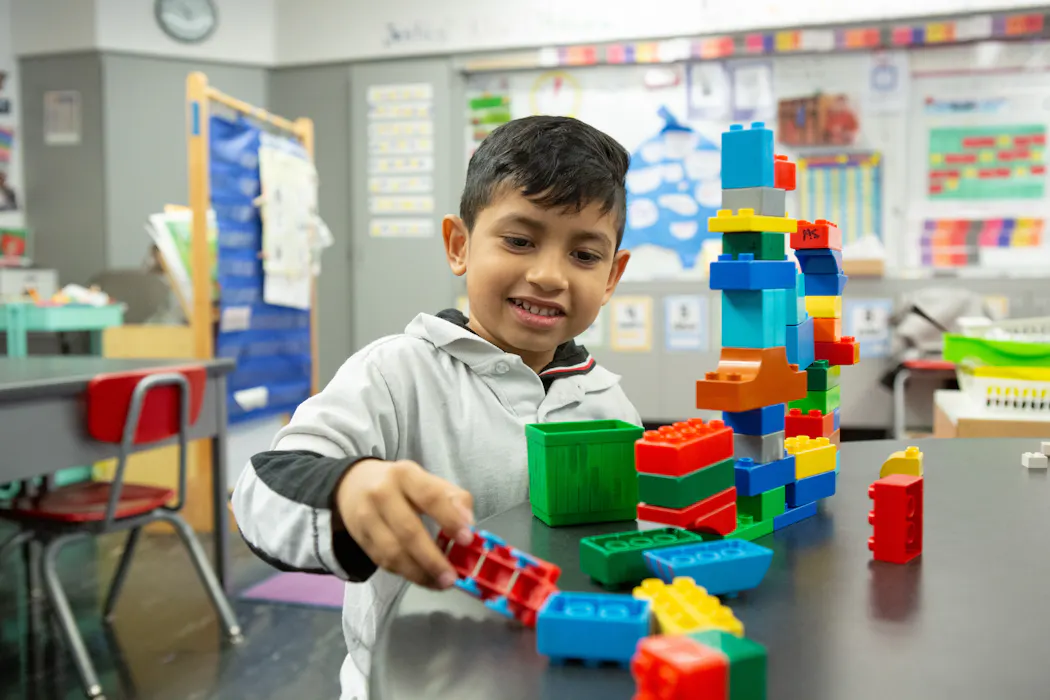
4 ways kindergarten lays the foundation for lifelong learning
The child at five is immersed in a material world they come to name, know and understand through direct tactile experiences, mediated by talk and interaction with peers and adults. (Allison Shelley/EDUimages) , CC BY-NC It’s the time of year when parents are thinking of registering their children for kindergarten in September — a much-anticipated moment in the lives of many parents and their young ones. The importance of early childhood education beginning in kindergarten is widely recognized across Canada. Kindergarten is publicly funded and offered in all provincial jurisdictions and territories. While the vast majority of five-year-olds across the country participate, it is not mandatory . As parents consider kindergarten transitions, what are some important things to understand about children’s development around kindergarten age? The child at five The child at five is essentially a sensory being immersed in a material world they come to name, know and understand through direct tactile experiences, mediated by talk and interaction with peers and adults. They learn through endless repetition: reading the same books and singing the same songs over and over again . Frank Wilson, a neurologist widely recognized for his book, The Hand: How its Use Shapes the Brain, Language and Human Culture , elaborates how our hands are the critical conduit to the brain in developing what is known as embodied cognition — neural systems that are central to our cognitive functions. Among young children, nimble fingers and fine motor control are associated with vocabulary knowledge . Interview with neurobiologist Frank Wilson about his book on neurobiology and the human hand. A typical five-year-old can be expected to have an oral vocabulary repertoire of 5,000 words , or 2,500 word families (run, runs and running constitute one word family). Read more: What are motor skills? Evidence-based ways to support children’s fine and gross motor development Research studies record enormous disparity in the vocabulary size of children disadvantaged by socio-economic status as young as three. Children whose home languages differ from the language of school instruction are also likely to need language learning support starting in kindergarten . Children today as young as five are firmly of the digital device generation. Jean Twenge, a leading psychologist who has studied the impact of exposure to and involvement with digital devices among young children, has raised concerns and cautions about the ubiquity of these devices . She advises their judicious use. Features of quality kindergarten programming High-quality kindergarten programming has a well-organized learning environment . Look for a clean, uncluttered esthetic that is designed to store and access learning resources, display children’s work efforts and facilitate movement within the class. The physical set-up of the classroom is likely divided into centres, as well as space for “carpet time.” The space is designed with the goal of establishing clear routines. Educators’ modelling, their talk in giving directions and managing behaviour all help to maximize time spent on learning and achieving goals. Classroom organization allows for flexible grouping such as whole-class storybook reading at the carpet, small groups at centres and individual work such as colouring, drawing and printing. Kindergarten curriculum is mandated by education ministries in each province or territory. Early literacy and mathematics concepts and skills are foundational to future learning and usually take precedence in the instructional day. High-impact instructional practices Classroom teachers have considerable discretion in how they translate the curriculum into teaching approaches and activities that engage children in meaningful learning experiences. Here are some high-impact practices: Rhythmics, music and movement: Taken together, these lay the foundations for pattern recognition associated with number concepts. The steady, repetitive beat of children’s nursery songs such as “Twinkle, Twinkle Little Star” accompanied by clapping and singing along help children understand the principles of counting . Patterns help young children predict and remember the words to a song. In this way, rhythmics, music and movement foster early language and general cognitive development . These elements have long been recognized as a key component of quality kindergarten programming . Books and read-alouds: The bookshelf needs to contain a broad range of reading materials that foster talk between the teacher and the young learners (“dialogic talk”) that has learning or instructional intent. Wordless picture books such as the Lion and the Mouse , an Aesop fable, support teacher-child interaction by way of inviting children to make predictions, extract the central lesson from the story and apply it to their own lives. Children benefit from and often request repeated readings of the same book. This way, they hear and learn new words in the same context. Only later do they transfer these meanings to new contexts. Blocks and puzzles: Block play accompanied by “block talk” presents another opportunity to support language development. Questioning techniques that support increasing complexity in children’s structures — what’s known as their scaffolded play — can include open ended questions (“How are you planning to make your airport?”) and problem-posing questions (“What can you build with these blocks?”). Early print literacy: The kindergarten year is a busy and demanding year for developing emergent literacy concepts and skills that are foundational for the Grade 1 year to come. It begins with children practising and becoming adept with a fine motor skills, and in particular a tripod grip for handling pencils and crayons. Activities include colouring simple drawings; drawing pre-writing shapes; drawing their own name (often all in capitals) or following path-of-motion exercises — drawing lines top-down, left to right, in circles or zigzag lines. By the end of kindergarten, children are expected to name upper-and lower-case letters of the alphabet and draw most of them. With my colleague Adrienne Waller, I developed extensive resources related to children’s handwriting instruction for teachers and parents that are developmentally progressive and engaging for young children Kindergarten programming fulfils a number of critical learning needs of the child at five. Children are active learners, constructing new understandings of their place in the world and how it works, supported through talk with their educators. Digitally mediated simulations are no substitute for real-world experiences. Prudent use of devices as tools that enhance learning is the key. Rhythmics, movement and music, books and read alouds, block play and puzzles and the development of emergent literacy and skills set the foundations for their educational experiences in Grades 1–12. Parents are children’s first teachers and they are aware of the contexts in which their children learn best. Look for a kindergarten program and setting that will help your five-year-old thrive. Hetty Roessingh receives funding from SSHRC
15 Jun 2026

Four Stages Of Competence: A Guide For Instructional Designers
Learn how the four stages of competence help Instructional Designers improve workplace learning, capability development, and training outcomes. Explore practical applications, examples, and L&D strategies. This post was first published on eLearning Industry .
15 Jun 2026

Your New LMS Won't Save You. Your Learning Strategy Will.
Why do organizations keep buying technology before defining what learning is supposed to do and what to do instead? This post was first published on eLearning Industry .
15 Jun 2026

Social media and teenagers: what the evidence says
Xavier Lorenzo/Shutterstock Is the time teenagers spend on social media really damaging their wellbeing and mental health? Around the globe, youth mental health problems are on the rise. This has coincided with an ever increasing amount of time teenagers spend on platforms such as TikTok, Instagram, X and Snapchat. In the public discourse at least, this correlation has been interpreted to mean one thing: social media damages the mental health of our young people. But what does the evidence actually say? Unfortunately, the scientific community has been unable to provide a definitive answer. Many studies report on the negative effects social media use has for teenagers. Many others provide evidence of the positive effects, or even highlight no effects at all. The evidence base is mixed and inconsistent. For instance, one recent study followed more than 100,000 Australian adolescents for three years. It found that moderate social media use was associated with positive wellbeing outcomes. Another large-scale study highlights the positive relationship between adolescent self-esteem and using social media for social support. By contrast, other research has found a consistent link between social media use and poorer mental health outcomes for adolescents, particularly for girls . Further adding to the complicated picture, other studies conclude that the link between social media and adolescent wellbeing is weak and cannot be considered clinically relevant . Looking at the variables In my own recent research , I used a method called specification curve analysis (SCA) to analyse a publicly available lifestyle dataset of nearly 3,000 15- and 16-year olds living in the west of Ireland. SCA is a computational method which reveals the associations between all theoretically relevant variables in a dataset. For example, my study assessed the links between the time teenagers spend on social media each day and a range of outcomes such as self-esteem, perceived stress, anxiety, depression and diet, as well as their physical activity and sleep quality. When all the combinations of relevant variables are considered, more than 50,000 different pathways linking social media to teenage health outcomes were assessed in my study. Below is the specification curve relating the amount of time those teenagers spend on social media to their health behaviour. Specification curve analysis showing the relationship between time spent on social media and health behaviour. The Y axis represents the strength of the relationship from -1 to +1. The X axis represents the result for each of the 10,240 research models (combination of variables) assessing the link between time on social media and health behaviours. Eoin Whelan, Acta Psychologica, Volume 266 , CC BY The blue dots represent a combination of variables which suggest the association between social media time and health behaviours is beneficial, and that association is statistically significant. The red dots represent variable combinations where the association is negatively correlated with more social media time. The grey dots are combinations where the relationship between social media time and health behaviours are not statistically significant. For example, when we look exclusively at the amount of time teenage boys in this dataset spend on social media, and the amount of time they spend engaging in physical exercise, the correlation is positive, hence a blue dot. More time on social media equals more time doing physical exercise. However, when ethnicity and family wealth are removed as control variables from the analysis – meaning the data is no longer adjusted for these differences – then that statistical connection disappears, hence a grey dot. When all control variables are removed, such as age, ethnicity, school grade and family wealth, the relationship between social media and physical activity for boys becomes negative and statistically significant: a red dot. Essentially, looking at the same data in different ways produces different results. When all possible associations are considered, the overall finding from my study is that yes, time on social media is linked with poorer health outcomes for teenagers. In this graph, when all the possible ways of looking at the data are assessed, 64% suggest more time on social media is associated with poorer health. However, the strength of those associations are small. When I compared these effects to other influences, such as feeling safe at school or having supportive parents, the effects of social media are quite modest. In fact, time spent on social media is one of the least powerful predictors of adolescent health in this dataset. This challenges the popular narrative that social media platforms are the main culprits behind rising mental health problems. Indeed, a recent report from the US National Academies reached a similar conclusion: there’s no strong evidence that social media causes widespread harm. While the results of my study align with this view, these results should be interpreted with caution and may not reflect the experience of all teenagers. There are risks associated with social media platforms for young people, and those do deserve attention. And importantly, if we conclude that the amount of time that teens spend online does not cause significant damage to their wellbeing, we also have to acknowledge that it does not enhance their wellbeing either. If the goal is healthier, happier teens, interventions should target what really matters: safe school environments, strong family support and tackling bullying. The teenagers in my study reported spending an average of 2.5 hours per day on social media platforms. Reducing that time in favour of activities proven to enhance youth wellbeing – physical exercise, creative activities, volunteering – would be an effective way forward. Eoin Whelan received funds from both Research Ireland (Ireland's national research funding agency) and the Fulbright Commission to study the effects of social media use on wellbeing.
15 Jun 2026

Passive Content Is Hard To Learn. Simulations Make Learning Easy.
AI tools now make passive eLearning dangerously easy to create. But "Text-and-Next" and "Mute-and-Multitask" habits mean learners disengage fast and retain almost nothing. Your people need to be active participants, not spectators. Discover why simulation-based training is the future. This post was first published on eLearning Industry .
15 Jun 2026
The missing infrastructure for India’s returning global talent
India is now the largest source of international students globally, sending more students to the United States, the United Kingdom, Australia and Canada than any other country. The recruitment infrastructure that gets them there is well developed and well funded. The infrastructure that brings them home into a meaningful Indian career is not. A few key data points frame the problem: A large majority of internationally educated Indian students return without a strong local professional network (industry estimates suggest upwards of 70%) Only a minority of returning Indian graduates from markets such as the UK secure graduate-level roles within two years of returning (industry estimates place this in the 20-30% range) There is no dedicated platform built for this segment; students rely primarily on referrals from friends and family Salary benchmarks for returning talent are unclear on both sides, creating consistent mismatches at the offer stage These outcomes are not a reflection of candidate quality or opportunity gaps. They are a reflection of missing infrastructure. Why the timing matters Two trends are converging. India is on track to become the world’s third-largest economy. At the same time, hiring in India’s high-growth sectors is accelerating: entry-level hiring in India rose 168% between 2023 and 2025, driven by AI-led roles, expanding opportunities beyond the metros and a growing reliance on internships as a hiring pipeline (LinkedIn, 2026) . The competition for that talent is now structural, 74% of recruiters in India report difficulty finding qualified candidates, and India Inc. is projecting average salary increases of 9.1% in 2026, with manufacturing and financial services leading the climb. The demand and the supply exist. The layer connecting them does not The scale of buildout is visible at the top of the market: Deloitte alone is hiring 50,000+ more people in India in 2026, with the country now anchoring nearly a third of its global workforce. Globally educated Indian candidates with strong communication skills, independent thinking and cross-cultural exposure are precisely the profile that GCCs, export-first startups, and scaling consumer brands are looking for. The demand and the supply exist. The layer connecting them does not. The structural gaps To understand what is missing, it is useful to break the problem into its component parts. No industry connection. There is no structured channel through which returning students can access Indian employers directly. This is in contrast to domestic graduates, who benefit from campus placement systems, alumni networks built in-country, and proximity to hiring hubs. Missing India readiness. Global academic experience does not automatically translate into familiarity with the Indian job market, its norms, its salary bands, its hiring processes, or the specific expectations of a high-growth startup or GCC environment. This translation layer is currently absent. Salary expectation mismatch. Without benchmarking data, returning candidates routinely price themselves incorrectly. This introduces friction early in the hiring process and reduces conversion on both sides. The combined effect of these three gaps is that a high-potential talent pool remains significantly underutilised, even as employers in relevant sectors report active hiring needs. The market opportunity The jobs-side market in India provides context for the scale of the opportunity. Total addressable market: an estimated 3.5-4.2 million white-collar job openings annually, with early-talent roles accounting for an estimated 1.6-1.9 million of these Serviceable market for globally educated talent: an estimated 15,000-25,000 relevant openings across 5,000-8,000 target companies Key absorbing sectors: India now hosts 1,700+ Global Capability Centers, 1,500+ funded startups (Series A-D), and 500+ D2C and CPG brands India’s GCC count is projected to grow to 2,400 by 2030, representing a sustained and growing demand for candidates with international exposure Hiring in these segments is now characterised as “disciplined and productivity-led,” which shifts the emphasis from volume to fit: a dynamic that favours curated, pre-screened talent over generic applications. What an effective solution requires A job board alone does not resolve the structural gaps described above. Standard job platforms convert applications at approximately 5%. The reasons are well understood: low intent on both sides, poor matching, and no pre-screening. What this segment requires is a managed, end-to-end solution with three distinct components. Upskilling and India readiness. Candidates need structured preparation: industry immersions, AI-enabled interview preparation, and psychometric assessments that identify the right industry and culture fit before applications are made. Access to the right employers. This means curated, high-intent job mandates: roles with a genuine urgency to hire, not listings posted for visibility. The focus should be on roles that need to be filled within 30 days, from companies actively seeking globally educated profiles. AI-driven matchmaking. Matching at scale requires more than keyword filtering. Fit mapping across skills, salary bands, culture, and role type, combined with pre-screened candidate profiles, is what drives conversion. The role of universities Universities abroad are increasingly aware that their career support infrastructure was built for domestic labour markets. For their Indian student cohorts, the proposition breaks down at the point of return. Individual universities cannot solve this independently; the employer relationships, the India market knowledge, and the candidate volume required to make the system work are not assets any single institution can build efficiently. What is needed is an industry-level solution that operates across university partnerships, aggregates employer demand, and builds a structured re-entry pathway for returning talent at scale. This enables universities to continue doing what they do best, delivering world-class education, while a specialist layer handles the employment outcomes that increasingly define their value proposition to prospective students. The infrastructure gap is well-defined. The demand on both sides is demonstrable. The conditions for a scalable solution are in place. The post The missing infrastructure for India’s returning global talent appeared first on The PIE News .
15 Jun 2026

UK under-16 social media ban: what parents need to know
Vukasin Ljustina/Shutterstock The UK government has announced plans to introduce a ban on social media use for children under the age of 16. This follows a consultation on the impact of social media on young people’s mental health, wellbeing and safety. It represents one of the most significant interventions in children’s online lives since the Online Safety Act . The announcement has generated strong reactions. Many parents welcome the idea, arguing that social media companies have failed to create safe environments for children. Others question whether a ban will work in practice, or whether it risks oversimplifying a much more complex issue. Perhaps most significantly, Ian Russell – one of the most influential and respected campaigners in the UK online safety debate – has questioned whether a blanket social media ban for under-16s is the right solution. Russell, whose daughter Molly died after being exposed to harmful online content, is strongly critical of social media companies. But he argues that the focus should be on making platforms safer by design and enforcing stronger regulation, rather than relying on a ban that many young people may simply find ways to circumvent. Here are some key questions answered for parents trying to make sense of the headlines. What is actually being announced? The government’s intention is to prevent children under 16 from accessing mainstream social media platforms. This would be likely to include services such as Instagram, TikTok, Snapchat and X, although the final list has yet to be confirmed. However, it seems messaging platforms such as WhatsApp are not included the scope of the ban . The proposal would require platforms to verify users’ ages and prevent underage access. This means the success of any ban will depend heavily on age-assurance technology. Such systems range from simple self-declaration to more sophisticated approaches such as facial age estimation or identity verification. There are also proposals to restrict engagement with strangers on gaming platforms, such as limiting unsolicited contact. Livestreaming and endless scrolling on platforms will be banned for young people. The prime minister, Keir Starmer, has said that the ban could come into effect in spring 2027. Teens’ access to livestreaming platforms is likely to become more restricted. SeventyFour/Shutterstock However, importantly, this is not simply a question of passing a law. The practical challenge is enforcement. Millions of children already have social media accounts, and many young people are highly skilled at navigating online restrictions. Experience from other countries suggests that some children will inevitably find ways around any barriers that are introduced. Read more: Australia has already banned social media for under 16s – here’s what the UK can learn from the experience The government has acknowledged this reality. The argument being made is not that a ban will be perfect, but that reducing access and raising the barriers to entry will reduce overall exposure to potential harms. Why is the government doing this? The proposal reflects growing political concern about children’s online experiences. In recent years there has been increasing attention on issues such as cyberbullying, exposure to harmful content, online exploitation, algorithmic recommendation systems, endless scrolling and excessive screen time. Many parents will recognise these concerns. Stories about harmful content reaching children and social media-related anxiety regularly attract media attention. Campaign groups raised concerns about the “addictive” design of social media. Read more: Ban on phones in schools: support for headteachers or unnecessary legislation? At the same time, concerns about children’s mental health have become increasingly linked to debates about smartphones and social media. While researchers continue to argue that the evidence for this is not clear, the perception that social media is contributing to a wider wellbeing crisis has become influential in public and political discussions. The government’s proposal reflects a broader international trend. Australia has already introduced legislation to restrict social media access for younger users, while policymakers in several other countries are considering similar measures. Will it work? This is where the debate becomes more complicated. Supporters argue that society already accepts age restrictions in many areas. Children cannot legally buy alcohol, cigarettes or gambling products. From this perspective, introducing age limits for social media is a reasonable response to evidence of harm. Critics, however, point out that social media differs from many other age-restricted activities. Young people use these platforms not only for entertainment but also for communication, social connection, creativity and access to information. For many teenagers, social media is woven into everyday social life. Read more: The online world comes with risks – but also friendships and independence for young people with disabilities There are also questions about whether bans address the root causes of concern. Some researchers argue that platform design may be more important than access itself. Engagement-driven business models can affect users of all ages. Restricting younger users’ access may reduce their exposure to these features, but it does not necessarily address the systems that created concern in the first place. There is also the possibility of unintended consequences. Some young people may simply migrate to less regulated platforms, use VPNs , create false accounts or access services through older friends and family members. Others may become less willing to discuss their online experiences if they fear losing access altogether. What does this mean for parents? Perhaps the most important point is that legislation cannot replace parenting, education and support. Even if a ban is introduced, young people will continue to encounter digital technology, online communities and social platforms throughout their lives. The skills they need to navigate these spaces safely will remain important regardless of what the law says. The government’s proposal represents a significant shift in online safety policy and reflects genuine public concern about children’s digital lives. Whether it becomes a transformative intervention or another chapter in a long-running debate about technology and childhood remains to be seen. What is certain is that the challenge facing parents, educators and policymakers extends beyond social media itself. The real question is not simply how to keep children away from online risks, but how to help them develop the skills, confidence and resilience they need to navigate an increasingly digital world. Andy Phippen does not work for, consult, own shares in or receive funding from any company or organisation that would benefit from this article, and has disclosed no relevant affiliations beyond their academic appointment.
15 Jun 2026

AI Pricing Strategies: How Smart SaaS Companies Price AI Features
AI has gone from being a premium product feature to a normal add-on. Everything is AI-powered nowadays, and customers are asking for such possibilities. But how do companies charge for these capabilities? And how can you charge for your own AI features? Let's discover everything together. This post was first published on eLearning Industry .
15 Jun 2026
98% of leaders say study abroad shaped their path to leadership
Industry leaders across more than 20 fields have reflected on the “transformational” impact of study abroad experiences, with 98% indicating their international experience shaped their professional growth into leadership roles. The research , conducted by Institute of International Education (IIE) and AIFS Abroad, drew on in-depth interviews with 44 executives and decision-makers, and was launched at the NAFSA conference in Orlando last month. “The skills and perspectives gained through education abroad are not only relevant but essential for effective leadership in today’s interconnected world,” wrote AIFS Foundation president William Gertz. He highlighted that leaders consistently pointed to their experiences abroad as “pivotal moments in their personal and professional development”. Of the 44 respondents, 96% indicated that going overseas was influential in developing cross-cultural leadership skills, improving their ability to work with people from different backgrounds, manage diverse teams, and build relationships across borders. What’s more, another central finding was that respondents often did not fully appreciate the professional value of study abroad immediately after graduation, with its impact accumulating over time. One of the report’s authors, IIE director of research Julie Baer, emphasised that study abroad “is not just a short-term academic experience, but a long-term accelerator for leadership”. Notably, she said the benefits were not limited to certain fields but showed up across sectors “from science and technology, finance, arts, law, and education”. The findings come at a turbulent time for America’s geopolitical relations, with fewer international students set to come to the US next academic year, and continued uncertainty around Optional Practical Training (OPT) and H-1B worker visas. As the administration continues to obstruct international talent coming to the US, the study abroad sector has seen some recent congressional victories , but it too has suffered from consistent federal funding cuts and visa challenges over the past 16 months. And while appetite for study abroad among US students continues to grow, rising costs and financial pressures at institutions are increasingly acting as barriers to participation. According to a 2025 survey of four-year college students, over three-quarters of respondents said they hoped or planned to study abroad. Yet finances remained the main concern for 80% of students and nearly half of those not planning to study abroad said the cost prevented them from doing so. We see a key opportunity to broaden how we talk about study abroad across industries Julie Baer, Institute of International Education (IIE) Against this backdrop, Baer said “now more than ever” it was “critical” to understand how international education shapes individuals’ careers and their development as leaders. “Particularly in this moment, employers are evolving their hiring expectations to look for people who can adapt, communicate across differences, and solve complex problems.” “The findings indicate that going abroad can be a strategic investment in the future workforce and leadership pipeline,” Baer continued, advocating for a broadening of how we talk about study abroad across industries. The report adds to a growing body of research highlighting economic benefit of international exchange, with NAFSA workforce research finding 96% of US businesses said performance would improve with greater global experience among employees. As such, Baer highlighted the importance of individuals showcasing and articulating the value of such experiences, with many of the survey respondents highlighting how educational abroad is often not highlighted on resumes. “We have an opportunity to move from thinking about study abroad as ‘where did you go’ to understanding it as ‘how did you grow into a leader,’” she said. The post 98% of leaders say study abroad shaped their path to leadership appeared first on The PIE News .
15 Jun 2026

AI schools like Alpha promise efficiency, but can’t replicate the messy process that helps kids learn
Students often learn best when they take risks and struggle to get it right, including on the playground. Jeff Gritchen/MediaNews Group/Orange County Register via Getty Images A child at a playground tries to climb, jump or negotiate with a peer, and their attempt does not work. They fall, get left out of a game or reach another impasse. Then they try again. Failure, conflict and frustration might look like a struggle, but this is often how children learn. I have spent 20 years studying digital literacy and how technology reshapes learning. My work turns on a simple question: What do people gain, and what do they lose, as society largely moves from traditional print to online learning? With this in mind, I believe that this question is growing more urgent as artificial intelligence-driven schooling gains ground. AI-powered educational programs like Alpha School , a growing private network of schools, replace much of the school day with adaptive software that adjusts lessons to each student’s pace and abilities . The pitch is personalized learning : Give each student the right material at the right moment, and they will succeed academically. The deeper you look at how children learn, the clearer it becomes that this growing brand of alternative schools might remove the discomfort that often comes with learning – taking away what matters most as kids develop. MacKenzie Price, left, the co-founder of Alpha School, meets with U.S. Secretary of Education Linda McMahon and Alpha students at the Alpha School’s campus in Austin, Texas, in September 2025. Rick Kern/Getty Images for Alpha School Welcome to Alpha Alpha School was launched in 2014 by the tech entrepreneur MacKenzie Price and the private equity billionaire Joseph Liemandt . It is perhaps the most well known of the growing list of AI K-12 schools operating in the United States. Alpha represents a particular vision of education reform – one that has caught the attention of the Trump administration. Education Secretary Linda McMahon toured its Austin, Texas, campus in 2025, and first lady Melania Trump invited an Alpha student as her guest to the State of the Union address in 2026. Alpha operates more than a dozen campuses across major cities like New York and Miami. Annual tuition ranges from about US$40,000 to $75,000 per year , depending on the school’s location. Students learn core subjects like math, reading, science and social studies from adaptive AI software for one to two hours a day. Students spend the rest of their time in workshops on topics like public speaking, coding, outdoor education and other projects. Their sessions are led by adults – typically not accredited teachers – whom the school calls guides. There are other similar schools, including Unbound Academy , a tuition-free Arizona charter; and Novatio , a virtual private school. These are separate from Alpha in name, but they share overlapping leadership and online programs. The Alpha model promises parents that they can get the right material to the right student at the right moment, confirm mastery and move on to other things that might have more relevance in the real world. But delivering content efficiently is not the same as understanding how learning happens. Decades of research suggests that effective learning is not always efficient. Alpha says its students received higher standardized test scores than their peers attending non-AI schools. Those numbers come from Alpha’s own internal data and have not been independently verified. A 2026 investigation by the independent 404 Media news organization found that the school’s AI-generated lesson plans were poorly constructed and often illogical, raising questions about student growth. But the deeper problem may not be whether the numbers are accurate; it is what the numbers cannot reflect. What struggle is for Cognitive psychologist Robert Bjork studies how when a student struggles to recall an answer before being instantly given the answer, this learning helps cement their knowledge. Developmental psychologist Jean Piaget described something similar. Children learn when the world does not behave as they might expect . So when a child, certain that a tall, thin glass holds more water than a short, wide one, pours the liquid back and forth and discovers their misjudgment, this helps them gain a clear understanding of what is happening before their eyes. School is also where children learn who they are and what they are passionate about and believe in, often with the help of other people. Psychologist Lev Vygotsky argued that a child’s development is fundamentally social . A student’s understanding of particular subjects forms in collaboration with teachers, peers and the daily friction of being one mind among many. Alpha’s students spend time with adult guides and other students on collaborative projects, but the bulk of the academic learning itself happens largely alone at a screen. Child psychoanalyst Erik Erikson mapped childhood as a sequence of stages in which children work out not just what they know, but who they are as people. These are not lessons you complete in an app. They are learned among friends and classmates. AI-powered schools offer parents and students the promise that they can condense their learning into short windows of time, with a tailored approach that meets their needs. Krongkaew/iStock Photos/Getty Images What an app cannot teach The limits of AI learning have shown up in one of the most ambitious recent attempts to have kids learn from an AI tutor. In 2023, Khan Academy, a nonprofit online site that offers free learning, launched Khanmigo . This AI chatbot is designed not to hand students answers, but to coach them toward understanding. Its founder, Sal Khan, initially described the goal as giving every student access to something like a personal tutor . But Khan Academy describes Khanmigo in more modest terms than it once did . Khan Academy now says Khanmigo is meant to be used with adult supervision. An AI bot can prompt, explain and guide, but it cannot replace human teachers who notice confusion on a student’s face. Chatbots see when a student answers a question incorrectly. But curiosity, resilience, belonging and the slow work of figuring out who you are cannot show up on a dashboard. The risk is not that these schools are bad at producing high test scores and other metrics. It is that they optimize for the part of childhood that fits on a chart and let the rest become an afterthought. When critics raise these concerns , AI schools counter that a human adult is present as students complete lessons with an AI bot. But presence is not participation. What this model may lack is the thing those humans are supposed to provide. Conversation, challenge and being known by others are what makes school more than a place to absorb content. A tool is not a school None of this means AI can’t help children learn. But a child on a playground learns because she falls and tries again and again, in front of people who notice. That may not be something an AI model can deliver in two hours a day. A question worth sitting with is not whether these schools work, but what people are willing to trade for the parts of AI learning that might work well. W. Ian O'Byrne receives funding from the U.S. National Science Foundation as part of the AI Cyberpathways grant. He is Director of the Initiative for Literacy in a Digital Age.
15 Jun 2026

Australia has already banned social media for under 16s – here’s what the UK can learn from the experience
Bricolage/Shutterstock As the UK prepares to introduce an “Australia plus” ban on social media for under 16s, many lessons can be learned from Australia’s experiment. Many people may think Australia’s ban is a success, with nearly 5 million social media accounts deactivated, removed or restricted . But the reality couldn’t be further from the truth. The Australian legislation only requires social media platforms – such as Instagram, TikTok and Facebook – to take “reasonable steps” to prevent under 16s from holding social media accounts. This means children can continue to view social media content – on YouTube, for example – on a web browser, without having an account. This legislation applies to all platforms whose “sole or significant purpose” is to enable “online social interaction”, allowing people to link to or interact with others, and to post material on the platform. However, the legislation excludes gaming platforms, messaging apps and platforms whose “sole or primary purpose” is educational or health related. The government provides a self-assessment guide for platforms to identify whether they must restrict access. Australia’s eSafety Commissioner did provide an “initial list” of ten platforms considered “likely” to fall under the legislation. These included Facebook, Snapchat, Instagram, X, and Twitch. Reddit was also included and immediately launched a legal challenge , which has yet to be resolved. The eSafety Commissioner also named ten platforms “unlikely” to fall under the legislation (such as Roblox, YouTube Kids and Discord). Yet such exclusions continue to raise concerns around potential harm. In February, the eSafety Commissioner put Roblox “ on notice ” following several international reports of grooming , including a man who was jailed for this offence in the UK. Was the launch of the ban successful? Since its launch on 10 December 2025, Australian media has been filled with stories of children remaining on social media platforms. There was a major spike in downloads of non-mainstream platforms, like Rednote, Yope, and Lemon8. Children reported exploiting the legislation’s known “loophole” by shifting their conversations to gaming and messaging apps, or by using VPNs to access existing accounts. Many under 16s who were initially locked out of their accounts also reported being able to reactivate or create new accounts immediately. Teenagers reported being still able to access social media. Irene Miller/Shutterstock There were also many reports of under 16s (and their parents) being surprised they were not asked to assure their age, at all. As some companies use behaviour-based age assurance technologies, with age estimation based on the accounts people follow, or they content they like, a young person interacting with mature content could mistakenly be estimated to be 16 or older. Of those who were asked to assure their age by providing images of themselves, many children reporting fooling the system with masks or by having older siblings (and even parents ) sit in front of the camera. All these workarounds were known , and widely reported, months ahead of the December launch. What does the evidence show? In March 2026, Australia’s eSafety Commission released its first detailed compliance report . It showed social media companies had taken “some steps” to restrict access to accounts. But the report also provided data from parents showing 70% of children retained active social media accounts. The report highlighted four key compliance issues. It found that messaging to under-16s on some platforms encouraged children to attempt age assurance, even where they declared themselves to be underage. Some platforms enabled under-16s to repeatedly attempt the same age-assurance method to ultimately pass age checks. Pathways for reporting age-restricted accounts have generally not been accessible and effective, particularly for parents. Finally, some platforms appear not to have done enough to prevent under-16s having accounts. The report explained Facebook, Instagram, Snapchat, TikTok and YouTube were being investigated for “potential non-compliance”. While the results of these investigations are not yet known, enforcement decisions are expected by midyear. In the meantime, parents continue to be frustrated with the ineffectiveness of the legislation. A recent study provides further insights into the flaws and limitations of Australia’s social media restrictions. The study found 61% of under 16s reported “no or little change” in their social media use. Only 26% reported they had been “significantly affected” by the ban. However, of those who were restricted, 51% reported a significant drop in access to news coverage. These results raise significant concerns for young people’s future civic engagement. What can the UK learn from Australia’s experiment? The UK government will implement stricter measures than Australia, by banning under 18s from accessing romantic or sexual AI chatbots and including gaming sites in the restrictions. However, Australia has already introduced similar measures. The Australian government announced a new legislative rule so its definition of social media includes platforms with “addictive or otherwise harmful design features”. It also introduced new restrictions on search engines, AI tools, gaming platforms and other technologies to limit children’s access to pornography, extreme violent content and self-harm content. The success of these measures is not yet known. Australia will also introduce digital duty of care legislation later this year, which will place additional expectations on technology companies for preventing digital harms. With the UK’s claim that it will introduce a “sweeping ban” of all children under 16 on social media, a critical question to ask is how that will be achieved. Australia’s experience and several global studies show significant limitations in age assurance technologies , which have error rates of one to three years when attempting to estimate people’s ages. The UK could require technology companies to use age verification for all social media users – where everyone 16 and older would need to provided government-issued ID or other evidence to prove their age. But this approach brings significant privacy concerns . The UK’s experience with age verification for pornography sites saw a significant increase in the use of VPNs , which could also be used to circumvent social media restrictions. Digital spaces should be safe for people of all ages. But I don’t believe bans are the answer. Technology companies need to be held to account and required to block harmful content and build safety into their designs. Lisa M. Given receives funding from the Australian Research Council and Australia's eSafety Commission. She is a Fellow of the Academy of the Social Sciences in Australia and the Association for Information Science and Technology.
15 Jun 2026
Nigeria lifts tuition remittance cap even as visa concerns persist
The Central Bank of Nigeria (CBN) has increased the maximum tuition fee remittance for students studying overseas from $15,000 to $25,000 per semester as part of broader reforms aimed at improving access to foreign exchange. The revised limit, contained in the CBN’s Foreign Exchange Manual, Fourth Edition, came into effect on June 1 and applies to tuition payments made through authorised dealer banks for eligible overseas higher education institutions. The policy also clarifies that tuition and maintenance allowances will be treated separately. Where tuition and maintenance fees are billed together, remittances will be made directly to the educational institution. Students living off-campus, or whose maintenance fees are billed separately, may receive maintenance remittances of up to $5,000 per quarter. Nursery, primary, secondary, foundation and A-Level programs remain excluded from the framework. Stakeholders welcomed the move, saying it better reflects the rising cost of international education. “From a practical perspective, the policy may improve flexibility and predictability for students already committed to overseas study, particularly those attending institutions with higher tuition costs,” Simisola Smith, West Africa associate director at Grok Global Services , told The PIE News . “The reality is that tuition fees at many international institutions now exceed the previous $15,000 threshold, particularly across destinations such as the UK, US, Canada, Australia and parts of Europe.” We are operating in an environment where students are increasingly concerned about whether they will be able to secure visa appointments, obtain approvals, navigate changing immigration policies and ultimately begin their studies on time Bimpe Femi-Oyewo, Edward Consulting However, experts stressed that the revised cap addresses only one part of a much wider set of challenges facing Nigerian students. “I do not believe the remittance cap is currently the primary factor shaping Nigerian students’ study abroad prospects. For many students, the bigger challenges today are access, visa uncertainty and funding,” said Bimpe Femi-Oyewo, founder and CEO of Edward Consulting . “We are operating in an environment where students are increasingly concerned about whether they will be able to secure visa appointments, obtain approvals, navigate changing immigration policies and ultimately begin their studies on time.” She also pointed to growing funding challenges for African students. “While scholarships remain available, access to educational financing has become more challenging for many African students. Several major loan providers that previously supported international students have reduced or paused lending in parts of Africa, creating additional barriers for students who may still have unmet financial needs after receiving scholarships.” The comments come amid growing uncertainty across several major destination markets. Earlier this year, The PIE reported that Nigerian student interest in the US had fallen by more than 50% following the expansion of Donald Trump’s travel ban, with students increasingly exploring alternative destinations. Recent analysis by The PIE found Nigerian applicants faced a UK student visa refusal rate of 22.6% in the first quarter of 2026, among the highest rates recorded among the UK’s major source countries. Over the previous 12 months, refused Nigerian applicants generated an estimated £1.6 million in visa fee income for the UK government. Financial pressures have also intensified in recent years as the naira has weakened and international tuition costs have risen, prompting concerns over mounting tuition debt among Nigerian students in the UK as access to foreign exchange became more difficult, The PIE previously reported . “Affordability and financial considerations have always been important factors for Nigerian students, but they have become even more significant in recent years due to currency devaluation, rising tuition costs and broader economic pressures,” said Femi-Oyewo. “Families are asking not only whether they can afford a destination, but whether they can realistically obtain a visa, access funding and begin their studies without disruption.” As a result, she said, Nigerian students are showing growing interest in destinations such as the UK, France, Spain, Ireland, Belgium and other parts of Europe, where pathways to study, work and long-term planning may appear more predictable. Smith echoed Femi-Oyewo’s view that affordability has become one of the most influential factors shaping student decision-making, with families increasingly evaluating destinations through the lens of return on investment. “The discussion is no longer simply about destination prestige; it is increasingly about return on investment,” she said. Students are carefully assessing tuition costs, exchange-rate exposure, scholarship availability, employability outcomes, graduate work opportunities and long-term career pathways, she added. From a recruitment perspective, Smith said the revised cap may help improve conversion among students who are already committed to studying abroad by reducing one financial obstacle within the payment process. However, she cautioned against overstating its impact. “I would expect the impact to be positive, but relatively modest when viewed in isolation,” she said. “The revised remittance cap is helpful, but I would not describe it as the primary factor shaping study-abroad prospects at the moment. One of the strongest themes emerging from our recent market intelligence work across Sub-Saharan Africa is that recruitment has become increasingly confidence-led.” “The challenge is less about demand disappearing and more about increasing friction within the decision-making process.” The post Nigeria lifts tuition remittance cap even as visa concerns persist appeared first on The PIE News .
15 Jun 2026
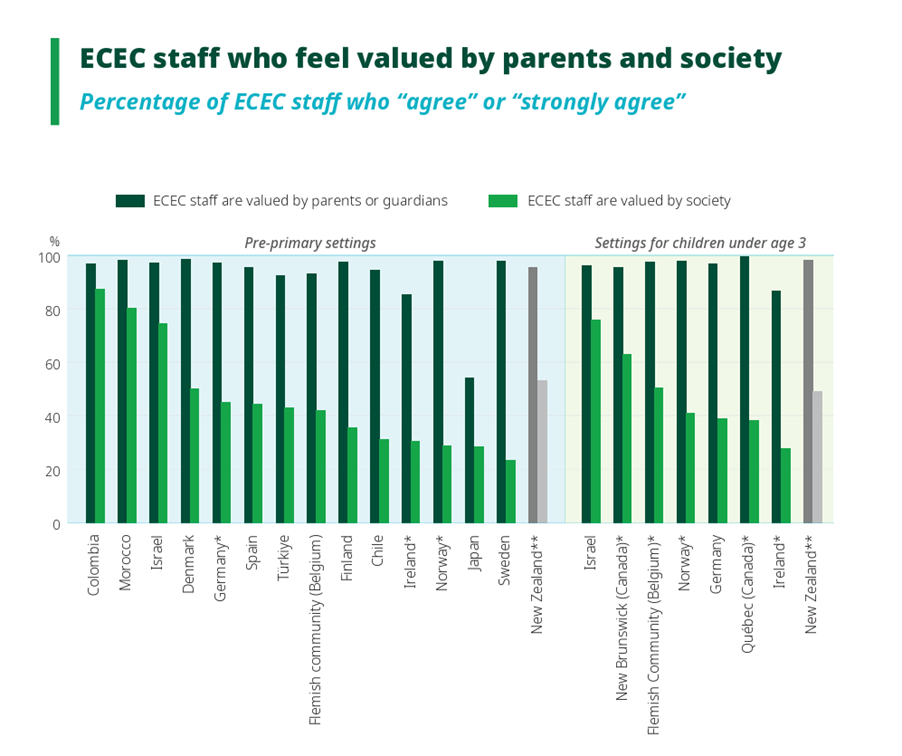
Valued by children, but feeling undervalued by society
By Andreas Schleicher, OECD Director for Education and Skills In Early Childhood Education and Care (ECEC) settings across the world, staff are greeted each morning with hugs, smiles, laughter and occasionally some tears. Nearly universally, they are admired by children and appreciated by parents. Yet, despite this near daily affirmation of their importance, many ECEC staff believe they are not valued by society. This lack of recognition is a threat to the sector’s long-term vitality. Breaking down the data, the OECD’s TALIS Starting Strong report shows that more than 80% of ECEC staff in all countries, except Japan, feel valued by parents or guardians in both pre-primary and under-3 settings. Likewise, close to 100% of staff feel valued by children, except in Japan (65%). However, perceptions shift dramatically when it comes to societal recognition. Across all countries, the share of staff who feel valued by society is significantly lower. While at least seven out of ten staff feel valued by society in pre-primary settings in Colombia and Morocco, and in Israel for both levels of ECEC, the share drops below one in three in pre-primary settings in Chile, Japan, Norway and Sweden, and in Ireland for both levels of ECEC. One reason for this contrast is the nature of daily interactions. ECEC staff often feel appreciated by parents and children because they communicate regularly, forming strong personal bonds and delivering visible, immediate impact. But beyond the walls of ECEC centres that recognition fades. In many societies, ECEC staff are perceived as caregivers rather than skilled professionals. Low pay, and limited public visibility or recognition, also leaves many staff feeling undervalued by the broader community. That said, it is interesting to note: most ECEC staff feel more valued by society than teachers in lower secondary schools. For example, in the Flemish Community of Belgium, Israel, Spain and Türkiye, ECEC professionals are twice as likely as high school teachers to report feeling valued by society. Even so, the overall findings raise concerns. When ECEC professionals do not feel valued or recognised, it becomes harder to attract and retain skilled staff. This is particularly true when low societal prestige is coupled with widespread dissatisfaction over pay. All these factors contribute to staffing shortages, high turnover and reduced morale, which directly impact the consistency and quality of education and care that children receive. The underappreciation of staff perpetuates the notion that working with young children is low-skilled, despite its critical developmental importance. The data show that ECEC staff who feel less valued by society tend to have more years of experience and higher educational qualifications. We can not say for sure, but ECEC settings are potentially losing some of their best staff due to dissatisfaction. When people feel unsupported – regardless of their profession – they can be less inclined to innovate, pursue training or stay in their jobs. Staff shortages are the main cause of lower quality education and care environments, according to ECEC leaders. In some countries, staffing problem are particularly bad. For example, in Germany and Norway (both levels of ECEC) and in Ireland and New Brunswick (Canada) for under-3 settings, more than half of centres struggle to maintain quality, citing a lack of staff for the number of children enrolled or frequent absences. In terms of solutions, increased funding is often discussed. But raising salaries is not an easy option for countries facing tight budget constraints. And while policymakers have long acknowledged the importance of the early years in shaping lifelong outcomes, investment in the workforce has lagged behind the rhetoric. Policymakers should consider ways of improving pay and elevating the status of ECEC professionals as a strategic imperative. One effective approach is to introduce a more diversified and structured career framework. By defining a broader range of roles – such as lead educators and family engagement coordinators – governments can create clear pathways for professional growth. Each role could come with progressively higher levels of pay, autonomy and responsibility, reflecting the complexity and impact of the work. This kind of tiered system not only incentivises ongoing professional development but also helps to elevate the status and standards of the sector. Countries and subnational entities like Colombia, the Flemish Community of Belgium, Morocco and Spain have somewhat managed to achieve these goals in pre-primary education, where staff are less likely to consider leaving the sector entirely. Instead, they often aspire to leadership or primary teaching roles. Notably, in these countries, staff also report feeling more valued by society and stronger satisfaction with salary. Given the highly gendered workforce, absences due to maternity leave and family caregiving are also more frequent than in many other sectors. To mitigate this, systems can invest in pools of qualified replacement staff. At the same time, efforts should be made to encourage more men to take up the profession, helping to balance gender representation. Public awareness campaigns and policy narratives can play a role in reinforcing the societal importance of ECEC professionals. In addition, broader policy measures – such as designing more flexible parental leave for both mothers and fathers – can lead to more equal sharing of parental caregiving responsibilities. Taken together, these strategies can help build a more resilient and valued ECEC workforce. * Estimates should be interpreted with caution due to a higher risk of non-response bias. New Brunswick (Canada)* Flemish Community (Belgium)* Norway* Germany Québec (Canada)* Ireland* ** Data only represent respondents included in the sample and not the population targeted by the survey. For more information, see Annex B. Source: OECD (2025), TALIS Starting Strong 2024 Database, Table D.8.2. This blog is based on a chapter from the TALIS Starting Strong 2024 Insights and Interpretations brochure: talis3s2024-insights-interpretations.pdf . The Starting Strong Teaching and Learning International Survey (TALIS Starting Strong) assesses the issues impacting early childhood education and care (ECEC). In 2024, it surveyed the ECEC workforce in under-3 settings and in pre-primary settings, which typically care for children aged 3-6, in a total of 17 countries and subnational entities .
15 Jun 2026

Conflict hits schooling hardest where children are the target – study
Wall of remembrance in Lagos for missing Nigerian schoolgirls. Beendy234 - Own work, CC BY-SA 4.0 , CC BY According to Unesco, around 250 million children (16%) globally are out of school although they are of an age to be at school in their countries. Available evidence suggests that out-of-school numbers are extremely high in conflict-affected countries, though the exact number is hard to quantify. For example, in the Central African Republic, South Sudan and Eritrea, more than 50% of primary school-age children are not going to school. Research has long shown that conflict disrupts education. But armed groups do not all operate in the same way. Some use tactics that directly target children, such as recruiting child soldiers or committing sexual violence against minors. These tactics do more than create general insecurity. They directly threaten children’s safety and wellbeing. We are a group of researchers who work on understanding the human consequences of conflict. In our recent publication on warfare’s impact on schooling , assessing 30 sub-Saharan African countries, we argue that this distinction between general violence and child-targeted tactics is key to understanding school enrolment decisions. When children are targeted by armed groups, parents and caretakers reassess safety and the risk that they are willing to take. In some cases, schools may no longer be seen as safe spaces, and the risk of sending children to school, especially younger or more vulnerable children, can feel too high. We show that when armed groups use child recruitment or sexual violence, the impact of conflict on school enrolment is much more severe than conflicts in which these tactics are not used. They also widen existing inequalities, especially for girls. These new findings highlight a point that’s often overlooked: education systems cannot function if children do not feel safe. Protecting schooling in conflict settings therefore goes beyond rebuilding infrastructure. It requires addressing the threats that keep children out of classrooms. Evidence from 700,000 potential school starters Our study used nationally representative data from 59 Demographic and Health Surveys across 30 countries in sub-Saharan Africa conducted between 2010 and 2021. In total, this covered almost 700,000 children of the age that should have been starting primary school during this period. We combined this information with detailed data on where and when armed conflict occurred, and whether child soldier recruitment and sexual violence against minors took place within 25km of where children lived in the year before they were due to start school. The results confirm a pattern many might expect: children living in areas affected by conflict are less likely to start school. But the effect is much stronger when conflict involves tactics that target children, such as recruitment and sexual violence. In areas where children are recruited into armed groups, school enrolment falls by about 3.2% compared to children living in conflict-affected areas where this tactic was not used. In places where they are exposed to sexual violence, the decline is even larger, around 9.5%. These effects are not the same for all children. Girls are hit especially hard. Their likelihood of enrolling in school drops by roughly twice as much as that of boys. This is true even in contexts of child soldier recruitment – an issue often thought to mainly affect boys. Fear, risk and parental decision-making Why do these types of violence have such strong effects on school enrolment? Although we cannot test this directly, anecdotal evidence suggests that fear plays a central role. When armed groups that are known to recruit children or commit sexual violence against them are active in the area, parents may begin especially to see the journey to and from school as unsafe . In some cases, it is not only the journey but also the schools themselves that are considered to be unsafe, as they are targeted or occupied by armed groups . For example, in South Sudan in 2014 armed groups attacked schools and forcibly recruited more than 100 pupils into their ranks. In other cases, children have been exposed to sexual violence during or after school attacks, or while travelling to and from school. One stark example comes from early March 2017 , when a militia attacked a school in the Congolese province of Luiza, beating male students and raping several schoolgirls. Read more: Why we did it: the Kenyan women and girls who joined Al-Shabaab In these contexts, fear can decrease the willingness of children to go to school. For example, a witness of a Boko Haram attack on a school in Buni Yadi, Nigeria, told the interviewer : After the attack, I went home. I was too afraid and decided not to go back. I told my parents I would never go back to school. They were also too afraid. Parents and caretakers are affected too. For example, after more than 200 schoolgirls were abducted from Chibok in northern Nigeria by Boko Haram in 2014, a local parent-teacher association leader told journalists that the attack has left families traumatised and entire communities living in fear that if their children went to school, they might never return home. When insecurity increases, these existing challenges can tip the balance, making schooling feel like a less safe or less realistic option, especially for daughters. Girls are often perceived as particularly vulnerable during times of insecurity. At the same time, they often face additional barriers to education, such as early marriage and household responsibilities. Implications Our findings add an important layer to how we understand the relationship between conflict and education. It is not enough to know whether conflict is present or how intense it is in terms of casualties. What also matters is how conflict is carried out, and whether children are directly targeted. Read more: 9 million Ethiopian children have been forced out of school: what the government must do For policymakers and international organisations, this has clear implications. Many efforts to support education in conflict-affected areas focus on rebuilding schools, providing learning materials or improving access. These are crucial steps, but they are not enough on their own. If children are not going to school in the first place, it is often because families do not feel it is safe to send them there. This means that protecting education also requires establishing and implementing policy that decreases child recruitment and sexual violence in conflict settings. It requires safe routes to and from school, and addressing gender-specific barriers. Roos van der Haer receives funding from the Research Council of Norway (grant # 350187). Gudrun Østby receives funding from the Research Council of Norway (#350187) Ragnhild Nordås receives funding from the Research Council of Norway (#350187). Andreas Forø Tollefsen and Siri Aas Rustad do not work for, consult, own shares in or receive funding from any company or organisation that would benefit from this article, and have disclosed no relevant affiliations beyond their academic appointment.
15 Jun 2026
Why did all 5 Chen siblings study dentistry in Spain? Meet the world’s smartest family of dentists
Meet the Chen family, the internet’s new favourite and definitely a contender for the title of “smartest family of dentists in the world.” Dad’s a dentist. Mum’s a dentist. All five kids? Dentists too. All of them graduated from some of the most prestigious dental schools in the US, including Harvard University, New York University, Northwestern University, and Tufts University. They’ve all risen to viral fame, and why wouldn’t they? They’re the type of family your parents would compare you to. Table of contents: Five siblings, one degree Where and what the children of the smartest family of dentists in the world studied Following in the footsteps of their parentsFollowing in the footsteps of their parents Is Spain a good country to study dentistry View this post on Instagram A post shared by niq chen (@niq) Five siblings, one degree Most siblings carve out their own paths. Some compete. Some intentionally choose different schools, different careers, and different cities. But when it comes to the Chen siblings — Dr. Nina Chen, Dr. Audree Chen, Dr. Niq Chen, Dr. Aleq Chen, and Dr. Nasdaq Chen — they chose to stick together. Same primary, middle, and high schools. And when it came time to choose their future paths, they decided not to be apart. They moved abroad together. Same country. Same university. Same degree. In a YouTube video, one of the children, Dr. Niq Chen, joked that they’re like Velcro. And he’s not wrong. The siblings even co-authored a study titled, “Utilising granulomatous tissue as a membrane for primary closure: Introducing Leon’s Everted Gingival Pouch (LEGP) technique”. And while they may have stuck together through dental school, each of the Chen children has built an impressive academic journey of their own for their postgraduate degrees. View this post on Instagram A post shared by niq chen (@niq) Where and what the children of the smartest family of dentists in the world studied Dr Nina Chen (1st child) University: Universidad Europea de Madrid and New York University (NYU) Degrees: Bachelor’s in Dentistry and a postgraduate degree Specialisation: Periodontics and implant dentistry Dr Audree Chen (2nd child) University: Universidad Europea de Madrid and Tufts University Degrees: Bachelor’s in Dentistry, a postgraduate degree, and a joint Master of Science degree Specialisation: Prosthodontics Dr Niq Chen (3rd child) University: Universidad Europea de Madrid and Columbia University Degrees: Bachelor’s in Dentistry and a postdoctoral degree Specialisation: Periodontics Dr Aleq Chen (4th child) University: Universidad Europea de Madrid and Tufts University Degrees: Bachelor’s in Dentistry and a postdoctoral degree Specialisation: Prosthodontics Dr Nasdaq Chen (5th child) University: Universidad Europea de Madrid and Columbia University Degrees: Bachelor’s in Dentistry and a postdoctoral degree Specialisation: Implantology View this post on Instagram A post shared by Universidad Europea (@ueuropea) Following in the footsteps of their parents Their interest in dentistry comes as no surprise. It might have even been inevitable. Their father, Dr. Leon Chen, is known for his work in implant dentistry and dental innovation, while their mother, Dr. Jennifer Cha, is a co-founder of an international clinic chain. While having all five children become dentists is uncommon, following in a parent’s footsteps is not unheard of, especially in the medical field. While dentistry and medicine are some of the hardest jobs in the world , having firsthand insight, access to mentorship, and early exposure can make these careers more familiar and achievable. For the Chen siblings, having two accomplished dentists as parents meant they grew up seeing firsthand how rewarding a career in dentistry can be. Is Spain a good country to study dentistry? With a family resume stacked with names like Harvard, NYU, and Tufts, many may assume the Chen siblings completed every step of their education in the US. But instead of staying home for their dental degrees, they moved halfway across the world to Universidad Europea de Madrid. So why Spain? While we don’t exactly know why they did it, we’ve done some research. For one, the Universidad Europea de Madrid offers an internationally recognised dental programme with a strong clinical focus and early hands-on training. The university offers a Bachelor’s degree in Dentistry (taught in English)and a Master’s in Dentistry (taught only in Spanish). The thing is, the university isn’t ranked in the QS World University Rankings by Subject for Dentistry. However, it has been recognised as one of the best in Spain, ranking fifth in the 23rd edition of El Mundo ‘s prestigious ranking. Besides, there’s a global perspective. Studying in Madrid exposes students to diverse patient populations, different healthcare systems, and international standards of care — an experience that can broaden both clinical skills and cultural understanding. Oh, and it’s cheap(er). An undergraduate degree in dentistry at Universidad Europea de Madrid would cost approximately 24,040 euros (US$28,208) per year. That’s way less than what you would be paying for in the US — and just imagine their parents having to pay for five children to attend dentistry school. For the Chen family, whose identity is built on things together and long-term thinking, the decision seems to be about expanding their reach rather than stepping away from the US. Disclaimer: This article was last updated on June 16, 2026.
15 Jun 2026

Worried about your child’s sleep? Keep screens out of bedrooms and limit iPads before bed
Kampus Production/Pexels Sleep can be one of the trickiest things for families with little kids. It’s not just important for parental sanity or a child’s grumpiness levels the next day. Sleep is crucial for brain development , especially in the early years. We also know getting enough sleep is important for learning and maintaining a healthy weight . Screen use has been shown to impact the quality and quantity of sleep in adolescents and adults. Our new research closely examines the relationship between sleep and screen-use in young children. Here’s what we found and what it means for screens in your home. Our research We surveyed 3,324 families with children aged six months to six years from across Australia. Caregivers were recruited through social media, flyers and newsletters. This data is from the first year of a five-year longitudinal study by the Australian Centre of Excellence for the Digital Child . Caregivers told us about children’s typical sleep patterns (their bed time, how long they slept, and naps) and any problems. They also reported on how much time their children spent on screens and on what type of devices (were they handheld like a phone or tablet? Or static like a TV?), and if screens were used in the bedroom. We also asked how often children used screens in the two hours before bed. What we found The children in our study were exposed to digital technologies early and often. Our findings suggest there may be different effects on their sleep, depending on their age, the type of device they use, and when they use it. For example, fewer than half (between 27% and 44%) of children aged two to five met the national guidelines of less than two hours of screens per day. This is similar to other studies , showing many parents struggle to limit screen use in everyday family life. We found use of devices in bedrooms, particularly handheld devices, was occurring from infancy and increased across each age. By age five, almost 40% of children were using handheld devices in their bedrooms. What about sleep? For infants (6-12 months), we did not find any significant associations between screen use and sleep. This means screen use may not have as strong of an influence on infant sleep, as other social or biological factors. However, we suspect passive exposure may be going unmeasured in this age group. For example, if a screen is being used around them by a parent or older sibling. But things change as children get older: for every hour of handheld device use per day, two-year-olds went to bed almost 30 minutes later. for every hour of handheld device use per day, three-year-olds not only went to bed later but then slept less overall and showed greater difficulties functioning the following day. We also found static screens had similar patterns of effects. However, handheld device use was typically stronger and more consistent across each of the ages. But this means both handheld (phones, tablet) and static (TV) devices were associated with less sleep and later sleep timing across most ages. Evening screen use told a similar story. Children who more frequently used any type of screen in the two hours before bed had shorter sleep, later bedtimes, and more sleep problems across most age groups from one to five years. This is compared with children who had limited or no screen use in the two hours before bed. What does this tell us? This study provides unique insights into screen use and sleep in a large sample of Australian children. However, this is what researchers call “cross-sectional” data. It’s only taken at one time-point. So this means we can’t be sure about the cause of these relationships. For example, this data shows screen use is associated with poor sleep, but it could also be that children who are awake longer have more opportunity to use screens than those who sleep longer. We will continue to look at this as part of a broader, long-term study of this group. This will help us understand these relationships more clearly across time. What this means for your family The good news is these findings point to specific, achievable changes for families that may help their kids’ sleep. Current screen-use guidelines focus on how much screen time children have. Our findings suggest that where, when, and on what device may also matter. So here are some concrete steps you can take. Remove screens from bedrooms as much as possible. Having screens in bedrooms may lead to longer use times and using screens closer to bedtime. If there are no screens in bedrooms, this may reduce children thinking of their bedrooms as a place for exciting activities. It can also potentially reduce points of friction (for example, taking a device away) in the lead up to bedtime. Create a relaxing pre-bed routine. If you think screens may be interfering with your child’s sleep, consider reducing or replacing screens before bed with activities like play, movement, reading and bath time. Families and children are all different and needs change. But when possible, having a predictable nighttime routine for young children is great for getting children ready to sleep. Limit bright, handheld screens, held close to the face, especially before bed. Light emitted from screens and even our environment can interfere with our sleep promoting hormone, melatonin . Young children’s sleep is important – for kids and parents. The screens in our homes are not going away, but with some simple adjustments to where and when they are used, families can protect the sleep their children need. Cassandra Pattinson receives funding from the Australian Research Council Discovery Early Career Award.
14 Jun 2026

The SOP Paradox In American Manufacturing
The gap between documented procedures and actual floor behavior isn't a knowledge problem. It's a habit problem. And habits form through practice in the workflow, not instruction in a classroom. Manufacturers who solve this win the next decade of operational excellence. This post was first published on eLearning Industry .
14 Jun 2026

How Learning Designers Build Technical Training That Works Across Languages And Cultures
This article outlines how a learning designer builds and executes a localization strategy specifically for technician-level training in advanced manufacturing environments. This post was first published on eLearning Industry .
14 Jun 2026

Want to learn a South African language? Your options are limited – here’s why
It’s 50 years since the Soweto uprising in South Africa. On 16 June 1976, tens of thousands of young black South Africans protested against being taught in the Afrikaans language (alongside English) at school. At the time, under apartheid laws, language, ethnicity and race were all treated as characteristics that defined identity and belonging. Geographic settlement (the artificial system of homelands ) added another layer of ethnolinguistic affiliation. In the case of language , the government designated Afrikaans, now spoken by 10.6% of the population, and English, now spoken by 8.7% of the population, as the two official languages. African languages – spoken by 78.6% of the population at present – had no official status except in the homelands. These policies made languages political: black South Africans regarded Afrikaans as the language of the white oppressor English was seen as the language of education, advancement and opportunities African languages were maintained as carriers of cultures and ethnic identities. Each African language of a homeland was linked with ethnic affiliation. This embedded the idea that if one spoke isiZulu (the language), for example, one identified as umZulu (a Zulu person) and one was meant to live in KwaZulu (the “homeland”). The homelands were abolished in 1994 and nine provinces were created. These provinces, however, still promote official African languages based on their first language dominance in the previous homelands. As scholars of African languages, it’s our view that the manufactured notions of ethnic allegiance and belonging continue to bar the promotion of African languages in the country. In a recent paper we looked at the distribution and teaching of languages at South African universities. We found that English and Afrikaans remain interprovincial languages and are offered across South African universities. African languages still primarily determine the university and province in which prospective African language students can study. The results suggest that the apartheid pattern of language use hasn’t been broken in the democratic era. African languages at universities Our research involved interviews with 10 academics in African language departments. We approached eight South African public universities that offered any of the four official South African isiNguni languages (isiZulu, isiXhosa, siSwati, isiNdebele). These can be classified as varieties of the same language. The research participants were lecturers who taught these languages. Apartheid policies used language and ethnic affiliation to determine admission to universities in the homelands. So we enquired about the language policies of universities today, especially for admission to study African Languages. We also asked about the language varieties that the academics accepted for learning, teaching and assessment. English and Afrikaans are offered in South African universities across the provinces. But a student’s own language still matters for admission to study an African language. When deciding who to accept, university African languages departments use the African language the applicant studied as a home language in grade 12. The National Language Policy Framework for Public Higher Education Institutions , published in 2020, supports the provincial language distribution. So do institutional language policies. Some languages favoured over others African language courses are taught based on the first languages that the students and most of the lecturers speak. English and Afrikaans courses at the same institutions accommodate students and lecturers who speak different first languages. This linguistic setup creates another layer of inclusion and exclusion for African languages in the democratic era. The findings revealed that African languages that many people speak as first languages enjoyed priority over African languages that a minority speak. For example, isiZulu (spoken by 24.4% of the population) and isiXhosa (spoken by 16.3%) were offered by seven of the eight universities in our study. Just one of the eight universities offered isiNdebele (spoken by 1.7%) and siSwati (2.8%). Read more: Zulu vs Xhosa: how colonialism used language to divide South Africa’s two biggest ethnic groups We found that some academics accepted only the standard language version of the isiNguni language that they taught in their own classrooms. They argued that their teaching practices were guarded by the rules of the standard language. They said this promotes a “pure” and “correct” language variety. Other academics said they accepted all language varieties of the isiNguni languages in their classrooms. They acknowledged that students’ linguistic profiles at universities have changed in the last few decades. Hence, they said their approach was based on respect for all students’ language rights , preservation of all African language varieties, and promotion of student engagement and belonging in the classroom. Some academics were still upholding the standard language ideology that the apartheid government imposed in the learning and teaching of African languages. Others were opting for approaches that recognise what students actually speak. Promoting African languages Based on our findings we recommend the following: African languages should be promoted at a national rather than provincial level. Higher education institutions should develop their own system of benchmarking language proficiency instead of relying on grade 12 certificates. Official African languages should incorporate standard and non-standard language varieties. African languages that are official in some provinces should be taught as second languages in provinces where they are not official. For instance, although Xitsonga first language speakers are concentrated in Limpopo, the language could be taught as a second language in KwaZulu-Natal. Similarly, siSwati could be taught as a second language in the Free State. Read more: What one university’s 30-year transformation reveals about Afrikaans and language planning in South Africa This would achieve several goals. Firstly, it would encourage collaboration between African language scholars across the country. It could break silos in the promotion of African languages. Secondly, African languages could cross provincial borders just like English and Afrikaans. This might change how languages are perceived. Thirdly, African languages would be accessible to everyone instead of just language experts and their first language speakers. This could enhance training of teachers, particularly for the advancement of mother tongue-based bilingual education . And it would preserve African language varieties, regardless of the number of their speakers and official status. Overall, changing the teaching of African languages to avoid the provincial pattern would promote language inclusion and social cohesion. Mbali Sunrise Dhlamini works for the University of the Western Cape. She receives funding from the NRF under the New Generations of Academics Programme. Russell H. Kaschula receives funding from the National Research Foundation as an NRF SARChI Chair in Forensic Linguistics and Multilingualism.
14 Jun 2026

Young, South African and unemployed: finding direction starts with knowing yourself – counsellor
Thirty-two years after South Africa became a democratic state, the futures of millions of young people in the country are shaped to a large degree by uncertainty, exclusion, poverty and discouragement. As one lens on this scene, unemployment in the age group 15-34 borders on 46% . I am an educational psychologist who has done 35 years of research on the career-life stories of young people growing up in contexts marked by extreme poverty, exclusion, inequality and disadvantage. These hardships shape their career development and views of the ever-changing world of work. I have encountered many young people who have bottled up and eventually internalised repeated experiences of disenchantment, rejection and “failure”. Some have dropped out of education, lacking support. Others have completed their schooling only to learn that marks and qualifications alone could not open doors to successful futures. In many instances, in their environments, unemployment and unemployability have become normalised. Yet many show resilience, adaptability and determination to find work and to construct meaningful lives. In a recent journal article , I described an intervention which involved career counselling for a group of 51 disadvantaged black South Africans, aged around 27. They had experienced poverty, unemployment, social exclusion, and limited access to educational and occupational opportunities. I wanted to assess whether counselling could help them use their resilience as a resource. Could it improve their adaptability? And if so, how? The results showed positive change for most participants following the programme, though the outcomes were uneven. Structural barriers to finding work remained formidable. Nevertheless many participants developed a stronger sense of agency, hope, adaptability and future orientation. The intervention appeared to help them tell their career-life stories in new ways, with purpose, self-understanding and a shift towards taking action. These findings underscore the importance of a counselling approach that helps young people recognise and mobilise their strengths, and convert their most significant developmental challenges into assets that benefit both themselves and their communities. The intervention In September 2020, the group of young, unemployed, rural South Africans took part in structured career conversations and reflections guided by researchers and career development practitioners. In a workshop and group discussions, we recorded their career interests, strengths and areas for development. They also thought about how their future careers could transform their early life challenges into something positive and empowering. They explored fields of study aligned with their individual profiles and aspirations that could help them experience meaning, fulfil a sense of purpose and contribute existential value to their career-lives. To this end, they conducted in-depth analyses of occupations associated with their selected fields. Participants then received guidance on managing emotions, stress and study techniques. The aim was to elicit themes about their conscious knowledge about themselves and their subconscious insights. A recurring theme in their reflections was personal development and motivation. Inspiration to work hard, and overcoming adversity, were part of this theme. They showed a growing awareness of the attitudes, beliefs and competencies necessary to achieve their career-life goals. Their awareness of the need to be adaptable increased. So did their understanding of employment and economic growth realities. They reported increased confidence in defining and achieving their career and life goals. They developed greater clarity about the meaning they wished to find in their work, the contribution they hoped to make to others through their work, and the deeper existential purpose that gives direction to both their work and their lives. Career adaptability The intervention used a method called Career Construction Counselling . This is essentially a way to help people come up with their own advice instead of being told what to do. Through reflecting on their own stories, they think of what steps they can take towards their future working life. This approach is consistent with findings from our career construction and narrative career counselling research. This suggests that reflecting on and reconstructing personal life stories can enhance self-understanding , agency, career adaptability and future planning. Studies have shown that people who actively engage with their own narratives are often better able to identify meaningful career directions , clarify their self- and career identity, identify appropriate study fields, articulate their mission and vision, and develop strategies for navigating future transitions. The approach emphasises adaptability, which has four elements: concern (do I have a future?) control (who is responsible for my future?) curiosity (what do I want to achieve in my future?) confidence (can I succeed?). A year after the intervention, the participants reported back . Their scores for career adaptability had improved somewhat. The area of strongest improvement was their career confidence. I concluded that narrative-based career construction counselling can strengthen career clarity, adaptability , and self-directed action among severely disadvantaged unemployed youth. However, lasting change also requires systemic intervention. Not only is career counselling scarce in South African schools; traditional approaches are often culturally mismatched and fail to empower disadvantaged youth. Resilience I’ve noticed that people often speak of resilience as if it’s an end point in itself. I believe resilience may be understood not as the culmination of coping but as a preparatory phase in the movement from passive endurance towards what the psychologist Mark Savickas calls active authorship (“ active mastery ”). My belief draws on life design (people actively shaping their careers and lives by constructing meaning, adapting to change, and aligning work with personal values and identity) and career construction perspectives . From this perspective, the crucial shift lies in supporting young people to move beyond “withstanding” adversity towards re-authoring their experiences. Kobus Maree does not work for, consult, own shares in or receive funding from any company or organisation that would benefit from this article, and has disclosed no relevant affiliations beyond their academic appointment.
14 Jun 2026
Watch: Ronny Chieng’s Harvard graduation address
The post Watch: Ronny Chieng’s Harvard graduation address appeared first on The PIE News .
13 Jun 2026

Explore The Future Of eLearning: Smart Ways Digital Education Is Transforming Learning
eLearning is transforming modern education through flexible, personalized, and interactive digital experiences that support learners anytime, anywhere. This post was first published on eLearning Industry .
13 Jun 2026

Why Enterprise Software Rollouts Underperform—And What L&D Can Do About It
More than half of digital initiatives miss their targets—not because the software fails, but because adoption does. Here's the framework L&D teams need to close the gap between go-live and genuine behavior change. This post was first published on eLearning Industry .
13 Jun 2026
Thought Leader Q&A: Exploring Decision Discipline, Accountability, And High-Pressure Leadership With Ray Resendez IV
This Thought Leader Q&A features ELB Learning's Ray Resendez IV, who offers insights on how organizations can cultivate sustainable leadership transformation with measurable outcomes. This post was first published on eLearning Industry .
12 Jun 2026